Outer Hebrides

Despite this site being primarily a travel blog, I never really expected to be writing anything about this particular location. It is a place we have been meaning to go to for quite a while but something alway put us off. Maybe that location was the issue. Situated off the northwest coast of Scotland, the Isles of Lewis and Harris form part of the Outer Hebrides, a collection of islands in the Atlantic Ocean. With the exception of the main town, they are sparsely populated and that town, Stornoway, itself is hardly a large metropolis, though it does boast the island’s only Tesco. The island’s attractions are spread thinly across a land largely devoid of trees but perhaps the thing that has put us off the most was the weather we were likely to encounter. The UK as a whole tends to get battered by frontal systems moving in off the Atlantic but a high pressure system over the country can deflect them to the north. These banks of cloud may well miss the bulk of the UK but the far northwest is rarely spared. Of course that doesn’t mean permanent rain but the probability is that a holiday without cloud and wind is unlikely to happen and the mercury will seldom top 20C. Or so we thought. Elaine has lived in Scotland for more than 39 years now and it’s even longer for me. Earlier this year we decided to bite the bullet and book a place on Lewis. So what if it would rain a lot, we’ve got waterproof coats and stuff and it’s only water anyway. Little did we know that yes, we’d get wet but that moisture would come from within rather than from the sky.

The only cloud we saw on Saturday.

We chose our accommodation for the week. We went for a cottage, not through Airbnb this time but Cottages.com. The cottage was called The Summer House and looked pretty good in the pictures on the website. They always do, don’t they? This one, however, had won awards and was, as they used to say in the beer adverts, reassuringly expensive. Interestingly, expense was one of the things that has put us off in the past as there isn’t much in the way of cheap accommodation up there, especially in the summer months. Thus, being a tight Yorkshireman I had to grit my teeth when I made the reservation. It was a lovely place. The Summer House is based in the village of Achmore, assuming a widely dispersed handful of houses can be called a village. It was handily placed in the middle of Lewis and just 20 minutes from Stornoway. A word about the island. Despite there being an Isle of Lewis and an Isle of Harris they are, in fact, just one island. Harris is the southern third, Lewis the northern two thirds. Harris is quite hilly whilst Lewis is more moorland and the bulk of the population live there. Why it requires the two names I do not know. The island is quite big so a car is essential. To get yours there you have two main options. Ferry operator Caledonian MacBrayne provide services from Uig on the Isle of Skye to Tarbert on Harris, and Ullapool on the mainland to Stornoway on Lewis. You can also get ferries from the island of North Uisit if you want to combine all of the Outer Hebrides in one trip. The ferries get busy in the summer and the advice is to book early. The summer schedules go on sale in January and I was in there at the when they did. We decided to take the Uig-Tarbert service to get to the island and Stornoway-Ullapool to get off it. The former takes an hour and a half, the latter an hour longer. For two passengers and a normal car the price was £56.90 and £91.35 respectively. We decided to break our journeys in both directions with a hotels in Invergarry, about half way to Uig on the way up and Ullapool on the way back. Although this added time and expense we are glad we did it as the journeys, whilst very scenic (especially to Uig), are rather tiresome.

Information technology is a wonderful thing but you can get obsessed with things. In the run up to this holiday we had been checking the weather forecast frequently. We knew that forecasts are hopelessly inaccurate any more than a few days in advance but we did it anyway. It was, at first, a rather dismal picture but the closer we got to departure we were feeling optimistic that we might get some sunny spells. There were reports of a heatwave hitting Britain on the weekend we were going but, as previously mentioned, it was unlikely to bother the Outer Hebrides. Maybe, just maybe it would keep those Atlantic fronts at bay? Our Friday crossing from Uig to Tarbert was in unbroken sunshine and the temperature was such that we could sit on the deck. Promising. As it turned out we were visiting the island on the hottest weekend anyone could remember. Temperatures would reach 29C that weekend before it cooled down to a more manageable 21C. We had lovely weather most of the week, maybe one evening and one morning of light rain and a bit of low cloud later on in the week. Otherwise the sun shone brightly during the day and well on into the evening too. I thought I’d done well weatherwise with my Saga cruise in May, this was just as good and even less expected. So what dose Harris and Lewis have to offer the enquiring traveller? I’ll split it up into three categories: Beaches, walks and ‘visitor attractions’.

Beaches

The Hebrides do do a mean beach.

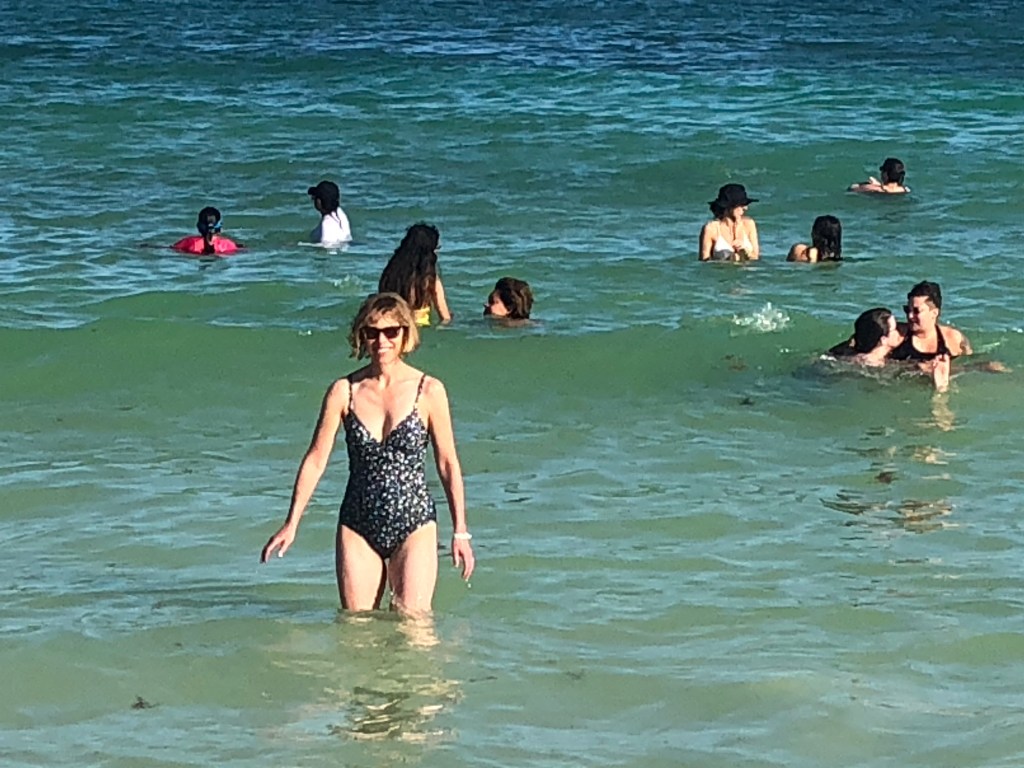
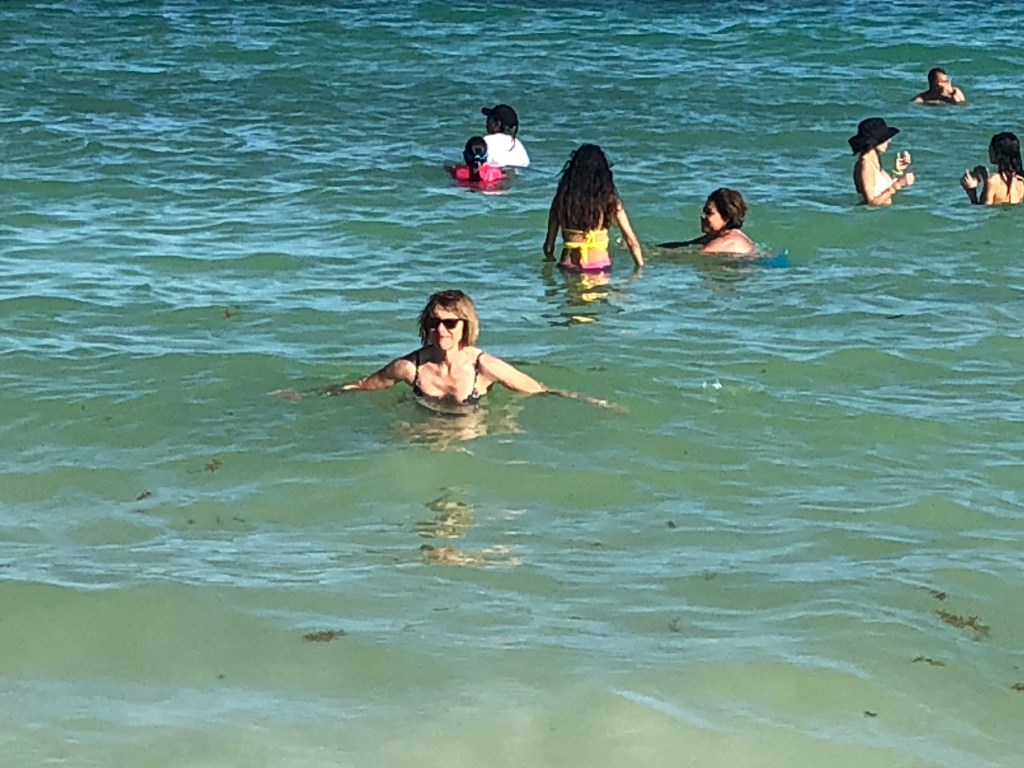
It may seem strange to count beaches on an island situated on the 58th parallel as a major selling point. However, if sitting on a beach is your thing there are plenty to choose from and you may have it all to yourself. We are not great beach dwellers but we certainly appreciated the golden, sandy beaches that abound on Lewis and Harris. Perhaps the most famous beach is Luskentyre on Harris and having already gone for a walk along it, we decided to plonk ourselves down on it to have our lunch. Whilst other folk were embracing the beach life, we lasted about twenty minutes though we did at least dip our feet in the water. Luskentyre is a stunning place and when the temperature is in the high 20s celsius it easily beats any Mediterranean or Caribbean beach. By Hebridean standards the beach was a busy though the few dozen folk there were spread out thinly.

Some other beaches we encountered, not that we lingered there, were either deserted or had two or three other people on them. There are plenty to choose from. We particularly liked Garry Beach to the north of Stornoway which we only discovered the morning we were leaving the island. It had sea stacks you could wander through at low tide, a bit like a mini Hopewell Rocks at the Bay of Fundy.

Another great beach was at Uig Bay. Not the previously mentioned Uig on Skye, but out on a limb on the west coast of Lewis. The Gaels do tend to reuse place names a fair bit. Ardroil Beach is situated in Uig Bay and is where the Norse chess pieces that now reside in the British Museum were found and whilst it is unlikely you will find any others, you can always get a tourist photo next to a carving of a King that stands there as a reminder. It’s a bit of a drive to get there but worth the effort.

There were plenty of other great beaches we saw in passing and plenty left to discover the next time we are there. They are easy to find – they are right next to the sea.

Walks

Going for a walk is a major draw of the islands. The above mentioned beaches are good for walking of course. We had a nice walk at Uig Sands. It wasn’t overly long or particularly taxing but it was worth that long drive to get there as the views were stunning. The Luskentyre beach walk was another easy amble along the sand and back along the road with the benefit of Toby and a couple of Morags enjoying the warm weather. The first walk we did was a coastal walk near the village of Carloway which took in Gearrannan Blackhouse Village. Unlike Uig Sands, this was fairly taxing. We did it the first full day we were there when the temperatures were high though there was a stiff breeze coming in off the sea which prevented us from overheating. Much of the walk was close to the cliffs, not dangerously so, but close enough to enjoy the dramatic scenery. There was no distinct footpath to follow either so planning the next few hundred yards of travel became very imnportant. It was not so much ‘off piste’ as ‘no bloody piste in the first place’. We passed no one on the way and whilst it may well have stretched our definition of a ‘pleasant’ walk, there was definitely a sense of achievement when we reached the top of a hill and the Blackhouse Village came into view. Not that we had finished. I discovered our chosen direct route down the hill was a bit of a mistake when I took a tumble on uneven ground which was hidden in the long grass and ended up on the deck in a less than elegant manner.

A similar cliff walk at the Butt of Lewis was a little easier. The terrain was less of a challenge and whilst there was no defined path again, the ground was ‘machair’, a fertile soil covered in short grass and meadow flowers. The highlight was the Butt of Lewis lighthouse, a splendid red brick structure, situated at the northern tip of the island. It seems a bit counterintuitive that the Butt is at the top of the island rather than the bottom.

58°30’57” N. I was the most northely person on Lewis at the time.

Speaking of lighthouses, we visited another one on the Isle of Scalpay. Scalpay is an island near Tarbert in Harris and is accessed via a bridge. Despite the link with the rest of the island, it retains its own personal character and gives the impression of what island life may well have been like thirty years ago. There are a number of walks you can do, all of which take in Eilean Glas lighthouse on the southern tip of the island. We chose the short one to get there a longer one back along the coast. More on the lighthouse later.

The Eilean Glas lighthouse walk was in fact a last minute decision. We had intended to complete a walk from Urgha to Rhenigdale and back, a seven mile round trip to a tiny settlement that was the last such settlement on Harris to be accessible by road. The track over a hill was known as the Postman’s Trail as that was how the mail was delivered before the road arrived. We set off with the top of the hill shrouded in cloud but when we came to the other side, we were put off by the near vertical precipice we would have had to negotiate via a precarious zig-zag path. Not only down but up again on the way back. The mist was clearing so we did at least get the benefit of the views and once back at the car we had the time to visit Scalpay and any disappointment we felt at not completing the walk was soon forgotten.

These are just a handful of the many walks that are possible on both Harris and Lewis and it is safe to say that we would need several more weeks to discover them all.

Visitor Attractions

The words ‘visitor attractions’ may strike fear into the hearts of those who want to choose a destination to get away from it all but don’t worry. There’s no theme parks, amusement arcades, water parks or anything noisy at all with the exception of the waves crashing into the cliffs. There are, however, a few attractions for the visiting tourist that are worth a visit. I’ve already mentioned the Gearrannan Blackhouse Village. This collection of traditional houses was restored after the last residents left in the 70s. Some are let as holiday homes but three are preserved as a museum and cafe. It’s definitely worth a visit either the easy way by car or the more difficult way that we did it, on foot.

The Callanish Standing Stones is another popular attraction. There’s a lot of neolithic standing stones in Scotland and several examples at Callanish alone. The main one sits atop a small hill and consists of a small stone circle at the apex of a much larger cruciform arrangement. As is the case with most of these standing stones, we don’t really know precisely why they were built, maybe there isn’t a precise reason to be discovered. The neolithic people may have just liked them.

A drive out to Bernera Island takes you the Iron Age House of Bosta. This turf covered building is a replica but stands where archeologists discovered the remains of a small village that dated back 1400 years. It is open for viewing from midday as long as the guide does not go off sick, as was the case when we went there. It’s interesting enough to see from the outside though and there are a few walks on Bernera Island you can do if you don’t mind traversing a bit of boggy ground. The main settlement on Bernera Island is Breacleit and like a number of other villages we passed through it has a museum/shop/cafe/petrol pump. Whilst describing these as visitor attractions is pushing it a bit, these are always handy places to stop and the small museums are worth the two or three quid donation to look around.

As mentioned in the Walks paragraph, Eilean Glas is a lighthouse on the island of Scalpay. Whilst getting there requires a walk, the destination counts as a visitor attraction in its own right, not only because it is commands a very attractive setting but you can also get cake and a cup of tea there. We had a very nice chat with the elderly couple who own the land and most of the buildings there – the current lighthouse is still operational and owned by the Northern Lighthouse Board – and whilst the place is by no means in a pristine condition, it appeared they were doing their best to keep the place going for the benefit of passing walkers. It wasn’t until we got home that we discovered that the couple had a very ‘interesting’ back story that they had somehow failed to mention to us when they were describing how they came to own a lighthouse. This involved them both serving time at Her Majesty’s Pleasure for being a little less than honest with someone else’s money. That was over twenty years ago though, I’m sure they are reformed characters now and are genuinely trying to run the place legally. The cake was nice at any rate.

Peggy’s Cove eat your heart out.

Stornoway’s major visitor attraction is Lews Castle which is part hotel and part museum. It has grounds through which you are normally free to wander. We missed our chance, however, as the week we were there was the run up to a large (in Hebridean terms) music festival called HebCelt. This did mean that we could go to the festival on the opening session which was on Thursday evening, the day before we left. We got to see Eddi Reader and Tide Lines doing their stuff though missed out on the legend that is Lulu who was the headline act on the Friday. I’m not a lover of music festivals and wouldn’t go to Glastonbury if you paid me a lot of money but HebCelt is much less crowded and being the first session following a dry spell it never got too muddy. If festivals are your thing, plan your break to Lewis accordingly.

If visiting a mighty cathedral is your thing then you may want to consider somewhere else for your holidays but we did discover one interesting place of worship up near the Butt of Lewis. St Moluag’s Church, or Teampall Mholuaidh if you prefer your churches in Gaelic, dates back to the 12th or 13th century and sits on or near a 6th century site believed to be the first consecrated ground in the Hebrides. Having originally told people it was in the care of the Church of Scotland, I’ve since discovered it is Episcopalian (Anglican) and having confidently said that the small altar wasn’t an altar, I’m happy to altar that statement (sorry for the pun).

The Whalebone Arch is worth a photo. The story behind it is pretty grim though. Back in the 20s a blue whale washed up on a nearby beach with a harpoon embedded in its body. It had obviously escaped capture by a whaling ship but slowly expired from the harpoon wound before being washed ashore. The islanders waited for a whaling company to come and collect it but no one did so they extracted what useful products they could get out of it. A local chap decided that he’d make a memorial to the sad creature by mounting two jawbones to form an arch. In what today might seem a bit tasteless, he included the harpoon that had killed it too. The arch is in someone’s garden but they don’t mind you going in to take a photo.

Whalebone Arch complete with grizzly form of whale execution.

The Bridge to Nowhere is near the Garry Beach mentioned above. It’s not particularly attractive but with a name like Bridge to Nowhere there has to be an interesting story to it. The bridge was built in the early 20s as part of a plan to develop the northeasten part of the island. It never happened and this bridge, along with a few miles of rough track, are all that remains of Lord Leverhume’s, the landowner at the time, dreams.

Visitor Information

Visitor information? I’m getting all Berlitz Guide here, aren’t I? Still, you might well be wondering about the sort of stuff we were wondering about before we went. Getting around was one of those things. I was half expecting the island to be covered in single track roads and indeed there are plenty. However, most roads you are likely to be travelling on are perfectly normal single carriageway, two-way roads. The single track roads with passing places tend to be on the island’s extremities and even then they tend to be interspersed with sections of dual track. Roads are very quiet, even the main one between Stornoway in Lewis and Tarbert in Harris. The only remotely busy traffic was in Stornoway and it was hardly gridlock. Don’t let the roads put you off, they are fine. You’ll need those roads too. The island is fairly big and there are a lot of peninsulas and extremities to be discovered. There is a bus service but a lot of planning would be required to rely on that to visit everywhere you might want to visit. Take your car, motorbike, motorhome or other jalopy of choice. I don’t have an EV but if you do you should be okay. If the long journey to the ferry ports put you off you can hire a car at Stornoway Airport, though I don’t imagine it is particularly cheap. The island was popular with cyclists too.

Shopping for provisions was another thing that we wondered about. Wonder no more, it’s easy. There is a Tesco in Stornoway which covers your every need and is even open on a Sunday (see below). They even have the delivery service which seems to serve everywhere on the island no matter how much on a limb they might be. As mentioned there are stores in most villages to pick up bits and pieces and there are a lot of roadside honesty box places to pick up some locally produced products (especially eggs).

Sunday trading: this was highlighted as a possible issue. The islands are known for their traditional views on the Sabbath. There’s a lot of churches for a smallish population with a Church of Scotland and Free Church of Scotland in most villages. When I first came to Scotland some forty years ago I was told that the islands were so devout that hanging your washing out on a Sunday was illegal. I think those who told me might have been exaggerating a bit but even now not much opens on a Sunday. We did pass a caravan in a lay-by selling coffee on the road between Tarbert and Luskentyre so it is obvious not everyone is afraid of the wrath of the Presbyterian ministers, but this is the exception rather than the rule. In answer to the age old question, however, yes, some people do hang their washing out on a Sunday.

Ignoring the wrath of the local clergy, and maybe that of Jesus himself, Coffee Isle Harris is open for business on a Sunday.

Language: apparently 60% of the residents of Lewis and Harris speak Gaelic. Road signs are often in Gaelic first and English second and even the Tesco aisles are signed in Gaelic, with English below in a less conspicuous font. Place names are almost exclusively Gaelic although many are of Norse origin rather than celtic. Does this mean you will have a problem communicating when you are there? No, not at all. All of the Gaelic speakers also speak perfectly good English and along with the 40% that have English as a first language, you are unlikely to hear much Gaelic at all.

Mobile phone coverage: we all like to keep connected, even if we go somewhere remote to get a way from it all. The mobile signal was a lot better than I expected. There’s obviously a few places on the extremities that are masked from the nearest mobile towers but in general I had a decent 4G signal all over the island. The internet access at the accommodation was reasonable too. It may have been slightly more laggy than on the mainland but it worked fine for anything we needed it for.

Eating: The island is not awash with dining out options. There’s a few restaurants in Stornoway and one or two others in larger settlements but being in Achmore meant we tended to eat our evening meals at the accommodation. We did try one restaurant in Stornoway and on another evening we got takeaway pizza from a company that produced them in a shipping container in a lay-by not far from where we were staying. Very nice they were too. There are plenty of coffee shops and community cafes for lunch and cake though.

In Conclusion

Is Lewis/Harris worth the effort to get there? Yes, absolutely, if you are looking for a week or so away from the crowds with nice scenery, golden sands and a more relaxed atmosphere than most other places in the UK. We thoroughly enjoyed our week there and would happily go back. Our judgement is, of course, enhanced by the weather we had which was better than we could have reasonably hoped for. Our previous break on Northwest Scotland (on the mainland, not the islands) had seen rain of biblical proportions and had that happened whilst we were on Lewis we may well have formed a different opinion. As it is though, that remote island out in the Atlantic proved us with a magnificent summer holiday.

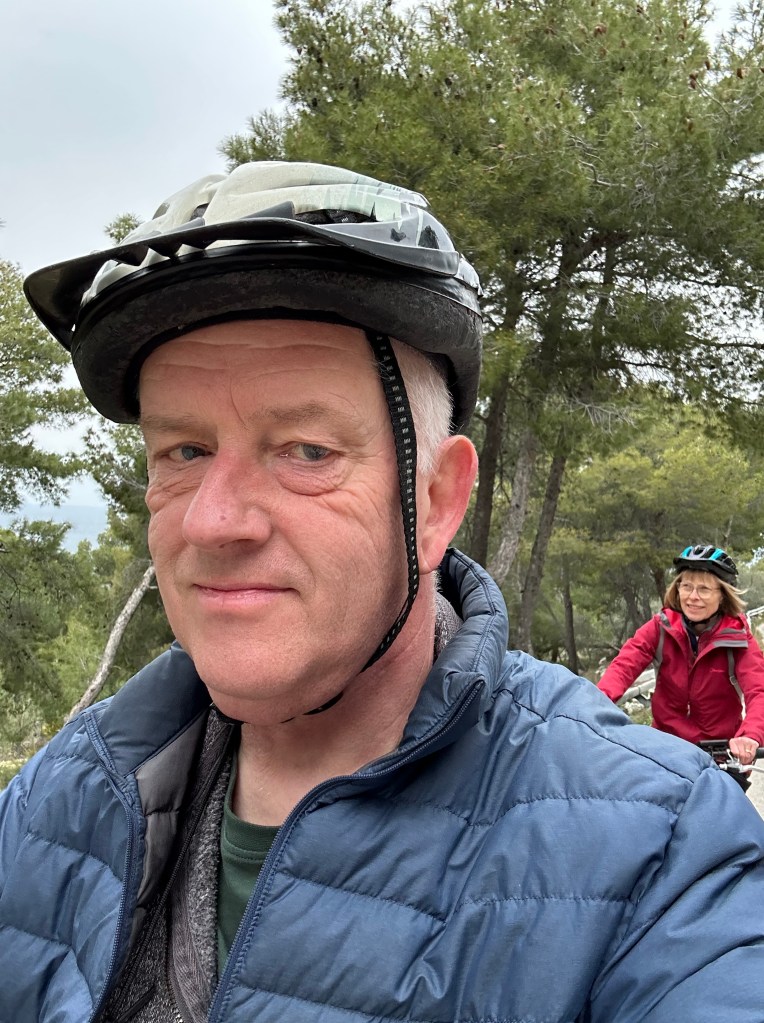
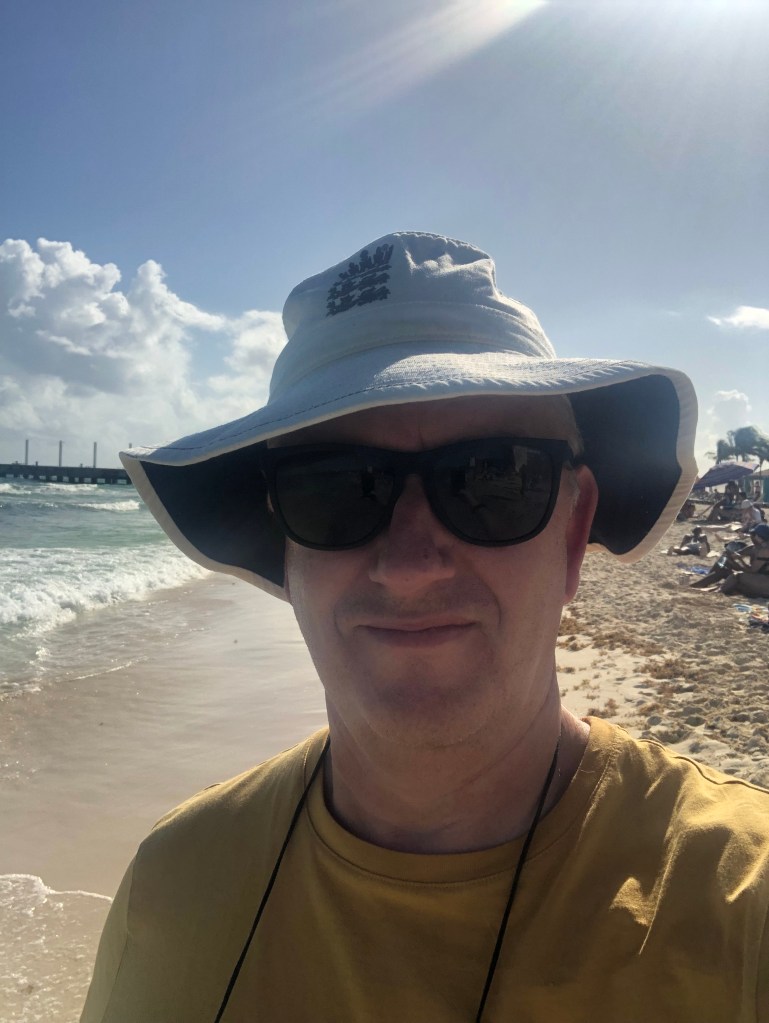
Yes, that’s me.

Technik Museums

Last year I blogged about a River Cruise I had taken on the Rhine. In it I mentioned that I’d visited a museum in the town of Speyer. I gave scant details about it and shared just three of the gazillion photos I had taken but that’s not because I didn’t like it. It was the Technik Museum and packed to the brim with aircraft, trains, u-boats, spaceships and other bits of mechanical hardware that make gentlemen of a certain age go a bit weak at the knees. As it happens Germany has two Technik Museums, this one at Speyer and a similar one at Sinsheim, some fifty kilometres away. Naturally, I had to do the set so a plan was formulated earlier this year. As with my trip to Amsterdam to fly on a DC-3 some three years ago, I would be accompanied by my friend and fellow avgeek Graeme for this journey. A year ago we had gone to Paris to visit the Musee de l’Air et Espace, taking the Eurostar to get there, but ended up having limited time at the museum itself due to us having to rearrange our return home plans thanks to a French ATC strike. Who’d have guessed? Anyway, we enjoyed the time we had there and resolved to visit more museums full of old aircraft. The plan for this year’s old plane extravaganza was a simple one: fly from Glasgow to Frankfurt with Lufthansa, get the train to Heidelberg, stay in the Ibis hotel next to the station and on the subsequent two days take the train to Speyer and Sinsheim to visit the museums. Although we knew little about it, Heidelberg proved to be a handy place between the two museums to base ourselves. Apart from a delay at German passport control and a late running train, getting to Heidelberg proved very straight forward and we were all set for our Technik Museums adventure.

Technik Museum Speyer

There must have been a reason why we chose to do Speyer first but I can’t remember what it was. A regional transport day pass was obtained at Heidelberg station for €19 and then a regional train delivered us to Speyer’s Hauptbahnhoff in about fifty minutes. A local bus got us to the museum via the city’s rather attractive (in the spring sunshine) main street. Before you enter the museum you get sight of several exhibits, some of which are situated outside the museum’s fence, others being mounted high on plinths and can be seen from some distance away. We each purchased a ticket that covered both museums including entry to the iMax theatres at both venues. They cost €52, a saving of €6 on buying them individually. If you don’t fancy the iMax, and as the various shows have been dubbed into German you might not want to, it is cheaper to buy individual tickets, €23 at each location. Children aged 5-14 get a discount, children under 5 go free. Armed with our tickets we passed through the turnstile and entered the first display hall. The museum has two main halls and an extensive number of exhibits situated outside. As mentioned, some of these are mounted on plinths and can be accessed by stairs. The most striking exhibit is a Boeing 747-200 formerly of Lufthansa that dominates the skyline both in the museum and beyond. Equally as impressive is a massive Soviet era Antonov An-22 in Aeroflot colours so naturally we made a beeline for both of those. It is quite bizarre climbing up stars to enter these behemoths of the sky and exploring all their nooks and crannies. However, there was much, much more to see. Although we didn’t count them there are supposedly more than 70 aircraft on display at Speyer and we must have seen them all. Commercial airliners, military aircraft, water bombers, wartime transports, cold war jets, we lapped it all up. The second display hall was dedicated mainly to spaceflight and contained a Soviet Buran space shuttle, not something you will see at any other museum. In fact it is fair to say that Speyer has got aviation pretty much covered. Not quite though as you will find out later.

The museum is not all about flight though. There is a big collection of railway locomotives, displays of cars, fire engines, some maritime stuff including an old U-boat and some mechanical organs. There is also a larger number of motorbikes that share the second hall with the space exhibition. It takes at least a day to see everything. We saw most but missed out on the motorbikes. The iMax showing was A Beautiful Planet including a lot of film taken on board the ISS. As mentioned, the soundtrack was dubbed into German and my German is limited to ‘ja’, ‘nein’ and ‘auf wiedersehn’ but the visuals were good enough to keep me awake for at least half of the show. There is a large cafe for lunch and much needed refreshment – it was a warm, humid day – and a big gift shop where I managed to not buy anything. The museum was very quiet on the day we visited. I’d expected groups of schoolkids on their end of term excursions but there were none. Having been there some fourteen months earlier took nothing away from the day at all, the museum is pretty awesome and Graeme was in full agreement. We retraced our steps to Heidelberg, grabbed a burger for dinner and prepared for Day Two.

Speyer photos coming up. Most will be from my previous visit as I felt I didn’t need to take any more so I could simply enjoy the exhibits.

Technik Museum Sinsheim

Once again we purchased €19 regional day tickets and jumped on a train going in the other direction. The journey was a bit shorter and there is a station right by the museum itself. The weather was less kind to us but we managed to avoid the worst of the rain by fitting in the outdoor exhibits between showers. Like Speyer, Sinsheim has mounted some of its aviation exhibits on plinths, most of which are on top of Hall Two. Not wanting to be outdone by Speyer and its huge aircraft exhibits, Sinsheim has got not one, but two supersonic airliners on the roof. An ex-Air France Concorde is mounted next to an ex-Aeroflot Tu-144. This is unique and a big deal for aviation enthusiasts. We were both going ‘wow’ and we hadn’t entered the museum yet. Once inside the gate we set off on our voyage of discovery once more. There are slightly fewer aviation exhibits at Sinsheim but it still took up a big chunk of the day seeing them. The stars were, of course, the supersonics. Last year, in our brief visit to the museum in Paris, we got to see two Concordes side by side which was pretty special. Seeing a Concorde next to the Tu-144, given the nickname ‘Concrodski’ by the western press, was on another level. We went inside both, the Tupolev first. The Tu-144 was, by a few months, the first supersonic transport aircraft to fly. It was slightly bigger than Concorde, went slightly faster and was slightly earlier into service. Funny, that. It wasn’t a success, however, for a number of reasons. That being said it was still quite incredible being on board one, even though it isn’t going anywhere any time soon. Having said that, and you can call me biased if you want to, but the Anglo-French Concorde is just a bit sexier than the Russian Tu-144.

What else is there to see at Sinsheim? Loads. In fact if your primary focus is cars then it beats Speyer hands down. Graeme likes Formula One and told me he’s never seen so many F1 cars in one place and he’s even attended some races. As well as racers, there are hundreds of vintage cars, sports cars, military cars, American limousines and there was a special exhibition in Hall 3 about Volkswagen vs Opel. There is also a large military display with tanks, trucks, armoured cars and so on with some of the wartime aircraft included. If tractors are your thing there is a section of Hall 2 dedicated to agricultural vehicles and like Speyer, they are very proud of their U-boat, this one being from the 70s but no less cramped inside. There is a big cafe again and the iMax show was Hubble, another one with footage from the ISS but in 3D this time. Yes, it was in German and yes, I did drop off more than once behind the polarising glasses but the showing was after lunch and a pint of Museum Lager so defy anyone else not to do the same. One other thing to note was the slides. To keep those kids entertained, who might otherwise be less than enthralled about examples of old engineering, there were numerous slides from the platforms on which some exhibits stood and the ground. There was one at Speyer too, a long one down from the 747. We didn’t indulge. Having spent most of the day there we headed back to Heidelberg and decided we ought to have something German for dinner, choosing Das Boots Haus where very large schnitzels were served with a most acceptable pils lager.

Our return home the following morning went off without a hitch and we both agreed that it had been a very successful trip. It might not be everyone’s idea of fun spending two days gazing at old bits of metal but if you are the sort that likes museums full of planes, cars, submarines, space vehicles, railway engines and plenty of other mechanical things then the Technik Museums really should be on your ‘to do’ list. Unless you have already done them in which case you could do worse than do them again.

Sinsheim photos coming up, all taken on this visit.

Not many museums have two supersonic airliners enticing you in.
I’ve no idea what this is.

An Island Hopping Saga

The Spirit Of Discovery in Fowey Harbour

A couple of years ago I had my first experience of travelling with that tour company for mature folk, Saga. You can read about it here. That was a short cruise up and down the English Channel. Last year I sampled their river cruising which, if you can stand it, you can read about here. This year it was back to the high seas on board Spirit of Discovery, one of two cruise ships owned by Saga and the same one I sampled two years ago. As with the past two Saga trips, I was accompanied by my mum and sister. It is a particularly good was for us to get away together as it is fair to say that mum is getting on a bit and Saga are geared up for the older traveller. We chose the cruise many months ago. All of Saga’s cruises depart from the south coast of England and whilst the itineraries are varied, that fact does put certain limitations on what they offer. To get to traditional cruising destinations like the Mediterranean or Canary Islands requires several days of getting there and back so these itineraries tend to be long. Priding themselves on all inclusive ’boutique’ cruising, a couple of weeks on board a Saga ship is going to set you back quite a lot of money. Week long cruises tend to go to the Norwegian Fjord’s, something mum and Jill have already done and the shorter sample cruise to nowhere in particular is what we all did two years ago. The itinerary we decided on was Island Hopping round the UK which was ten nights on board, a bit longer than we would have preferred, but the stops looked interesting so we booked it. Departure day was May 5th so we were hoping for the weather gods to take pity on us as we were staying in British waters and let’s be honest, anything can happen. It turned out that apart from a little glitch at the very start of the cruise, those weather gods were very much on our side.

In my previous blog (here’s the link again) I gave you an insight to what cruising on the Spirit of Adventure was like. In two years it hasn’t changed a bit which gets me out of writing about it again. The only difference was that we were in standard cabins on Deck 8 this time. When we booked there were superior cabins that were actually bit cheaper due to some promotion or other but they were dotted around the ship. We felt it was better to be close together and were allotted three standard cabins next to each other on the starboard side amidships. This had the bonus of us being able to open up our balconies to make one big one. The only difference between the standard and superior cabins is the latter have a bit more floor space and maybe an extra chair. That’s it. The standard cabin is fitted out to the same high standard as the superior ones and looked after by the hard working housekeepers in the same way. Go for superior cabins if you wish but I don’t think they are worth spending much more money on. There are a few fancier rooms and suites but I don’t think they would be worth turning an expensive cruise into a very expensive cruise for. Cabin aside, take a look at the other blog to see what facilities the ship has to offer. I’ll just add here that it is a lovely ship, just about the right size and the staff are still as good as they were last time.

Instead, for this blog, I will concentrate on the itinerary. This may not have the wow factor of the Norwegian Fjords, the interest of foreign ports or indeed the weather of the Mediterranean but… Hang on, we had fantastic weather that was actually better than parts of the Med at the time, not to mention interesting British ports and even some wow factor scenery so let’s not belittle the cruise by the simple fact that we never entered ‘foreign’ waters. Let’s get started with Day One

Day One: Portsmouth Sailaway

Experience Is Everything. Including check-in.

The nice thing about going with Saga is that they put on a nice car with a nice driver to take you to the port. It’s as if Saga guests appreciate ‘nice’. As before a rather fancy Mercedes Van pitched up on time at mum’s house in Huddersfield for the 247 mile journey to Portsmouth. As before there was one other traveller already in the vehicle. Not the same one as last time, that would have been spooky, but a 95 year old solo traveller taking her first Saga cruise. The driver was a very polite young man and he delivered us to Portsmouth without incident. Check-in was in the Brittany Ferries Terminal and formalities were completed quickly. We were bused to the ship, mum was given some assistance up the gangway and we were shown to our cabins without any fuss. The ship’s buffet restaurant, The Grill, was open for a late lunch and after that we went back to the cabin for lifeboat drill just in case we encountered any stray icebergs in the Irish or North Seas later on in the cruise. We set sail bang on time at 5pm and once we’d slipped our moorings Captain Simon Moore came on the ship’s PA system to welcome us on board and tell us that Day Two’s port of call had changed. We were due to visit the island of Guernsey in the Channel Islands but the forecast winds were in such a direction that tendering the guests to the port would be too risky so he had made the decision to take us to Fowey in Cornwall instead. This was a tad disappointing as we’d got excursions booked in Guernsey that we were looking forward to but we weren’t in a position to organise a mutiny so Fowey it was. We ate in the main dining room as we would do on most evenings. The food was as good as I remembered. Later, the ship’s entertainment company gave us a show based on rock music which may seem a bit odd for a cruise where the average age of the passenger was 79 (the cruise director gave us this information so I’m not making it up) but those present seemed to enjoy the cast’s rendition of Bat Out Of Hell.

The Saga crowd love a bit of Meatloaf.

Day Two: Guernsey Fowey

Fowey, emiting small Cornish town vibes.

Situated up a narrow estuary that the ship had to reverse up before dropping anchor, Fowey (pronounced ‘Foy’) is a very picturesque Cornish town with narrow streets and an active harbour. With the sun shining and light winds, it was hard to believe that the weather had prevented us from calling at St Peter Port in Guernsey but then I’m no expert in parking cruise ships so what would I know? Having cancelled our planned excursions on the Channel Island, Saga had quickly cobbled together a few trips from Fowey and we had rather hastily booked ourselves on one to Lanhydrock House, a National Trust property that I’d last visited thirty years ago. In hindsight we shouldn’t have bothered. The tour set off late due to delays in getting the ship’s tenders permission to land and there was a lot more walking for mum to do than we had anticipated. Consequently we had limited time in the house itself before we had to head back to the bus for the journey back to the ship. The captain had arranged for one of the ship’s tenders to do a mini cruise up and down the estuary so we nabbed one of those in the afternoon and I also had time to nip into the town. It is a very pretty town and we would have just been as well doing this in the morning rather than the tour but there you go. The evening’s entertainment was provided by Belfast comedian William Caulfield as we sailed out into the channel at the end of Day Two.

Day Three: At Sea

The obligatory lifebelt shot.

Sea days. Not much to report. We spent time in the Britannia Lounge, on deck and even in the pool. Ice creams were eaten, quizzes were entered where as usual we finished second and they day passed at a slow pace. Sailing up the Irish Sea provided little in the way of views but we enjoyed the day nevertheless. It was Formal Night, the first of two on this cruise. Now I’m not a fan of wearing collar and tie but as my mum was watching I grumpily complied. It is possible to avoid the formal dress code by eating in The Grill or staying in your cabin but we had a reservation at East Meets West, a speciality restaurant that specialises in Asian cuisine. We had eaten there two years ago and it was just as good this time. One of the nice things about Saga is everything on board is included in the price including the speciality restaurants. You’ve just got to get in quick to make a reservation. Entertainment was a choice of a Motown show in the theatre or an Abba show in the Britannia Lounge. We chose the latter. Mama mia!

Day Four: Belfast

Norn Iron red squirrel.

With views of Samson and Goliath, we moored in Belfast not far from George Best Belfast City Airport which pleased the avgeek in me. We had booked a tour for the morning, Scenic Coasts and Glens. It certainly delivered on that with a nice drive along the Antrim coast, although ‘Glens’ should really have been ‘Glen’, singular. That glen was Glenariff and the reason it was chosen was it had a teashop which is important to your average Saga guest. You could, if you were feeling relatively vigorous, go for a walk down the glen to a waterfall which I did. It was very nice but the highlight of the place was the red squirrel that was going about its business oblivious to a bloke with an iPhone taking a hundred pictures of it from not too far away. The trip back was via a different route and thanks once again to the glorious sunshine, Northern Ireland was looking rather nice. Afternoon was spent sat in the sunshine whilst I watched the comings and goings from Belfast City Airport and mum and Jill enjoyed my commentary on them. It was the 80th anniversary of VE Day and the ship’s crew made an effort. There was a religious service conducted by the ship’s chaplain which mum, who isn’t a religious person but has genuine memories of the original VE Day, wanted to attend. I can’t say any of us were too impressed. The evening show in the theatre was a variety affair with a VE Day theme which where the ship’s company and visiting acts made a better job of it than the vicar. Many flags were waved.

Day Five: Holyhead

North Wales. It’s quite pretty.

There was only one tour we were ever going to do on our stop in Wales. The Ffestiniog Railway is one of North Wales’ numerous narrow gauge railways and whenever the three of us are on a holiday we like to grab a bit of heritage railway action. It was an hour long bus ride to Porthmadog where the line commences its journey to Bleanau Ffestiniog in the hills. Alas, the lovely weather North Wales had been suffering for several weeks resulted in our train being diesel hauled rather than steam as the railway was keen not to be responsible for setting Wales alight from stray cinders. It wasn’t too much of a problem, the diesel loco was kind of cute anyway and the glorious scenery was the main thing. Indeed, it was a lovely run along a line that was built in the 19th century to transport slate from the mines at Bleanau to the port at Porthmadog. The journey was one way for us – the bus was awaiting us in Bleanau and it took a very scenic route through Snowdonia to get us back to the ship in time for a late lunch. The evening’s entertainment offering was something different for the ship’s resident cast of four singers and six dancers. They put on an Agatha Christie mystery. It was not a nice juicy murder to be solved by a Belgian detective, just a minor burglary at the seaside, but it was good fun and I think the performers enjoyed turning their hands to acting for a change. At least they said they did as they thanked us all for coming as we filed out. By then we were already at our next destination as it wasn’t too far away. We dropped anchor for the night off the Isle of Man, British and not British at the same time. A British Isle though, definitely, so it fitted the brief for the cruise.

Day Six: Douglas

State of the art Electric Railway

Prior to the cruise we had decided that we were going to go independent in Douglas and declined the offer to buy an official excursion. The three of us had been to the Isle of Man in 2019 and felt we knew the place and could hack a few things by ourselves. Consequently, we took a tender to the town and then took a few minutes deciding precisely what those few things would be. We decided to hit the rails again and took a taxi to the start of the Isle of Man Electric Railway at the far end of Douglas promenade. This railway – more of a tramway than a railway – trundles up the Manx coast to Ramsey on rolling stock that dates back to the 1890s. We didn’t go all the way, stopping instead in Laxey. We could have taken another tram from there up Snaefell, the highest hill on the Island, but decided instead to go on a the Laxey Mine Steam Train. This was a former mine train, or at least a modern copy. It didn’t go far but it was well worth the three quid it cost each of us. After a somewhat more comfortable tram back to Douglas we took the Horse Tram along the promenade. This was only partially open the last time we were here and it was nice to go the full distance which unfortunately wasn’t quite close enough to the port to avoid the need for another taxi. Back on board we considered that this had been a successful day of independent travel. Some new guest entertainers joined us today, one of which was an American chap called Brad Sherwood who entertained us with his magic show in the evening. I still wish I could work out how they do it.

Day Seven: Sea Day

The Paps of Jura

Not another boring sea day I hear you ask? As it happens no it wasn’t. The captain had told us the previous day that we would not be taking the high seas route to Ullapool, complete with its Atlantic swells and increased risks of chunder, but we would do some scenic cruising amongst the islands of Scotland’s west coast. All we needed was a nice day and a place on deck that was sheltered from any wind we might encounter. Whilst there was a bit more cloud around than on previous days, it was remained nice enough for us to spend much of the day on deck with the Orca team. Orca team? What are they? It was a group of four people who accompany cruises to point out interesting wildlife which must be quite a nice gig for the guys who get them. Their presence added to what would have been a pleasant day’s cruising anyway. We had woken up passing the Mull of Kintyre and headed north past Islay and Jura. We would pass through Sound of Corryvrechan, also known as The Race, where the world’s third largest whirlpool awaits careless navigators. Thankfully our navigator wasn’t careless so we avoided being sucked down to a watery grave, and passed into the Firth of Lorn. The Sound of Mull followed before we entered less sheltered seas for the overnight transit to Ullapool. On the way we had seen maelstroms, mountains, castles, hills shaped like boobs, porpoises, two types of dolphin, a lost homing pigeon and an autogyro. After coming third in the quiz – a nice change from second – we avoided the entertainment that was on offer for some reason and had an early night. Passing through the Inner Hebrides at 12 knots is obviously tiring work.

Day Eight: Ullapool

Ullapool. Small town set in big country.

For those who are unaware, Ullapool is in the far northwest of Scotland. It is a small town which would be of little significance were it not for the fact it hosts the ferry from the mainland to Stornoway on the Isle of Lewis. Its fame has increased in the past few years as it is a ‘major’ stop on the North Coast 500, a road trip around the top of Scotland beloved by drivers of motorhomes and less so by locals who get stuck behind the aforementioned motorhomes. It is situated in an estuary with a backdrop of hills and mountains so on a day when the sun was shining and the mercury topped out at 21C, it wasn’t going to be anything other than gorgeous. I had booked onto an afternoon tour labeled ‘strenuous’ in the official literature but mum and Jill had a free day. We took the tender into the town in the morning and discovered a boat trip for them to do in the afternoon. Consequently, off they went to discover the Summer Islands and its associated wildlife (porpoises mainly) whilst I headed off on my strenuous official trip. Strenuous is a relative term but bear in mind the average customer on the cruise was 79. It involved a bus journey to a lookout point, nothing remotely strenuous about that but then the bus took us to Corrishaloch Gorge. There was a bit of walking to do which whilst far from strenuous for a fine physical specimen like me, would certainly have been a challenge for half of those on the ship. It took us down the gorge to a suspension bridge and waterfall and was all very nice. We could then go back the way we came or take an alternative route which a handful of us did. I was five minutes late back at the bus, the others were twenty. I don’t think the guide will be offering that alternative again. Back on the ship we watched the sailaway from as the views were really rather lovely apart from the bit where we passed the headland and discovered the motorhome park. They’ve got to park them somewhere I suppose.

Day Nine: Kirkwall

The remaining standing stones of Steness.

The Orkney Islands lie off the north coast of Scotland across the Pentland Firth. For the first and only time on this cruise the weather let us down a bit. It was a bit misty at first and that mist developed into a low overcast for the rest of the day. As it didn’t rain and there was little wind it was, however, a cracking day for Orkney. Here we had booked two tours. The one in the morning was one of three free tours Saga offered on the cruise and consisted of a bus trip to a set of standing stones and back. Not much perhaps but as it was free it was pretty good value. Orkney has a lot of history and much of that goes back to neolithic times where standing stones were a bit of a thing for reasons we can only speculate about. We passed the impressively large Ring of Brodgar on the bus but stopped at the nearby Stones of Stenness, probably because it was nearer the car park for the less mobile guests. There’s only four stones left here, or three and a half to be precise, but it was nice to get up close and personal with them. On our return I had a brief wander round Kirkwall, taking the free shuttle bus the two miles into town before returning to the ship for trip number two. This took in Scapa Flow, the Churchill Barriers, the Italian Chapel a small Orcadian fishing village and a stop for tea and shortbread. The latter two stops were padding the tour out a bit but the first three had very interesting stories to tell. In particular the Italian Chapel which was built in 1944 by Italian prisoners of war that had been taken to Orkney to build the Churchill Barriers which guard the entrance to Scapa Flow, the stretch of water where the Royal Navy moored many of their ships between assignments in both World Wars. The Chapel was made from two Nissun Huts and anything else the prisoners could get their hands on, decorated by hand with paint traded from locals. It’s a work of art really. We departed Kirkwall in the evening and came second in the evening quiz again. The ship’s company put on a West End/Broadway show. There was a big audience for that one.

“Um diddl iddle iddle um diddle eye”

Day Ten: Sea Day

Scenic North Sea Cruising.

Getting from the north of Scotland to Dover takes a while in a ship so there was no chance of any scenic cruising today unless you count gas platforms and wind turbines as scenic. The lack of stops on this final leg of the journey did mean I could get some washing done – there are two laundrettes on board for passengers to use – though I’d managed to get most of it done on Day Seven. Laundry might not add much fun to a holiday but it makes the getting home bit more bearable. That aside we spent much of the day doing very little as the North Sea passed by. We had a go at deck quoits, played a bit of table tennis and I even took another dip in the pool. In the evening we dined in The Club, another speciality restaurant that is basically a steakhouse. We hadn’t meant it to be our last supper so to speak but reservations can be hard to come by. We never managed to get a reservation in the third speciality restaurant which does seafood. Our final chance of glory in the evening quiz came to naught, we didn’t even come second for goodness sake, and a variety show in the theatre gave us a chance to say cheerio to the performers. With suitcases left in the corridor for collection it was lights out for one last time.

The final curtain call.

Day Eleven: Dover Disembarkation

Dover Cruise Ship Terminal with a bit of White Cliff behind.

The sharp eyed amongst you will notice that we ended the cruise at a different port to the one where we started. I don’t know why but it really doesn’t matter too much with Saga where a fleet of Mercedes vans are on hand to whisk all the passengers to where they need to go. Disembarkation was a straightforward process and within a few minutes we were heading northwards along with the same lady who had shared our car on the way down. The journey was slightly less straightforward due to a big hold up on the M25 resulting in us detouring through London, crossing beneath the Thames via the Blackwall Tunnel, but we arrived back at mum’s house at 15:00 which was precisely the time I had estimated before setting off. Thus ended my third Saga experience.

To conclude, this cruise was a great success. Yes, the weather gods were on our side but I can’t fault Saga for what they do for their target audience. The only question you need to ask is are you the target audience and there’s more to that question than just being of the required age. If the answer is yes then you get a ship that is big enough to be interesting but small enough to be personal, a nicely equipped cabin with a balcony, decent entertainment, excellent service throughout, all the drink you could ever need (other than Diet Coke) and some really excellent food. Add to that the transport to and from the port and included (sort of) insurance and it is an ideal package for those who want a holiday without the hassle. They are not cheap – this ten day cruise in a single occupancy cabin cost just shy of £5,000 with optional tours on top of that but my bill at the end of the cruise meant that Saga owed me money (due to the cancelled excursions in Guernsey) as I hadn’t spent an additional penny on board. Last year I sampled Cunard’s service on the Transatlantic crossing and found it good. In cruising terms, Saga was on a par with them, if not better. They just need to ditch the Pepsi for Coke although I suspect I was the only person on board who was bothered about that aspect of the cruise.

Slow Route To Victoria Pt 2

New York to Victoria

Rocky Mountain High

For Part One of the tale of my mega trip from my home in Troon to see my daughter in Victoria, Canada, using surface transport, click HERE.

I finished Pt 1 of this two part blog having disembarked the Queen Mary 2 in New York and getting a taxi to the Moynihan Train Hall in the middle of Manhattan. To get to Victoria within the rules I’d set myself I had to get across the North American continent without using aircraft. There are limited options for doing this. I quickly decided that train was the only mode of transport I would consider – Greyhound Bus never entered my thoughts – so I had looked into the various rail routes from the Atlantic to the Pacific. Whilst rail travel is by no means popular in the USA or Canada, there are a number of ways to cross the continent by train. I could have caught a train to Toronto and then taken The Canadian, a fantastic four day trip across Canada to Vancouver. I had done this before though and wanted to try something different. I decided that the US operator Amtrak had the best option, a three day journey to Seattle utilising two different trains. On reaching Seattle I could have taken an Amtrak bus to Vancouver where I could then get a ferry but I decided to stay the night in Seattle and get the FRS Clipper ferry the following morning directly to Victoria. I reserved roomettes on the trains some ten months in advance along with the transatlantic crossing on the QM2. The first train was The Lakeshore Limited. This runs from New York to Chicago, a 21 hour overnight journey. After five hour wait in Chicago, The Empire Builder would take me to Seattle in a total of 46 hours over two nights.

The Moynihan Train Hall is a new expansion of New York’s Penn Station. It was completed in 2021 and is rather magnificent. They say that first impressions count which meant my initial thoughts on Amtrak were very positive. On long distance trains you can check your luggage through to your destination which is a particularly good idea if you have a roomette. There isn’t a lot of room in there for a couple of suitcases. On the last day of the transatlantic voyage I had made sure to pack a small bag with the stuff required for three nights on the train and headed to the main Amtrak ticket office where the two suitcases were checked through all the way to Seattle. I then headed to a very nice business class lounge which is open to sleeper passengers. A much needed sandwich and a couple of drinks whilst overlooking the main concourse was very pleasant, especially after being in a bit of a rush to get there. About twenty minutes before departure we were called to head down to the train. I was in luck. I had been given an upgrade. Instead of a roomette I was in a bedroom which had more space and an en suite. Things were going well! It wasn’t a long train and it was easy enough to find my room. Sure enough, it was a bedroom rather than the roomette. That was about as good as it got for this first journey. We departed bang on time into the labyrinth of train tunnels beneath New York before emerging into the daylight in the north of the city. The car steward introduced himself and congratulated me on the cabin upgrade. He then mentioned the downside which was the best views were on the other side of the train. The track runs alongside the Hudson River for quite a long way and my views of this were through the corridor window. It wan’t much of a problem to be honest but it put a slight dampener on the joy of the upgrade. The room itself was, well, tatty. Trains to the east of Chicago use Viewliner stock which is old and badly in need of refurbishment or better still, replacement. Size is limited by the tunnels that run through New York and whilst they seem big enough, when you compare them to the Superliner stock that runs on the services to the west of Chicago they feel inadequate. The train consists of a couple of Viewliner sleeping cars, a restaurant car, baggage car and two or three coach cars but doubles in size when it reaches Albany and is coupled up to the Boston service. The bedroom features a bench seat that converts to a bed, with another bed that can be pulled down to form a bunk. There is a strange looking extra chair that serves no purpose other than to reduce the available space. I tried sitting in it but it was in a bad state of repair that I got straight out of it again. The en suite was a wet room so a bit of planning may be required as to the order of one’s ablutions. It was perhaps the best feature of the room as everything else was tired and worn. There was a little sink with a couple of plug sockets and a table by the window. When I booked the trip I seem to remember a room cost quite a bit more than a roomette. I’m glad I didn’t have to pay that premium.

We progressed along the eastern bank of the Hudson for a couple of hours before we reached Albany. I spent much of that trying to connect to the train’s wifi. I had bought a sim card before I departed the UK to use data in the USA and Canada. I was kind of hoping that the train’s wifi would mean I could stay connected to the outside world. It didn’t work. I was destined to be ‘off grid’ for my entire trip across the USA except for a couple of wifi hotspots I managed to briefly connect to. It was quite a major downer for me. I know we are supposed to enjoy being unconnected to the world from time to time but on a solo journey like this I do like to keep in touch with friends, family and above all Elaine. We had about an hour in Albany where I was able to use the station wifi and that was me off grid until I arrived at my hotel in Seattle. Down on the tracks the other half of the Lake Shore Limited had arrived from Boston and was shunted into our half to double the size of the train. We set off again into the evening. I had a dinner booking for 7:15pm so headed along to the dining car. I plumped for the Chicken Enchiladas. It wasn’t great. The meals are prepared in advance and heated up on the train and compared with my previous experience of train food across the border in Canada, it was poor. Later I wandered along the train to the cafe/bar where I bought a Twix. I mention this only because it got me a walk through the rest of the train to see how the coach passengers were getting on. They were making themselves comfortable for the night in their seats. These looked decent but I’d have hated to try and sleep the night on them. Stops at Utica and Syracuse gave me a brief chance to stretch my legs – such stops are called ‘smoke stops’ although smoking wasn’t compulsory – and eventually it was time for bed. With a little bit of difficulty I worked out how to set the bed up – I’m sure the car steward would have done it for me had I asked – and I settled down to try and sleep.

It wasn’t a great night. I slept on and off but along with the general rattling of a fifty year old Viewliner car and a very whiney A/C, every so often the train would make a rather violent sideways motion, possibly as we passed over the points onto another track. I got up and used the en suite. It was a bit bijou of course but the water was warm and at least I didn’t have to wander down the corridor to the ‘public’ shower. Breakfast was another reheated effort, ok but nothing special, and I settled back in the room as we passed through midwest farmland and the industrial outskirts of Chicago. We arrived five minutes early. I wasn’t unhappy to get off the train.

I had five hours in Chicago before the next leg of the journey. I happen to have relatives in Chicago, or, to be more precise, north of Chicago. What’s more, I had only met one of them before. We’ve known each other for a few years now through social media via other relatives in Canada who had got in contact with my mum via a genealogy website. David is my third cousin and was there with his wife Jane and daughter Erin. I had met Erin before when she was over in Edinburgh. The three of them were there to meet me getting off the train and later joined by Erin’s cousin Kiersten and we spent a happy few hours together wandering round downtown Chicago and enjoying one of the famous Chicago pizzas. It was delicious! Alas, Amtrak waits for no man, just freight trains, so I was back at the station in time to catch The Empire Builder to Seattle, a 2206 mile journey through seven states. I didn’t receive an upgrade on this train so on boarding I went to find my roomette. This wasn’t as easy as it should have been. It was Room 1 in car 730. I couldn’t find car 730. I found car 830 but if I know one thing about the number 830, it isn’t 730. I walked up and down the train a couple of times before I found an Amtrak employee. I was getting a bit flustered by then. I was informed that car 730 was down there. I’ve been down there I said and can only find car 830. She informed me that that was the correct car. It is called car 830 on the eastbound service and they don’t bother changing the number, presumably just to confuse first time passengers on the service. I finally discovered my roomette just as we made an on time departure from Chicago.

The Chicago Farewell Committee.

The stock used on trains to the west of Chicago is an improvement on that used to the east. The Superliner cars are double deckers and whilst not exactly new, my car was in a much better state than the Viewliner that had delivered me to Chicago. The roomette contained two seats facing each other which converted into the lower bunk with a pull out table between them. There was a small closet with a couple of hangers that should immediately be removed as they annoyingly clunk about with the motion of the train. Above is a pull down bunk which suggests the roomette can be used by two people but it would be a bit of a squeeze. It came in useful, however, as there is no space for bags on the floor. With the bed half pulled down my two pieces of hand luggage were placed on top out of the way along with the bedding for the lower bunk when in day mode. The downside was I cracked my head on the bunk whilst getting out of the seat on several occasions. There are two 110V US power sockets. The nearest toilet was across the corridor and downstairs there were more loos and a shower which was stocked with towels and bars of soap. There was also a luggage stack for larger items if you didn’t fancy checking in your suitcases. Carlos, the cabin steward, was in a roomette across the corridor and a thoroughly decent chap. The rest of the train consisted of more sleeper cars, several coach cars with similar seating to that on the previous train, a dining car and the panorama car which had a cafe on the lower deck. Thanks to the panorama car and the overall state of the train, it was a marked improvement on the Lake Shore Limited.

The train headed northwards to Milwaukee and then northwest towards Minneapolis. Progress was stop-start due to passing freight trains and a tech issue. Long distance Amtrak trains utilise lines owned by the fright companies in much the same way as ViaRail do in Canada so it was no surprise. As it turned out, these were the last delays of note we encountered and we were pretty much on time for the rest of the journey. I headed for dinner which as before is included in the fare for sleeper passengers. Coach passengers can pay $45 and are fitted in at the end of service for sleeper passengers. Like the train in general, the food was a big improvement on what I’d been served on the Lake Shore Regional. You are allocated a specific time for dinner and when called you are seated at the first available table. As a solo traveller this means you get to meet some interesting people. For the first dinner my dining companions were a university lecturer, an orthodox presbyterian minister and a young mum with an eleven month old baby. I’d end up sitting with the first two on other occasions but the mum got off somewhere in North Dakota in the wee small hours. Amtrak do a signature dish of Flatiron Steak so I decided to give that a try. It was pretty good. An alcoholic drink is included and along with the lecturer and minister I went for a beer. I headed for bed at around 10:30pm. I asked Carlos to make the bed up and took notes so I could do it myself the following evening. The bed and bedding were comfortable and I had high hopes for a decent night’s sleep.

What’s for dinner?

It was a decent night’s sleep. I did wake up at 04:50 but that was a good thing as I witnessed the most glorious pre-sunrise with northern skyline a shade of crimson that I have never seen before. We had just passed Fargo, North Dakota and after another couple of hours sleep I awoke again to the endless flat lands of the Great Plains. I headed to the lower deck to try the shower which was very good and after getting dressed I went to the dining car to get my name on the breakfast waiting list. Once called I had a good breakfast of omelette, sausage, potatoes and a croissant at a table shared with a grandad, mum and son on their way to Glacier Park. As usual, interesting stories were swapped and friendships that lasted for a whole day were forged, such is the nature of long distance train travel in these parts. At lunch I was sat opposite Bruce and Becca and next to Jim. Bruce was a recently retired dairy farmer from Wisconsin whilst Becca had homeschooled many daughters indeed. Jim was the presbyterian minister I’d met the night before. Once Bruce and Becca found out what Jim did that was it. I found myself in the middle of a long and involved doctrinal discussion and before long Bruce was thanking God for our Amtrak lunch. I was respectfully silent when it came to the ‘Amens’. As it happened I was wearing a Genesis tee shirt. Becca’s curiosity got the better of her. Sorry Becca, in this instance Genesis is a rock band who take their name from the first book of the Bible. She took it well but I could see the disappointment in her eyes. Eating aside, I spent most of the day in the panorama car. The Great Plains are pretty much the same as the Canadian Prairies. A few small towns, including Glasgow Montana which I was determined to get a photo of, and a lot of flat, dull countryside. I had loved it on The Canadian, just losing myself in the whole big country and even bigger sky thing. Was it the same on this journey? Almost, but not quite. I did enjoy the big country aspect but the big sky was overcast and rainy at times. There was, perhaps, a bit more of humanity’s odd endeavours to see, even if it was only a field full of abandoned cars or a line of nodding donkeys. No different to Canada but more frequently encountered. It wasn’t all plains either, the North Dakota Badlandnds provided some relief (literally) to the landscape. There were a number of smoke stops which meant I can now say I’ve set foot in North Dakota and Montana. Despite the summer solstice being just a few days away, it was getting quite chilly outside, just 5C in Shelby Montana. As the afternoon turned to evening and I went for dinner, the Great Plains started to give way to the Rocky Mountains.

The Rockies are the scenic highlight of the trip. If you make the trip in winter, however, you aren’t going to see much of them due to lack of daylight. My trip was mid-June, close to the longest day which gave me an evening of Rocky action before the light finally faded. The views were good, though low cloud obscured some of the peaks. After a couple of hours we reached Whitefish, the final destination for a number of passengers and a smoke stop for the rest of us. When we commenced our journey the light had faded and the rest of the Rockies passed by unnoticed.

…a decent mountain photo.

I didn’t sleep particularly well and with gaining another hour overnight I was up and ready to go by 06:30. During the night we had stopped in Spokane where the train had split. One half, along with the panorama car, was going to Portland, Oregon with my half heading to Seattle. The dining car came with us which meant a decent breakfast whilst the fruit farms of eastern Washington State passed by. It was all rather pleasant. After breakfast, however, things started to drag. The train passed through the Cascade Mountains. This sounds scenic and they possibly are but deep in the valleys with tall trees lining the track views were fleeting at best. The route is by necessity meandering which limited speed to 25mph and with the panorama car on its way to Portland rather than Seattle I was pretty much restricted to the roomette for the rest of the journey. We eventually emerged from the Cascades and through more fruit farms before reaching the coast just beyond Everett. The track turned south and followed the Puget Sound into Seattle where the train would terminate. We were actually half an hour ahead of schedule which was a little bonus as by then I was ready for the rail part of the journey to end.

I would have to wait until the following morning to complete the journey though. Amtrak does operate to Vancouver but the train departs before the Empire Builder arrives and the afternoon service is by bus. I didn’t really fancy that so I had booked a night in Seattle and a seat on the FRS Clipper ferry direct to Victoria the following morning. I took a taxi to the Moore Hotel due to the fact I had no idea where it was thanks to my lack of internet access. There I was able to check in early which was a big bonus. The hotel had an air of faded glory but was perfectly fine for my needs. Importantly it had wifi and I managed to reconnect with the world. I also had an afternoon and evening to kill which I did do by wandering round the local area. It was a good area as it happens, with tourist hotspots like Pike Place Market and the aquarium just a few minutes away. It was a little less desirable in the evening as the hotel appeared to be just a block away from where the many homeless of the city gather but that is a problem in most major western cities. It was only a brief visit but overall I liked Seattle and will have to go again.

Mount Rainier along with a cloud pretending to be Mount Rainier

It was an early start the following morning. I needed to be at Pier 69 by 07:00 to check in for the FRS Clipper to Victoria. It wasn’t too far a walk from the hotel, even with two heavy suitcases in tow, and I was there in good time. Victoria Clipper V is a twin hull high speed passenger only ferry. Whilst it can be used simply for ferrying folk between Seattle and Victoria the schedules are timed for those Americans who fancy a day trip or short break to the capital of British Columbia, hence the 08:00 departure. At check in I had to pay $20 for each suitcase which was on top of the fare. A single fare isn’t much less than a return which is another indication that they prefer day trippers. There are three classes on board, I took the basic one which was perfectly fine. The journey took three hours to travel the 72 miles between Seattle and Victoria. It was a good run in perfect weather, up the Puget Sound and across the Strait of Juan Da Fuca at a healthy 29 knots. Slowing to a snail’s pace we entered Victoria Harbour and moored at our berth just a short distance from the BC Parliament Building. It took a while to clear Canadian immigration but once through, Rebecca was there to meet me and with the bags deposited in the boot of her ageing VW Beetle, I considered that this was Journey’s End.

FRS Clipper (in Victoria a couple of days later)
Eleven days and nine hours after leaving my house, Journey’s End.

Conclusion

At the beginning of Part One of this two part blog I explained why I set out on this adventure. Was it possible to get from Troon to Victoria on the far side of Canada using surface transport. The answer is, of course, yes as I have shown. Is it a practical way of getting between the two? It is, but only if you have a lot of spare time on your hands and are prepared to spend a fair amount of amount of cash or if you are really, really keen to avoid flying. From start to finish the journey took eleven days and nine hours. That is a significant chunk out of anyone’s life. You could possibly shave half a day off that time with different connections at either end but that’s about it. I’ll detail the cost below but we are talking in the region of £3,300 for the ‘fare’. That could be significantly reduced if you take a coach seat on the train rather than sleeping accommodation or sleeping in a hostel rather than hotels but had they been the only options, I wouldn’t have gone as I’m not a masochist. Of course there was more than practicality to my trip. For me the journey is part of the travel experience and it was an experience I enjoyed. As mentioned in Part One the QM2 crossing was great to do once but as a ‘cruise’ it was a bit of a dead loss with five days out of sight of land. They treat you nicely and everything but it does get a bit, well, boring. That arrival into New York though… As for the train, again I enjoyed the journey but I was a bit disappointed with Amtrak. The Lake Shore Limited wasn’t great, despite my upgraded room. Shabby carriages and below average food means I won’t be taking that train again any time soon. The Empire Builder had much better rolling stock and the food was pretty good. On both trains the car stewards were great but otherwise the service wasn’t the best. I can’t help but compare the journey with my rail trip across Canada in 2022. That was an epic journey that I’d do again in a heartbeat. Just about every aspect of it was better than the Lake Shore Limited and Empire Builder including the scenery. I believe the California Zephyr is the Amtrak service to go on if you want to be wowed by the scenery so maybe I’ll put that on the to do list. I might be sounding a bit ungrateful here as I really did enjoy the journey. I met some interesting people, saw some things that I’ll never see again and have memories that will last a lifetime, or at least until the dementia sets in. Would I do it again? As I’m unlikely to develop a fear of flying it’s a big ‘no’.

Costings:

  • Train Barassie – Glasgow £5.00
  • Train Glasgow – Southampton £61.19
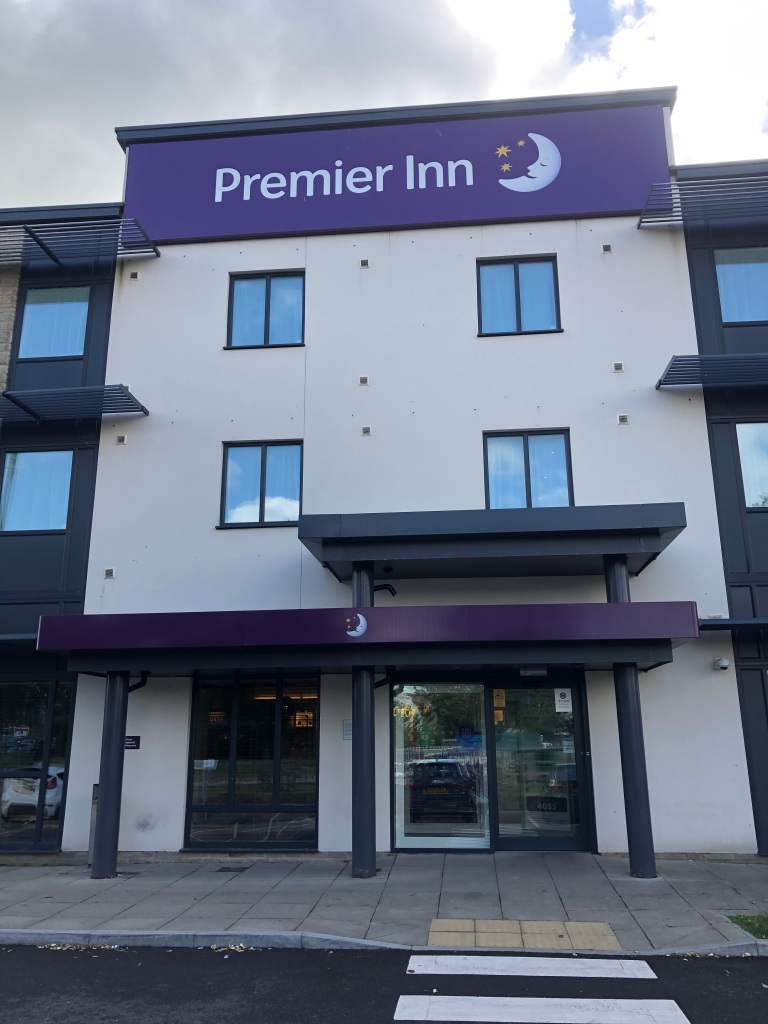
  • Hotel Premier Inn Southampton £103.00
  • Ship Southampton – New York £1388.00
  • Train New York – Seattle £1450.44 ($1836)
  • Hotel Moore Hotel Seattle £152.00
  • Ship Seattle – Victoria £89.86 ($113.75)
  • Checked Bags Seattle – Victoria £31.60 ($40)
  • Taxis New York and Seattle £27.65 ($35)
  • TOTAL £3308.74

Notes: Above costings in US Dollars are converted at a rate of £0.79 to the dollar. In addition I would add the following ‘essentials’, Internet on board the QM2 £81.90 (special offer) plus at least £80 towards drinks on board the ship. I was in a shared taxi in New York which probably saved me £40. You might want to tip your cabin steward on the trains so maybe add another £30. The Barassie-Glasgow train was bought on the day with a Scottish bus pass discount. Train from Glasgow to Southampton was booked on trainline using a ticket split. Both the QM2 and Amtrak fares were booked ten months in advance. Premier Inn was booked direct online a few months in advance. The Moore Hotel was reserved through Expedia. FRS Clipper was booked online several months ahead.

Slow Route To Victoria Pt 1

Troon to New York

Queen Mary 2

Back in the days of pandemicmania, the seed of an idea planted itself in my brain and began to grow. Would it be practical, or indeed possible at all, to visit my daughter Rebecca without the use of aircraft. Although she lived in Victoria, Canada, some 4500 miles of ocean and continent away, it didn’t take long to realise that it was entirely possible. As for practicality, that depended if you had a spare couple of weeks and could justify spending the money to pay for such a trip. I’m retired so I had the time. As for the money, well that was a different matter. Crossing the North American continent by train was not exactly cheap but getting across the Atlantic using the one remaining scheduled ocean liner crossing was prohibitively expensive. In the end I decided to take the shortest flight across the Atlantic I could, to Halifax Nova Scotia, and then get a train, or three trains to be precise, from the Atlantic to the Pacific and then a ferry to finish the job. I completed the trip in the August of 2022 and loved every minute of it. You can read all about it here: Atlantic to Pacific By Rail. Get yourself a cup of tea first, it does go on a bit. Or just read this blog but get a cup of tea anyway.

Fast forward to the summer of 2023. Elaine mentioned to me that she didn’t want to go away on a long-haul trip the following summer so if I wanted to do one of my solo adventures, that would be a good time to go. I revisited the idea of getting to Victoria by surface transport and nervously opened the Cunard website to see if there were any deals going for a transatlantic crossing on the Queen Mary 2. I was pleasantly surprised. Solo occupancy cabins for a six night crossing in June 2024 was much less than the prices I had been quoted two years previously and the fare includes not only the passage but also six days of food (but not drink), entertainment, someone making your bed each day, an iconic arrival into New York and the opportunity to pretend you are important. The latter point seems to be the clincher for some people. I thought it was decent value even if it did mean an inside cabin on Deck 6 right at the very front of the ship. I booked it. How would I then get from New York to Victoria? I could have got a train to Toronto and taken The Canadian train again and believe me, I was sorely tempted, but in an attempt to experience something a bit different and also save a day’s travel, I headed to the Amtrak website to plot a route across the USA. It wasn’t a difficult decision. On the day of arrival into New York there was an overnight train to Chicago where another train would take me to Seattle over the course of two more nights. I booked myself in a roomette. I could have saved money by travelling on a regular seat in coach class but there are limits to my thriftiness. There was just the small matter of getting to Southampton from home and then to Victoria from Seattle but there are trains and ferries that can be used to ensure the surface transport rule is honoured so all I had to do was wait ten months for the journey to begin.

The journey commenced on June 8 when I was given a lift to Barassie Station by Elaine. I had two well packed suitcases, one with my stuff and another which was in effect a Red Cross Parcel for those imprisoned by the high price of things in Canada. We said our goodbyes and I got on the 10:48 to Glasgow Central, a busy train on which I somehow managed to sling the bags on the overhead rack. At Glasgow I lugged them across the concourse (via Boots where I purchased the required Meal Deal) for the next leg. That was the Avanti West Coast 11:56 departure to London. It was one of the services that routes via Birmingham so there were plenty of stops before I reached Birmingham International Station. There was a forty minute wait before a very busy Cross Country train turned up which would deliver me to Southampton. All trains ran on time and I arrived just before 8pm. I had booked the City Centre Premier Inn for the night and decided it wasn’t far enough away to warrant a taxi, and with my two heavy suitcases in tow, walked the three quarters of a mile to said establishment and checked in. Had the ship been departing any other day than a Sunday I would have utilised the Caledonian Sleeper overnight down to London and a train from there to Southampton in the morning but the Sleeper does not run on a Saturday night. There was an overnight Megabus coach from Glasgow to Southampton but I’m not mad enough to even consider that option so travelling down the day before and a night in the Premier Inn was the best plan. After a decent night’s rest I was very happy I had done it that way. I had been allocated a check-in time of 3pm by Cunard so had a few hours to kill. I had a wander round the city and took the opportunity to work out how to get to the Mayflower Terminal at Southampton docks. It was a mile and a half away from the hotel so I went for the walking option rather than pay an inflated taxi fare. This proved to be another good decision. I headed past the station where many taxis were waiting to transport those arriving on the day to the QM2 and three other different cruise ships that were scheduled for departure that afternoon. I walked down the entrance road to the docks, turned right and there she was, the Queen Mary 2. Walking had given me my first view of the magnificent looking ship that would be my home for the next six nights. Yes, I would have seen it from the taxi but by walking I had another ten minutes to admire her classy lines from a distance, something you can’t quite do whilst on board. I was the only person walking and it was a privilege to do so.

Walking to the ship was worth the effort just for this view.
With her name written large, I approach my home for the next six nights.

At the Mayflower Terminal I deposited my bags on a conveyor belt and hoped I’d see them again soon. I then joined the massive check-in queue. It was 2-30pm, half an hour before my allocated check-in time. By the time I reached the front of the queue it was 3-30pm. An hour in the queue was perhaps a bit longer than I would have liked but once it was my turn to check-in, it took approximately 30 seconds. There was a further airport style security check which only took a few minutes and I was ready to follow the ‘To The Ship’ signs. A walk up the covered gangplank led me through the door on Deck 2 into the atrium. I was welcomed on board and shown to the lift, then left to find my cabin on Deck 6. It wasn’t difficult but I can see how some folk may have found this a bit overwhelming. Whilst I hadn’t expected to be walked to my room I did feel the whole boarding process could have been a bit better. Anyway, when I found my cabin, which I will now refer to as my stateroom, the two suitcases were already sitting outside and an envelope with my keycard was sat in a little letter rack thingy. I opened the door and stepped in.

I’ll pause the travelogue here to talk about the Queen Mary 2. Built in Saint-Nazaire, France, she was launched on 21 March 2003, christened on 8 January 2004 and commenced her maiden voyage four days later. Her construction was marred by an accident on 15 November 2003 when a gangway collapsed during an event where shipyard workers and their families had been invited to inspect the ship. Sixteen people died and thirty-two injured after falling 15 metres into the dry dock. She is designed as specifically for the Transatlantic Crossing and as such is the only operational ocean liner in the world. All other cruise ships are just that – cruise ships. QM2 is sleeker, faster and cuts through the waves much better than even the largest cruise vessel. When she entered service she was the largest passenger ship ever built. With the advent of the super cruise ship over the past twenty years she isn’t even in the top forty any more but still clocks in with a gross tonnage of nearly 150,000, more than double that of the Queen Elizabeth 2, the ship she replaced. (Gross tonnage is a measure of internal volume, not weight) The external appearance is in keeping with the Cunard Line heritage and, as I mentioned above, she looks stunning. The heritage themes continue on the inside. The decor, whilst not always to my taste, is in keeping with the golden age of transatlantic travel and much is made of the history of Cunard and those who have sailed with the line in the past. She was refurbished in 2016 and has been kept in good order since then. Amongst the public areas are numerous restaurants and bars, a theatre, cinema/planetarium, ballroom, nightclub, library, shops, casino, gym, spa and, for use on Transatlantic services only, kennels. There is a covered pool and another two on deck at the rear of the ship. The promenade deck wraps round Deck 7, three laps equals 1.1 miles. There are open decks at the top of the ship and over several decks at the rear. Power comes from four diesel engines with two supplementary gas turbines. These generate electricity to power the ship and drive the four propulsion pods. Top speed is 30 knots and she generally cruises at 24 knots. Whilst there are many larger and newer passenger carrying ships now, I don’t think any of them are as impressive as the Queen Mary 2.

Kennels, complete with fire hydrant for American dogs and lamp post for British dogs.

Back to the travelogue. Having watched the lifeboat drill on the cabin TV and checked in at the appropriate muster station, a compulsory feature of all cruises, I headed up to the top deck of the ship, known as The Lookout, to observe the sail away. There was no brass band to play us off or fireworks, this was just a run of the mill departure as far as Southampton was concerned. With several blasts of ship’s impressive whistle – more a hooter than a whistle – we slowly moved away from the dock and set sail down the Solent. Three other cruise ships were in port. QM2 towered above Seven Seas Splendour and P&O Arcadia but was dwarfed by Arcadia’s new sister ship, Arvia. We could hear the passengers on Arcadia being encouraged by the onboard DJ to make some noise to show us on the QM2 how to have fun. I think, perhaps, that DJ had the wrong idea of what the average Cunard customer would consider fun. Once out of the Solent we passed to the east of the Isle of Wight before turning west and that was the last land I would see for five days. That is quite a long time with noting to see but the sea. I’d occasionally look out at endless ocean and lose myself in the vastness of it all but the awe only lasted for so long and I had to find other stuff to do. This leads us to life on board a transatlantic liner.

The Queen Mary 2 is a big piece of kit. It took a while to get used to everything it had to offer and I was still finding nooks and crannies that I had missed right up until the end of the journey. First thing to discover was my stateroom, number 6003. This was the most basic type of accommodation for the fare paying passengers, an inside cabin. Basic is a relative term, however, it was perfectly well appointed. It had a comfortable double bed, a desk and chair, two USA and two UK plug sockets, a TV, a not particularly efficient fridge, plenty wardrobe space containing a safe and slippers but no bathrobe, and an en suite containing a vacuum lavatory, sink and shower. The room was attended to twice a day by Alan, the cabin steward, a Filipino chap who knew my name before we introduced ourselves to each other. I was more than happy with the cabin and the service. I could have paid more for higher standard stateroom, either at the time of booking or by bidding for an upgrade in the run up to the voyage. I’m glad I didn’t. There were times when I thought a bit of natural light would have been nice but not a couple of hundred pounds worth of nice for the stateroom across the corridor which had a window. A balcony stateroom would have given me a balcony on which I could watch the unchanging scenery go past but at an extra £800 I’d have spent much of the cruise trying and failing to justify the extra expense. Those are just the normal staterooms. For the full luxury Cunard experience you could spend several thousand pounds more for a Princess Grill or Queen’s Grill Suit. They look really nice in the pictures and you even get to use exclusive restaurants (Princess Grill and Queen’s Grill, hence the name) and lounges that we cheapskates were barred from. 85% of the passengers are cheapskates, however, and they occupied the range of ‘normal’ staterooms and most of them would have got much the same as I had, with or without the benefit of a window or balcony. And maybe a bathrobe. I should have asked Alan for one.

En suite shower.

As mentioned above, in addition to passage and accommodation, your fare includes all the food and most of the entertainment on board. Whilst you could make the crossing without spending an extra penny, it is more likely that you will incur a few expenses along the way. The currency on the ship is the US Dollar which rather goes against the traditional British style that the Cunard try to recreate. Not that you see any actual greenbacks as the ship is cashless. You lodge a credit card either before the cruise or at the purser’s desk soon after departure and your stateroom keycard becomes your payment card for everything on board. The fare I had chosen included $125 cabin credit which was handy though it didn’t last long. During the fist night $96 was debited from that total for the gratuities for the hotel services staff at $16 per day. This was a surprise to a number of folk I spoke to although it was quite clear in the Cunard literature. It was odd though as we’d only had one night’s worth of service thus far and the whole idea of gratuities is a bit alien to we Brits anyway. You could get the purser to remove the charge from your account and choose to tip, or indeed not tip, in the old fashioned way at the end of the cruise. I just left it and hoped that Alan would get his fair share. In the end I charged $300 to my stateroom account which meant $175 was charged to my credit card at the end of the voyage. Much of that was for drink. Whilst you could get tea and coffee for free in the buffet and maybe fruit juices too, all other drinks had to be paid for. The prices were not extortionate but they mount up. Also, 15% is added to all those prices as a gratuity to the bar staff. Like most cruise lines, drinks packages are available to purchase in advance, or even on the ship. The full package was a whopping $75 per day. This meant you could drink all bar the top end wines and spirits. By my calculations you would need to knock back eleven alcoholic drink a day to make it worthwhile. I know some folk who could get more than their money’s worth from that but not me. I decided to take the pay-as-you-go option along with a bit of smuggling. The contraband was sixteen cans of Diet Coke that I had purchased in Southampton on the morning of the departure. I had managed to stuff them into the suitcases and they were still in them when I was reunited with the cases on board. Whilst I felt I was doing something slightly clandestine, there isn’t any rule against taking soft drink on board although there are limits on alcoholic drinks. I drink a lot of Diet Coke and a bottle of the stuff on board was nearly $5 with the gratuity. I drank all of them over the six days saving my stateroom account $90 at the initial outlay of £9. Sorry to mix up the currencies there but it’s clear my smuggling activities saved me a few dollars/quid. A man can’t live by Coke alone, however, so a few vodkas, in to which some of the smuggled Coke was poured, and beers into which it wasn’t, were bought and consumed as I went.

$90 worth of Smuggled Coke

A big part of this and indeed all cruises is the food. You are not going to go hungry on your transatlantic voyage. The main dining room is the Britannia Restaurant, an impressive space over three decks. It is where the 85% of passengers not travelling Grills Class can formally dine for breakfast, lunch and dinner. For dinner you can choose a particular sitting or do what I did and opt for open dining. I never had any wait to be shown to a table. You are asked if you would be prepared to share, I always said I was. Even if you prefer to eat alone it will be on a table that is just a couple of inches from the next so it is likely you will end up chatting to other cruisers anyway. The food was good. Not amazing or extraordinary but a good choice of quality dishes. The service staff were smart and attentive. My only gripe would be the food sometimes took a while to arrive and when it did it could have been a bit hotter but my overall experience of the Britannia Restaurant was positive. It isn’t the only option when it comes to dining. The King’s Court is a large buffet style restaurant that is open all day and possibly through the night too, I never checked. It was extremely popular, especially for breakfast and lunch. There was a wide selection of dishes to choose from and the quality was good but I could never shake off the idea that it was more of a canteen than a restaurant. I used it often, sometimes through necessity as the Britannia Restaurant was off limits to me on Gala Nights. Part of the Kings Court was reserved for speciality dining. I visited one night when it was turned into Coriander, an Indian restaurant. This cost an extra $20 but was worth it as it was the best meal I had on the ship. Another optional extra was the Verandah, an a la carte steakhouse. This could be anything up to a $50 supplement. I had booked in advance for a lunch there one day for $20 but when it came to it I really didn’t fancy a steak lunch and cancelled the reservation. The money was refunded and I never got to sample Verandah. All I can say is that I heard good reports about it. A big thing was made of Afternoon Tea, served every day in the Queen’s Room. This is the ship’s ballroom, transformed into a large dining room every afternoon. Finger sandwiches, scones and cakes are served along with a choice of teas or, if you don’t drink tea, they’ll bring you a fruit juice. Champagne is served too but you have to pay for that. A pianist or a classical string trio plays and it is all very civilised. I was never very hungry at 4pm but I visited it just the once purely so I could report back. Naturally I had to sample everything on offer (apart from the tea) and after the fourth or fifth cake decided that everything was very nice and I could maybe give dinner a miss that evening. The scones with jam and clotted cream were sublime. I later discovered that you could do a DIY Afternoon Tea in the King’s Court which was handy as I had missed out on the mini treacle tart in the Queen’s Room only to find some sitting in the buffet the following day begging me to eat one of them. I did. It was lovely.

Britannia Restaurant. It is much bigger than it appears here.

Those were the main dining options but there were others. The ‘British Style Pub’, the Golden Lion, served some pub grub classics at lunch time. I tried the fish and chips one day which was not a bad effort. Some of the bars would have sandwiches and nibbles and there was a place up on deck, the Boardwalk Cafe, that would serve food to the sun worshippers had there been any. I think it remained closed for the entire voyage. If none of these options appealed to you there was always room service at no extra cost. I’d have personally gone a bit bonkers had I remained in my stateroom to eat but judging by all the trays with half-eaten plates of food that lay in the corridors at any time of the day, this option appeared to be a popular one. The main bar/lounge was the Carinthia Lounge on Deck 7. This seemed popular and would host quizzes and other events throughout the day. On one afternoon there was a performance of Twelfth Night in there, not perhaps the best place for it as the layout of the place meant I could hardly see any of it. My favourite bars were the Golden Lion as mentioned above and the Commodore Club at the front of the ship on Deck 9. It had good views over the pointy end, not that there was anything to view other than sea of course. There was a cigar room, Churchills, next to it if you happen to enjoy puffing on a smouldering dog turd. Off the top of my head the other bars were The Chart Room, Champagne Bar, Terrace Bar and Pavilion Pool Bar but there may be one or two others tucked away that I missed. The good news for those of us smuggling Diet Coke on board is that the bar staff will happily, or maybe even begrudgingly, will bring you a glass with ice.

Whilst food and drink take up a large part of any cruise, there are is still a lot of time to fill with other activities. With watching the scenery pass by not one of them, Cunard have a whole load of stuff to do throughout the day and into the night. Every day a list of the following day’s activities is included so you can plan your day. I should have saved a copy to show you an example but neglected to do so. The picture below was from cruise last year which I discovered on the internet and used without permission as, frankly, I doubt they’d got permission from Cunard to use it in the first place. It is absolutely typical of what to expect but not precisely the same what I had to choose from.

It looks a full programme but there were times when I was struggling to find something to do. Maybe I’m a bit too choosy. However, the Cunard Insights lectures, which were on different topics to those in the picture, kept me going. There were four different lecturers on my cruise. I passed on the American Politics and Art History/Architecture ones but attended those by Steve King and Captain Chris Rigby. Steve was a lovely chap, who I’d met the first evening at dinner. He had a lifetime of working in radio behind him and his talks were mainly about 60s music. Not really my thing but interesting enough to pass an hour each day. Captain Rigby’s topic was aviation. He was a former pilot with BA, Britannia, Ryanair and possibly another couple of airlines. His lectures were about aviation so I obviously had to go to them. Most of them were aimed at an audience less, well, avgeeky than me so I didn’t really learn much. One was specifically about his thoughts as to the disappearance of flight MH370 which seemed a little bit conspiracy theory to me but as he freely admitted, we will never know until they find the thing and that might never happen. The lectures took place in Illuminations, the ship’s cinema and planetarium. I’d been hoping for some sort of planetarium display but for some reason there wasn’t one on my crossing. The seats were cozy though and I admit to nodding off during a couple of the talks. There was also a Q&A session with both speakers that took place in G32, the ship’s nightclub. Not, in case you were wondering, at the same time that the DJ was spinning the decks or whatever it is that DJs do.

I went to most performances in the Royal Court Theatre. Two were song and dance extravaganzas by the ship’s on board entertainment staff. Others were visiting acts such as Piano Showman Chris Hamilton, comedian and impressionist Foggie Flax and tenor Shimi Goodman. Despite his name Foggie Flax was actually quite funny and the two musicians were talented. All the shows were 45 minutes long and were performed twice each night. I enjoyed them but was happy they weren’t any longer. There was plenty of music performed throughout the ship in bars and public areas and I even went to a classical guitar recital in the theatre one afternoon which was mercifully short. The guitarist was good but one classical Spanish guitar piece sounds much like another to me. The only other ‘organised’ entertainment I attended was the pub quiz in the Golden Lion. Forming a team of one named Norman No Mates, I entered three of them and came second in two. Pleasing yet frustrating at the same time.

Quiz Night on Masquerade Gala Night. I didn’t get this one right.

For the rest of the time I was either walking around Deck 7 which got rather tedious after the third lap, sat in a bar or on one occasions sat on a sunbed by the covered Pavilion Pool. It wasn’t for long as it was a bit chilly. Some folk sat outside if they could find a sheltered spot and it wan’t too foggy but it didn’t look much fun to me. I did spend some time in the spa one day. This cost me $59 but I figured it was worth it. The hydrotherapy pool and jacuzzi were very nice and there was a suitably hot sauna, a warm herbal sauna and a broken steam room. I enjoyed it. This and the $25 tee shirt I bought in one of the shops was the only thing to be charged to my onboard account other than the drinks and service charge. You can also visit a well equipped gym if you wish or if you fancy something a little less energetic there is a large library on the deck above it. The ship has WiFi featuring internet from the Starlink satellites. Access to just the WiFi is free and is useful for visiting the Cunard pages where you can find things like the daily programme, make reservations and keep an eye on your stateroom account. Full internet access needs to be paid for and isn’t cheap but I bought a whole voyage pass several months earlier when Cunard had a sale on. It cost $108. It was money well spent as I would realise later on the train part of this journey when I inadvertently went ‘off grid’. The WiFi signal was nearly always good with just the occasional period with slow download speeds. I may have struggled to avoid boredom had I had no internet access. I don’t mind being a solo traveller but I do like to remain in contact with friends, family and above all Elaine. A word about dress code. Most of the time it is pretty relaxed. They do say that smart casual is required in the evenings with long trousers and a collared shirt for the chaps. On Gala Nights, however, dinner jackets with ties or bow ties are ‘compulsory’ in most areas on the ship. I didn’t take a tuxedo or indeed a tie. That meant dining in the Kings Court and being restricted to a couple of bars. I didn’t mind. In fact I felt a bit rebellious by not conforming to the Gala Night dress codes.

That is how I passed my time on board. The ship followed the great circle route to New York at a steady 24 knots. I barely felt any motion, even in my cabin at the front of the ship. Most crossings last seven nights but some, including this one, take six. With the time zone changes the clock was put back an hour on five of the six nights. If nothing else, crossing the Atlantic on a ship is a great way to beat the jet lag of a transatlantic flight. Our arrival into New York was scheduled for 07:00 Eastern Time. Unfortunately a couple of incidents on the way led to us arriving four hours late. On the first night of the cruise I was awaken from my slumbers at 01:30 by the dulcet tones of the captain. I thought hello, this is a bit over friendly but he hadn’t entered my stateroom of course, he was making an announcement on the ship’s public address. A passenger was ill and required a helicopter evacuation to Plymouth. For safety reasons we needed to be told this even though nearly everyone would have slept through the incident. A course adjustment was made to rendezvous with the coast guard helicopter and the poor sod was whisked off the ship and hopefully make a recovery from whatever malady he was suffering from. Some folk reckoned they’d seen his distressed wife prior to the evacuation. We were left wondering if she had been winched onto the helicopter with her husband or if she had to remain on board for the rest of the trip. The delay this caused wasn’t much. However, on the morning of the fourth day we received another PA from the captain. During the night the ship had broken down. It was an interruption with the electric supply apparently and as the propellers are turned using electrical energy it was quite important to get it fixed. He mentioned that we had stopped overnight to fix the problem but a look at the live map display suggested we had sailed a racetrack pattern, hopefully under some sort of control. Anyway, he said the problem was fixed and we were on our way again. We would, however, not make it to New York by 7am. Eventually they secured an 11am berth at the Brooklyn Cruise Terminal and kept their fingers crossed that the problem would not resurface. It didn’t.

Spot the position where the ship broke down.

This delay would prove to be a pain to those with connecting flights, trains or buses. My connection should have been fine as I wasn’t due to leave New York until 15:30 although it did cut things a bit fine. The advantage, however, was that I didn’t have to get up at four in the morning to witness the highlight of the cruise – the arrival into New York. It was a lovely morning. Even the relative 40kt wind could not stop me from grabbing a position on The Lookout deck to witness the arrival. The southern shore of Long Island was already in view and soon we were passing beneath one of the flight paths into JFK Airport. Abeam Brighton Beach we began our turn to the north towards the Verrazzano Narrows, spanned by the mighty Verrazzano-Narrows suspension Bridge. The iconic Manhattan skyline hove into view beyond it. The QM2 passed beneath this bridge with just four metres to spare, in fact the reason the ship’s funnel is shaped the way it is to ensure this absolute minimum clearance under the Verrazzano Narrows bridge. It certainly looked close from The Lookout deck, a few metres lower than the top of the funnel. Once through, Manhattan was clearly visible along with all the traffic in Upper Bay. Having slowed down to a crawl it still took another two hours to reach the dock. The Statue of Liberty appeared in the distance to welcome us and slowly grew, remaining off to the left as we turned towards the Brooklyn Terminal. Eventually we turned through 180 degrees and edged to the dock. By 11:00 we were, as my mate John would say, all fast, F&A, FWE. I really need to ask him what that actually means. I guessing it means ‘parked’. It wasn’t quite the end of the cruise though. Disembarkation is by the colour of the tags they gave you to put on your bags the previous day. It wasn’t until 12:40 that my group was called and then followed quite a long wait to get through immigration in the large shed that is the Brooklyn Cruise Terminal. Once through that I joined a taxi queue which seemed to go on for ever, got into a discussion with the couple behind me – the chap was the ship’s bridge (cards, not the place where they drive the ship from) instructor – and we agreed to share the price of an Uber to the Moynahan Train Hall in the centre of the city. I arrived just over an hour before my train was due to depart. I wouldn’t say I was worried but I was concerned that I might be getting concerned.

Video from The Lookout
Lady Liberty gives us a wave.
The Red Ensign flies proudly against the backdrop of Manhattan. Voyage complete.

So to summarise this part of the journey. Is taking the Queen Mary 2 a practical way of reaching the New World? Yes, it absolutely is. Is it a convenient way of doing so? Absolutely not, at least as far as I’m concerned. You’ve got to put aside a week or so of your life to make the crossing as opposed to seven or eight hours by plane. There is the advantage of gradually getting used to the time zone changes and of course if you are afraid of flying it is the only way to cross the pond but most people don’t do it for practical reasons. They do it because it is an event. The crossing is part of their holiday and in some cases all of their holiday. I spoke to people who were getting the first flight back to Blighty, hopefully they disembarked the ship in time. Is the experience worth it? I can only speak for myself when I say yes it is, but only the once. I enjoyed the experience but have no desire to repeat it. As a cruise holiday it is a bit of a dead loss – one of the things about cruise holidays is visiting different ports. Five days of endless ocean is a bit, well, boring. Sure, the ships activities are many and varied but I was definitely getting a bit of cabin fever by the end of the journey. What about Cunard? I thought they were good and are probably worth thinking about if you fancy a cruising holiday. They pay homage to the golden age of ocean liners and all the things you expect are up to scratch. The different class system might put you off but it wasn’t really a factor to me. My suggestion is yes, go with Cunard but unless you really need to be in New York, choose a ‘normal’ cruise to Norway or something that looks a bit nicer than endless ocean. All four Cunard ships do normal cruises but only one of them, the Queen Mary 2 also does the regular transatlantic crossing.

Part Two of this journey to follow. It took half the time so you will be glad to hear shouldn’t be as long. I will reveal the cost of the entire enterprise at the end.

River Cruise

The Spirit of the Rhine. It’s long, narrow and low. It’s also hard to get a full photo of it.

It had to happen sometime. I’ve been retired for five and a half years now and I finally got round to taking that holiday favoured by retired folk, the river cruise. I’m surprised it took so long to be honest. It should, in fact, have happened two years ago. We were emerging from the covid pandemic when I caught it for the first time. Luckily for me it was something and nothing but for the people at Saga, the holiday company for those in the Autumn of their lives, it was a serious case of stay away from their boat. The holiday was cancelled four days before we were due to go. Having taken an ocean cruise with Saga last year, it was time to try again for the not so choppy waters of the Rhine this year. A cruise at the end of March was selected and we all managed to avoid catching transmissible diseases in the run up to the cruise, though by now we could have possibly boarded with ebola and no one would have been bothered. (I’m lying. If you catch ebola don’t go on a river cruise.) By ‘we’ I mean my sister Jill, mother and me. If you have read, or indeed choose to read my previous blog SAGA you will see how this threesome of travelling companions has come about and also my thoughts on Saga themselves. It’s a jolly witty read if I may say so myself! I may as well say so myself, nobody else will.

When it comes to river cruising, the choices are limited. There’s a finite number of navigable waterways in the world. ‘Normal’ cruising takes place on seas and oceans and there’s a ton of them to choose from and whilst cruise ships do tend to get concentrated in certain areas, the choice of itineraries is much greater than on rivers. In Europe you can go river cruising on the Danube, The Douro in Portugal, the waterways of the Netherlands and maybe somewhere in France at a push. The biggie, however, is the Rhine. Actually, the Danube is longer and a similarly important river cruise waterway but the Rhine gets my vote as the most important. Defining what is and isn’t the Rhine is tricky at either end of said waterway but the bit we are interested in runs from Lake Constance to the Hook of Holland and is measured in Rhine Kilometres, a unit of length that matches a normal kilometre except in one case which we will see later on. There’s 1032 of those but the first couple of hundred are not navigable. The rest, from Basel onwards, is fair game for river cruises and a surprisingly large number of commercial cargo vessels. The cruise we chose was called ‘Rhine in the Springtime’ and of the three or four departure dates available, we chose the first one of the year for the very sound reason that it was quite a bit cheaper than the others. ‘Cheap’ is a relative term. River cruises are not known to be at the budget end of the holidaying spectrum. What’s more, single occupancy of a cabin will cost you a hefty surcharge so a saving of a thousand pounds or so by taking a cruise so early it only just qualified for the ‘Springtime’ bit is not to be sniffed at.

As with the ocean cruise, Saga look after you. Included in the price is insurance and transfer to whatever port of exit you decide to use. For most folk on this cruise this was St Pancras Station where the Eurostar train would whisk them off to Brussels where a bus would pick them up and take them to the boat which was moored in Dusseldorf. We, however, took the flying option. This required us to be at Heathrow Airport for a 12:55 departure so we asked Saga’s UK travel service to take us down the day before. We booked an airport Premier Inn for the night allowing us a more leisurely short ride to the airport the following morning. We spoke to others who had been picked up at three in the morning for the flight or the train so felt the extra expense of the hotel for the night was more than worth it. The flight went directly to Dusseldorf from where we were met and sent on a short bus ride to the boat. We were welcomed on board and shown to our cabins.

Our home for the next eight nights was The Spirit of the Rhine. This was one of two river cruising boats built specifically for Saga back in 2020/1 (bad timing there), the other being The Spirit of the Danube. They promised a big upgrade in the standard of vessel Saga had been using up to then and both my mum and sister, who had been on the older boats, stated that Spirit of the Rhine delivered that promise. As for me, I had nothing to compare it with but find it hard to believe the Spirit of the Rhine could be bettered. It can carry up to 182 passengers – there were approximately 160 on our cruise – with a crew of around 40. Typical of Rhine cruisers, it is 135 metres long by 11.4 meters wide. There are 91 cabins over three decks. 20 are on the Lower Deck. Being near the water line, these have thin, fixed windows and are 14 sq metres. Nicely appointed but a little tight. On the Middle and Upper Decks the rooms are 17 sq metres and have large French balconies. A French balcony is basically a French door with a fence across it to stop you from falling into the Rhine. Other river cruiser boats manage to squeeze an actual balcony in their cabins but they are tiny and I think the French balcony is better by having that space behind the doors. Whatever, these cabins are a fair bit more expensive than the Lower Deck ones, with the Upper Deck costing slightly more than the Middle Deck, but I think they are worth the extra expense. The Lower Deck cabins might feel a bit claustrophobic after a while. I was on the Middle Deck, my mum and sister were on the Upper Deck. We were each in a designated single cabins but from what I could see they were exactly the same as the other cabins on the Middle and Upper Decks, just with one less chocolate on the bed in the evening. There is a reception amidships with the Lorelei Lounge ahead and the main restaurant on the deck below. There is a small, speciality restaurant at the stern on the Upper Deck and they’ve squeezed a small gym – two treadmills and two exercise bikes – on the lower deck. On top there is the sun deck which extends almost the full length of the boat, interrupted only by the wheelhouse which is mounted on hydraulic jacks so it can be lowered to fit under the lowest of bridges. There’s plenty of chairs and loungers and also a small splash pool if you fancy watching the German countryside going by whilst sat in warm water. That’s about it for the public areas. It might not sound a lot but there’s plenty of space for all on board. It’s not a cruise ship though, places to go are limited and theres no casino, beauty salons, bars other than the main one or theatre like on a Saga ship and certainly no surfing simulators, water slides and go-kart tracks like on the mega cruise ships. There’s a large chess board on the sun deck though…

We didn’t move from our mooring until the following morning. Such is the way with some itineraries. It was perhaps just as well as some of the passengers arriving by train had picked up a delay and didn’t get in until late that evening. The rest of us got to sample the catering for the first time. Dinner was served at 7pm. You could have gone in a bit later but with most of the passengers being Brits we all tended to file in at that time in an orderly fashion. There were tables of six and four and it was a case of taking whatever available table you fancied. Sometimes we’d share a table of six, others we got a table of four to ourselves. The menu was four courses, starter (choice of two), soup (two), main (three) and dessert (two, plus a cheese option). The food was almost without exception excellent. There was always some simple items available in addition to the mains – grilled chicken, a small steak or salmon – for those with a more delicate palate. Or, indeed, if you just fancied something relatively plain for a change. Wine, beer and soft drinks were available, all served by the very attentive staff. Portion sizes were just right, not too big, not too small. As an alternative to the main restaurant, the small Rhinefells restaurant at the rear of the ship could be booked for evening dinner. We did this on the second night. It was nice but the food was not really any different to the main restaurant. It was a more intimate atmosphere and you could observe the chefs preparing your dinner but the menu appeared to stay the same throughout the cruise so we felt there was no need to try and book it for another night. All the food on board was included in the price of course. Breakfast was a buffet with a large array of items to choose from. An egg chef prepared fried eggs and omelettes to order otherwise you just got your own stuff and tucked in. We Brits love a buffet breakfast so no one was complaining though we thought the sausages weren’t particularly great. Lunch was also a buffet with some extra items delivered by the waiting staff directly from the kitchen on request. Once again it was good stuff and allowed you to have as big or as small a lunch as you wanted. A lighter version was served in the Rhinefells restaurant. In the afternoon sandwiches and cakes were available in the Lorelei Lounge and on one afternoon afternoon tea was served in there. Drinks were also included, both with meals and in the Lorelei Lounge all day. The selection of included drinks was more limited than on a sea cruise but still perfectly adequate and we didn’t spend an extra penny whilst on board, though there were plenty premium brands available at extra cost.

Life on board the boat tended to take place in the Lorelei Lounge. Some time was spent on the sun deck, especially for the scenic parts of the cruise, but a March date was never going to see a battle for the sun beds. The lounge was a pleasant space where, as already mentioned, drinks were available from 9am to midnight and nibbles were served in the afternoon. It was the place where the cruise director would give us the appropriate information for our ports of call, the Captain introduced his staff and Michael, the resident entertainer, would, well, entertain us. He’d run quizzes, compare a few games, play a bit of piano lounge music, encourage us to hit the dance floor, tell the odd joke and also sing. He did a pretty good job at keeping most of the passengers entertained and didn’t massacre the songs from the musicals which was good. If you are used to ocean cruising, you might think the entertainment was a bit on the sparse side but for the size of ship you couldn’t really expect anything else. On a couple of evenings visiting musicians serenaded us. One was a trio from the Moselle region who performed typical German drinking songs which, like the drink, went down rather well. The other was a couple of chaps from Alsace who were supposed to perform some folk music from that region but we figured they were just giving us a few light tunes which went on a bit too long. Whatever, there was always something in the evening to help pass the time.

Resident entertainer Michael. He’s from Yorkshire you know.

River cruises are, of course, much more than killing time on the boat. Our itinerary had us visiting seven different places though we didn’t see much of Dusseldorf where we boarded. On the itinerary was Cologne, Koblenz, Rudesheim and Speyer where we then turned about and headed north, visiting Bingen and Nijmegen before we arrived in Amsterdam where we spent a full 24 hours before the cruise ended and we came home. ‘Scenic’ cruising only happened on a couple of afternoons. Between Koblenz and Rudesheim lies the Middle Rhine Gorge, all romantic castles, near vertical vineyards and picture postcard towns. Plus, with tracks on either bank, quite a lot of trains. Having cruised this section, passing the Lorelei (or Loreley) Rock on the way south, we cruised it again in the other direction which was not a bad thing. We were lucky with the weather both times. Much of the other time we were moving was in the dark and the for bits that did take place during the day, the scenery tended to be interesting rather than pretty. The Rhine has attracted a lot of industry over the years and it there’s no way of avoiding it. Passing the Bayer Pharmaceutical plant in Leverkusen isn’t going to be high on anyone’s list of ‘must see’ sights but at least we can say we’ve seen the birthplace of Asprin. The river is marked on both banks every 100m. The Kilometres are shown as a number, zero is somewhere in Switzerland, 1032 next to the North Sea. A ‘+’ sign is placed at the half KM with poles placed every 100m. The 529 and 530km indicators are, however, only 580m apart due to a surveyor’s cock up. I got as much pleasure out of seeing that anomaly as I did from seeing the Loreley rock.

The stops were all interesting with the exception of one. Sorry about that Bingen. Excursions were available at all locations but the uptake wasn’t great and the ones at Cologne and Bingen were cancelled. Some excursions were included in the price and we Brits weren’t going to miss out on them. A walking tour of Speyer and a coach trip from Nijmegen to Arnhem and ‘A Bridge Too Far’ were the first two. In Amsterdam, where we were mored a couple of miles out of the centre, we were bused into the city and took a canal cruise. In the afternoon a shuttle bus was organised for those who fancied an independent wander round the city. Those leaving by Eurostar got a bonus tour of a tulip farm on the day of departure but not those who flew. The extra paid for excursions were walking tours at Koblenz, the Mechanical Music Museum plus wine tasting at Rudesheim and the Technik Museum at Speyer. We didn’t join any of those. Mum and Jill had done the Mechanical Music Museum before and the Technik Museum was just a short way from the boat so I went myself, paid at the gate and saved twenty quid. Walking tours are a big thing on river cruises and whilst Jill and I did the included one in Speyer, it was better discovering the locations at your own pace. Saga boats even have little gizmos you can use to have a self-guided walk around most ports of call. We tried this in Bingen without much success and elsewhere we just did our own thing. In Cologne we visited the famous cathedral. In Koblenz we took the cable car over the confluence of the Rhine and the Moselle. In Rudesheim we took another cable car and mum and Jill sampled Rudesheimer coffee. I don’t like coffee but I’m sure it was delicious. In Bingen I did manage to discover an interesting crane. Sorry again Bingen. There’s plenty to see wandering round Amsterdam as I’m sure you know. Not that I saw those bits, I went on a tram ride instead.

So, river cruises, yes or no? For me the jury is still out. I think I need to take another to form an honest opinion. I couldn’t really fault Saga. Whilst I have nothing to compare it with, the boat was excellent, the staff were great, food and drink were fantastic and I fail to see how all that could be bettered. Yes, it was the first cruise of the season so there was the odd teething problem, the onboard wifi wasn’t great and a few more excursions suitable for the less mobile passengers would have been good but these are straws I’m clutching at. So why the indecision? I’m just not sure river cruising is really me. Certainly if my mum wants to take her kids on holiday again we will probably plump for an ocean cruise as there are more choices, both in terms of itineraries and what to do on and off the ship. Having said that, the Danube looks an interesting river….

Madeira M’Dear

Madeira. As a wine it has been around for a couple of hundred years. As a named island about 600. As an island, over a million.

When I was a lad my dad had an LP that we played on the mono record player. It featured Flanders and Swan, a couple of comedy musicians from the 50s and 60s. One of the songs on the album was called “Have Some Madeira M’Dear”. It wasn’t one of my favourites – I preferred the ones about the London Bus and the Gnu – but it has stuck in my memory for many years. Well, bits of it have. The song is about a fortified wine called Madeira that is produced on the island of the same name. And that, dear reader, is a rather vague segue from me telling you about an unimportant childhood memory to my latest trip to a foreign land.

Madeira is a volcanic island in the Atlantic Ocean not too far from the Canary Islands but not particularly close either. It is a semi-autonomous part of Portugal along with its smaller neighbour Porto Santo. It has been inhabited since the 1400s and despite some obvious problems with the topography of the place, agriculture was the most important part of the economy and continues to this day, as does the production of the aforementioned wine. Nowadays, however, tourism is the major source of revenue for the island and it has been a popular destination with the British for over a century. Other European nations have since joined we Brits in enjoying what the island has to offer and, pandemics notwithstanding, the island seems to be doing pretty well out of us all. On the face of it that might seem a bit odd. Unlike other holiday hotspots in the Mediterranean or mainland Portugal itself, Madeira does not have any beaches worth talking about. The climate, whilst mild all year round, tends not to have the heat of the Med in summer. Tourists are well catered for in hotels but theme and water parks and other similar touristy things are basically non-existent. Even the similar Canary Islands to the southeast have much more of a ‘traditional’ beach holiday feel to them. Madeira is not much of a party island and frankly I wouldn’t bother taking kids there. What that leaves, however, is a certain demographic of holiday maker of which Elaine and I fit into quite well. Namely, the middle aged. No kids to worry about, no young ‘adults’ throwing up outside nightclubs and no ‘Full English’ breakfasts at beachside cafes. Actually there were a few of those though not beachside as there was no beach. What draws those middle aged (and a fair few elderly) people to the island? Let me explain.

Madeira. Basically 95% steep hill, 5% very steep hills.

We had been thinking about Madeira as a holiday for a few years but never with much enthusiasm. However, in the middle of the summer we decided that an Autumn break was a good idea. We considered Spain and the Canary Islands before deciding on Madeira for no good reason. Being the hard-nosed travellers that we are we took the easy option and booked a package holiday with Jet 2 Holidays. I know, I know… It made sense though. Had I put together a trip myself we would probably have come up with much the same as there was only the one flight a week from Glasgow and one of the benefits of buying the package was there are transfers to and from the hotel included and more important, you get ATOL protection should the airline or tour company go belly up whilst you are away. I booked the trip online through the Jet 2 Holidays site about ten weeks prior to departure. A few weeks later I received an email from Jet 2 Holidays saying that they had been informed of building work taking place next door to the hotel and should we want to we could change to a different hotel without the normal administration fee. We had to pay any difference in price of course and we chose one that was £100 more. Two weeks before departure we received another email saying that there was building work near this new hotel, we could change again if we wanted. We did to a hotel that was another £200 more. I felt it was good of Jet 2 Holidays to warn us of the potential disruption whilst a small part of me was thinking, hang on, we’ve just had to fork out an extra three hundred quid. Never mind, the latest hotel seemed to be a decent choice although the website was hardly going to say it was rubbish, was it?

Come the day we pitched up at Glasgow Airport for the afternoon flight to Funchal. Jet 2 Holidays is the tour operating arm of the airline Jet 2 and it was one of their Boeing 737-800s, some 23 years old, that was transporting us to Madeira. There was a bit of a delay, nothing too serious, and we arrived in Funchal just as the sun was setting. I must put my avgeek hat on here and say something about Madeira Airport. For years it had a short runway carved into the side of a mountain. So short in fact that aircraft returning to the UK could not carry enough fuel to get there. Instead, they uploaded the minimum they could get away with, flew to another airport, maybe in the Canary Island, maybe the Portuguese mainland, filled the tanks up there and flew home. This was not an ideal situation so in 2000 they extended the runway over the sea. As the existing runway was on the side of a mountain, over the sea meant 58m above the sea so the entire runway extension is on a platform supported by 180 columns. It is very impressive when you see it close up. Whilst the runway is now plenty long enough, the airport is still has quite unique problems caused by the height of the local terrain and the possibility of severe crosswinds. It is a Captain only landing and take off and specific training is required. Thankfully, our captain did a sterling job and it was fun to witness the very late turn onto final approach as we landed on Runway 05. That’s it, no more aviation geekery stuff in this blog, feel free to read on.

As mentioned, this was a package holiday so a number of Jet 2 Holiday reps were there to meet us and send us to the appropriate bus to our respective hotels. Light had faded completely by then so first impressions of the island were limited. The journey to the hotel took half an hour. When the airport was extended a major road was built along the south of the island. We were told that before that the journey to central Funchal took well over an hour. Our hotel was the Allegro which I was sad to learn was not named after the ‘classic’ Austin Allegro car of the 70s and 80s. It’s literal meaning is to perform music at a brisk speed but I suspect it just seems like a nice word to give to a hotel. It was situated in the Lido area of Funchal to the west of the centre and home to many bars, restaurants and other hotels. We hadn’t realised it was in the tourist area when we booked it but it turned out to be pretty well placed for us. Despite being eleven stories high, the hotel isn’t really too big especially when compared with some of the large, sprawling properties that line the coast. After a problem with mouldy shower sealant was sorted out it proved a nice place to stay. The rooftop bar was especially welcome at the end of the day and the pool area was never too busy, not that we used it much. A decent buffet breakfast and a large, comfy bed (not at the same time) is enough to keep most British holidaymakers happy. We got our bearings the following day, staying local and formulating some sort of plan for the rest of the week. We met the Jet 2 Holidays rep who gave us some ideas, another plus when taking a package holiday, though adding several demerit points to your independent traveller rating. I’ll break it up into sections, not necessarily in chronological order.

Funchal

Funchal from not quite the top.

Funchal is quite a big city, the sixth largest in Portugal to be precise. Its 100,000 residents make up 40% of the island’s population with most of the rest in nearby towns on the south coast. Its main feature is that much of it is built on the side of a very steep mountain so rather than spreading outwards, it has spread upwards. Whilst it caters well for tourists in the hotel, bar and restaurant department, it isn’t overly filled with things to do. This is fine for some people. We met a couple who were holidaying in Madeira for the seventh time but had not left the city in all those visits. The rocky beach even had a few brave people sunbathing on it though quite how they found it remotely comfortable is beyond me. The Lido area where the hotel was situated was unsurprisingly named after a large lido where you could go sunbathing in a bit more comfort but if getting the rays is your primary focus of a holiday I would have thought Funchal would not be the first choice. There is a bit of an old town to wander around, a colourful market and some interesting street art but the main tourist attraction is getting up and down the mountain. There is a scenic cable car ride to take you up. At the upper station there are the Monte Palace Gardens to look around, impressively built into the side of the mountain like everything else. Another cable car ride takes you to the Botanical Gardens. We only did the former so can’t pass judgement on the latter. Once the gardens were done there’s the matter of getting down. You could take the cable car of course but the fun way is to take the toboggan. The Carrieros do Monte are the men who guide your toboggan, basically a whicker basket on wooden runners, down the public roads down the mountain for two kilometres. The only thing they have to steer and brake are their feet which are encased in specially designed shoes. It’s a Funchal tradition that goes back well over a century and is quite good fun. It isn’t as much of a white knuckle ride as some folk make out but it is definitely worth doing. It costs 35 Euros for a couple plus a few Euros tip for your carrieros. Unfortunately 2km isn’t enough to get you back into the city centre but there are buses and taxis to complete the job or you could do as we did and walk down the steep lanes. Speaking of walking, there’s a nice walk along the costal path to the fishing port of Camara de Lobos which is largely flat. We did it in both directions but once again you can do it one way and get a bus or a taxi back. There are some museums to look at if that’s your thing including one dedicated to Madeira’s most famous son, Christiano Ronaldo, plus shops both local and international but whilst Funchal is a good place to base yourself, it would be a bit of a waste spending the whole seven days there.

Escaping Funchal

Apart from walking to the next town there are basically three ways of escaping the clutches of Funchal. The first of these is to catch the local buses. They are a cheap way of reaching the rest of the island as well as linking up the bits of Funchal that you might want to discover. We had arrived with the best intentions of utilising them but in the end we didn’t. We had arrived during a heatwave with temperatures eight or nine degrees above what was expected. This made walking a bit uncomfortable but we figured not as uncomfortable as being on the Number 22 to Porto Moniz. Some buses were quite modern, others less so with air conditioning provided by opening the windows. They also seemed very busy and the central bus station was a half hour walk away (or another bus ride) from our hotel. In a future visit we will give them a try as long as the temperature is more normal. To do so would certainly wipe out those independent traveller rating demerit points we had earned by going on a package tour. The second method, and by far the most convenient, is to take a guided tour. It’s probably the most pricy too but like much on Madeira it isn’t too expensive. We took a couple of these, the details of which are below. These tours take place on full sized coaches or, as in the ones we took, minibuses. A full minibus on a hot day is probably no more comfortable than the service bus but the advantage is it takes you where you want to go without meandering around hairpin bends to all the tiny villages. The real plus of the organised tour is, of course, the guide whose encyclopaedic knowledge of the island keeps the interest level going the entire trip. Method three for discovering the island is to hire a car. Every other shop is seemingly a car hire place and 40 Euros can get you a Dacia Sandero (see my blog entitled Crap Cars ) for a whole 24 hours. We did it for one day, a Sunday when the roads were a bit quieter, and if we ever go back would get one for longer. Driving in Funchal is a bit hectic and out of town can be interesting but the island has a pretty good road network with hundreds of tunnels and bridges to cope with the terrain.

Organised Tour

The scenic tour of the east and north of the island took seven hours. I think it was about 70 Euros each plus another ten if you took the lunch option which we didn’t. The journey itself was basically sightseeing to a number of lookout points. The scenery is really quite spectacular and the fact the island is covered in lush vegetation sets it apart from its Canary neighbours. There was also a stop at a rum factory – sugar cane used to be the major crop on the island and is still grown, not to sprinkle on cornflakes but to make rum. Lunch stop was in the town of Santana which is the home to some pretty traditional houses, some of which are still private residences or at least part of a private residence. They are quite photogenic but the stay in the town was probably half an hour too long though we did meet a parrot who said ‘hola’ before bursting into laughter. It made us chuckle. We returned to Funchal via a route over the mountains, visiting the summit of Pico do Arieiro, one of three peaks above 1800m tall and the only one accessible by vehicle due to the Portuguese Air Force radar station situated up there. From there you can walk to one of the other peaks along a ridge path. There was not nearly enough time for us to do that but if we ever go back it might well be on the ‘to do’ list. We were lucky in that there was no cloud around so were afforded magnificent views. After the drive back to Funchal, with a couple more photo stops, was complete we were quite glad to be off the minibus. Not that the tour was bad, it was the air conditioning struggle to cope that made the latter stages of the journey rather uncomfortable. I suspect it would be fine on a normal day.

Levada Walks

The other guided tour we did was a levada walk. Levada walks are the one thing that attracted us to Madeira in the first place despite having just a basic knowledge of what they involved. Levadas are water channels that criss-cross the island to move water from where it is to where it might be used. Madeira is no stranger to rainfall and much of the water collects in lava caves high up the mountains. As long ago as the fifteenth century the people who settled the island built levadas to carry the water from these sources to irrigate their hillside farms. They continue to irrigate the land to this day. Some have been repurposed to provide hydro electric power, not something that was on the minds of those early settlers when they cut the first ones out of the basalt rock that the island is made of. There are over 2200km of levadas on the island. Much of the network is not easily accessible but a good amount have paths, or frets as they are known locally, running alongside them. Ironically, this makes Madeira, an island of steep inclines, a great place to go for a walk. Whilst it is gravity that carries the water down the mountains, the levadas are built with such a shallow incline that walks along their length are basically flat. This makes for easy walking but there are a few things to be aware of. The frets are narrow. The levada on one side isn’t much of an issue as they are only a couple of feet deep at most but on the other side there is frequently a near vertical drop. Handrails are provided on some sections but vertigo sufferers might feel a bit uneasy. Walks are in fact graded by difficulty and vertigo potential for this reason. Some levadas don’t just go round the mountain, they go through them too. Tunnels have been hacked out of the basalt to take the levada and a very narrow fret and passing people coming the other way is quite tricky. Claustrophobia sufferers might want to give levadas with tunnels a miss. It is, however, worth the effort. Madeira is a stunning island and looks even better when viewed from a remote mountainside. The levada walk network is well established and well signed. Getting to the start of a walk is fairly straight forward if you have a car or go on an organised tour, maybe a bit less so on the service bus. As well as the guided levada walk, we did another ourselves using the hire car to get to the start. The guided tour was Levada do Castelejo. This was in the northeast of the island, about three quarters of an hour away by minibus. It may have been a couple of degrees cooler on the walk than in Funchal but it was still hot. We were glad at the lack of gradient. It was a good introduction to the delights of levada walking with the guide filling our heads with facts about how they work and what crops are grown as a result of this method of irrigation. The one problem with guided walks is that some people are rather slow. Whilst we kept up with the guide some did not and missed out on what he was telling us. We had several stops for the stragglers to catch up. After 7km we left the levada and walked down to a small village for a beer and piece of Madeira Cake – not the same as the ones we get at home – whilst the guide took a shortcut back to get the minibus. We were back at the hotel in the early afternoon, the entire trip taking about four hours. I think it cost 30 euros each.

The second levada walk we did was on the Sunday we had hired the car. With the benefit of Apple Car Play, Google Maps guided us to the starting point which was quite high up mountain in the north of the island. The walk was Levada Faja Do Rodrigues which is a mere 4km long but as it is a linear walk that ends up at the source of the levada in the middle of nowhere, you have to walk the 4km back again. Still, 8km is only five miles so nothing to worry about? At first no, nothing. There were some precipitous moments but nothing too scary. We then came to the first tunnel. It wasn’t too long but still took a bit of getting used to with the narrow path. Having safely negotiated this we were quickly plunged into another tunnel. This was longer and we had to negotiate our way past some walkers heading in the other direction. Back out in the open air we passed an English bloke who said there was a massive tunnel coming up. He wasn’t wrong. I’m not sure how long it was but it took us half an hour to get through. There were numerous walkers coming in the opposite direction and very few places suitable for us to pass. The walls of the tunnel were extremely knobbly which led to bumped heads and scuffed shoulders. It wasn’t much fun if I’m honest and when we emerged into the light again we were quite relieved. We pushed on to the end of the walk and then realised that we’d have to pass through the tunnels again to get back to the start. Thankfully it was easier going back. There was less opposite direction traffic which meant we were through the long tunnel in twenty minutes. We also had the benefit of knowing what it was like and adjusted things accordingly. It didn’t stop me from taking another hefty crack on the bonce, the tunnel echoing to the sound of much profanity once more, but overall the return experience was better than the outward one. Completing the walk gave us a sense of achievement but if we are to go again we may well select walks that involve less subterranean sections.

End of the walk selfie, look how happy we are. They we realised we had to go back the same way we’d come.

Food and Drink

Jet 2 Holidays offered half board at the hotel but to have taken it would have been to miss out on the wide array of restaurants that were within walking distance of the hotel. Traditional Madeiran cuisine understandably features highly and it isn’t bad at all. However, there’s plenty of other places so you’ve got lots of choice if you don’t fancy cooking your own chicken on a hot rock as I had to do one evening. (It was very nice once cooked and I didn’t get salmonella) Prices tend to be quite reasonable and the quality is good. When we looked into tipping etiquette we were given conflicting advice so we just added 10% to the bill each time and hoped this was sufficient. Staff seemed genuinely pleased with this. I’ll give a special shout out to two restaurants. One was India Palace. This is not just the top rated curry house in Funchal according to Trip Advisor, it is the top rated restaurant full stop. It is an unassuming place but boy does it do a good curry. The other place is near the centre of Funchal and is called Beef and Wines. As a name it lacks subtlety but it does exactly what it says on the tin. Whilst non-bovine products are on the menu, this is first and foremost a steakhouse with an extensive wine list. The signature dish is Madeiran speciality Espertada, chunks of beef grilled on skewers. I’d had similar on the first night we’d arrived where I was presented with the skewer and got on with it. Beef and Wines took this to the next level. The chunks of steak were huge and the waiter carved slices of it onto your plate. They came back as many times as you wanted allowing you to overdose on steak if you wanted to. Having said all that, we didn’t have it, preferring to share a large piece of fillet which was delicious. It may have been the most expensive meal we had on the holiday but it was still a lot less expensive than an equivalent steakhouse at home. As for drink, we finally got to try Madeira. It wasn’t our favourite tipple.

Conclusion

Would we go back to Madeira? Most certainly. Not next year or maybe even the year after but it is definitely a place we could return to. We never got to see the west of the island as there were wildfires going on but it is the levada walks that are the big draw for us and there’s plenty left to discover. We would utilise a hire car for longer but likely stay in a similar area to where we stayed this time. It was a bit too hot the week we were there but that was out of the ordinary. Had it been a more normal temperature it would have been perfect. If you want a semi-active holiday it is an excellent destination. Don’t forget to swear loudly though when you bash your head in a levada tunnel. It helps no end.

All Inclusive

Hilton Playa Del Carmen, All Inclusive, Adults Only

When you hear of the word ‘holiday’, or if you are North American, ‘vacation’, what do you think? Companies that sell holiday packages seem to assume that sun, sea and sand are what most people want, combined perhaps with party evenings and cocktails. I presume they have done some market research and come to this conclusion. Maybe I should be a bit more cynical and think it is the adverts that are forming those ideas of what a holiday should be in people. Whatever, it is safe to assume that a holiday for a lot of people involves going somewhere with guaranteed sunshine, a nice beach and a regular supply of intoxicating liquor. And maybe a buffet breakfast too. We Brits love a buffet breakfast. There are, however, a large number of people who can’t think of anything worse than lying in the hot sun developing melanomas, sitting on a beach where the sand gets right up the crevice or swimming in a mixture of salt water and the outflow from the local sewage treatment works. Elaine and I fall into that category. For us a holiday tends to involve going somewhere that looks interesting, hiring a car and travelling around to see if it is indeed as interesting as we had hoped. It usually is. Lately, and forgetting the pandemic for a moment, we have tended to go to Canada. Not only does it tick the interesting box, it is also spectacularly beautiful and perhaps the most important of all, our daughter lives there. We tend to stay in Airbnb properties, usually for three nights at each destination, before moving on to a new one. I’ve been planning a holiday like this for the summer and we are looking forward to it, despite the lack of a buffet breakfast. That’s not to say we haven’t tried the sun, sea, sand holiday in the past. We had a fortnight in Menorca in 1994. We even had a couple of weeks in St Lucia in 2001. Neither holiday will make the highlight reel of Hughes Holidays.

Having read that initial paragraph, you might be a bit surprised as to the location of our recent holiday. We spent a week in Playa del Carmen in Mexico. This resort is situated 30 miles south of city of Cancun on the Yucatan Peninsular and the whole area exists for one thing – tourism. It might be cruel to call it the Benidorm of the Americas but it’s a mecca for Americans, Canadians and also many folk from Latin American countries. It is also popular with Europeans with daily flights from a number of cities. It has a pleasant climate for most of the year, is lapped by the warm waters of the Sunny Caribbean Sea™(thankand does a good line in tequila sunrise. All in all, it is an ideal holiday destination for the sun, sea and sand lovers and one that provides many tourist dollars to the Mexican economy. What could possibly be there for us? It was Elaine’s idea. We knew that the place where Rebecca worked in Canada closed the first week in January. Why not see if we could arrange a holiday for that time at a destination where we could meet up. Hopefully our son Nicholas could get time off and come too. Great idea but where exactly? Mid way between Troon and Victoria lies Nova Scotia. It’s a lovely place but not somewhere we fancy going in the depths of winter. Mexico, however, fitted the bill. It’s a seven hour flight from Victoria, ten hours from London, and the weather at that time of year looked perfect. Mid-20s, not much in the way of rainfall and, most importantly, a relatively easy place to get to from both the UK and BC. We booked a package through British Airways Holidays for the three of us and invited Caryn, a family friend along too. At the same time we booked a package through Last Minute for Rebecca and her boyfriend Harry for the same hotel. Their flight from Victoria arrived an hour after ours from Gatwick whilst our respective flights back were scheduled to depart at exactly the same time. It was if it was meant to be.

Having booked the holiday last September there was three or four months of worrying about what spanners might get thrown in the works. It turned out that nothing did. None of us got Covid, assorted strikes in various different industries did not affect us and the disarray in Canadian air transport caused by weather in the run up to departure had passed. On December 31st our respective flights ran to schedule, our bags made the connection and apart from a small panic when I realised British Airways and WestJet utilised different terminals at Cancun we all met up and piled into the pre-arranged transport to our resort hotel. It was shortly before 7pm when we set off and so we celebrated GMT New Year on the bus. It was five hours until the local New Year and eight before British Columbia New Year but it had been a long day for those travelling from the UK so we thought it best to get at least one of them done and dusted.

It took about an hour to get to our hotel. This was the Hilton, Playa del Carmen, an all inclusive, adults only resort. All inclusive resorts abound along the coast. I’m not sure why we chose this particular one but we all felt it was a good choice. Not that we have anything to compare it with but it seemed very well appointed. We all had Garden View rooms which were at the cheaper end of the resort’s accommodation spectrum yet were huge in size, each containing a large jacuzzi next to the beds which barely reduced the living space at all. The beds were comfy, the air conditioning efficient, bathrooms were spacious and all in all we were impressed. The resort had several restaurants, numerous bars and two pools – the main pool and a smaller quiet pool. It was right on the beach although that beach was public and got rather busy during the day. We checked in and had bands attached to our wrists. These were to identify us as residents of the Hilton and not chancers coming in from outside to avail themselves of the free stuff on offer. All inclusive meant that – food and drink were part of the package though certain things required a supplement. Once settled in to our rooms we went to the buffet restaurant for some food and then joined the New Year Party that was taking place. Well, sort of. We were all knackered from a long day of travelling and remained on the periphery. For the New Year countdown itself we retired to the balcony of Rebecca and Harry’s room where we watched proceedings. They were twenty seconds late with their countdown which annoyed the OCD in me but fireworks went off and we all retired to our respective rooms. Despite the party going on until 1am I was very tired indeed and fell asleep without difficulty. I’m not sure what I was dreaming about at 3am but I suspect it wasn’t New Year BC time. Two out of three new years would have to do.

The following morning we all met up at the buffet breakfast (a big thumbs up for that) to decide what we were going to do during the following six days. What exactly do you do on a holiday like this? Sit in the sun, swim in the pool, paddle in the sea? For a week? Mainly yes, but not all the time. We booked an excursion for the following day but then spent the time getting ourselves orientated with the resort and the town itself. The main strip of Playa del Carmen was more or less right outside the hotel’s reception, not that you’d know it from inside. It was a long street of shops, restaurants and bars and packed with tourists, this being New Year’s Day and peak holiday time. It was good to know it was there even if we didn’t have to use it. The Hilton itself took a bit of discovery with the assorted restaurants and bars dotted around the place. The routine for getting beach towels and reserving sun loungers needed to be learnt – basically, grab some towels as soon as the towel station is open and plonk them on the lounger in a way that a German would be proud of. Even better, grab the towels the day before and reserve your lounger before the towel station opens. Towels on the sun loungers might be a cliche but it’s a real thing apparently. There were cabanas dotted round the pool. I didn’t really know what they were either. However, they are like four poster beds with an attached cool box which are available to rent for $99 a day. We did not avail ourselves of them as it might have been a squeeze getting all six of us on one. The main pool had various activities throughout the day including, on three of the days we were there, the foam party. To a 61 year old bloke like me this sounded absolutely horrendous. Soapy suds are generated by a couple of foam cannons and sprayed into the pool where some of them stick. Music of sorts is blasted out of speakers, the resort’s resident dancers gyrate in their thongs and you might get some bloke pouring cheap tequila down your throat from the bottle. What possibly is there to like about that, apart from maybe the thong wearing dancers? I can tell you it was brilliant. I don’t know why but it was great fun. Soap suds flying everywhere, a few beach balls thrown in for the hell of it and the hour it lasted flew by.

The tour we had booked was to Chichen Itza. This is an old Mayan city full of pyramids and all that sort of thing. It is first on the list of tours that visitors to the region might embark on. We’d booked the full day experience which involved a stop in the town of Vallodolid, lunch at some Mayan themed restaurant, Chichen Itza itself and a swim in a cenote, a sink hole in the limestone rock that the Yucatan peninsular is made from. All was going well until we pulled out of Vallodolid and were informed that Chichen Itza was closed due to ‘civil unrest’. To cut a long story short, the local population, most of whom were of Mayan descent, were less than happy with the management of the site and were kicking up a stink about it. It took a while for the tour leaders to come up with an alternative plan, concocted whilst we were enjoying lunch. Instead of Chichen Itza, we would go to Ek Balam, a different Mayan city. There was an option to return to the resort but we decided to stick with the tour. The schedule changed and we did the cenote swim first. This was really rather pleasant. The sink hole has sheer vertical sides and the water at the bottom, part of the aquifer that gives Yucatan its supply of fresh water, was fresh, warm and extremely inviting. The cenote done and dusted, we headed on to Ek Balam. You know what, if Ek Balam is number two on the Mayan city list, Cichen Itza must be bloody good. It was a fascinating place and, unlike Chichen Itza, you can walk on it, all the way to the top of the temple. The place was busy of course. Many other Chichen Itza tour buses had diverted there so it was quite crowded, even at the top of the temple, but we all felt we had got a very good dose of Maya at the end of what was a long day, even if it wasn’t quite the city we had expected.

The other tours and off resort activities we did consisted of a snorkelling trip, initially for five people but reduced to four when Elaine got a touch of the Montezuma’s revenge, which the remaining participants seemed to enjoy. I didn’t fancy it so I booked myself on a jungle ATV tour. Once in the jungle, which covers most of the peninsula, I got to zip around some dirt tracks twice, interspersed by another cenote swim. Nice though that cenote was, it wasn’t a patch on the other one. It was the ATV ride I was there for and that was great fun, even if the first one I was one was worryingly smoking by the end of the first ride and I managed to drive the second one into a tree and was stuck for a while until I worked out where reverse gear was. Elaine, Nicholas and Rebecca all went on another outing to walk some rescue dogs in what was a rough part of town. The woman that runs the refuge was most appreciative of their efforts. Of the hundreds of thousands of visitors who visit Playa del Carmen every year, only a handful even know about the place. Apart for a couple of walks along Playa’s main tourist drag and the beach, that was it as far as leaving the resort was concerned.

No photos allowed on the snorkelling tour but I suspect it was something like this.

The rest of the time was spent relaxing, swimming in the Sunny Caribbean Sea™ and the pool, foam parties, eating and drinking. There were several places to do the eating and even more to do the drinking. We tried the Mediterranean style, the genuine Mexican and Asian fusion restaurants. We also tried a breakfast at the Caribbean cafe. All were good but we always tended to default to the buffet which had a great selection for breakfast, lunch and dinner that meant all tastes were catered for. You are supposed to make reservations for dinner at any of the restaurants but the buffet place always seemed to have plenty of room for those who forgot. Drinks were free but as in any other all-inclusive place in the world, this was restricted to local brands. Anything fancy had to be paid for. The coffee shop was well patronised, not just by the coffee lovers but by those who liked an ice cream, milkshake or pastry. The minibar in the room was also well stocked with free drinks so you were never going to go thirsty.

One last tequila.

All too soon it was time to leave. Checkout was at noon and the minibus was due at 13:30. Although our wristbands were carefully removed when we checked out we were given a chit that allowed us to continue using the facilities until then so with a final shot of tequila we boarded the bus back to Cancun Airport. It took two and a half hours to get there. The traffic and roadworks were horrendous but it is a known thing which is why we’d set off five hours before the scheduled departure. When we finally got there, Rebecca and Harry were dropped off at Terminal Four, the rest of us at Terminal Three and after a bit of a long check in queue we were through airside and complaining about airport prices for the food. Both our flights departed on time and we were all back in our respective homes when we expected to be. It took a couple of days to get over the jet lag, maybe a day or two longer to reacclimatise to the Scottish winter.

Are all inclusive beach resort holidays really for us? It turns out that at the right time, in the right place and most importantly with the right people that they actually are. They might not make for a particularly gripping blog but you can’t have everything. We are already thinking about doing something similar next winter.

Premier Inn

Welcome to the Wherever Premier Inn.

The British Institution was a 19th century organisation formed to exhibit artworks. We are, of course, not remotely interested in that. The phrase ‘A British Institution’, however, has come into popular parlance to mean anything uniquely British that is generally well loved. Anything means anything. Red telephone boxes, fish and chips, primary school nativity plays, Bobbys with boob-shaped helmets and so on. There is no definitive list but if you are British you will understand what they are. I’m about to add something else to this non-existent list: The Premier Inn. Back in 1987 the brewing company Whitbread opened up a hotel next to its Beefeater pub and restaurant in Basildon, Essex. It named it Travel Inn. Over the next few years Travel Inns started popping up all over the country. Unlike traditional hotels, Travel Inn sold rooms at a fixed, low price with breakfast and other meals having to be paid for separately. For around £30 per night you could get a room with a double bed and also a bed settee meaning a family of four could squeeze into one for the same price as single occupancy. Most of these hotels were newly built and situated on the edge of towns and cities and had plenty of parking space. Motels had been popular in North America for decades but it took until the early nineties for the concept to catch on in the UK. Not that Travel Inn was a copy of the American Motel. Like that first one in Basildon they were built next to existing Whitbread pubs or, where necessary, new pubs were built alongside the Travel Inns. These family friendly hostelries, often under the brand name of Brewer’s Fayre, became popular with locals as well as the hotel patrons. Throughout the nineties Travel Inns began to appear in city centres including in London, frequently repurposing existing buildings. The jewel in Travel Inn’s crown was, and possibly still is, the one contained in the old London County Council building next to the London Eye. Fixed room pricing was unsurprisingly abandoned and a room in a London Travel Inn might set you back £100.

In 2004 Whitbread acquired a competing hotel chain, Premier Lodge. Merging the companies, Premier Travel Inn was formed which three years later became Premier Inn. There are now over 800 of them. Apart from a few in the Middle East, Germany and Ireland, all the Premier Inns are in the UK. Whitbread sold its brewing interest in 2001 to concentrate on its hotel and restaurant business and Premier Inn, the largest hotel brand in the UK, makes up 70% of their earnings. The success of Premier Inn did not go unnoticed and rivals sprung up. The largest of those is Travelodge whose first hotel actually predates that first Travel Inn in Basildon. Whilst successful, Travelodge, with 570 locations, has not expanded as much as Premier Inn and it is fair to say has a reputation as a somewhat downmarket hotel chain. Most Brits love the Premier Inn, whether they admit it or not. Not many speak of Travelodge with much affection.

It’s August 2020 and Covid-19 is really taking the piss. Lockdown restrictions may have eased but foreign travel is still nigh on impossible and anyone who fancies a holiday is urged to take a ‘staycation’, whilst constantly being reminded that they are about to die (or kill someone else) if they simply forget to keep their mouth covered with a bit of cloth.

“Let’s go away for a few days, we need a change of scenery.”

“How about a few days in a Premier Inn somewhere?”

“Erm, OK…”

Your Premier Inn room. Just like the last one, just like the next.

I recently had six nights away from home. Where I went is of no relevance here. Neither is the fact I stayed in three different Premier Inns as, frankly, there was virtually no difference between them. The restaurant in one of them was closed except for breakfast but that is down to a pandemic rather than design and in ‘normal’ times the experience in each of them would have been identical. That is the thing about Premier Inns. You are pretty much know what you are going to get. As most of the visitors to my blog are British it is likely that you will know too. However, for the benefit of those not native to this land and those who are but have been living in isolation for the last thirty years, here goes. First of all, programme your satnav to find the place and park your car in the carpark. This might be free or there might be a slightly annoying charge. Then get used to the colour purple. It is the corporate colours of Premier Inn. It is distinctive without being garish, at least in my opinion. There is likely to be a small reception area and if you are lucky there might be someone manning the desk. Premier Inn employees tend to be friendly but of course I haven’t had the chance to try them all out and test them on their amiability potential. You will have booked online so it’s a simple process of giving them your name and them giving you a key card for your room. In some locations you can use a machine to check yourself in and collect a key card. You are likely to need this to get through corridor doors on the way to your room. That room will likely be very familiar to you, even if you haven’t stayed at that particular Premier Inn before as it is the same as all the others you’ve stayed in. The only real differences are if you’ve chosen a family or accessible room. We will consider the normal double room. Through the door there will be a minimal amount of wardrobe space on one side and the bathroom on the other. Beyond the wardrobe is a worktable and chair. There will be sockets and perhaps USBs along the back of the table for charging your devices, British plugs only. That most British of hotel accessories, the tea tray is sat on the table. Above the table is a telly with a lot of freeview channels. On the other side is the bed. Premier Inn make a big play of their beds being of such quality that a good night’s sleep is guaranteed. That’s a bold claim but they are in my experience usually comfortable. In pre-covid times they even had a pillow menu to help you achieve optimum sleeping potential and even now you can request extra pillows if you wish. At the window end of the room there is an armchair or maybe the settee/pull out bed if you happen to have been billeted in a family room. Back to the bathroom, a bath with a shower over it (some locations have a shower only) and a sink is it. A big and a little towel per occupant is provided. Toiletries are limited to two wall mounted liquid soap dispensers rather than the usual small individual bottles, which saves the planet from plastic waste and no doubt saves Whitbread thousands of pounds. The room has an individual heating control but air conditioning is likely to be limited to opening the window. That is your room for the night or the next few days. It is nothing special yet it is somehow quite a comforting place to return to after a hard day’s doing whatever it is that takes you there in the first place. The wifi is free or you can pay to get a faster connection. I’ve never needed to do that but I guess if you want to watch Netflix on your ipad rather than freeview it might be worth the fee.

A good night’s sleep guaranteed apparently. It worked for me.
Bathroom. Don’t be fooled by the mirror, there’s only two soap dispensers.
Plenty of room to hang up your clothes as long as you haven’t brought many..
The tea tray. It’s the most important thing in a Brit’s hotel room, even more than the bed.

The other aspect of hotel staying is the catering. As previously mentioned your Premier Inn will either have an integral bar/restaurant or be next door to a pub which serves the same purpose. It is usual pub grub for dinner though the menus may differ. Breakfast is, however, standard across the range. For £8.99 you can attack the all you can eat buffet breakfast. The Full English (or Scottish, Welsh, Irish) is a British institution in itself and whilst other countries have seen their hotels go down the breakfast buffet line, none do it as well as in Britain. When a British person is away from home it is perfectly natural for him/her to expect to start the day with a huge plate full of highly calorific food as after all, it could be all of four hours until lunch. Whilst a bowl of cornflakes may well suffice at home, an unlimited supply of bacon, sausage, eggs, hash browns, beans, black pudding, mushrooms, grilled tomatoes, toast, butter, jam, tea, coffee AND a bowl of cornflakes as an aperitif is the minimum we expect when we are staying in a hotel. At the moment a buffet breakfast is not really ‘covid secure’ so it’s table service but you can still have as much as you dare ask the server for before embarrassing yourself. It’s pretty good value for £8.99, though if there’s a Morrisons across the road, as was the case in one of the places I was staying recently, you might be able to stuff your face with assorted piggy products and the accompaniments for less than that.

The Full English. A British Institution within a British Institution.

That is, in a nutshell, your Premier Inn experience. No need to check out, just drop your key card in the box and bugger off. Compared with other hotels, staying in a Premier Inn may seem a very mediocre experience. That belies the fact that you will (usually) have a comfortable stay for (usually) not a lot of money which thereby allows you to get away more than you would otherwise do. Not to mention the fact it’s better than Travelodge. Whitbread hit the jackpot when they decided to go into the hotel business. I doubt even they realised just how much ‘a couple of nights in a Premier Inn’ would become a British Institution.

Malta

Malte Flag complete with George Cross.

Time for another retrospective travel blog. As it happens the journey I’m focusing on this time took place just a couple of weeks after the trip to Chernobyl that I talked about in my previous blog. Other than that there is little that connects the trips. One was to a desolate, abandoned and contaminated part of the former Soviet Union, the other to a sun-baked rock in the middle of the Mediterranean. My travel companion on the latter trip was Elaine. One of the reasons we decided to visit Malta was that you could fly there from Prestwick. The thought of a ten minute journey to the airport rather than the usual 45 minutes or more to Glasgow or Edinburgh didn’t exactly clinch the deal but it made it a whole lot more appealing. What else tempted us to the EU’s smallest nation? Thinking back I’m not overly sure. We had booked a week there so we must have hoped that something interesting awaited us. There was going to be sunshine of course which we like but it was never the sole factor in choosing where to go. It turned out that a week was just about right to discover a country with an interesting past.

Malta is not a country ashamed of its colonial past.

First of all some basics. As mentioned, Malta is the smallest country of the European Union. It’s 122 Sq Miles of land is home to almost half a million people and welcomes 1.5 million visitors every year, or at least it did in less troubled times. As you might have gathered from those statistics, it is densely populated, especially in the southern half of the island. It’s situation in the middle of the Mediterranean, mid way between Italy and North Africa has made given it strategic value to its rulers over the centuries. It was a British colony from 1814 to 1964 and the effects of this can be seen to this day. They drive on the left and nearly everyone speaks fluent English, though that last point may be down to the fact that no one else in the world has the first clue as to what they are saying when they converse in Maltese, a curious mix of Italian and Arabic with a little English thrown in for good measure. Tourism accounts for 15% of the country’s GDP with the UK tourists topping the list of visitors to the island, well ahead of Italy and Germany. It’s mild in the winter, hot in the summer and if you don’t see any sunshine when you are there you will be particularly unlucky. The combination of sun, sea and sand would make it a perfect holiday destination were it not for the fact there isn’t much in the way of sand at all. Beaches tend to be rocky and not overly inviting but sun-worshipers can get their fix by the side of the pools of the numerous holiday hotels that sit around much of the island’s shoreline.

Traditional Maltese phone box.

We, being rather contrary folk, plumped for a hotel slap bang in the middle of the island in a place called Attard. It was one of the few places on the island where you couldn’t actually see the sea. It made up for this breach of tourist hotel etiquette by being a rather nice hotel. The Corinthia Palace Hotel is part of the Corinthia group and we’d stayed at their property, the Budapest Grand, the previous year. They had another hotel in Malta (they are a Maltese company) by the sea but for whatever reason (probably the price) we plumped for this one which happened to be across the road from the Maltese Presidential Palace. The presidential motorcade went past our room on several occasions. The Presidential Palace has some nice, colourful gardens too which are free to walk around which made up for the lack of a nearby rocky beach. Whilst the hotel was a hit, its location did throw up some logistical problems but being the hard-nosed travellers (hard-nosed travellers that were staying at a five star hotel mind you) that we are, they were nothing we couldn’t overcome once we has access to the Maltese Bus timetable. A twenty minute ride on a slightly disappointingly modern bus got us to the main bus station in the nation’s capital Valletta where the rest of the island was your oyster with very reasonable fares. I say disappointingly – only a handful of years earlier the buses were all ancient British Bedfords that had been criss-crossing the island since the pre-independence days. It would have been nice to experience these but I suspect the novelty would have worn off by the end of the first day. Being a fairly swanky hotel it had its own taxi rank but we only took the rather nice black Mercedes twice, one of which was back to the airport at the end of the week, as not only are we hard-nosed travellers, we can be tight-arsed travellers too.

Sedan Chair in Casa Rocco Piccola. It was a bit pricey so we took the bus instead.

So, apart from sunshine and the presidential pansies, what else did Malta have to offer? Quite a bit to be fair. Valetta is a nice city to wander around. The main bit has the one shopping street and a number of narrow lanes and is a popular place for tourists to go. The harbour is scenic and there are old battlements and forts to discover. There was the Maltese equivalent of a National Trust property which attracted Elaine like a magnet. The Casa Rocco Piccola was indeed a grand place and well worth a visit if only to realise it’s not just the Brits who do grand houses. Malta played a heroic part in the second world war, resisting attacks from the Axis forces at a terrible human cost and there is much in Valletta, and indeed the rest of the island, to remember the conflict. Malta was awarded the George Cross for its resistance and contribution to the overall war effort. The War Rooms in Valletta tell the tale of the conflict and should be on every visitor’s to do list, if only to get an idea of the sacrifices made by the island’s population and a handful of British service personnel in the three years the island was basically under siege. Just across the harbour are the Three Cities. Vitoriossa, Senglea and Bromla are make up just some of the Valletta urban area and here operates Rolling Geeks, a rather unique self-driving tour of the area. You basically hire a golf buggy which is fitted with an ipad which acts as your guide and satnav system. It also keeps you in touch with the head office of the company who where you are tracked to make sure you are following the correct route. At the time we had an uneasy relationship with satellite navigation systems and by the end of it it was under further strain. On several occasions we got the call telling us we’d gone wrong, despite us following the ipad instructions to the letter, including one time when we were required to reverse out of someone’s garden. Eventually we managed to break it and had to wait for someone to come from head office and reboot it. Strange as it may seem it was a lot of fun and I can highly recommend it. The area is interesting, less touristy than other parts of Valletta and it is a way to sightsee that you are not likely to find elsewhere.

Valletta Harbour complete with resting seaman.
They like a balcony in Valletta, even McDonalds has one.
To commemorate the awarding of the GC and by George, they deserved it.
Casa Rocco Piccola’s back garden.
Valletta old town as seen from the Three Cities.
A Rolling Geek

We decided to discover the south of the island on the Sunday morning. We were told that there was an open-air market in Marsaxlokk, a twenty five ride in the aforementioned Mercedes tax away. It is the only one on the island apparently. Being Brits abroad, we felt it was our duty to visit it which is odd as open-air markets across the entire continent of Europe are full of crap goods and interesting looking food displayed in less than sanitary conditions. As we weren’t in the market for food anyway it was a rather pointless visit for us. The market being a rarity in Malta, it was absolutely rammed with British tourists getting their holiday market fix. It seemed particularly popular with Geordies for some reason. Maybe you can’t get this quality of tat in Newcastle? We quickly decided that we should leave and walked the mile or so around a headland to Brizebbuga. This was a small town situated on Pretty Bay, an area of coastline that was presumably named before they built Malta’s premier container port on the other side. It was, however, nice to find a genuine Maltese town with a beach that only the locals use. Nearby were the caves of Ghar Dalam. I like a good cave system. I’ve spent many a happy subterranean hour wandering round limestone caverns in a number of countries of the world. Naturally, we had to try the Ghar Dalam cave out. I have to say it will not be going in my list of top ten caves of the world as you can only enter the first fifty yards or so but the accompanying museum and it’s collection of dwarf elephant and hippopotamus bones is testament to the prehistoric occupancy of the caves by the hunter gatherers of over 7000 years ago. Ghar Dalam is worth a visit if you are passing but I wouldn’t plan a trip to the island based solely it.

Marsaxlokk Market. Unless you are eager for red fish I’d give it a miss.
Pretty Bay. Before the container port was built presumably.
Ghar Dalam cave. This is about the sum total of it.

One of the ways to get to Ghar Dalam from the tourist areas of the island is to take the open top bus tour. It does our hard-nosed traveller credentials no good whatsoever to say that we did just that one day. There are two to choose from, north and south. Having seen some of the south already we plumped for the north. It turned out to be a reasonable way to see a bit of the island we may have missed but one of the things that appeals about this type of tour is its hop on and hop off potential. With a circuit of the north of the island taking three hours we were limited in the amount of hopping on and off we could do before boarding the last bus of the day that could get us back to the hotel, which thanks to its location next to the Presidential Palace was on the route of the tour. We did manage a stop in the town of Mosta, a busy place which contained the Mosta Rotunda, an impressively domed church. That dome was once the third largest unsupported dome in the world, something the Maltese are quite proud of, but nearly came to grief in 1942 when a Luftwaffe bomb pierced it, landed on the floor of the church and failed to explode, much to the relief of the three hundred locals gathered there for evening mass. Being a Catholic Church this was naturally elevated to the status of a miracle and they have a replica of said ordnance on display in what must be a bit of a first for a place of worship. The rest of the bus trip offered little in the way of interesting stops but it did give us a brief look at the less well populated part of the island. There’s not much of Malta that isn’t urbanised to some degree but what little agriculture they have takes place in the north and west of the island.

Mosta Rotunda. Even the Germans couldn’t destroy it.
If you look carefully you can see where the Luftwaffe bomb pierced the dome.
Not many churches have a WW2 bomb on display.
Malta is a densely populated island but there are bits of countryside left.

Back on a conventional bus we made the short journey to Mdina, the Silent City. Situated in the centre of the island, Mdina is a fortified city that was the ancient capital of Malta. Motor vehicles are banned within its walls, hence the nickname the Silent City, and the place is much the better for it. It is popular with tourists who fancy a day away from the seaside so there are the usual tourist shops but overall it is quite a lovely place to wander around. Norman and Baroque architecture dominates the place (I didn’t know that, I had to look it up) and the grand houses and palaces now serve as private residences and the occasional convent or other religious building. I spent a most pleasant hour or so taking photographs of knockers. Door knockers before you ask. They really are quite proud of their knockers in Mdina. You could even see a splendid pair of knockers at the convent. On the way back from Mdina, we naturally had to pop in to the Malta Aviation Museum. Situated on the site of a former RAF airfield, Ta Qali, the one the Luftwaffe were trying to bomb when they punctured the dome of the Mosta Rotunda, this museum isn’t particularly big but packs in a fair bit of stuff in telling the 100 year history of Maltese aviation. Avgeeks and military history buffs should go there and give it some support.

Mdina, from the outside.
Mdina from the inside, all Romeo and Juliette like.
Mdina: What a lovely pair of knockers.
A slightly eerie Mdina gargoyle. He’s probably looking at all the knockers.

Along with Mdina, there is one trip away from your tourist hotel that most visitors will endeavour to take. The Republic of Malta is actually made up of three inhabited islands. Malta itself is the biggest of course but to the north lies Gozo, a 25 minute ferry trip away. A fifth the size of the island of Malta, it is home to around 30,000 of the nearly half a million residents of the Republic. Between these two islands lies the tiny island of Comino which, according to Wiki, has a permanent population of three. Whilst Gozo came highly recommended, there was the challenge of getting there to overcome. To retain our hard-nosed travellers credentials what we should have done was get the bus into Valletta, another bus to Kirkewwa at the northern tip of Malta, take the ferry to Mgaar on Gozo and then hire bikes to discover just what this island had to offer. What actually happened was we booked ourselves on a tourist trip which meant we were picked up at the hotel, taken to the jetty in Valletta Harbour, plonked on a boat with a load of other tourists, given wine and beer served in thimbles, and subject to the sort of music that one normally hears in the local discotheque. After about twenty thimbles of beer I stopped regretting the decision to entrust our Gozo travel plans to Supreme Cruises and started to enjoy the trip up the East coast of Malta to Gozo. In Gozo a tour bus awaited us and whisked us off to the Azure Window, an impressive natural arch as you will see by the photograph. What you will not be able to do is go there and see it for yourself. Less than a year after we got the inevitable selfie, the arch collapsed in a winter storm and all traces of the pillar and top of the arch lie below the waves. According to Google Maps the area is now called the Blue Hole, a name that is less likely to attract the day tripper, but it remains a mecca for divers who are the only people who now get to see the rocks that used to be the Azure Window. The bus then took us to Victoria, Gozo’s largest town, for an hour’s wander and a spot of lunch. After that it was back to the harbour and on to the boat for a trip to Comino. There isn’t much on Comino. The island wraps around a bay called the Blue Lagoon which is very pretty when no one else is there. Unfortunately, many tourist cruises stop there for a couple of hours on the way back to Valletta from Gozo and ours was no exception. What nearly everyone does is head to the Blue Lagoon and pay quite a lot of Euros to hire a deck chair and parasol before finding a square foot of beach to sit on. A line of mobile vendors selling everything from burgers to bucket and spades tend to their needs before it is time to return to the boat. You can get away from this by going for a walk in the hot sunshine but there isn’t much to see other than a Blue Lagoon turned pink by hundreds of sweaty torsos crammed on to a rare stretch of sand. We found a rock to sit on in the shadow of a burger van. It was a long two hours. We are in no hurry to visit Comino again. One plus of this tour was I had a chance to go for a speedboat ride. It was an optional extra but was good fun even if the force in which the boat pancaked onto the sea from time to time quite possibly compressed my spine by a couple of inches. The overall verdict of the Gozo trip was that we should have probably stuck with the idea of getting the public bus, the ferry and hiring bikes but at least we can say we have seen the Azure Window which most of you reading this never will.

See Gozo the easy way. See Comino if you have to.
The Azure Window selfie, something you won’t be able to do before you die.
The Blue Lagoon on Comino. Looks more idyllic than it actually is.
Speedboat. Not recommended for pregnant ladies, people with bad backs and pregnant ladies with bad backs.

And that was pretty much our week in Malta. We did a bit of the sunseeker stuff too but there is only so much sitting round the pool we can take. I could also mention the food but that tended to be pizza/pasta from a place near the hotel though one day we did find what was supposed to be a traditional Maltese restaurant. I had a rabbit casserole. The Maltese like a bit of rabbit. I can’t say I did, especially when presented with the bunny’s ribcage. So, what was the verdict? We had a very pleasant week in Malta but it isn’t a place we are desperate to go back to. Whilst the weather was great it isn’t the prettiest of islands. For a start it is densely populated but even the more rural areas aren’t particularly scenic. The brief glimpse of Gozo we had suggested it was a nicer looking place than its big neighbour. Having said that there are interesting things to see, some nice towns to wander around and it’s all within easy reach no matter where you are staying. The costal fringes are, of course, very touristy but as a tourist yourself you can hardly complain about this. If sunbathing during the day and partying at night is your thing then it will serve you just as well as other Mediterranean islands, the lack of sandy beaches aside, and it’s colonial past means that it is particularly suited to a British clientele. If you like history it is worth a visit too. The island has passed through numerous rulers including the Knights Hospitaller, assorted Greeks and Turks before first the French and then the British took control. So yes, it is a place I’d recommend you go and visit, if just the once. Assuming of course we will be allowed to visit anywhere in the future.

The Azure Window again, just to emphasise the point that you can’t see it anymore.