Dupuytren’s

Guillaume Dupuytren, born 1777, was a highly esteemed anatomist and surgeon in post-revolutionary France. He gained his fame by treating Napoleon Bonaparte’s haemorrhoids, amassing piles (sorry) of cash in the process. Away from the pint-sized Gallic despot’s derriere, he laid claim to having performed the first successful drain of a brain abscess and became head surgeon at the Hotel Dieu, Paris’s oldest hospital. With his much renowned Treatise on Artificial Anus now a distant memory, the great Dupuytren is known chiefly for one thing: lending his name to a condition called Dupuytren’s Contracture, a disease first described by the great man in 1833.

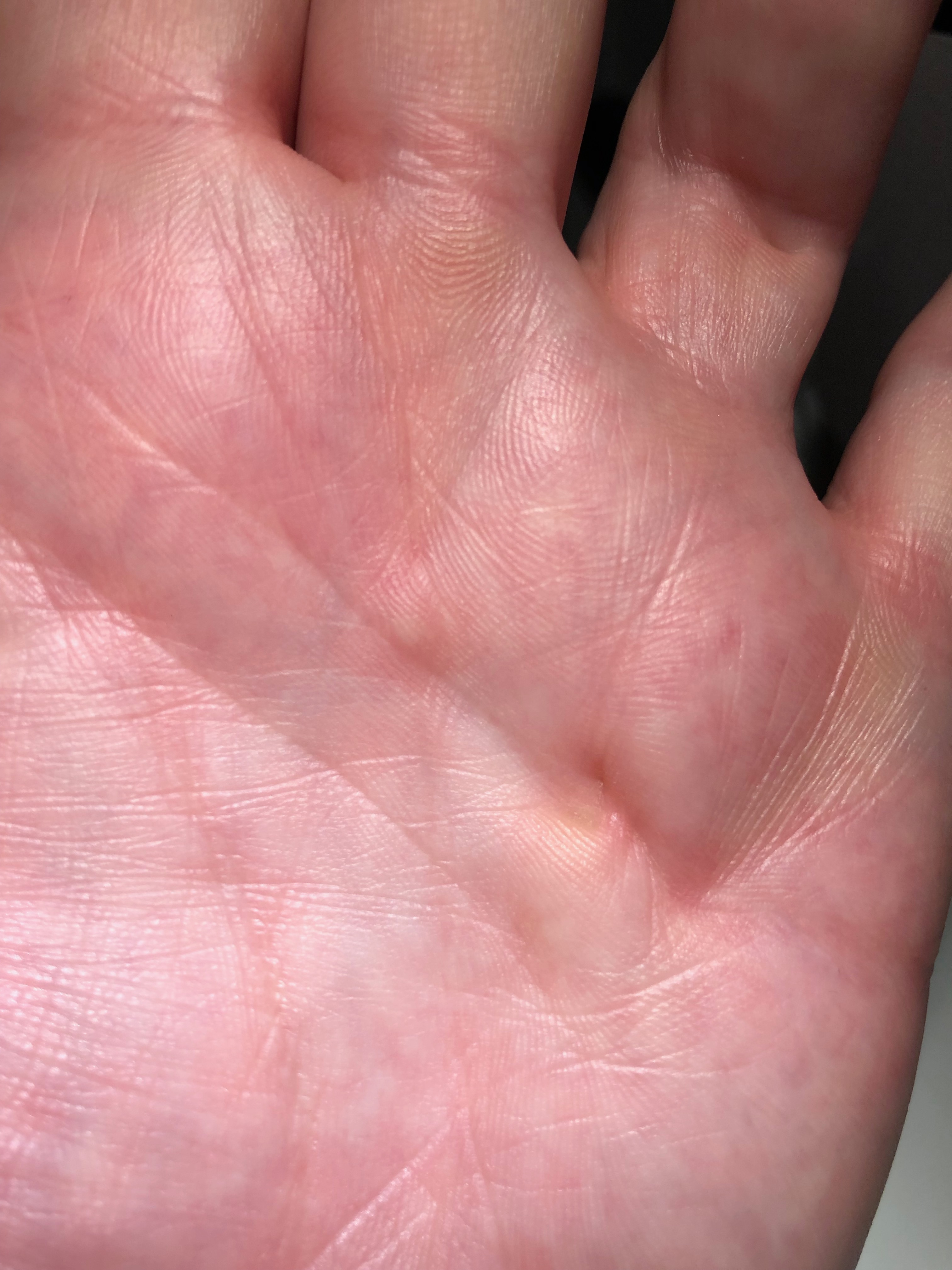
It starts with a nodule…
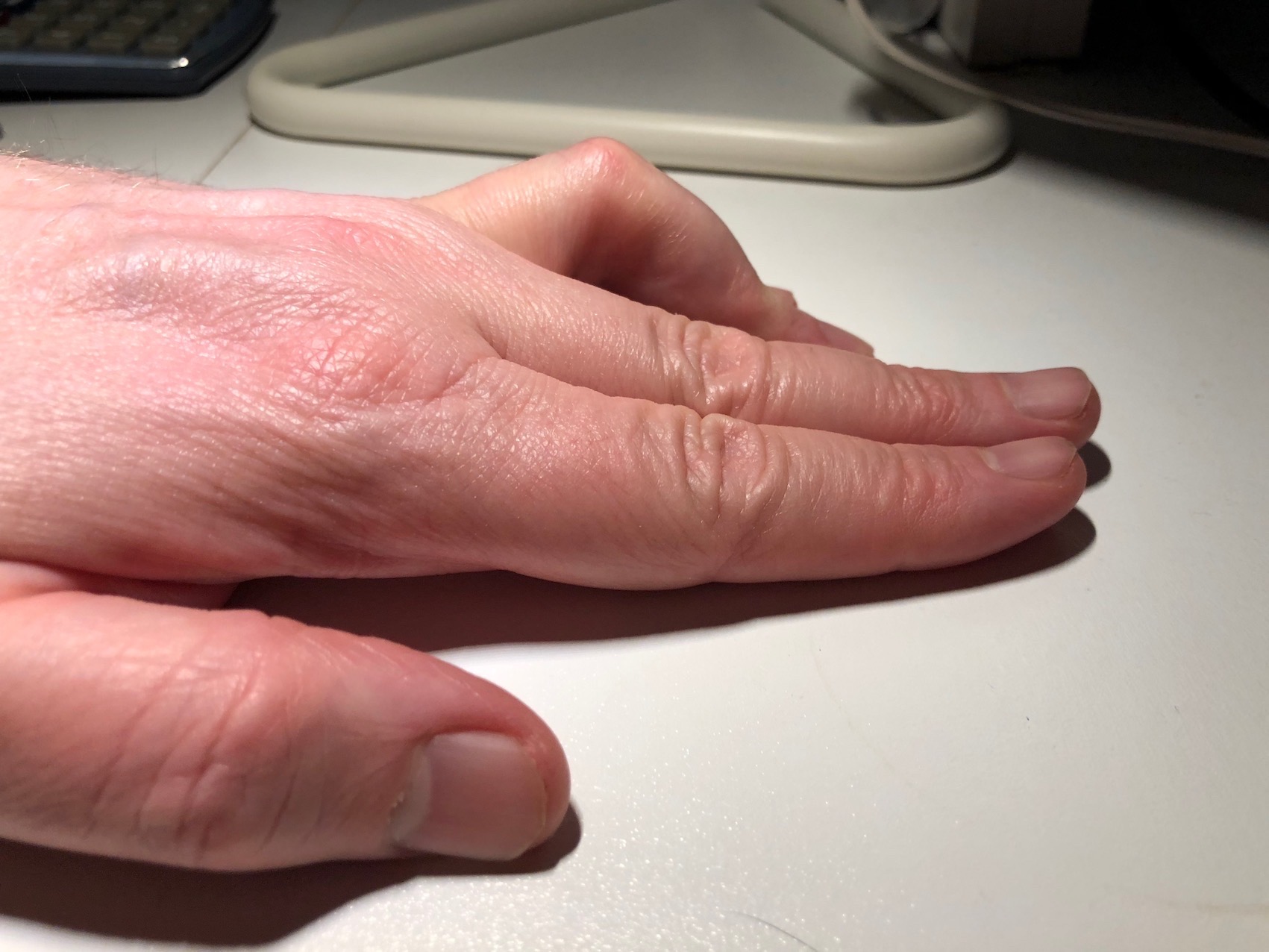
..and then your finger starts to bend. Bashing it with a mallet is not recommended.

Dupuytren’s Contracture is a condition where a finger becomes permanently bent in a flexed position. Nodules appear in the palm of the hand and over time the connective tissue hardens causing the finger to curl towards the palm. If this is news to you, it certainly was to me two or three years ago when I first noticed a nodule in the palm of my left hand. Slowly but surely, the ring finger began to bend and over a period of several months it became quite noticeable. I was packed off to the GP who referred me to the orthopaedic hand specialist at Ayr Hospital, Miss Gibson. I duly pitched up at the appointed hour where Miss Gibson prodded and squeezed the offending digit before getting out a protractor and measuring the angle of flex. It was about fifteen degrees. Thanks to being married to a nurse and also googling the subject, I had already assumed it was a Dupuytren’s Contracture and Miss Gibson, who sees more curly fingers in a day than most will see in a lifetime, confirmed the diagnosis. She then told me to go away and come back once the bend had reached thirty degrees.

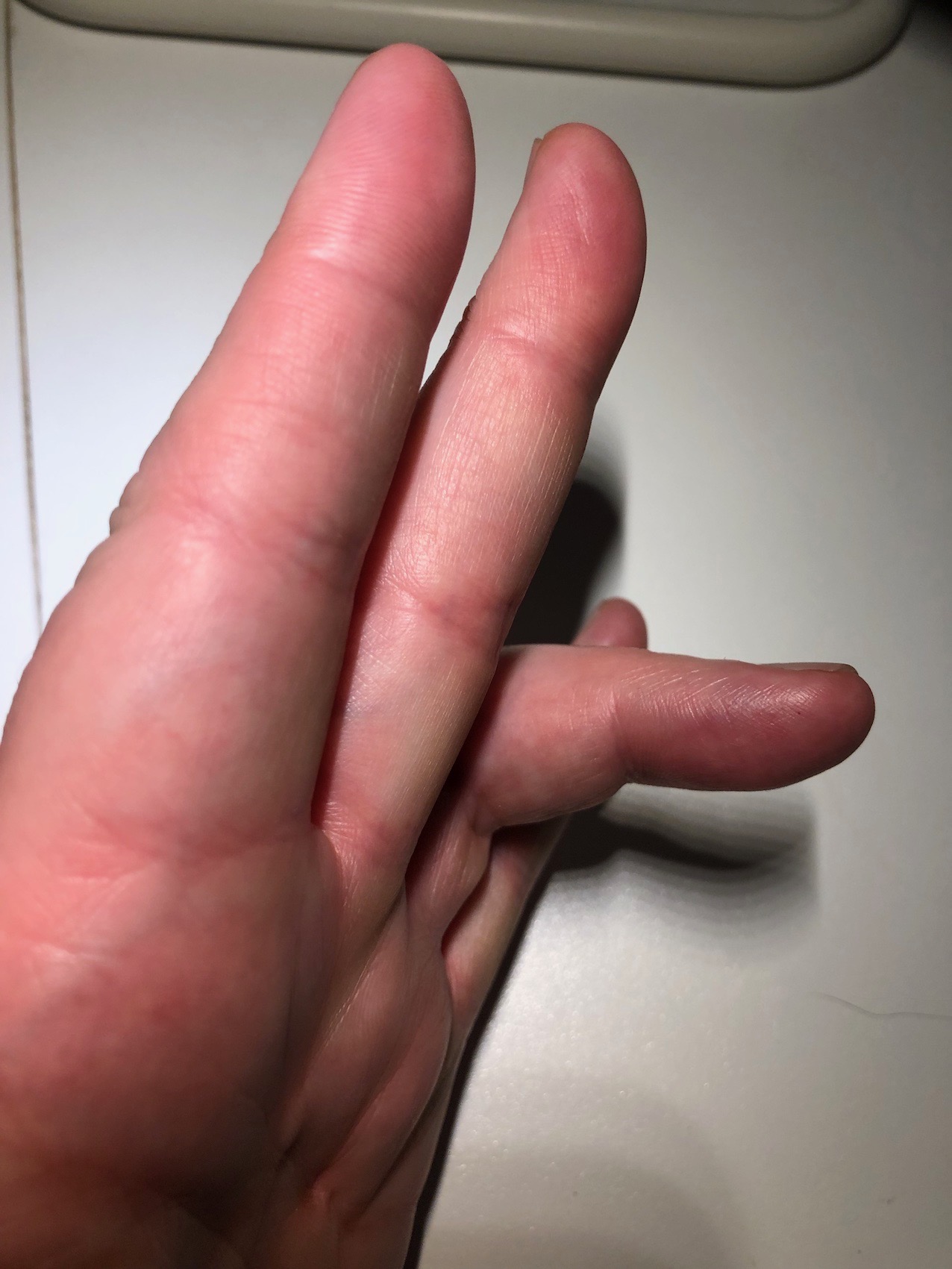
Dupuytren’s is seldom in a hurry and it was the beginning of this year, two years after the initial consultation, that I was back. By then I had estimated that the angle had gone up to forty-five degrees which impressed Miss Gibson as her protractor proved that I was correct. A lifetime of vectoring aircraft around the skies was obviously not wasted. She informed me of the various procedures to correct the bend and said that they were all rubbish apart from surgery. Surgery would take place under a general anaesthetic and the hand on which it was being performed would be out of action for quite some considerable time afterwards. Oh, and it might hurt a bit too. Not wanting to take time off work for some bizarre reason, I was told to come back in the summer. By this time Miss Gibson’s trusty protractor was entering territory it seldom treads with nearly sixty degrees of bend. That sealed it, I was on the list.

Actually, it’s nearer ninety…

Dupuytren’s is not a life-changing condition. There is seldom any pain involved and as you have nine other digits to choose from your ability to do stuff is not really impaired. In my case it happened to the ring finger on my left hand which, as I’ve never worn my wedding ring, is perhaps the least important of the ten digits I have at my disposal. The only thing that was remotely annoying about it was that I sometimes caught it when I put my hands in my pockets. As such I felt a little guilty about taking up precious NHS resources for what is, effectively, a cosmetic procedure. It was only going to get worse though and it could have got to the stage where putting gloves on was impossible so my guilt was assuaged. The reason fingers spontaneously start to curl is not known but there are a number of contributory factors – smoking, alcohol abuse, liver disease, diabetes, epilepsy and so on. As an anti-smoking fascist who drinks in moderation and is a fine specimen of healthy manhood (stop sniggering at the back) none of these apply to me. Previous hand trauma is also a factor – the disease is common amongst cricketers for that reason – but as far as I’m aware my hands have not been subject to any violent actions (I told you to stop sniggering). It also runs in families. Bingo! My mum has got it, as did her brother who got his fixed with one of the rubbish treatments Miss Gibson had mentioned. Rubbish or not, his pinkie is now straight as a die. The condition is also prevalent amongst the Nordic people, so much so that it is also known as Viking Finger, which sounds a bit rude but is a damn sight easier to spell than Dupuytren’s.

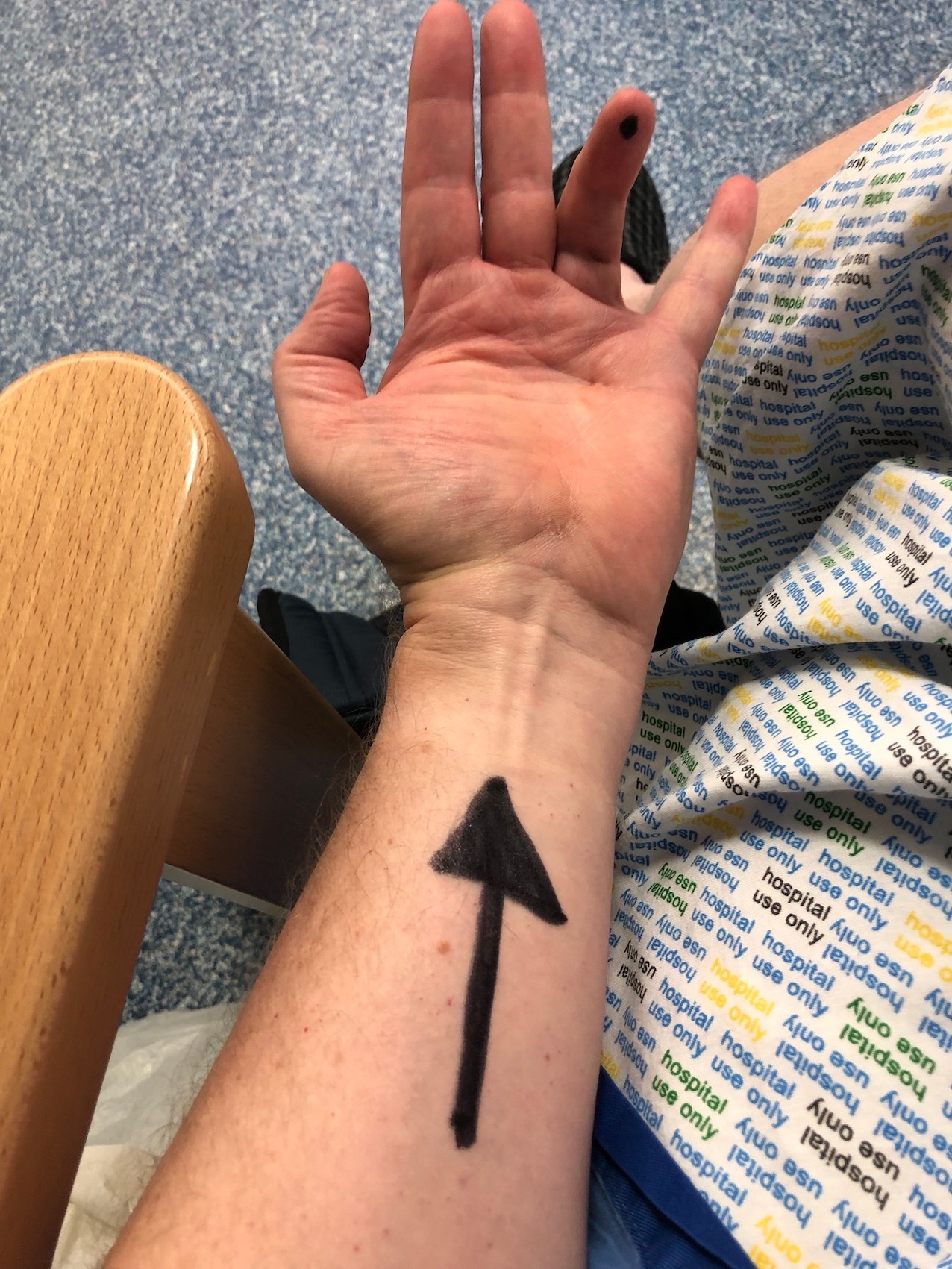
Having retired in September, I would have all the time in the world to get the operation done. Well, not quite. Regular readers of these blogs will realise I’ve been quite a busy boy since throwing off the shackles of servitude and the first date I was offered didn’t suit. The alternate was last Monday, 17 December. That was hardly convenient either for Christmassy reasons but Miss Gibson’s secretary was a bit scary so the 17th it was. The deed was to take place at the Day Surgery Unit, Ayr Hospital, a place Elaine knows well as she used to work there. Alas, she was working at her current place of employment on the 17th so I had to get a taxi to the place. ‘Are you worried?’ asked the taxi driver. It was a question I’d been asked on numerous occasions previously and the answer had always been ‘erm, no, not really’. I was beginning to get worried that I should have been worried. Once clerked in, I was told to get changed into rather fetching hospital garb ‘but keep your pants on’. I was pleased about this as the gown is a bit draughty up the back. Miss Gibson came to see me and drew a large arrow on my left forearm and a black dot on the offending finger. I was glad to see she was taking no chances. She described the incision she was going to make. I thought I detected just a tad too much enthusiasm in her voice but perhaps I was mistaken. I was second on the list and left to ponder my fate whilst the woman in the adjacent booth was wheeled in to theatre.

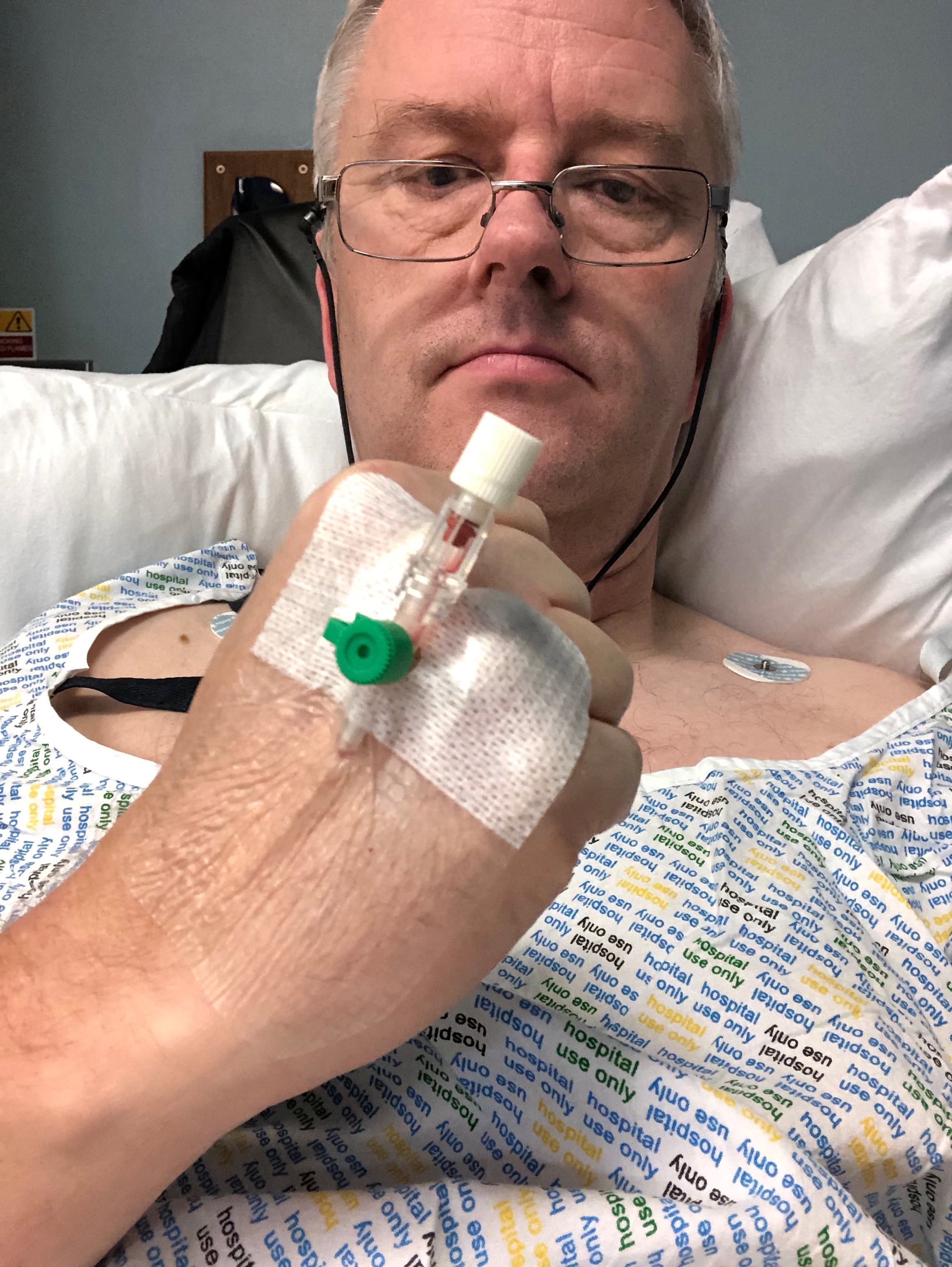
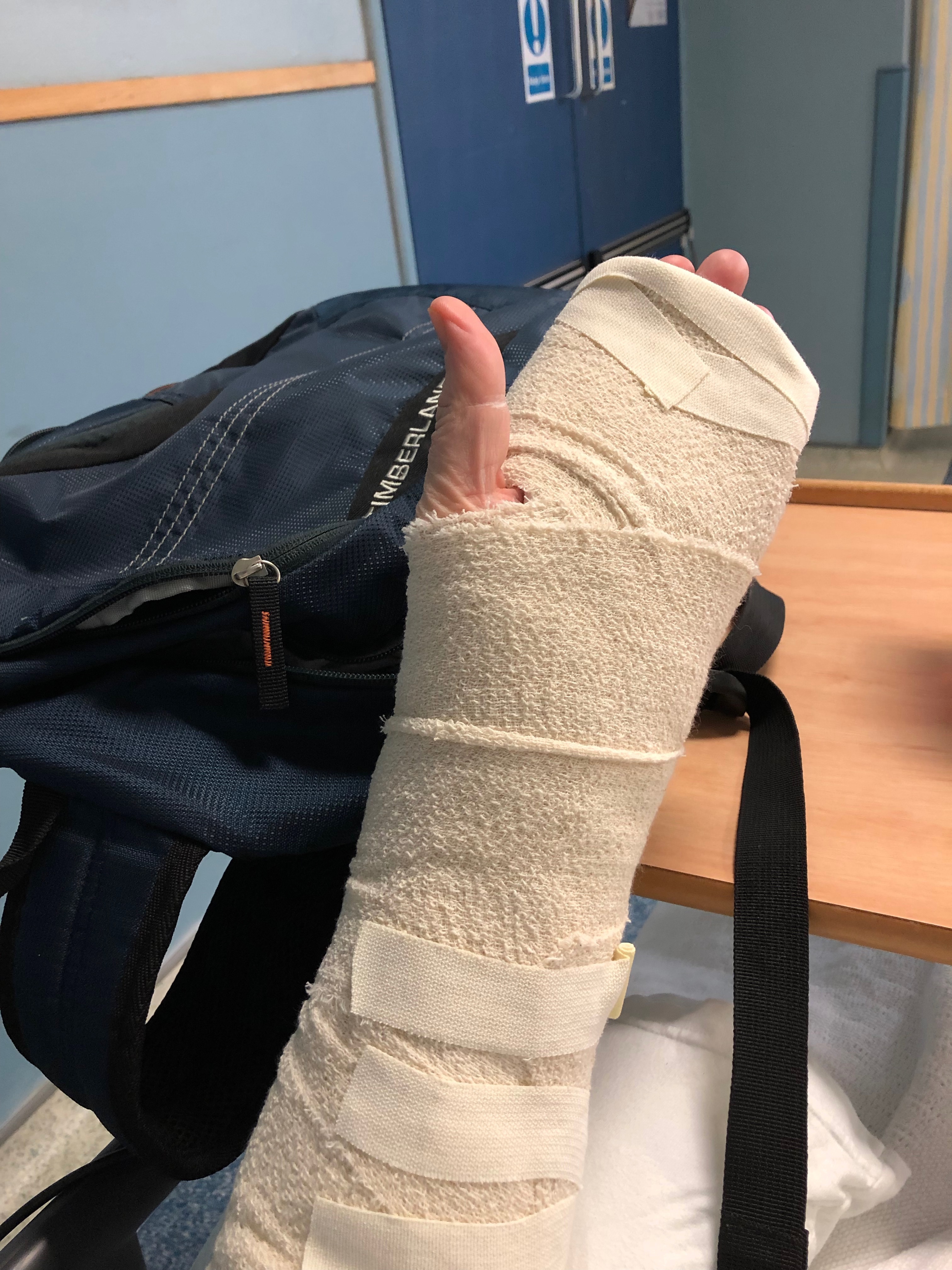
When it came to my turn I was asked to walk to the theatre and park myself on the operating table. I put this down to them realising I was a prime physical specimen, the finger aside, rather than NHS budget restraints but who knows? Next came the insertion of the Venflon. I can’t say I’d been looking forward to this as shoving a tube through a hole in the back of your hand – the right hand in my case of course – is not going to be achieved without a significant amount of pain. Indeed, it stung like buggery but it was over in an instant and I was all ready for the off. A syringe of something or other was pumped through the Venflon which made me feel a bit weird and it was followed with another, bigger syringe of something different which made me feel zzzzzzzzzzzzzz. If you have never had a general anaesthetic, just imagine what it might be like being dead for an hour or so. No sensation, no dreaming, just nothing. I was back on the ward when I came round with my forearm in a cast resting on a pillow to my side. Hardly any drowsiness, I opened my eyes, got my bearings and felt I could have got up, dressed and taken the bus home. I didn’t of course, I thought it better for one of the nurses to come and check that I was OK first and besides which I was getting a lift home an hour and a half later. I was brought buttered toast and icy cold blackcurrant juice which was very nice and asked to change back into my civvies. Not that this was easy with one hand, the left one being totally useless in a cast and under all its wrappings. I could see the tips of the fingers though, all present and accounted for, though there was absolutely no sensation whatsoever in the one that had been operated on. I was informed that once the numbness wore off it would hurt so strong painkillers were dispensed for me to take home. Elaine arrived, gave the staff the large tub of Cadbury’s Heroes that I’d been looking forward to as a Christmas treat, and off we went, just like that.

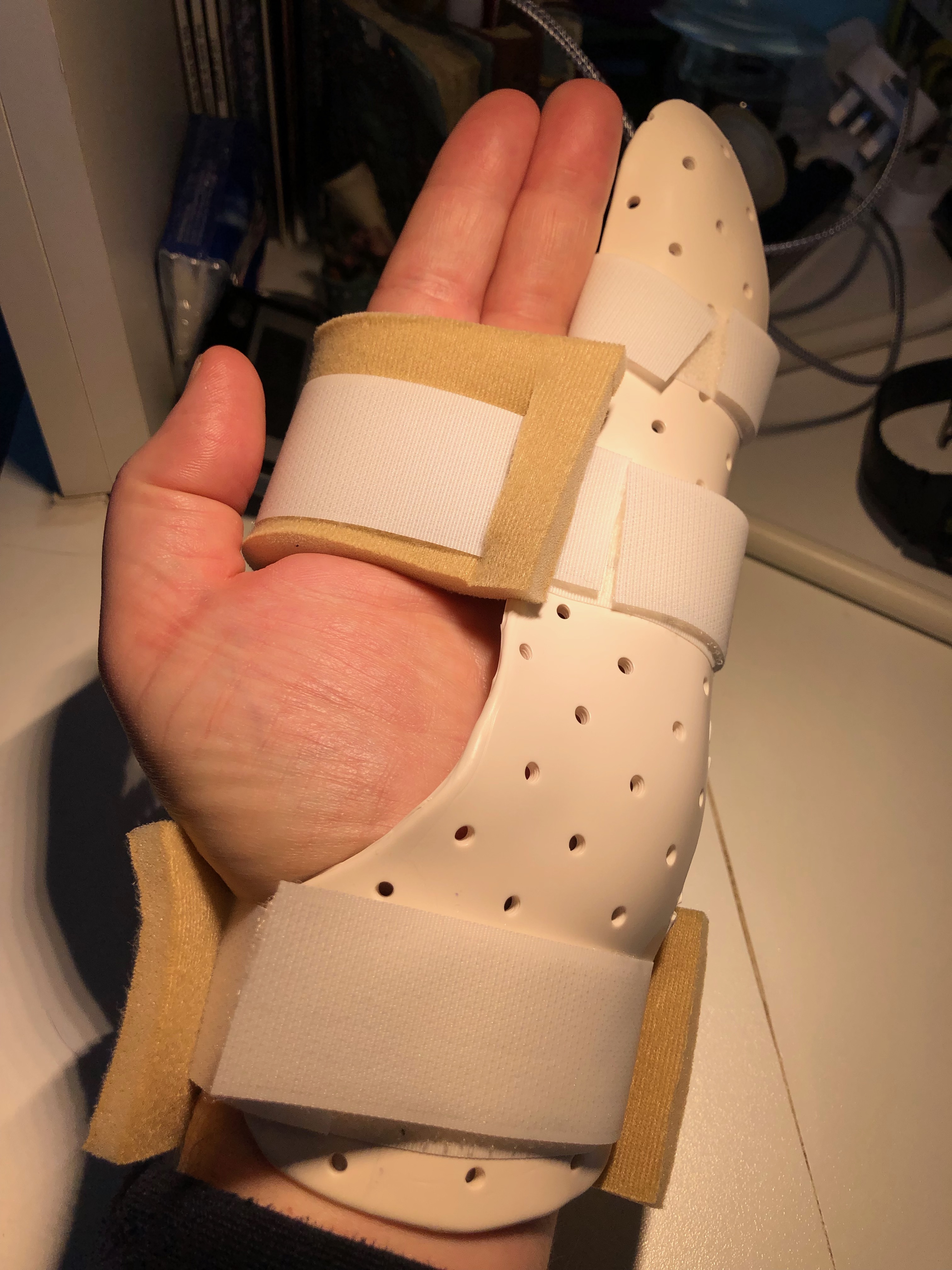
Behold the cast of awkwardness.

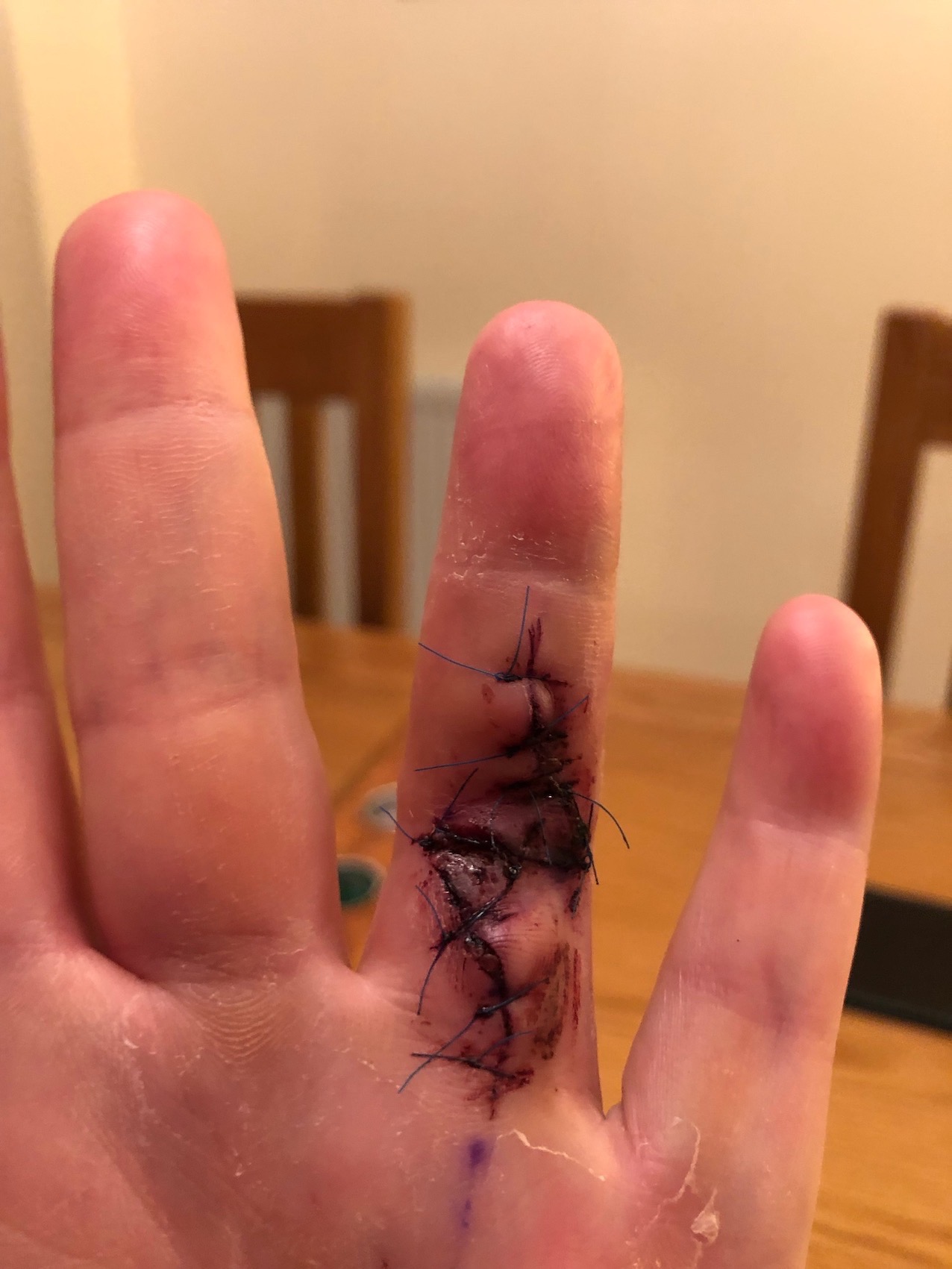
This is not the end of the story, however. The cast only remained on for forty-eight hours which proved to be two days of awkwardness. Certain things one takes for granted become rather tricky when all you have to use is one good hand and at a push the thumb of the other. You’ve got to be prepared to look a bit of an idiot – an old sweatshirt, even older tracksuit bottoms and my summer slip on shoes were the only things I could wear as the operation of buttons and laces was somewhat beyond my abilities. Luckily, I’m no stranger to looking like an idiot so I didn’t feel particularly self conscious as I pitched up at Ayr Hospital again on the 19th, another twenty quid taxi journey complete with suitably inquisitive driver. There, a very nice and rather amusing physiotherapist removed the cast, showed me the wound which was most interesting, applied a fresh dressing and made a splint from some special material that looks like it belongs on the face of the Phantom of the Opera. I’ve got finger exercises to do twice a day but otherwise the splint stays on until the 27th when another twenty quid taxi will deliver me to the hospital for the removal of the stitches. On pain of death I must keep the splint dry otherwise bacteria will reproduce and digest my hand, which means two things: I get out of the Christmas washing up and as the hand will be a stranger to soap and water it is likely to pong a bit by the 27th. Being a tight Yorkshire git I took the bus in to Ayr and the train to Prestwick to meet Elaine rather than a taxi. I’m unable to drive until at least the 27th, possibly longer than that.

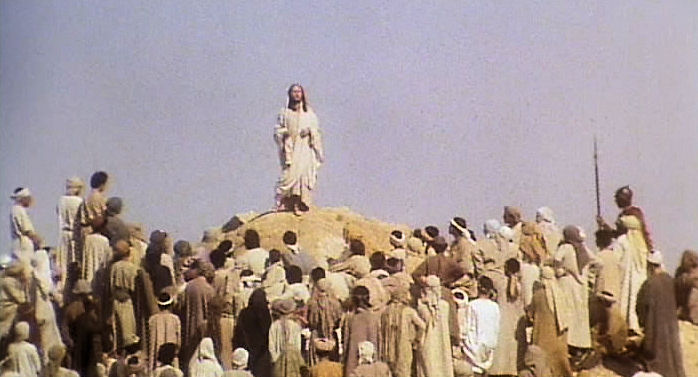
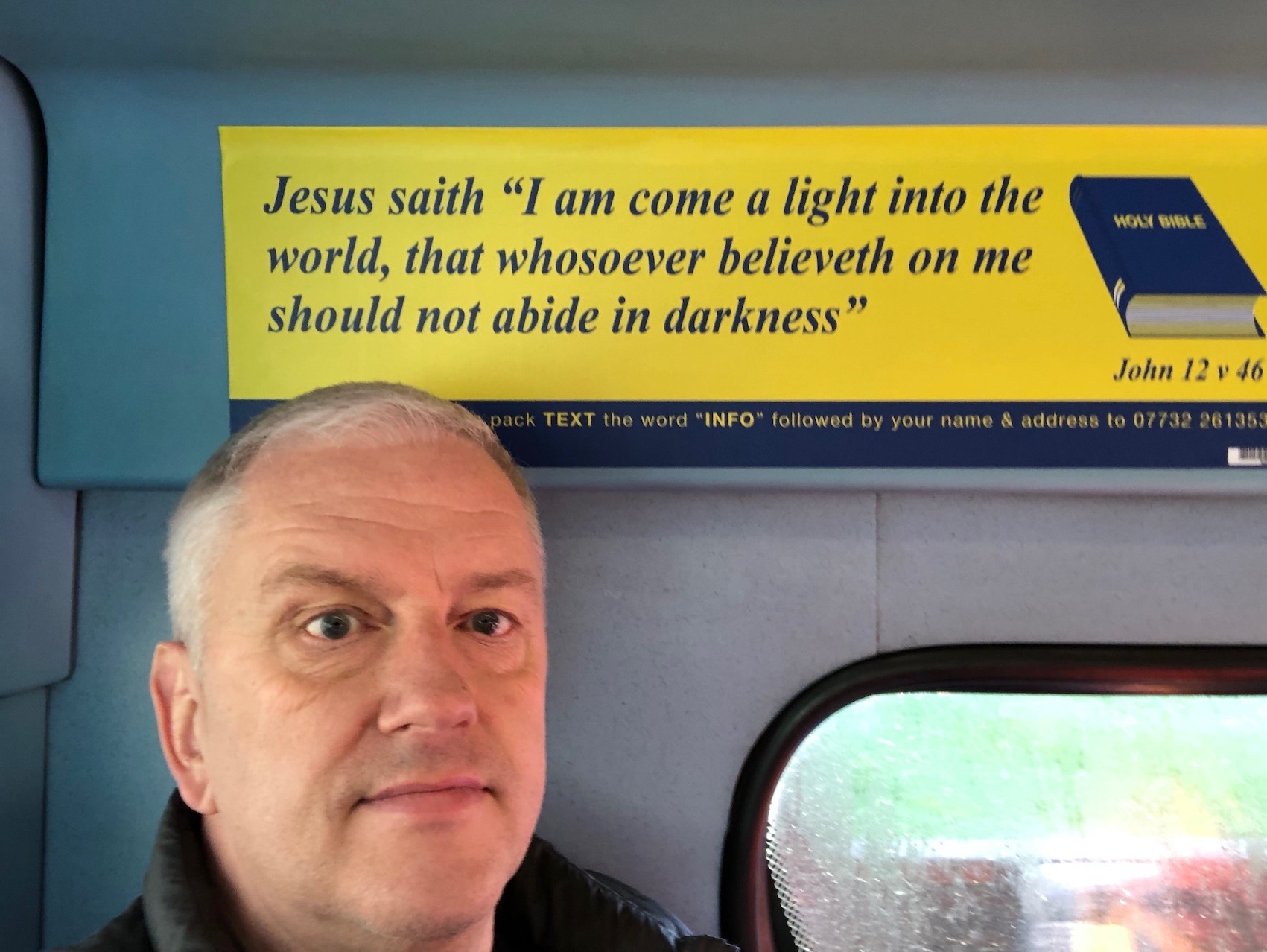
The bus recommended Jesus but I placed my trust in the anaesthetist to prevent me from abiding in darkness.
Nice of the Phantom to lend me his mask.

Having now taken the splint off to do the exercises, which were bloody painful thanks for asking, it does appear that I have a ring finger that is just about straight. There’s still a degree or two of flex but if I keep bending and pressing it as the exercises suggest it may well go totally flat. The splint went straight back on as instructed. Once the stitches are out, and there appears to be quite a few of them, the splint is only worn when in bed. That could go on for several months. It’s a lot of hassle to straighten out one curly finger but hey, at least I’ll be able to get my gloves on. Would I do it again? I might have to. There is a suspicious looking nodule forming on the palm of the same hand next to the original one. I’m guessing in two or three years time the middle finger will no longer have the ability to flip the bird…

Many thanks to Ms Gibson and all the team at Ayr Hospital’s Day Surgery and physiotherapy departments. The care has been first rate throughout.

The mark of Zorro!

Lockerbie

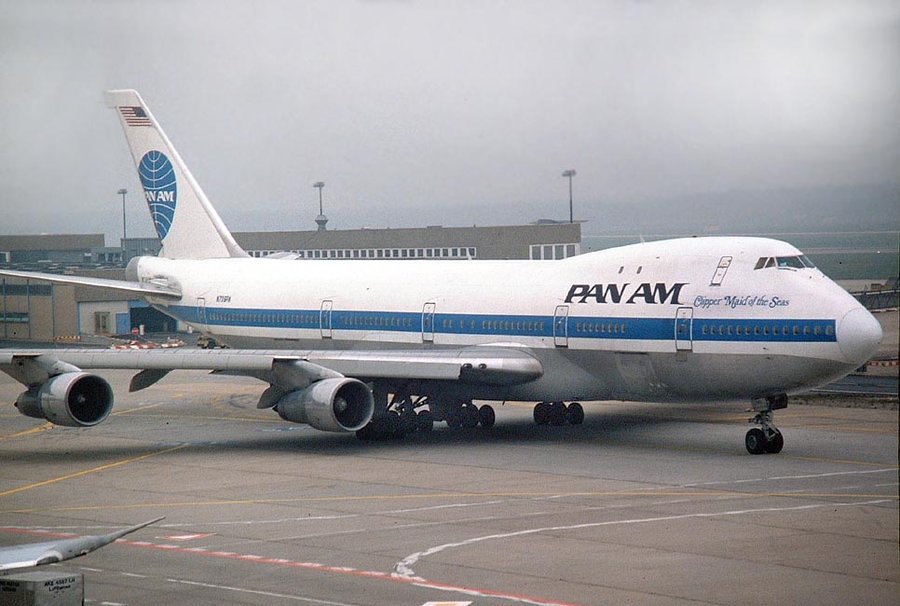
Clipper Maid of the Seas (photo credit itusozluk.com)

During my thirty seven years of gainful employment as an Air Traffic Controller there were thankfully few incidents of note. There is one occurrence, however, that sticks out. Some thirty years ago in 1988 it was approaching Christmas. Elaine was six months pregnant with our first child and we had arranged to visit my parents in Huddersfield over the festive period. With my shifts following a six on and four off pattern I had requested six days’ leave commencing from the start of the cycle that began on December 21. I later decided to save a day’s leave by going in to work on the 21st and taking the rest of the cycle off with us planning to travel down to England on the 22nd. Those days the cycle started with afternoon shifts and so it was that I turned up for work at 13:00 that Wednesday. 

That same afternoon some four hundred miles south 243 people were, by various means, converging on Heathrow Airport’s Terminal Three. Some of those were flying in on a Boeing 727 of the American airline Pan Am from Frankfurt. The flight number was PA103, a service that would continue to New York’s JFK Airport. It would involve a change at Heathrow with passengers and baggage transferring to another aircraft where they would be joined by the others commencing their journeys in London. Americans heading home for Christmas, Europeans looking forward to a festive break in the USA, the passengers were a standard cross section of the flying public at the time. The aircraft appointed to the task of flying them to New York was Boeing 747 registration N739PA, which Pan Am had named Clipper Maid of the Seas. As well as the passengers, sixteen crew members were on board. At 18:04 the 747 pushed back from its gate and twenty one minutes later it took off from runway 27 Right, quickly disappearing from view into the low overcast. 

At about the same time I was part of a two man team controlling  the Talla sector at the Scottish Air Traffic Control Centre, located in Atlantic House, Prestwick. This piece of airspace extended from Edinburgh through the Scottish Borders down to the Lake District in England and extended vertically to 28,000ft. It was at that time primarily concerned with traffic into Glasgow and both in and out of Edinburgh. Sat to my left was my colleague Jim Hood who was the radar controller, responsible for ensuring separation of the aircraft under his control. I was the sector planner, assisting Jim in his tasks, planning ahead utilising flight information written on paper strips, passing and receiving information by phone to adjacent sectors and airfields. It was Jim who spoke to the aircraft though we both listened to their transmissions. At approximately 19:03 the pilot of a British Airways Shuttle Service from London to Edinburgh or Glasgow, I can’t remember which, called up to say he had seen a large ground explosion ahead of him. This was news to us and I immediately rang the watch supervisor, Adrian Ford, to inform him of this report. Adrian came down to the sector to take the details and Jim asked another lower flying aircraft if he could see anything. Vectored to the assumed area of the explosion, the pilot of this aircraft could see nothing due to cloud and continued on his way. Meanwhile we were noticing a lot of extra radar returns in the same area which was unusual but not a cause for concern. 

On the other side of the room sat Alan Topp who was the high level controller. In those days the whole of Scottish upper airspace (above 25,000ft in general, 28,000ft in the area of the incident)  was split into just three geographic sectors. At quiet times, which included the evening, these sectors were combined and as such, Toppo as he was universally known was the sole controller of a huge piece of airspace. Just before 19:00 PA103 (callsign Clipper One Zero Three) was transferred to his frequency by the controller of the Pole Hill sector at the London Air Traffic Control Centre at West Drayton, just north of Heathrow. As was the convention at the time, Toppo positively identified the aircraft on his radar screen and confirmed the reported altitude as Flight Level 310 (31,000ft). He then advised the crew of the aircraft to route direct to 59N 10W. This position was where PA103 was due to exit Scottish airspace and enter the Shanwick Oceanic Control Area. It was also the clearance limit for PA103. To proceed beyond that point and across the Atlantic the crew would need to obtain clearance from Shanwick Control who were situated in a different room within Atlantic House. This they did via their second VHF radio and the planning controller there generated a route for the aircraft to follow, passing it to Tom Fraser, the Clearance Delivery Officer (CDO), who had the task of informing the PA103 crew. As the route is long and complex the crew were supposed to give a full read back but after Fraser had passed on all the details, the only response was silence.

At 19:03, during or immediately after the CDO’s message, a bomb, hidden inside a radio cassette player in a suitcase, exploded in the forward cargo hold of Clipper Maid of the Seas. The bomb punched a hole in the aircraft’s fuselage and caused an explosive decompression that effectively sheared off the nose section. As it fell to earth, the aircraft broke up into several sections. The wings and centre fuselage section fell onto Sherwood Crescent, a residential street in the small town of Lockerbie where, thanks to the thousands of gallons of Jet A1 aviation fuel still contained within the wing tanks it exploded like a bomb, leaving a crater 154ft long that extended on to the southbound carriageway of the A74, the main road linking Glasgow with England. The 259 passengers and crew on board PA103 had no chance of survival. Neither did eleven residents of Sherwood Crescent whose houses were destroyed on impact. With debris raining down on other parts of the town it was something of a miracle that there were no other ground victims. Then again, it was a huge stroke of bad luck that it hit a small town that is quite isolated amongst agricultural land in the first place. 

Fifty miles to the northwest in Atlantic House, which incidentally was situated on Sherwood Rd in Prestwick, Alan Topp was unaware of the apocalyptic scenes in Lockerbie. All he knew was that PA103’s radar return had changed. At that time there were two types of radar, Primary and Secondary. Primary is the raw radar that was developed in World War II. A powerful ultra high frequency electromagnetic pulse is transmitted by the rotating radar antenna and a tiny amount of that is reflected back off anything that gets in the way. That reflection is detected by the same antenna and the direction and time it took for the signal to arrive back can be used to plot a position on a radar display. Things that reflect the radar waves include aircraft, thunder clouds, flocks of birds and nearby hills. As maintaining identification of an aircraft in and amongst all the other stuff became increasingly difficult, secondary surveillance radar (SSR) was developed. Here, a much less powerful signal is transmitted from the rotating radar transmitter. This signal is picked up by a device on board an aircraft called a transponder which then TRANSmits a reSPONse that is detected by the radar antenna. Once again, the direction from which the response comes from and the time it takes is used to plot the aircraft on the radar display. What’s more, the response is a coded four figure number called a squawk which is unique to a specific aircraft in any one air traffic control unit which enables the controller’s display to show the aircraft’s callsign. The coded response also informs the controller of the aircraft’s altitude (Flight Level). The benefits of SSR are obvious – flocks of birds and nearby hills are not equipped with transponders so don’t show up – but it relies on a functioning piece of equipment onboard the aircraft to work. Toppo noticed that first of all the FL310 indication below PA103 disappeared from his display. Six seconds later, PA103 disappeared too. The explosion had rapidly disabled all the communications systems including the transponder. As far as SSR was concerned, PA103 no longer existed. 

Toppo’s display was, however, a composite of primary and secondary. The primary signal went from detecting one large aircraft to three different aircraft, slowly spreading out. In hindsight it seems obvious what was happening but at the time it was anything but. Transponder failures were rare but not unheard of and Toppo tried calling PA103 several times to recycle the squawk code, in effect turning the transponder off and on again. There was, of course, no response from the crew. A KLM aircraft that was also under Toppo’s control was asked to relay a message to PA103. That too resulted in silence. With five primary radar returns now on his screen where PA103 once was it began to dawn on him that something catastrophic may have happened. “Clipper One Zero Three, this is Scottish, how do you read?” Silence. “Clipper One Zero Three, Scottish…” Silence. Toppo selected the phone line to the supervisor’s desk and informed Adrian Ford that there was a possibility that he had lost an aircraft. Ford responded that he was dealing with a report of a ground explosion. It was becoming apparent that these two incidents were one and the same thing. 

Back over on the Talla sector, Jim Hood and I were carrying on work as normal. We had passed on the information to the supervisor, drawn a blank from another aircraft that had gone for a look but still had a job to do with other traffic in our sector. The primary radar returns on our screen were puzzling though. They were increasing in number and spreading out eastwards. It looked to us like a weather system though it was only really severe the rain and hail of large thunder clouds that showed up on our processed displays. I remember phoning Newcastle ATC to see if they could see anything as the cloud was extending in their direction. They could and suggested that it maybe weather related. Eventually we were relieved from the sector for a break and to fill out the paperwork required after the BA pilot’s report of the ground explosion. It was only then, half an hour after Clipper Maid of the Seas’ final flight had come to an appalling end, that we heard that Toppo had lost contact with PA103. On the rest room television I checked the news on teletext. There were reports of a petrol station having exploded in Lockerbie. It wasn’t the petrol station that the BA pilot had seen. It was the fireball after the fuel tanks of PA103 exploded on contact with Sherwood Crescent. As the evening drew on an understandably sombre mood came over the Ops Room. We knew that there would have been many fatalities and we knew that the cause would almost certainly be a bomb. It became clear that the cloud of primary radar contacts was the lighter debris, held aloft by strong winds. It remained there for a couple of hours, maybe longer, some items reaching the North Sear before gravity’s unerring pull finally overcame the turbulent air that had carried it.  It was a haunting sight at the time and remains so in my memory. 

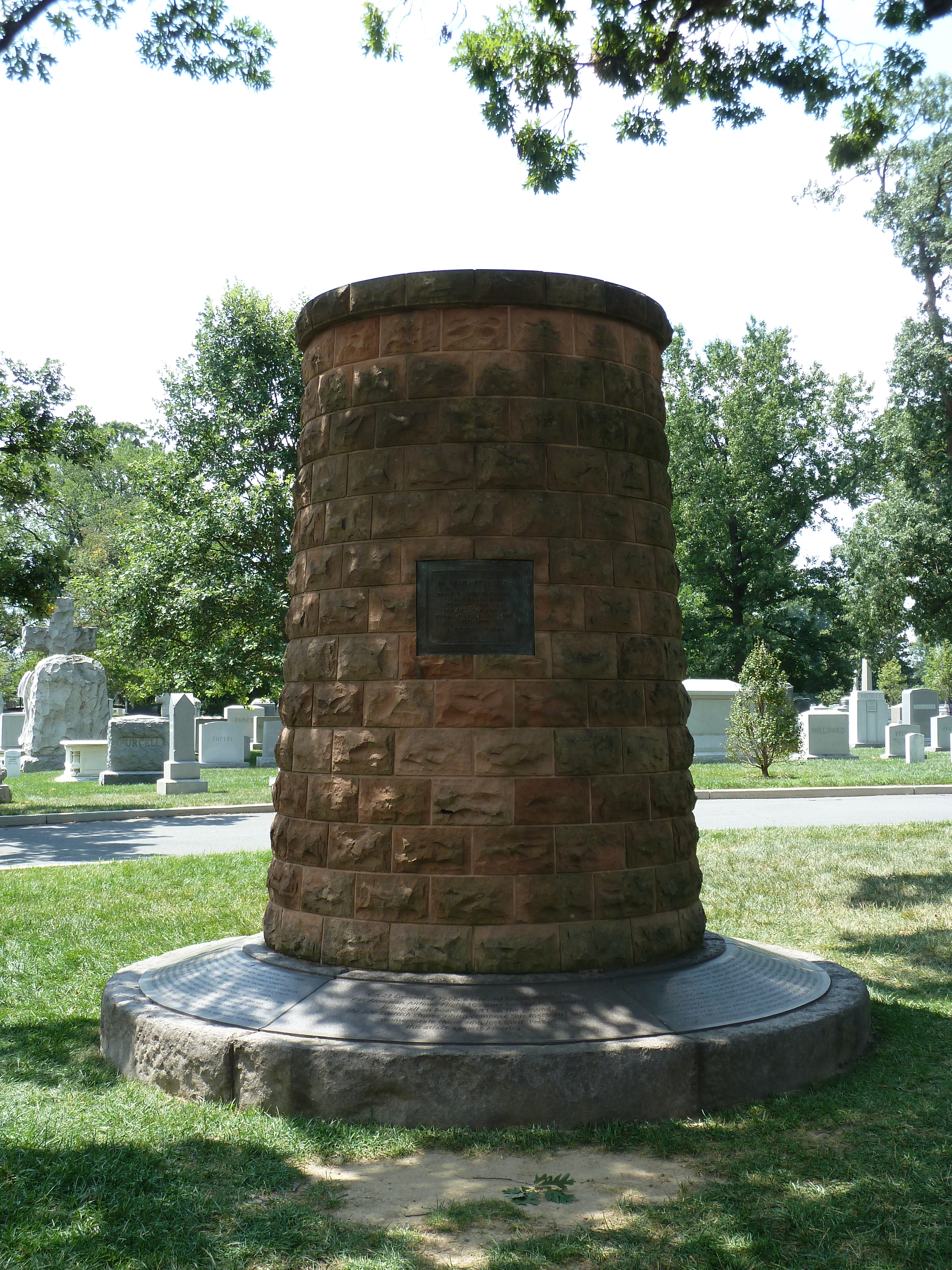
The following day Elaine and I travelled down to Huddersfield. We would normally have travelled via the A74 past Lockerbie but chose an alternative route. After Christmas we returned. This time we did use the A74 and were met with a scene of utter devastation. It was a week or so after the event and the road was open as a contraflow on the northbound carriageway. That was because part of the southbound carriageway no longer existed. What was left of Sherwood Crescent was next to this. It was a like a World War 2 bomb site. I’ve seen pictures of the Blitz; seeing something like that in the flesh leaves a lasting impression. Some of the dead were never found – most of those had lost their lives at that particular location. Since then the A74 has been replaced by the M74. Sherwood Crescent was rebuilt but an earth bank separates it from the new motorway. No house stands at number 13 though. Here, where the mid section, wings and fuel tanks hit, a small area of parkland contains a memorial to those who lives ended there. 

Of the characters mentioned in this tale Tom Fraser was affected the most. His was the last voice heard by the flight crew on board PA103, a fact that continued to haunt him. He died a few years later, having collapsed in a corridor at work. I remember him being wheeled out of the building by paramedics as I returned from the canteen. It is only recently that I found out it was he who was working the CDO position that evening. Jim Hood retired in 1995. He lives not far from me and I see him fairly frequently. Now in his eighties he is as fit as a fiddle and has made the most of his retirement. Alan Topp retired a couple of years later. A slightly eccentric character, he faired less well than Jim dying of heart failure in 2011. Adrian Ford went to work at an ATC college in southern England a few years after the event. I believe he is now happily retired.  I was 27 at the time. As you know I continued in Air Traffic Control until September this year when I too joined the ranks of the retired. The events of 21 December 1988 have of course left a lasting impression on me. I often wonder as to how much the victims knew of their impending deaths, were they conscious as they tumbled through the airspace that Jim and I controlled? I hope not. I would not claim to be traumatised though. Maybe Toppo was. Losing an aircraft under your control, even when you are completely blameless, is an Air Traffic Controller’s worst nightmare. It’s one I’m glad I avoided throughout my 37 year career. There is much more that I could write about this massacre but I’ll leave it here. It was the personal aspect I wanted to get across, even though I was a very small part of the tragedy. I’ve only ever been through Lockerbie on the train, or passed it on the A/M74. I will make an effort to go there next year and stand on Sherwood Crescent. It will change nothing of course, but it is something I feel is right to do. 

Lockerbie Memorial at Arlington Cemetery, Washington DC in 2010.

Hokej

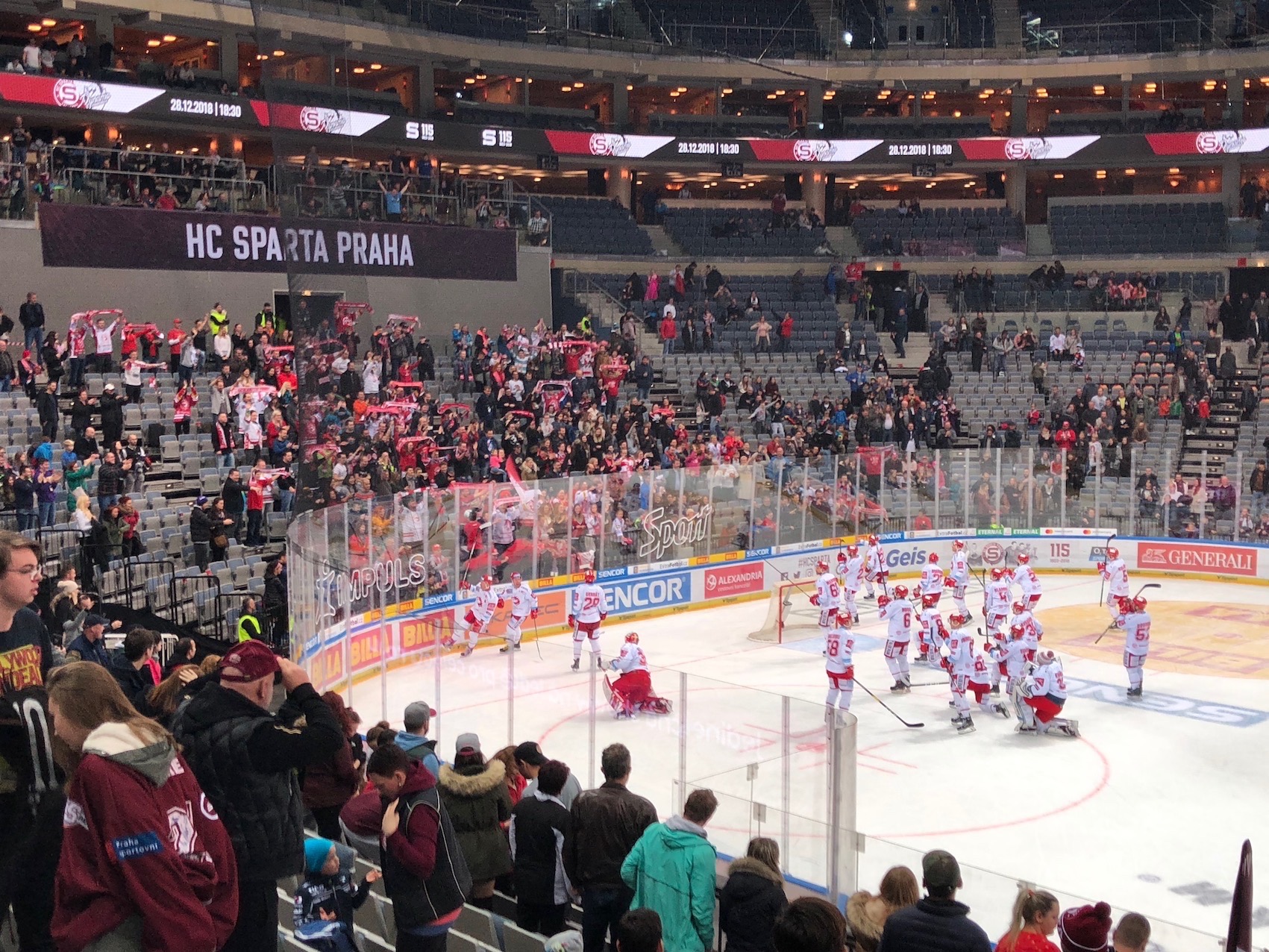
 Czechs enjoying a bit of hokej

As some of you will know I’m a bit of fan of ice hockey. It started back in the dim and distant past that was the mid-90s in, of all places, Paisley. Then a team sprung up in Ayr and I was hooked. The that team folded in 2002 and eight lean years followed before a club was formed to play out of Braehead Arena on the edge of Glasgow. I went along from the start and soon considered myself to be a fan of the Braehead Clan, a club which just last summer changed its name to Glasgow Clan. Whilst most of my hockey viewing (as a fan you quickly drop the word ‘ice’) takes place at Braehead Arena, I do like to take the opportunity to watch games in other countries. Not that it happens much, I’ve been to a handful of games in the USA, I also followed the Ayr Scottish Eagles to Litvinov in the Czech Republic twenty years ago and Rouen in France just before the club folded. I saw Braehead in Sweden a few years ago. Just a couple of years ago I was in Prague and got to a game in the Czech second tier of hockey which was a great experience as Czechia is a major hockey nation. Recently I had the opportunity to see a game in the USA and no less than three more games in Czechia. This meant missing several Clan games so would it be worth it? 

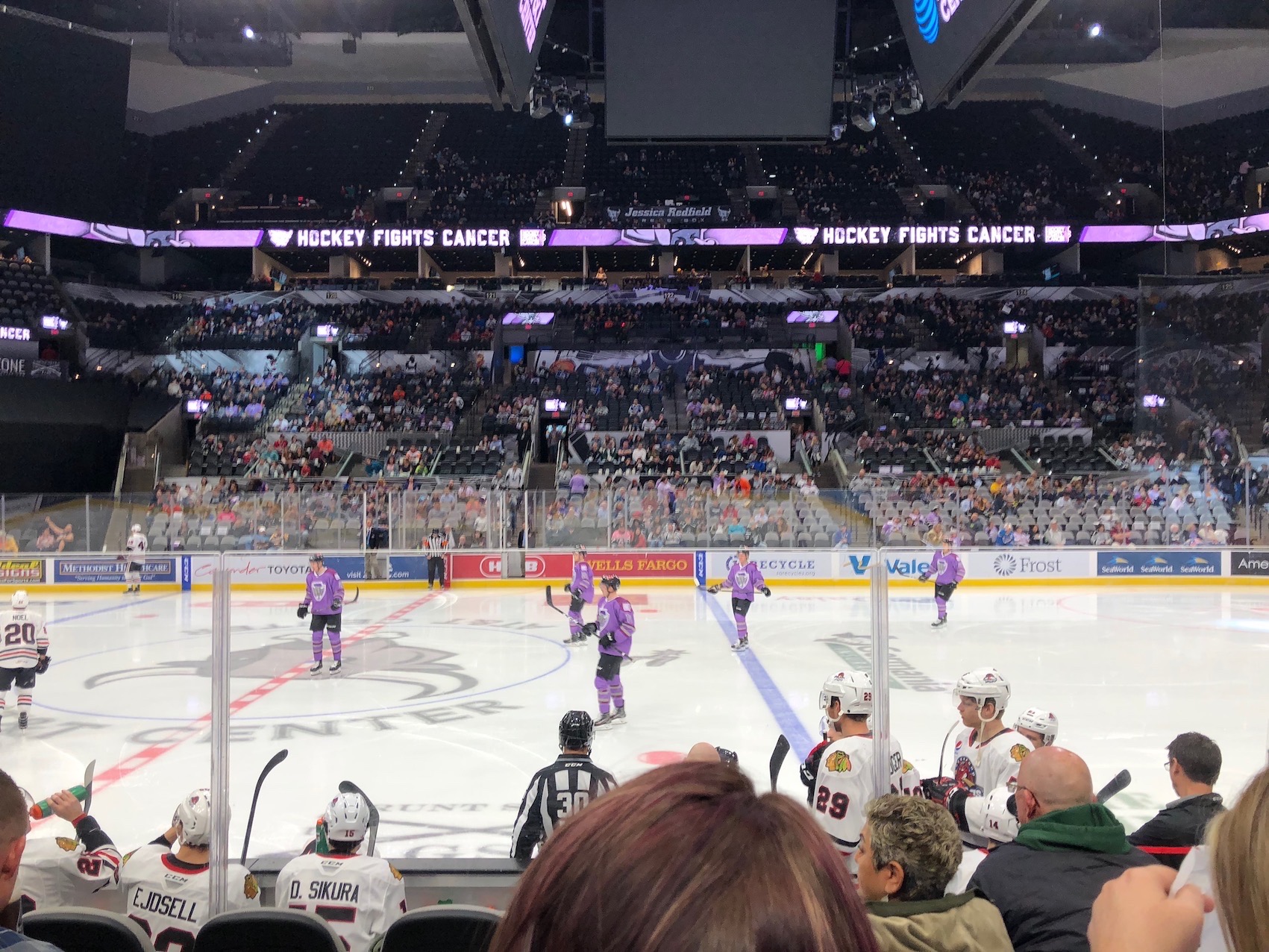
Prior to my recent trip to Texas I discovered that there was a game to watch whilst in San Antonio. The local club, San Antonio Rampage were playing the Rockford Ice Hogs in the American Hockey League. The AHL is a level below the top professional league, the NHL. This meant reasonably inexpensive tickets, one of which was procured for the game. The wrong game as it turned out, being the silly sod I am I had bought myself a ticket for Rampage Vs Ice Hogs on the following Tuesday. Much swapping of emails with Ticketbastard, sorry, Ticketmaster and I got it changed to the Saturday I was there and duly pitched up to the ticket office at the AT&T Center to collect it. After a bit of a discussion I was issued with a ticket for a completely different seat to the one I’d originally booked but hey, I was in the building so what the hell. The arena is huge, much bigger than I was expecting. I had no idea that San Antonio was as big as it is. So big in fact that it hosts a major league basketball club, the Spurs. Basketball is a big deal in the USA, much bigger than hockey. It dominated the sports channels on the TV and the Spurs have several NBA titles to their name. The AT&T Center has a capacity of 18,500 and will sell out for a Spurs game. The cheapest Spurs ticket is $139 plus fees for a seat in the gods. To get one next to the action you will pay $2300. Plus fees. To park your car in the endless parking lots will cost you an extra $20. Just as well, then, that I don’t like basketball. Tickets for the Rampage range from $14 to $57,  parking was $8 and you get to see hockey, not basketball. It’s all a bit of a no brainer. My replacement ticket took me to a seat that wasn’t very good as it was in the front row. Some people like rinkside seats but this one was behind the player’s bench. I moved back a few rows to a vacant seat at the end of the first period. It still wasn’t great but at least I could see the hockey, not the back of the players’ heads.

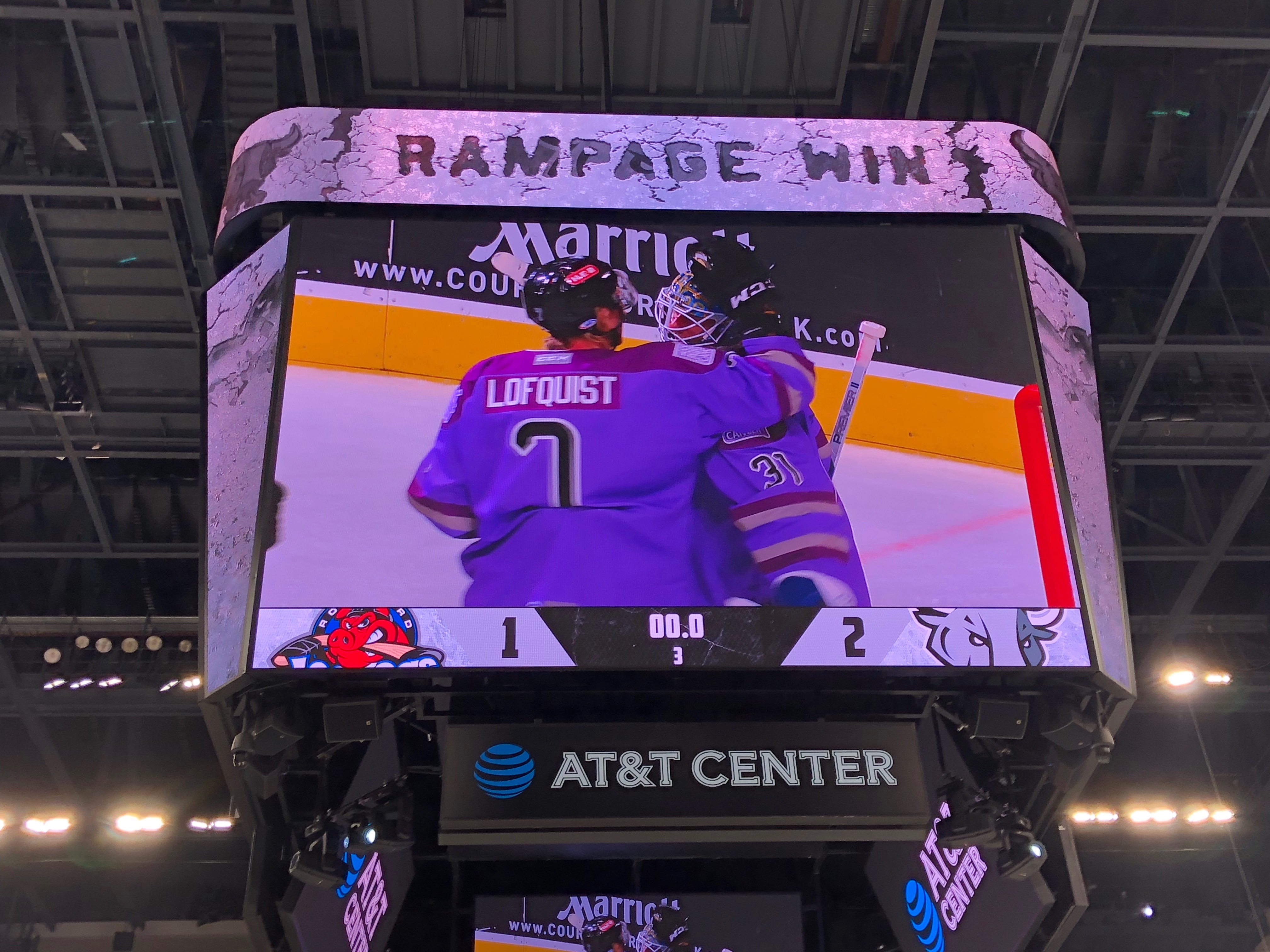
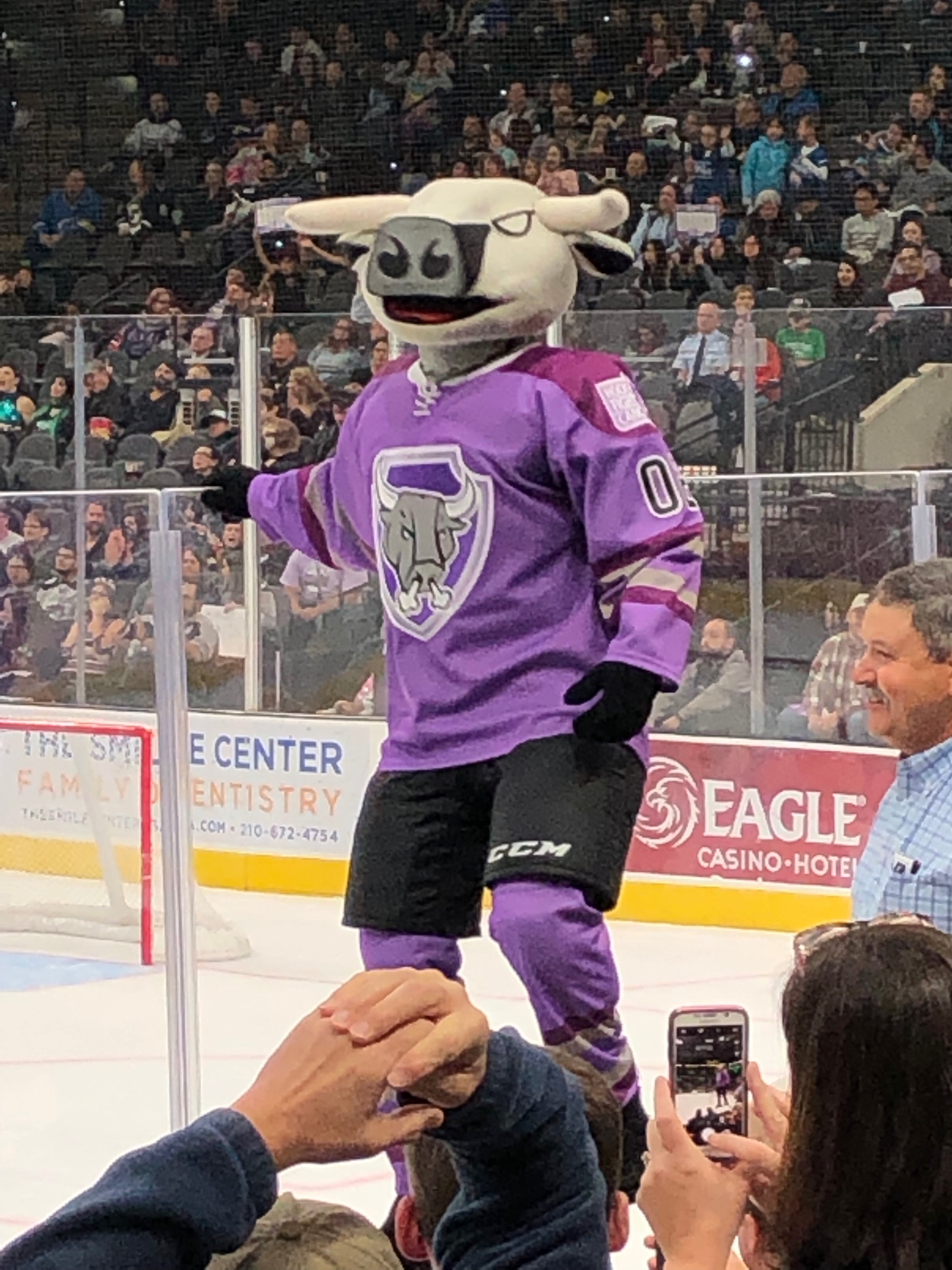
The hockey was of a good quality and the game a close one. The home team won 2-1, deservedly so, and most people went home happy. The crowd was announced as just over 8000 which is a pretty good turnout. I’ve been to NHL games with far fewer spectators. The game presentation was professionally done with the big scoreboard instructing people to make some noise, showing the occasional ‘kiss cam’ and also, as this was a ‘hockey fights cancer’ special, showing appropriate bits of video in support of the cause. Like Braehead/Glasgow, they have a bovine mascot though I must add here that ‘T-Bone’ is not a patch on ‘Clangus’. The atmosphere was a bit sterile though. When Clan score a goal I jump out if my seat, shout something akin to ‘yeahhhhhhh!!!!’ and generally wave my arms around like a deranged gibbon, as do most of the Clan support. When the Rampage scored it seemed to take a few seconds for it to sink in. A loud klaxon blared, a few fans got excited, the rest just smiled. I’ve found this before with sport in the USA. Unless it is at the business end of the season people treat a game as an evening out, not a religion. It takes nothing away from the game but just a little away from the overall experience. I’d enjoyed the game though and was glad I made the effort. I wish the Rampage well, especially as their coach, Drew Bannister was Clan’s player coach in the 2011-12 season. 

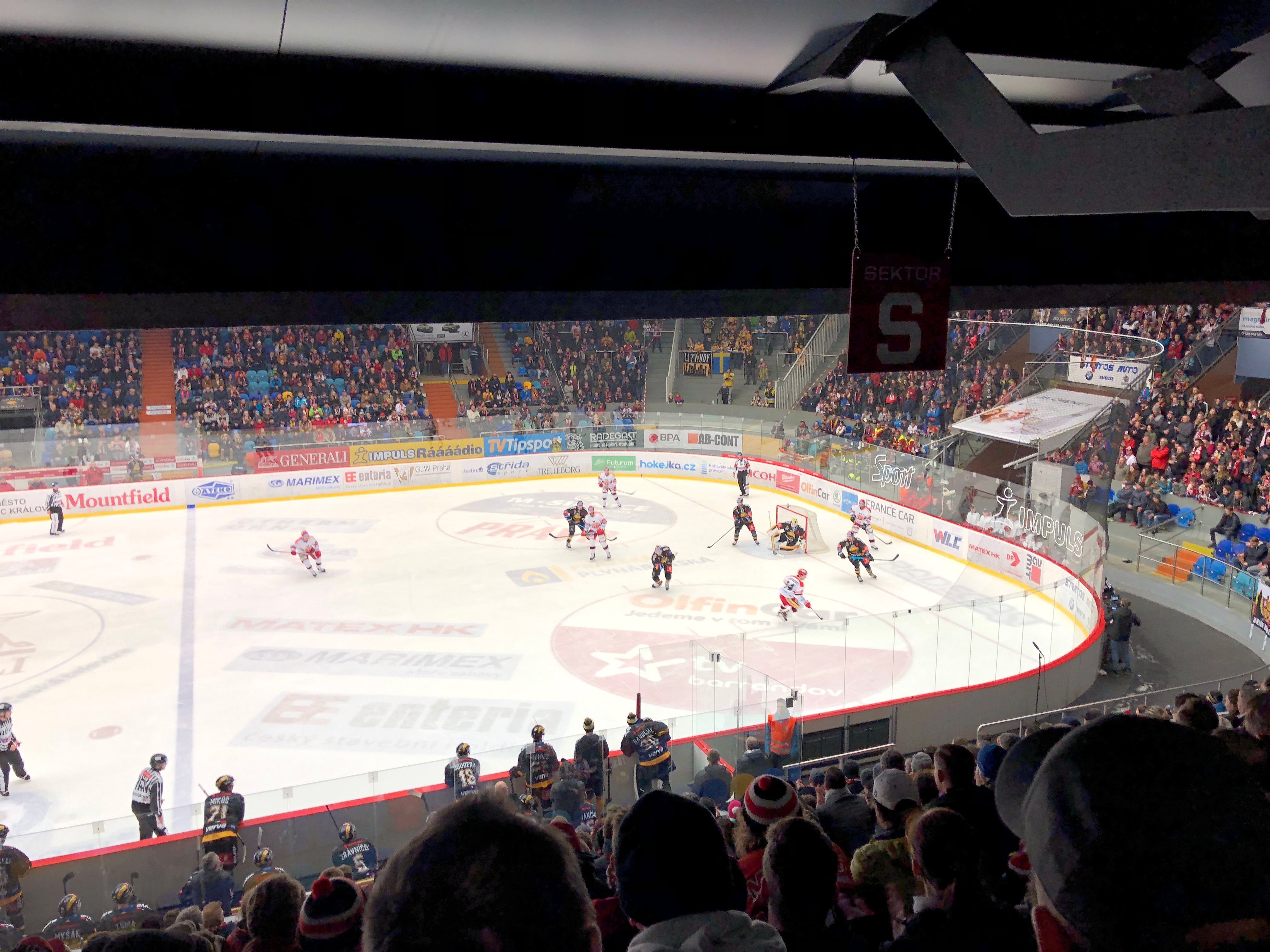
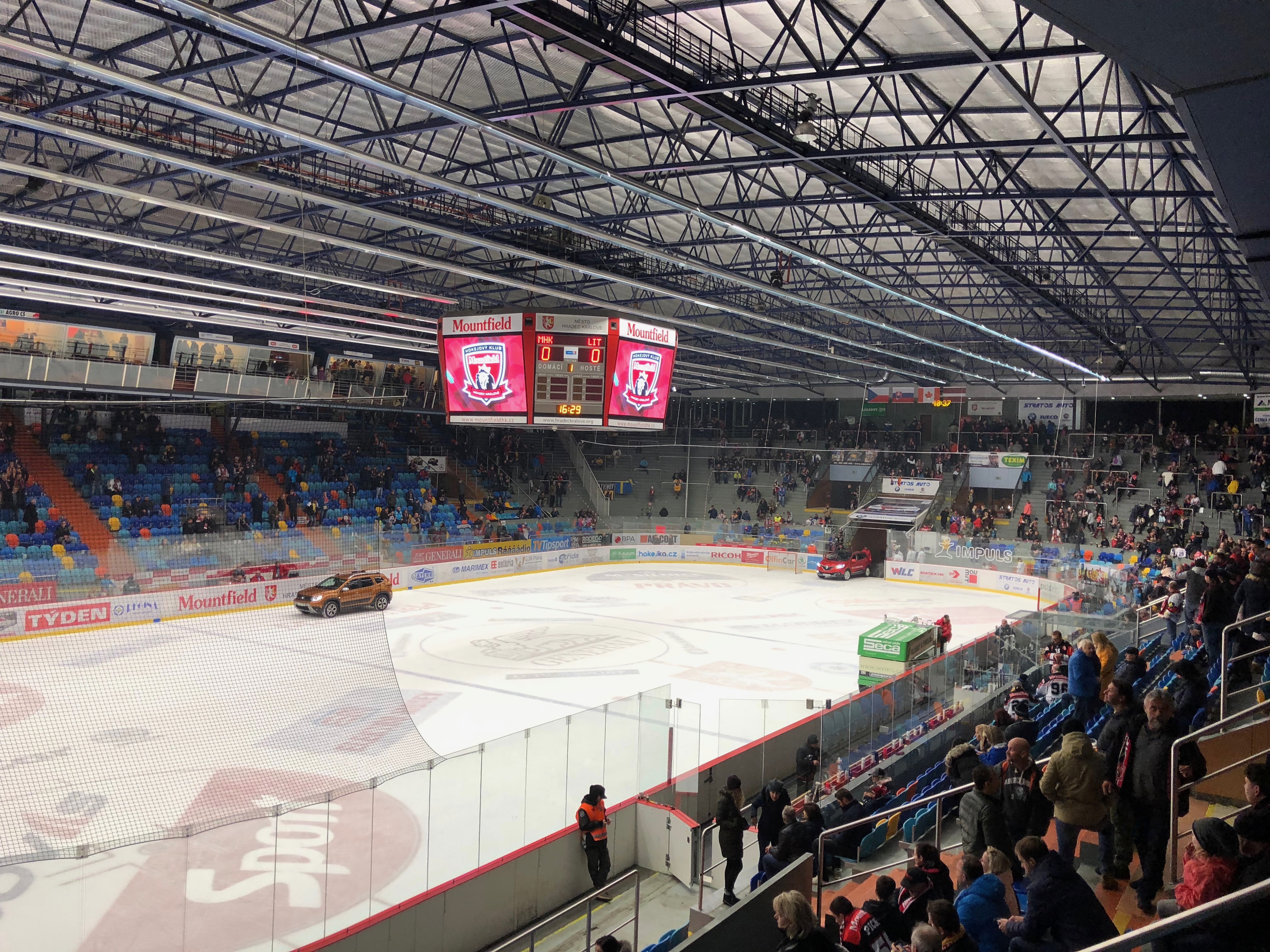
A week or so after the game in San Antonio I found myself in Czechia (this name was formally adopted in 2016 but is only slowly catching on). Accompanying me was a friend of mine, David. He was the chap who introduced me to hockey at Paisley all those years ago. We had decided to go and experience euro-hockey and felt a good place to start was this central European country which takes its hockey very seriously. It helped that it was a relatively cheap destination and easy to get to and so it was that we found ourselves in the town of Pardubice, about an hour east of Prague on the train. Once checked in to our hotel we hot footed it to the neighbouring town of Hradec Kralove to watch their local team, Mountfield HK (not the most Czech of names, it was something to do with a sponsor) take on Litvinov in the Czech Extraliga. This is the top level of hockey in the country and the standard is high. It was a little less physical than the hockey I’d seen in San Antonio or indeed at home but the skill level more than made up for it. The game was another close one with the home side prevailing once more, registering a 3-2 victory. The overall experience was rather different though. The CPP Arena in Hradec Kralove was built in 1957 and has a capacity of 7,700. Over 5,000 were there that evening and whilst most were sat in the seats that surround three sides of the rink, a good number were standing on the terrace at one end. Whilst this may seem a little archaic it was the place where the noisiest fans congregated. They barely stopped chanting throughout the entire game and the place was full of what can only be described as atmosphere. I’ve no idea what they were chanting of course though I thought I heard the words ‘Hradec Kralove’ a few times. ‘Mountfield’ never got an utterance. It seems civic pride outweighs love of the sponsor. Our seats, which cost about six pounds each, had a restricted view so we ended up standing too, though at the back of the seated section rather than the terrace. Mulled wine, beer and a large variety of sausages were available to purchase in the concourse for not many Crowns and it felt to me that this was exactly how professional hockey should happen. The fans celebrated goals and the victory as though the apocalypse had been averted. Real fans. 

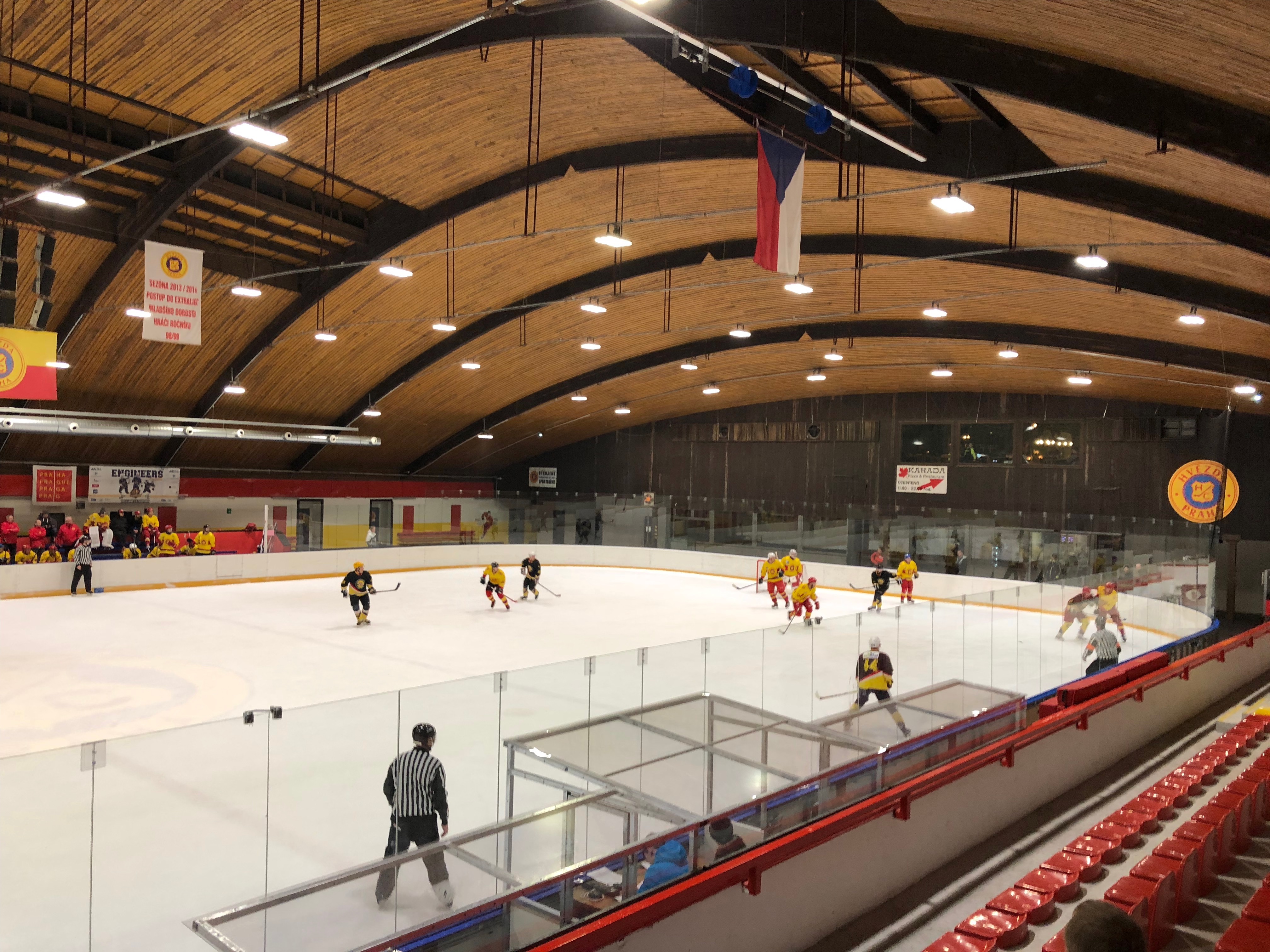
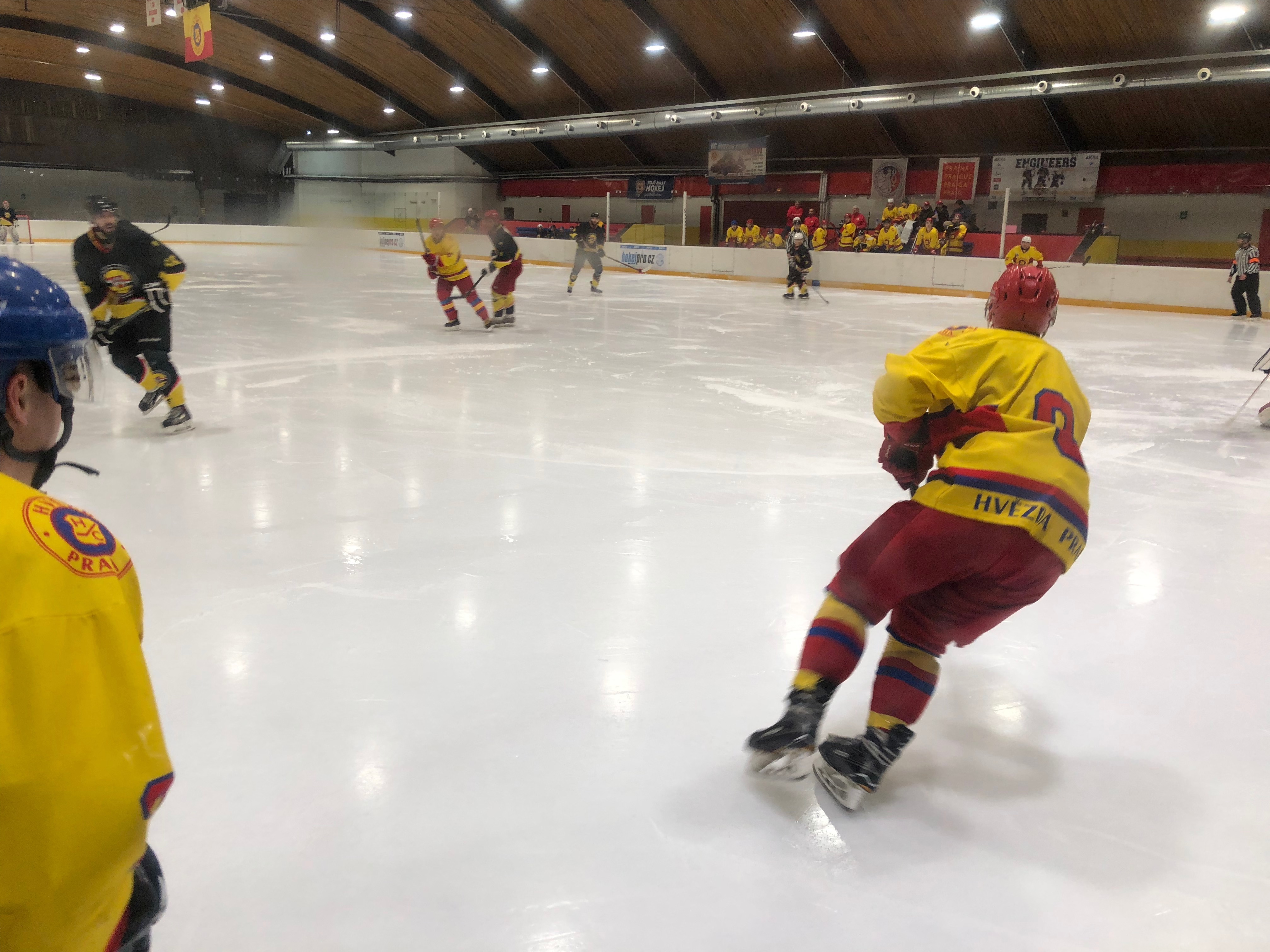
The following day we went back to Prague. Our original plan was to stay in Pardubice where the local team were due to play on the Sunday but unfortunately that game got rearranged to the Tuesday by which time we had gone home. Instead, we decided to go and see Sparta Prague on the Sunday afternoon so billeted ourselves in the Czech capital for two nights. On the Saturday evening we discovered a game in the Prague regional league, in effect the fourth tier of hockey in that country. We found the rink in a residential area of the city and with a little bit of trepidation stepped inside. What we discovered was grass roots hockey taking place. A junior game was just finishing, there was a hockey shop doing some decent trade, a bar and a cafe and a rink that was there for playing rather than spectating. Eventually we discovered that there was no charge to go in and watch. The home side was Hvezda Praha who within a minute of the second period starting were 7-1. They didn’t run away with it though, their other two goals in a 9-3 win coming towards the end. It was quite enjoyable watching this level of hockey. There were only a handful of people there to watch and the players obviously play for the love of the game. It was also perishingly cold as befitting of a sport played on ice.

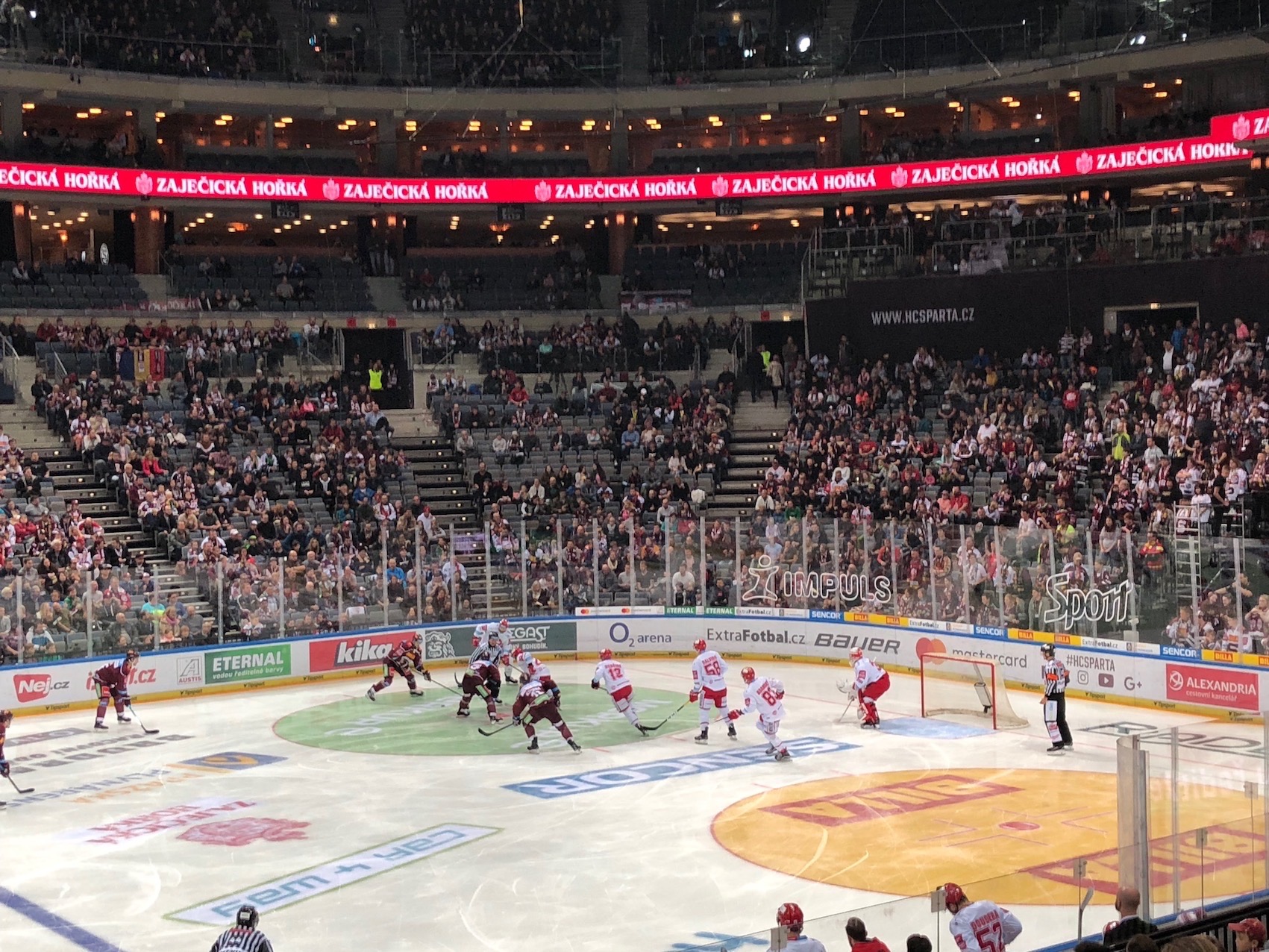
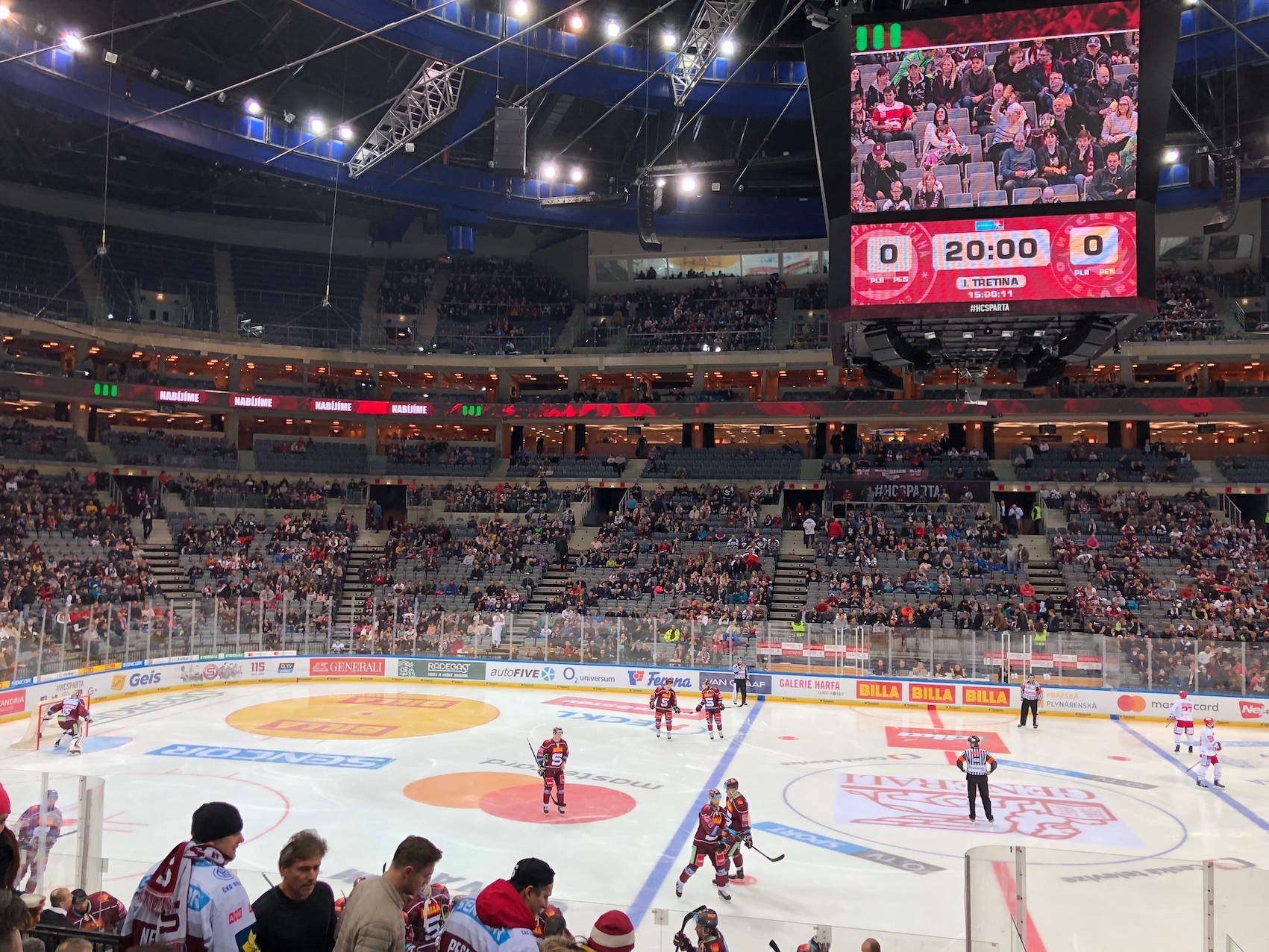
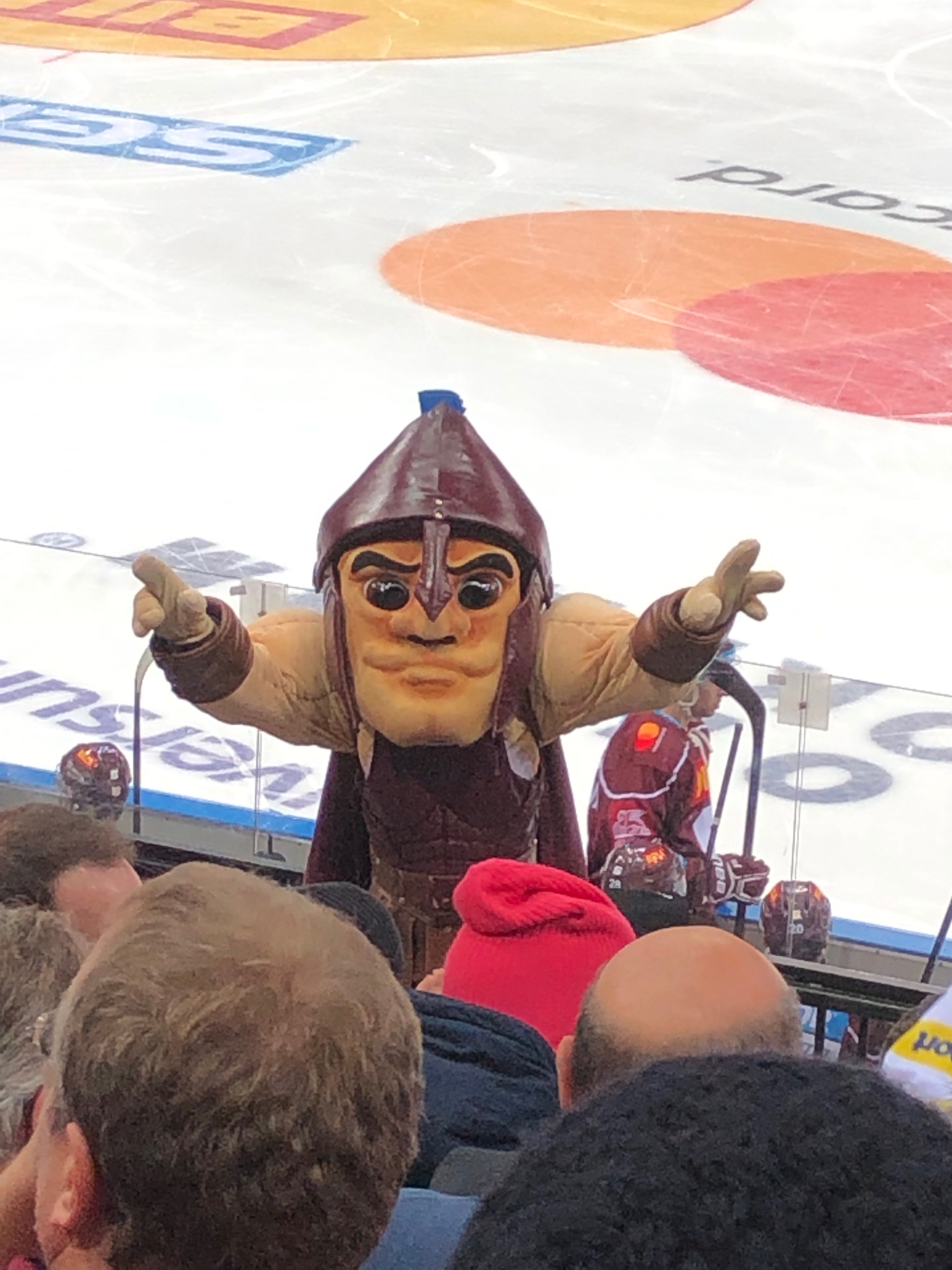
Sunday’s game, an afternoon face off, was quite a contrast. The O2 Arena in Prague holds 17,500 people. Over 10,000 0f those seats, including our two centre ice seats that cost about a tenner each, were full for Sparta Praha Vs Ocelari Trinec. Trinec is a small town on the Polish border a couple of hundred miles east of Prague who play their home games in a 5,000 seat arena. There would have been something of Goliath Vs David in this encounter were it not for the fact that Trinec are punching well above their weight in the Extraliga and were sat on top of the standings with Sparta five places below. The big arena experience was similar to that in San Antonio made much better by the overall atmosphere. The presentation on the big scoreboard was professionally done and kept the fans involved during the breaks in play. There were dancing girls and a mascot who interacted with the fans. The arena concourse had all the appropriate food and other concessions which were being well patronised, much the same as the AT&T Center, if somewhat cheaper. The quality if the hockey was similar too. The big difference was that the crowd were well and truly into it. Whilst there was no terracing in the arena, fans behind the goal stood anyway and as in Hradec Kralove a couple of nights before, sang and chanted throughout the game. Unfortunately for them, in the end they didn’t have a great deal to cheer about. The teams traded goals early on but the score remained 1-1 until a few minutes from the end when the visitors, who had looked the more assured team, scored a powerplay goal. They added an empty netter in the dying seconds to complete a 3-1 victory which, whilst fully deserved, sucked the atmosphere right out of the place. Most home fans streamed out of the arena before the handshake, hurt. This is as it should be of course. 

Four games of hockey, three home wins, two countries, one man’s view: if some higher being informed me that I had to watch hockey for the rest of my days in either the USA or Czechia, I would most certainly plump for the latter. Whilst the quality of the hockey on offer in the games I saw was similar, the USA could offer NHL which would be the ultimate but I’d happily trade that for the enthusiasm of the Czech supporters and the atmosphere they bring to their rinks. Discounting the amateur game, should that higher being then tell me to choose between Mountfield and Sparta as my favoured club I suspect I’d go for the former. Whilst the hockey watching experience was great in both locations, I favoured the older, harder edged arena in Hradec Kralove with the smell of sausage permeating the cold air. I would definitely have to have a better seat than the one I’d got though. Of course any higher being couldn’t really give a toss and I will continue supporting Glasgow Clan. I will, however, take more time out from the familiar surroundings of Braehead Arena to experience how others enjoy their hockey. Sweden or Germany anyone?

Nawlins

Steamboat Natchez without us on it.

“So, we’ve booked a week in Texas” I said, “what shall we do?”

“Let’s go to New Orleans” he said.

“That’s not in Texas” I said.

“I know” he replied.

As mentioned in my previous blog, the destination of Austin, Texas was determined by Avios Reward flight availability. British Airways fly to New Orleans too but that was not available so we had to do it the roundabout way. The day after we arrived in Austin we were back at the airport where Southwest Airlines, the Ryanair of America only much, much better, whisked us off to the Big Easy, just over an hour back the way we had come the previous day. It was Nicholas’s idea. I was more than willing to stay in Texas for the week but he was determined and so it was we found ourselves at the very pleasant Hotel Le Marais in the heart of the French Quarter. We had two and a half days to discover the place. This commenced at a local restaurant called the Acme Oyster House but not before we had popped into a shop that sold over a hundred different hot sauces, all available to try. Some of these were really quite incendiary but they were not enough for Nicholas. He asked the rather bored lady behind the counter which of the sauces was the hottest. She pointed to one called “Satan’s Blood’ and waved a bit of paper in front of his face for him to sign. Apparently it was some sort of waiver to prevent anyone from suing the shop in cases of oesophageal scarring. Carefully inserting the pointy bit of a tortilla chip into the red liquid, he collected the merest smidgeon and popped it in his mouth. Almost immediately he bent double in pain and emitted a string of obscenities that were something of an eye opener to his dad. What a sissy I thought, it can’t be that bad and I signed the waiver. I have to say here that my smidgeon was slightly bigger than his smidgeon which is why I immediately starter breathing dragon like flames from deep within my throat. The pain spread to my eyes which stirred my tear ducts into action, to my mucus membrane which went into overdrive and I’m sure the wax in my ears started to boil. By this time Nicholas had regained enough sense to buy a bottle of water in an attempt to douse the flames. A good idea I thought so I invested a couple of dollars in my own. Relief was immediate but temporary. It took at least half an hour for the 800,000 Scoville Unit heat to finally get to a comfortable level.

By this time we were at the Acme Oyster Bar. This was a hugely popular place which we passed several times later where people were queueing down the street to get in. We were squeezed in straight away by virtue of the fact it was half past three in the afternoon. There a rude waiter who presented us a menu full of New Orleans specialities. These seemed to consist entirely of shrimp and oysters, neither of which do anything for me but there was one dish that took my fancy, red beans and rice. This is probably the equivalent of beans on toast in that neck of the woods and despite looking as though someone had been sick on the plate was quite nice. Nicholas meanwhile had persuaded Mister Grumpy to bring him an oyster to try before his main dish of grilled shrimp. Pouring the aquatic vagina lookalike down his gullet, he pulled a face not too dissimilar to the one he had made after trying the Satan’s Blood sauce, though there was less steam involved. Unlike the hot sauce I was in no way tempted to try one myself. The grilled shrimp cheered him up though and after leaving just a modest tip for Mister Grumpy we left and spent the rest of the day wandering round the French Quarter. 

The French Quarter is New Orleans’ heart. It is a grid of narrow streets with low rise buildings that contain hotels, bars, restaurants, shops, dubious looking clubs and a surprisingly large number of personal dwellings. Most of the buildings are traditional with balconies on the front and everything you may have seen about New Orleans is confirmed. One street in particular was the party hub. Bourbon St is a cacophony of neon and noise and as far as I was concerned, rather ghastly. This was a shame as the rest of the French Quarter was very pleasant. You were never very far from live music, especially when the sun went down when a jazz band would appear on one corner, a blues guitarist on the next. If not on the street you could hear it coming from within the bars and this on a Wednesday evening in November. There was much more of it by the time we left two days later just as the weekend was getting underway. 

The following day we embarked on a tour that took us out of the city, along the banks of the Mississippi to a preserved plantation, of which there are several to choose from. The journey out there was interesting. For a start the bus was late thanks to many of the French Quarter’s streets being dug up. Once clear of the city we followed a highway built on an endless bridge over swampland before arriving at the Oak Alley Plantation. Back in the 1830s a well to do French speaking Cajun couple established a sugar plantation next to the Mississippi. This required funds which they raised by mortgaging their possessions. Most of those possessions were slaves. A rather grand house was built for the family whilst the slaves were housed in shacks near the fields where they worked. The house still remains and we got a tour round it. Very nice it was too with grand columns announcing to the world that this was a family of some importance. It was a short lived dynasty, however, and following the death of the husband, the wife struggled on with not much success and the plantation was passed on through numerous different hands. In the meantime slavery had ended in the USA but with nowhere else to go, most remained where they were as paid labour. Paid in tokens, that is, of no value anywhere but on the plantation itself. Early in the twentieth century the plantation closed and the house was sold to a couple as a retirement home. In the seventies it passed on to a trust who restored the house to its former glory and run it as a tourist attraction. The slave quarters were long since gone but replicas had been built to show the stark contrast in the lives of the owners and the owned. It was a very interesting place to visit. I can’t say there were many laughs though.

On returning to the bus the driver decided to take our money which was $64 less than we thought. I didn’t want to make a scene though so kept quiet. The second part of the tour involved a drive to a place on the outskirts of the city where we were deposited in the care of a swamp tour company. Eventually we were plonked on a boat driven by an old bear of a man with a gammy leg, not that he needed it once he was at the tiller. This was a pleasant trip on which we viewed alligators, turtles, herons, water rats, kestrels and above all else, swamp. There’s tons of it out there. The guide claimed to be a direct descendent of the Cajun settlers who arrived in the area in the mid-eighteenth century after being booted out of the Maritime region of what is now Canada by the British. They weren’t wanted in the other colonies and finally settled in the swamps of Louisiana. They, along with the creole culture of the African slaves give the region its rather unique ‘French but not really French’ feel. Whether or not he was a thoroughbred Cajun, he could certainly spin a good yarn even if his accent and the noise of the outboard motor made it hard to hear at times. 

Back at the hotel the tour company had realised their error and demanded the extra $64. Fearing being taken back to the swamped and dumped there I paid up. Cajun and Creole cuisine dominate the restaurants in New Orleans and once we were back there it was a fairly hard task to find one that wasn’t. We discovered a faux-posh steak restaurant and went there for really rather large pieces of cow.  Say what you like about the Americans, they do a good steak even if they are pretending to be French at the time. Our last day in the city involved us taking a tram just for the hell of it. Well, not really the hell of it, I like trams and New Orleans’ tramway system is something of a gem. The St Charles Ave line has been in continuous use since the 1830s, the odd hurricane disruption aside, the horse drawn cars giving way to electricity in the 1890s. It was this that we, or should I say ‘I’, decided to ride on. Tram Philistine Nicholas just had to grin and bear it. It took us through the warehouse district into a well to do suburb along a wide avenue where the central reservation was shared by the trams and joggers alike. Large houses lined the streets along with the odd university. The trams, or streetcars if you are American, on the St Charles Ave line were built in 1923 and complete with wooden slatted seats where the backrests can be moved depending on the direction of travel. The other lines, which were restored in the early 2000s after a forty year absence, use replica trams. 

With my tram fetish satisfied, we set off to find the Mississippi as one should in New Orleans. It wasn’t far away and we walked along its bank to hear the Steamboat Natchez tooting its horn. A cruise on that might be nice for a couple of hours we though as we walked up to the ticket office only to see the gangplank raised. With that boat sailed we decided that the best way to get a cruise on the mighty Mississippi was to take the Canal St Ferry and at two dollars each way it was somewhat cheaper than the Natchez. Shorter too as the crossing takes five minutes at the most on a rather spartan ferry but at least we can say that we have cruised on the Mississippi. Our last supper in this city saw Nicholas try oysters again. This time though they were grilled and flavoured with garlic and other stuff which went some way to disguising the fact he was eating something akin to snot. I didn’t try one, preferring cajun chicken which was almost exactly unlike the cajun chicken you get over here. With that we headed back to New Orleans’ rather shabby airport – there is a new terminal opening next year – and our flight back to Austin.

It turned out to be a good call by Nicholas for us to go to New Orleans. We fit plenty in our two and a half days there and there is almost certainly a lot more to it than what we saw. It has a deserved reputation as a party town but it also has an interesting history. Whilst it is resolutely Anglophone American (don’t even think about saying ‘Orleans’ the French way), it still plays on its Francophone Cajun and Creole past which manifests itself in street names, food, music (Creole, not Cajun, since when have the French been any good at music?) and trashy culture such as necromancy and voodoo. We didn’t do a cemetery tour but they are a big thing there and you don’t have to go far in the French Quarter to find a voodoo shop full of goat skulls or dolls to stick pins in. Would I go back? Yes, maybe as part of an itinerary that took in a few southern states. It is an interesting place and after all, there’s trams to ride there. 

Texas

texas flag.jpg
Lone Star.

The United States of America is a big place. So big in fact that they chop it up into fifty different bits to make it more manageable. Not that these subdivisions are equal in size you understand. The biggest is Alaska which is positively enormous with a population that consists mainly of bears, seals, indigenous eskimos and a few strange people who seem to like really, really lousy weather. The smallest is Rhode Island which is not an island, about the size of a football pitch yet has a population (human, not bear) some fifty percent bigger than Alaska. I’ve been to both of those states, barely scratching the surface of Alaska on a week’s cruise and doing Rhode Island to death in the space of an afternoon. As is evident America is a land of contrasts and a positively fantastic place to visit. Easy to get to, not overly expensive when you get there and they speak a form of English that is generally understandable. Not that the Americans will be able to understand your (proper) English all the time but communication problems you may have in say, Uzbekistan, are few and far between in the USA. I’ve been a few times but until a couple of weeks ago had only ticked off thirteen states and even then I might have cheated a bit as I don’t think I got out of the car in Maryland. I can now say that I’ve done fifteen of them. This blog is specifically about the fourteenth, Texas.

I planned this trip in the summer. It was to be a post retirement father and son bonding trip. A couple of years ago my son Nicholas and I went to Shanghai for three days which seemed like a long way to go for a short break but it went well so we felt it was good idea to do something again. The destination was chosen purely on the grounds of Avios reward flight availability and a limited window of opportunity in November for us to be able to go. British Airways flies to Dallas and Houston in Texas but they also fly to the state’s capital city, Austin. Seats were secured on this service which gave us a full week to fill. Texas is a big place. Not as big as Alaska of course but it is the largest state of the contiguous USA. It is probably unfair to base any opinion on the place following just a week within its borders, especially when we went to Louisiana for the best part of three days, but it would be a rather dull article if I didn’t. The flight to Austin went perfectly well. There is an advantage in flying in to Austin. It seemingly doesn’t handle any other intercontinental flights. Consequently, when you land you do not arrive at the same time as ten other wide body aircraft all discharging hundreds of passengers to the mercy of the USA’s Department of Homeland Security. Getting in to the USA is one thing that puts people off going. The queueing can take hours and the officials seldom have a sense of humour. At Austin, however, the chances are you won’t even see an official. They have biometric passport gates which sometimes even work the first time you try. You still need to do a customs check once you’ve got your bags but that was straight forward and with that you are disgorged in to the Texas twilight. A taxi whisked us to our hotel for the night. Did I say hotel? It was actually a motel, one of those that you will have seen in any number of movies, where you park outside the door, the room is a bit on the dingy side and the owner is waiting to stab you to death whenever you take a shower. Thankfully, the owner must have been on holiday and the accommodation turned out to be fine, even if we didn’t own the obligatory pickup truck parked outside the window.

IMG_2761.jpeg
Bates Motel, Austin

We walked in to the city centre in search of food. Our first impressions of the city itself were not that great. For a start, with few exceptions pedestrians are not really a thing in the USA and walking anywhere makes you feel quite conspicuous. There also seems to be a huge homelessness problem in Austin. Rightly or wrongly, this adds to the unease about walking around the place even though your own problems are as nothing compared to those watching you pass. Eventually we found what passed for civilisation in the city, a couple of blocks with bars and restaurants. There wasn’t much happening on this Tuesday evening except one place which we gravitated to and decided it seemed a good place to eat. It was too. It was Tex/Mex, quite appropriate really. Well, the Tex bit at any rate. We took an Uber back to the hotel. It seemed worth the few dollars it cost and it is Nicholas who has the account anyway so he paid. That was our Austin experience all done and dusted. I can’t say I’d hurry back, though a Tuesday evening in November was not exactly giving it a fair trial. The following morning we returned to the airport and flew to New Orleans for two nights, returning to Austin late on the Friday, picking up a hire car and following a comical journey where Google Maps took us to the wrong place twice, before crashing (not literally) into an airport hotel for the night. In contrast to the motel, we got huge suites each. It was a shame we were only there the night.

IMG_2915.jpeg
Sam Antonio River Walk, or indeed river cruise


The following morning, pausing only for the obligatory enormous breakfast, we headed the eighty miles or so to San Antonio, the oldest municipality in the state of Texas. It was surprisingly big, the seventh most populous city in the USA and second in Texas only to Houston of which more later. In and amongst all that urban sprawl, however, was an actual city centre. It was quite compact but a distinct focal point for the city. The reason for this was that The Alamo was, and bits of it still are, located here. The Alamo holds an important place in American history. This despite the fact that when the battle took place Texas was not part of the USA and wouldn’t be for another ten years. Not only that, the Texians lost but the massacre of the defenders proved to be the turning point in the revolution and Texas would soon win its independence from Mexico, becoming the 27th US state those ten years later. The battle now firmly established in American folkloreand San Antonio welcomes many thousands of visitors a year. As The Alamo in itself isn’t enough to keep those visitors happy, other touristy things have popped up round about it including the riverwalk and some shops which give the town some sort of beating heart sadly lacking in other American metropolises. The first thing we did there was go our separate ways, Nicholas to the cinema and I to an ice hockey game. San Antonio Rampage were at home to Rockford Ice Hogs in the American Hockey League, the second level of hockey in North America. I’ll bore you with my thoughts on that in another blog.

IMG_2941.jpeg
The Alamo. What’s left of it.

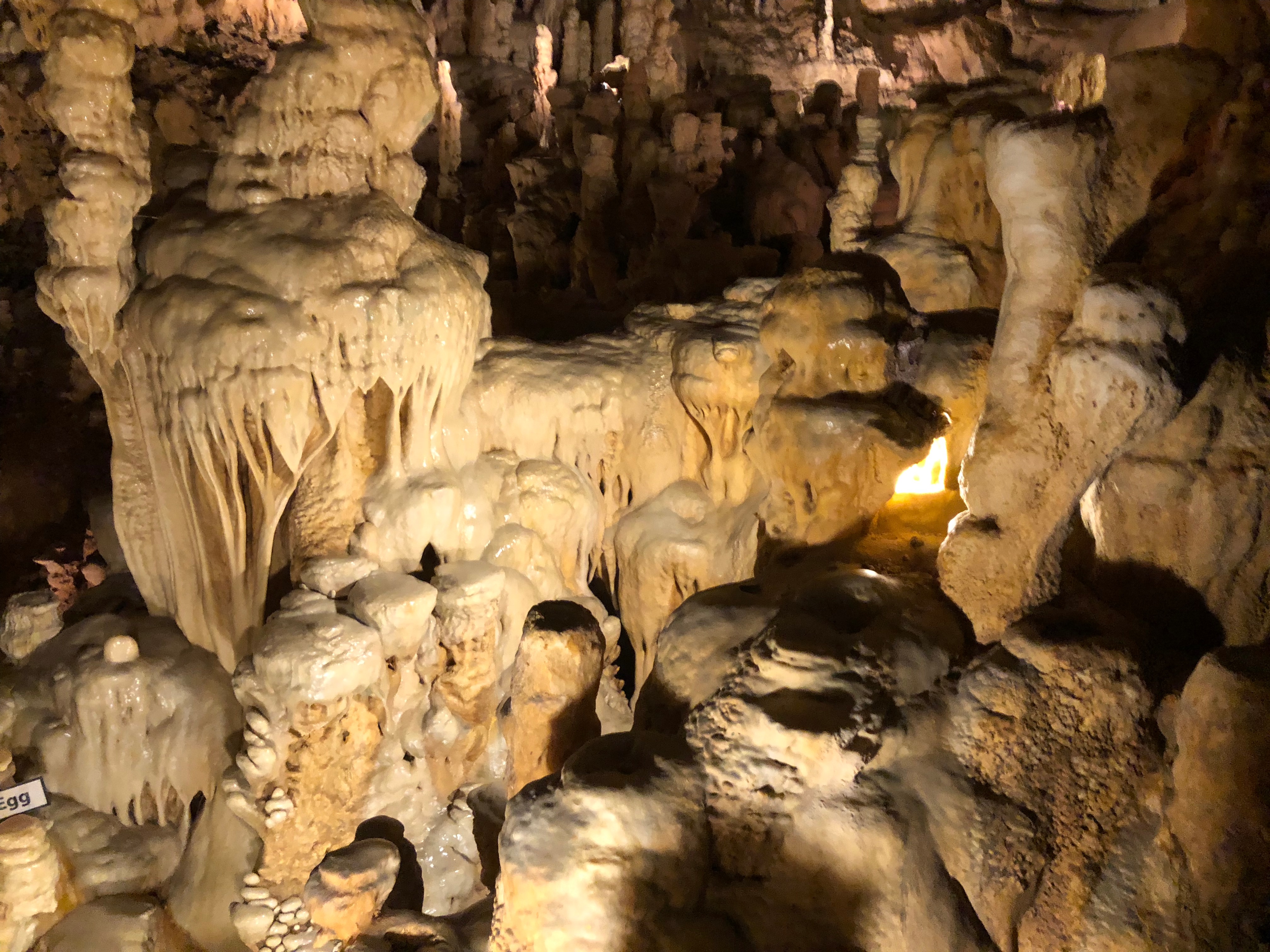
The following morning we visited The Alamo, or what’s left of it. The church is still there, as is a stretch of wall that was thick enough to contain something of a museum but I suspect the souvenir shop was a recent addition. This didn’t really matter though as we took the walking tour with our guide, the only person we heard say ‘howdy’ during out time in Texas, filling is in on all the details of the battle and where things had happened such as David Crockett (don’t call him Davy) being killed and where the women and children hid as their menfolk were being slaughtered. It was worth the fifteen dollars as it would have been a bit underwhelming without the narrative. Later, we went down some caves situated just out of town as frankly you can’t beat a good cave and these were indeed good caves. We discovered the finest pizza house in all of San Antonio to eat, did some of the tacky tourist attractions and overall San Antonio left a good impression. Not enough of one that we wanted to stay an extra night, however, which happened to have been the original plan. We had changed it earlier in the week and left San Antonio early the following morning to head 220 miles east to Houston.

IMG_2971.jpg
Limestone + water = caves

I should add here that driving in the USA is easy, at least compared with other countries that choose to drive on the wrong side of the road. The country is made for the motorist with multi lane roads all over the place, decent signage, service stations at virtually every freeway exit, cheap petrol and with a few hot headed exceptions, reasonably courteous drivers. There’s only one problem with it – it’s all rather boring. The road from San Antonio to Houston was two hundred miles of straight dual carriageway through a featureless landscape, until the last fifty miles as that is where Houston started. Not that this made the views any prettier. Here the road widened from a four lane highway to six, then to eight, then to eight with an extra four on the ‘frontage’ roads, with extra toll and multi occupancy lanes when deemed necessary. We passed several huge interchanges where sliproads were carried high into the sky to connect one freeway with another. We should have probably taken one of them but with so many to choose from poor google maps got a bit confused as to which lane we were in. We ended up quite close to the centre of the city before we veered off to the south as our destination was the Johnston Space Centre, some  twenty miles south of downtown yet still well within the urban limits of this massive city.

IMG_3021.jpeg
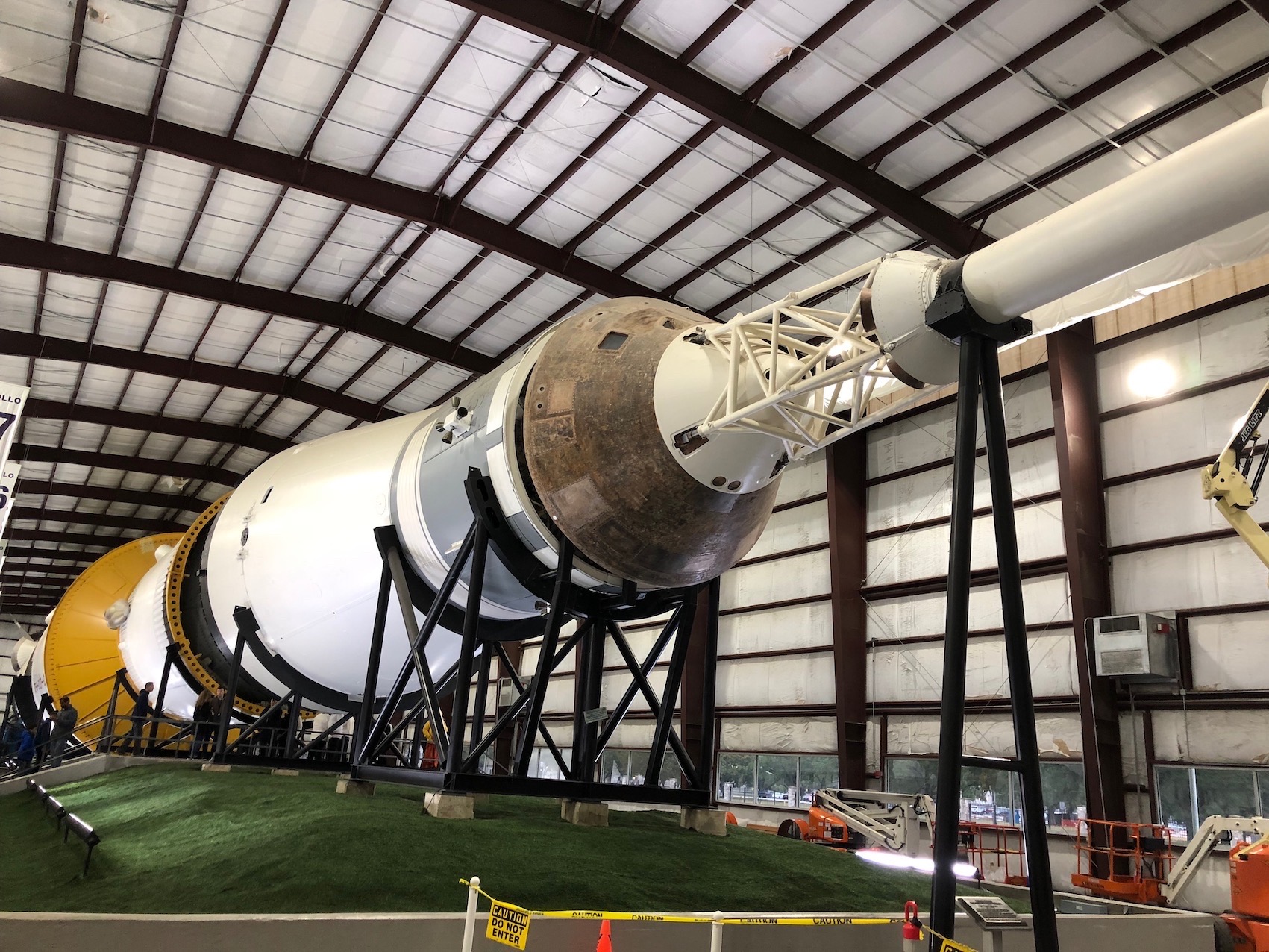
Saturn V, still waiting to go to the moon

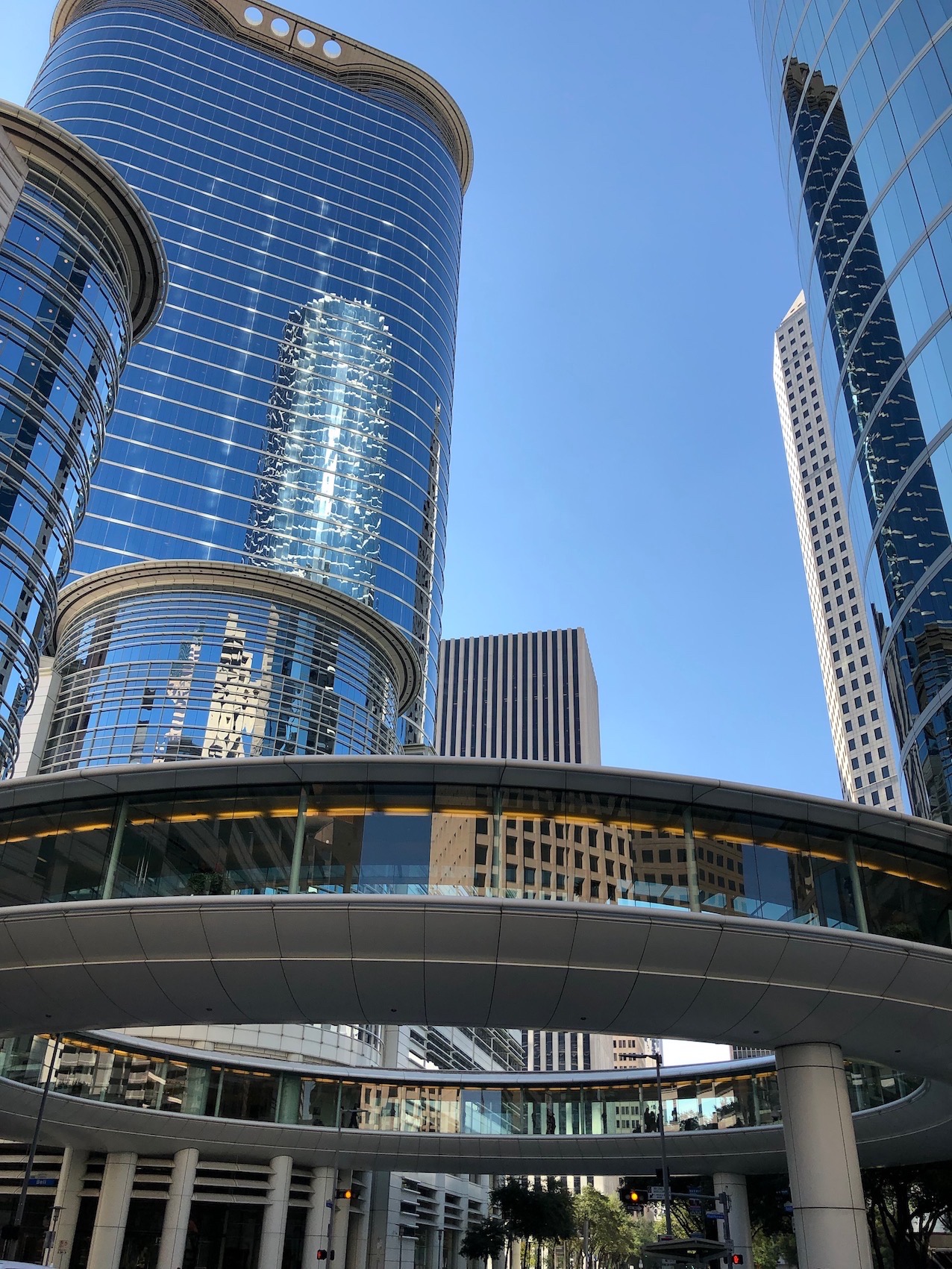
Houston is the home to NASA’s manned spaceflight program and they have built a pretty good attraction there. It was a popular place on a damp November Monday so god knows what it is like in the summer. There are, of course, many exhibits including the big ones such as the Space Shuttle atop the 747 transporter aircraft and a complete Saturn V rocket that would have propelled the Apollo 18 mission to the moon had the program not been cancelled after Apollo 17. We also got to see one of the Mission Control rooms and enjoyed our trip. For anyone with a modicum of interest about space exploration it is worth a visit if you are in the Houston area. Does the city have anything else to offer though? We fought our way to our downtown hotel and had the evening and the following morning to find out. The answer was, basically, no. Set out in the typical American grid, downtown Houston is a soulless place. There is the shopping district which has few shops, the theatre district with few theatres, a few shiny skyscrapers belong to oil companies and countless anonymous office blocks interspersed with parking lots. It would appear that many people drive to work there then drive home again eight hours later. Unless we missed it, which is of course possible in a big place like this, Houston is no party town. There is a new surface metro that trundles through the streets. The streetcars looked awfully under-utilised. We left Houston to head back to Austin for the flight home. The drive was a bit more interesting as we passed through a small Texan town in search of a toilet, the service station at every junction rule having let us down for rather too many miles. The road to Austin had a few curves in it too which was a bonus. Our car was duly returned, our bags placed in the care of British Airways and our overnight flight to London signalled the end of our Texas (and New Orleans) adventure.

IMG_3037.jpeg
Houston. It’s about as good as it got.

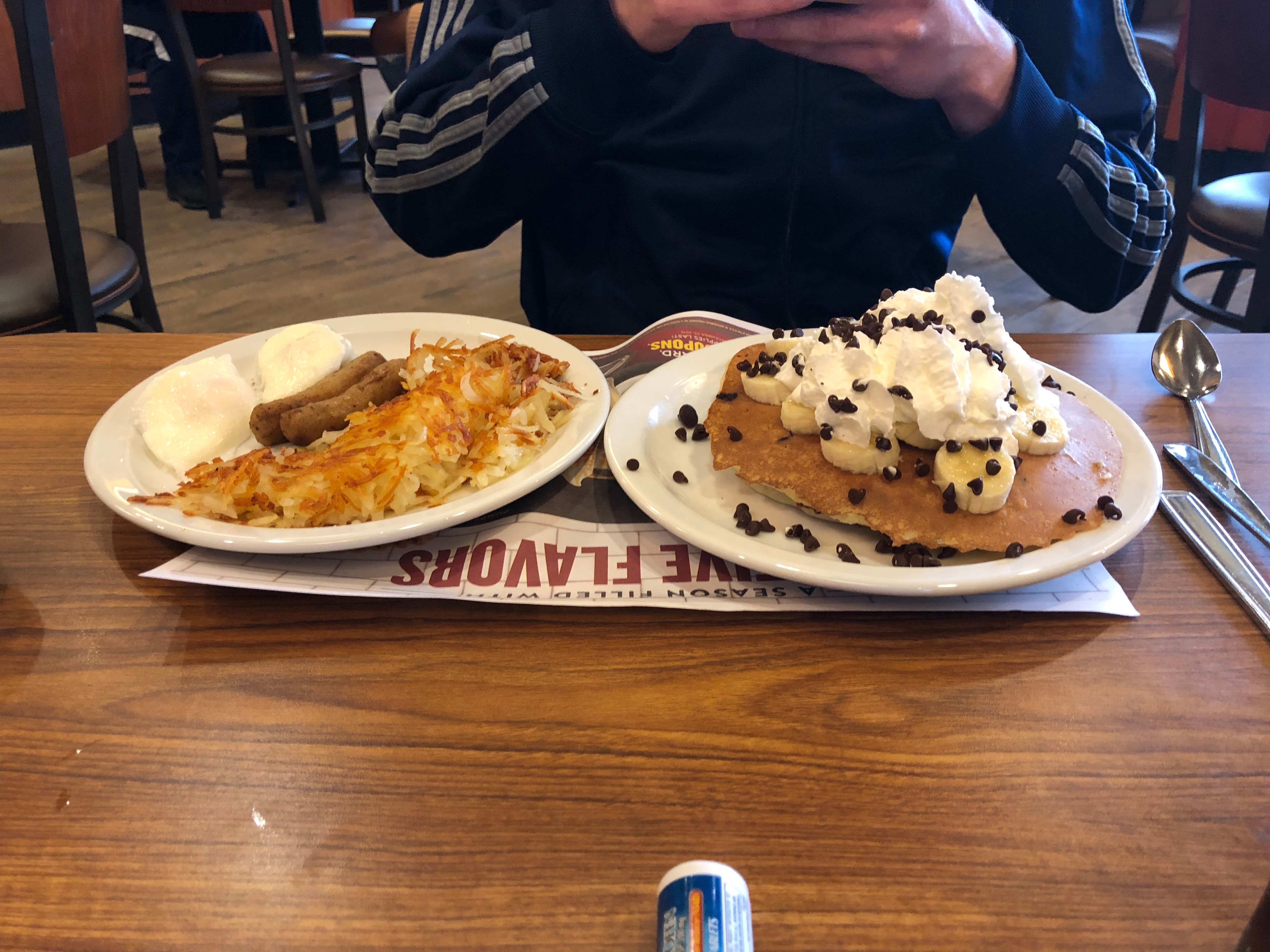
So, what to make of Texas? It’s a big place and four days doesn’t really do the place justice but it was long enough to work some things out. Big breakfasts for a start, though I must admit I never did actually work them out. Whilst the breakfasts were not uniquely Texan, much of the food was had a distinct Tex/Mex edge. This is no bad thing, though after a while you just need a pizza. Texans are a friendly enough bunch but much less ‘southern’ than I expected. The ‘Deep South’ appears, somewhat curiously, to be to the east of Texas and a bit further north too. The place has an interesting history and it is likely to be that that makes Texans a breed apart. In many ways I felt that Texas was the Yorkshire of the USA. The biggest state of the Lower 48 compared to the biggest county in Britain. Texans, like Yorkshiremen, feel a loyalty to their state/county of origin that those not lucky enough to be born there can’t possibly feel. Texans are still proudly American of course and the number of Stars and Stripes flags flying is astonishing. Some of them are huge in fitting with the ‘everything is bigger in Texas’ theme. Alongside them, however, are an equal number of Texas flags. In Yorkshire earlier on this month I witnessed more Yorkshire flags than I’d ever seen before. The Lone Star appears to carry similar weight to the White Rose. Is it a place I’d return to? Maybe, but not in a hurry. It is so big that there must be more of interest than the little bits of it we covered. For now though I feel that the Lone Star state is, for me, now done and dusted.

IMG_2975.jpeg
Just a light breakfast…


Dales

IMG_2655.jpeg
Yorkshire in the Fall. New England eat your heart out.

It might just be an accident of birth but being a Yorkshireman leaves one with certain responsibilities. Constantly mentioning the fact is the main one of course, along with singing the county’s praises at every single opportunity. A fondness for baked batter, served with gravy as a starter, is another whilst being partial to ales brewed in places like Tadcaster is a given. To us there will be no one who can bowl a ball as fast as Fred Trueman or can, erm, block a ball like Geoff Boycott. It is perfectly natural for a Yorkshireman to distrust those born ‘down South’, or indeed to the west across the Pennines. In fact, just to be on the safe side it is best just to distrust anyone who isn’t from Yorkshire no matter what direction their homes lie. Despite not living in the county for nearly forty years, I can happily state that I take my responsibilities as a Yorkshireman just a seriously as I did when I left. Except the ale bit. I prefer a Belgian lager to Sam Smith’s if truth be told. Yorkshire is a big place. Whilst it is all Yorkshire it can be subdivided in to different bits and there can be a healthy rivalry between the folk from each even though deep down we all retain the Yorkshire bond. Non-Yorkshire folk are missing out. We know it even if they don’t.

I’m from the West Riding of Yorkshire. It is a hilly, industrial landscape. Fast flowing pennine streams powered the mills that wove the wool from the sheep that lived on those hills into fine worsted cloth. Towns and cities sprawled into any suitable valley and population growth was massive. Although the heavy woollen industry, like so many others, declined in the second half of the last century those big industrial towns remain. Some might say the landscape is scarred though I disagree. The views are, however, interesting rather than beautiful. To get stunning vistas you need to travel elsewhere in the county. A couple of months ago we visited the Wolds in the east of the county. It wasn’t a place I knew much about and the gentle, rolling hills along with the nearby seaside was most pleasant. This week we visited the Yorkshire Dales. I last went there over forty years ago, possibly nearer fifty. After a couple of days there I realised that absence was far too long.

IMG_2658.jpeg
The Strid. Don’t get too close


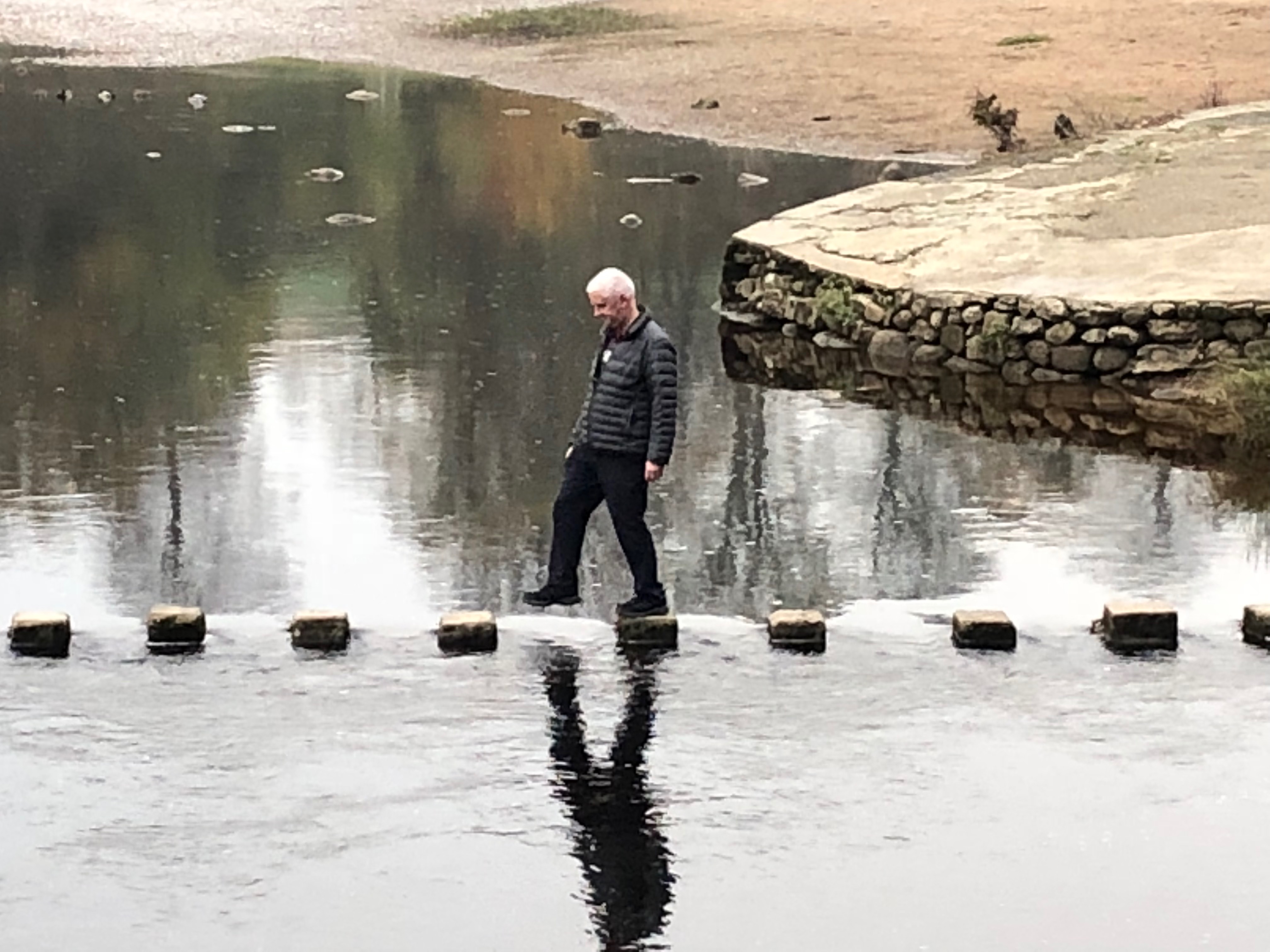
We drove via Bolton Abbey which is on the very edge of the Dales National Park. This estate belongs to the Duke of Devonshire and is extremely popular with visitors. Even on an early November Monday there were plenty of people wandering along its trails. You pay a tenner to park your car but for that you get access all areas. The estate borders the River Wharfe and you can walk along both banks. A round trip is about four miles, maybe six when the extension outside the estate is added on. The Strid is a notable feature. Here the Wharfe narrows to form a fast flowing, deep and dangerous rapid. Stern warnings are posted advising people to stay away from the edge as falling in is an almost certain death sentence. People have tried to jump across the narrow gap and their last thoughts must have been along the lines of oh bugger, I wish I’d heeded the warning. At the other end of the estate lies some stepping stones across what by now is the quite benign (but just as wet) Wharfe across which you hop to get to Bolton Priory. I say hop, there is a footbridge too which would have been the sensible option. Elaine took it, I braved the stones. Thankfully I made it to the other side without dipping my toes or anything else for that matter in the chilly waters though mid stream I must admit to being extremely nervous. I remembered the Priory as a ruin. It turns out it was only half a ruin, the other half being a serviceable church that has seen worshipers visit every Sunday since the 1154 which is quite something when you think about it.

Version 2
Foolhardy

As the light faded we left and took what was probably the scenic route to our accommodation. That is one of the problems about visiting a place like this in the off-season. Still, we arrived at Stow House, a lovely B&B near Aysgarth in Wensleydale. Built as a vicarage in the nineteenth century, the house had been renovated to a very high spec by the current owners. Our room was big, big enough to have the bathtub in it rather than the en-suite, though there was plenty of room for it in there too. I still think of B&Bs as guesthouses in the likes of Blackpool where the hot water only runs for a couple of hours a day and the landlady boots you out by half past nine. Things have moved on it appears. Whilst a room at Stow House may cost you more than two shillings a night it is a lovely place to stay. They serve you a mean breakfast too, though the artisan bread was a bit too posh for me. I’d have preferred Hovis. White Hovis.

IMG_2691.jpeg
Aysgarth Upper Force. It would look better without us in the way.

We had taken our walking shoes as not to have done so would have been a mistake. The Yorkshire Dales is a perfect place to go for a walk and the following morning we did so. The hotel owner suggested a route, loaned us a map and off we went. Our first port of call was Aysgarth Falls where the River Ure tumbles down three distinct waterfalls. What is it about water obeying gravity’s unerring pull? There is something mesmerising about it tumbling over the edge of a precipice and the sound seems to draw you in. Not too close though. Whilst the falls at Aysgarth, of ‘Forces’ as they are traditionally (and accurately) known, may not be as dangerous as The Strid, falling in them is hardly likely to enhance your day. Having paid our respects to the Upper, Middle and Lower Force we set out across fields of sheep who only displayed mild interest in our presence. We were aiming for Bolton Castle which has nothing to do with the Bolton Abbey of the previous day. This structure dates back to the fourteenth century by the wonderfully named Scrope family and is still owned by their descendants. Much of it was ruined in the English Civil War but within its decaying facade lies habitable rooms that once housed Mary, Queen of Scots but then again, virtually every castle in England claims to have had the treacherous old queen as a visitor at some stage. The castle is a tourist attraction now but had closed for the winter a couple of days before we were there so we never got a look around. Instead we set off back from whence we came via an alternative route. This took us onto moorland where the only other life was sheep – endless sheep – and a farmer training a sheepdog that appeared to still have some way to go. Eventually we dropped back down into the village of Carperby where a pint of the afore mentioned Belgian Lager (apologies to the Yorkshire gods)  was imbibed at the local boozer. We extended the walk back to the hotel and took in some footpaths less well trodden. The area is a tangled web of public footpaths that appear on maps and are properly signposted but some of them don’t appear to attract many feet. We made it, however, a ten mile walk through countryside that was attractive, spectacular and bleak all at once.

IMG_2705.jpeg
Bolton Castle. Big. Imposing. Closed.

Having scraped a not insubstantial amount of sheep excrement off our shoes we relaxed, trying out the bath, and then  got ready to go out for tea. The B&B didn’t do dinner – the clue is in the name –  so armed with the recommendation of the owner we set out for Leyburn and the Sandpiper, one of a healthy number of pub/restaurants in the area. It was good too. The following morning we had to set off for home. We visited Hawes on the way, a small town that is quite big in Dales terms. It was a nice place to wander round even if it did have slightly too many antique shops. There was a rope factory – more interesting than it sounds – and an old station that has not seen a passenger alight a train since 1964. The Wensleydale Line ran between Northallerton on the East Coast Main Line and Garside on the Settle-Carlisle line and the eastern section has been restored as a heritage line. The long term aim of the Wensleydale Railway is to restore the eighteen miles to the west that remain dismantled. When they do they will have one of the best heritage lines in the country. Hawes is also home to the Wensleydale Creamery. Here you can purchase the only Wensleydale cheese that is made in Wensleydale. Cheese is popular stuff as witnessed by the huge number of people visiting its shop and visitor centre on a damp November Wednesday. There were many different cheeses to try. I felt it my duty to try them. Most were delicious. Some were foul.

IMG_2729.jpeg
Hawes Station with static train at the platform.

So our all to brief visit came to an end. You know me, I like to travel. I’ve been to some fascinating places, seen some wonderful sights and endured long journeys to get there. I’m probably guilty of forgetting that there are great places to visit on the doorstep. The Yorkshire Dales is one of those yet it has taken me nearly fifty years to return to it. And me a Yorkshireman too.

Islander

Version 2
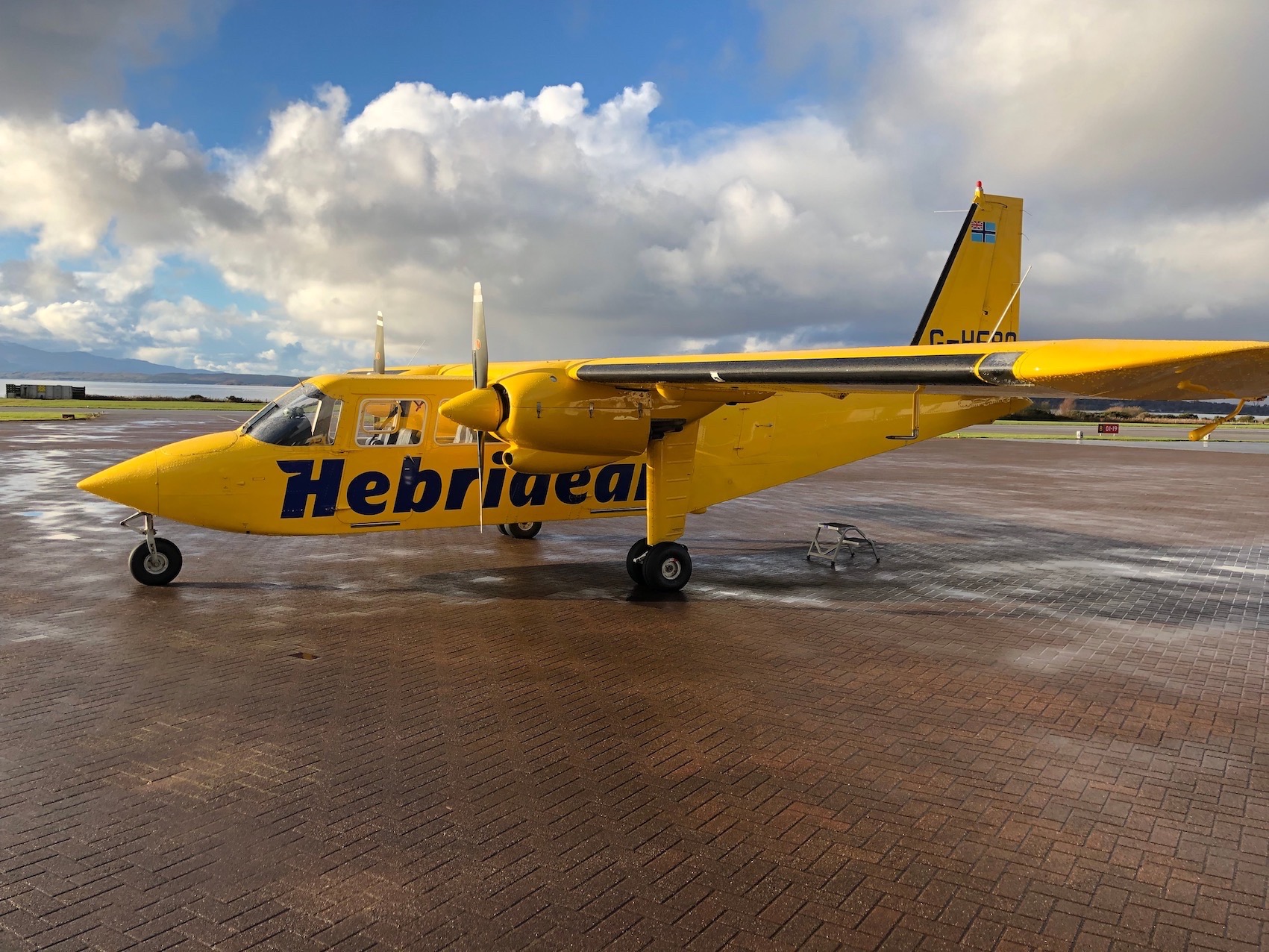
The Britten Norman Islander. British engineering at its best. Not all of them are this yellow.

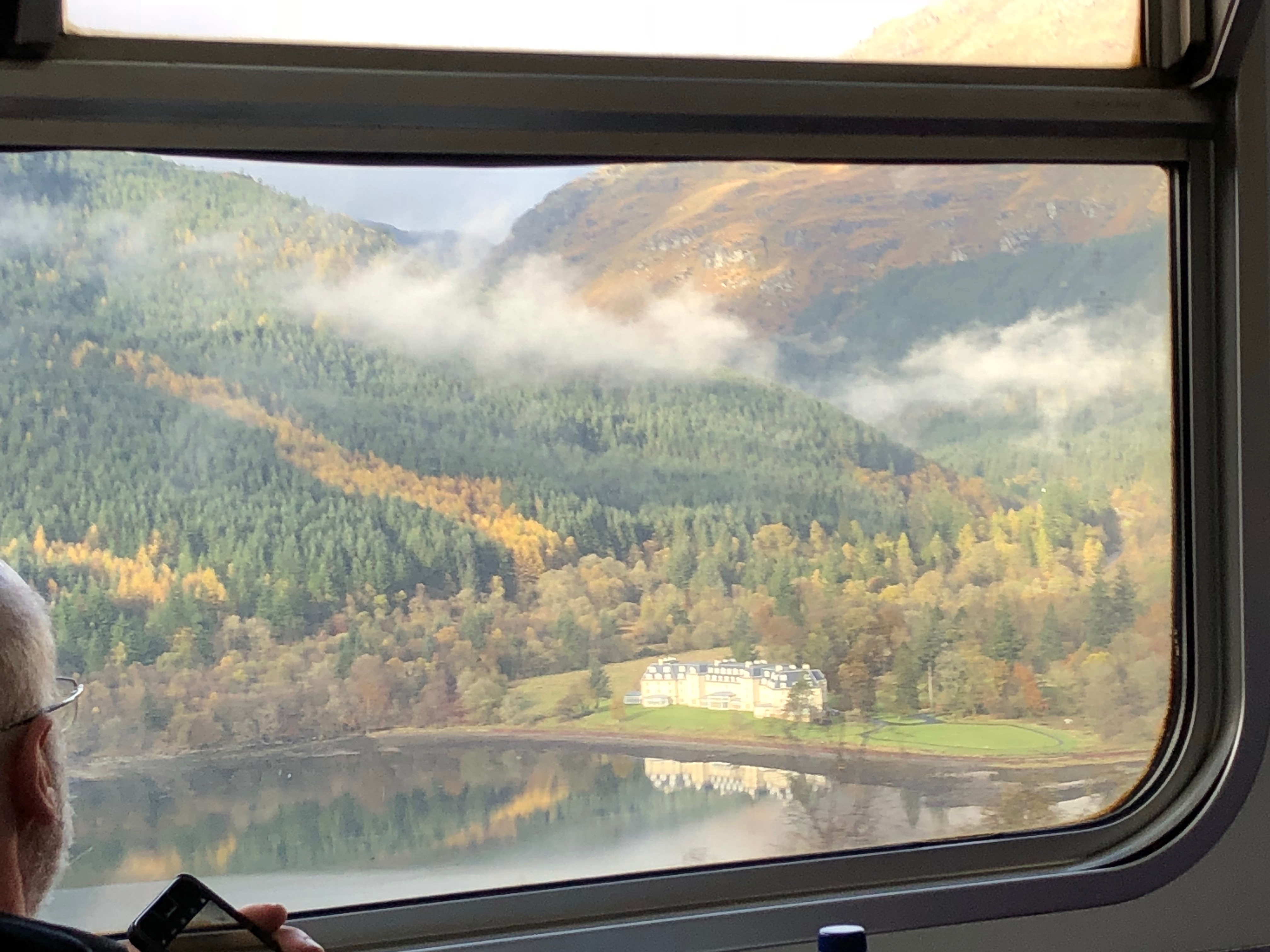
The Highlands and Islands of Scotland is a nice place but its geography makes it a bit of an undertaking to go and see it, even though it starts just a couple of hours up the road. Car and ferry is the usual way of getting around up there but there are alternatives. I managed to see quite a lot of the Argyle and Bute region in a day trip without setting foot on a ferry or, and just five minutes in a rather expensive taxi. My adventure on Thursday started at Glasgow Queen St Station (the train up to Glasgow from Barassie is no adventure at all) where I was rather excited to catch the Oban train. One of the great railway journeys of the world, some say the greatest though that’s a bold claim, the West Highland Line attracts people from all over the West Highlands. It also attracts tourists and blokes like me who like a great train ride every once in a while. What makes this a great one is the spectacular country through which it runs. Upon leaving the Glasgow suburbs it tracks along the banks of the Clyde to Helensburgh where the single track branches off and heads into a land of earth and water that makes you wonder how you can be just a few miles from the sprawl of Scotland’s largest city. Perched on the side of the hill, it passes Gaerloch, a sight so beguiling you can see it dawn on the faces of the first time passengers that something special is happening. Utilising the service as I did on the first day of November has its advantages. The colours of Autumn add an element to the views that you would miss in the summer. The hills were a mosaic of  golden yellow and bronzed red with the low lying mist only adding to their wonder. The further up the valley we went, the more the passengers snapped their smartphone cameras. The track then passed through a brief gap in the steep hills to reveal Loch Lomond on the right hand side giving those, like me, sat on that side of the train a chance to marvel at the natural beauty of the region. In reality it was tantalising glimpses through the increasingly leafless trees that line the track. Occasionally there would be a gap and for a few short seconds we could admire the glassy waters of the largest inland body of water in Britain reflecting the hills that surround it.

Version 2
Hills, lochs, mists, colours, a hill called The Cobbler and a bloke with a beard.

The train rattles along at a sedate speed, stopping only to allow passengers to embark or disembark at stations with strange sounding names or to allow trains making the reverse journey to pass. The driver, in possession of a new ‘token’ then pulls gently away onto the next section of track which is his and his alone. The TGV it isn’t but then why rush when you’ve got all that scenery to take in? Some two hours out of Glasgow we reached Crianlarich, a place you can reach by car in an hour and a half. This isn’t a race though. I arrived perfectly relaxed, something I would not have been had I been driving up the A82 which despite it following the western shore of Loch Lomond is not a great road. Just after Crianlarich the track splits in to two. On branch heads north to Fort William and Mallaig. The other heads west to Oban. The line up to Fort William is just stunning, climbing up to cross the bleak Rannoch Moor before more lochs, hills and general all round wowness all the way into Fort William. The section from Fort William to Mallaig is just as good and get this – you can do it by steam train, in the summer at least. That particular journey is a train enthusiast’s wet dream and one Elaine and I undertook a few years ago on one of those most unlikely of occasions in that part of the world, a hot, sunny day. Crossing the Glenfinnan Viaduct, famous from the Harry Potter films, the countryside is just breathtaking and, what’s more, Elaine won a bottle of whisky in a raffle. I am, however, digressing. The Oban branch might not have the wow factor of the Fort William and Malaig route but it isn’t half bad. Its first port of call is Tyndrum Lower. Tyndrum is the smallest settlement in the UK to be served by two stations with Upper Tyndrum on the Fort William line. The stations are a half a mile and a steep hill apart with the handful of houses that make up the village perched between them. Lochs feature highly as the track runs alongside Loch Awe and Loch Etive, passing the Falls of Cruachan where a summer only station lay silent, unlike the falls I assume. I alighted at the penultimate stop on this branch, Connel Ferry, named at a time when there was indeed a ferry that transported people across Loch Etive. There isn’t now as the old rail bridge that spanned the narrow opening to the loch has been converted to a single track road bridge carrying the A828.

Version 2
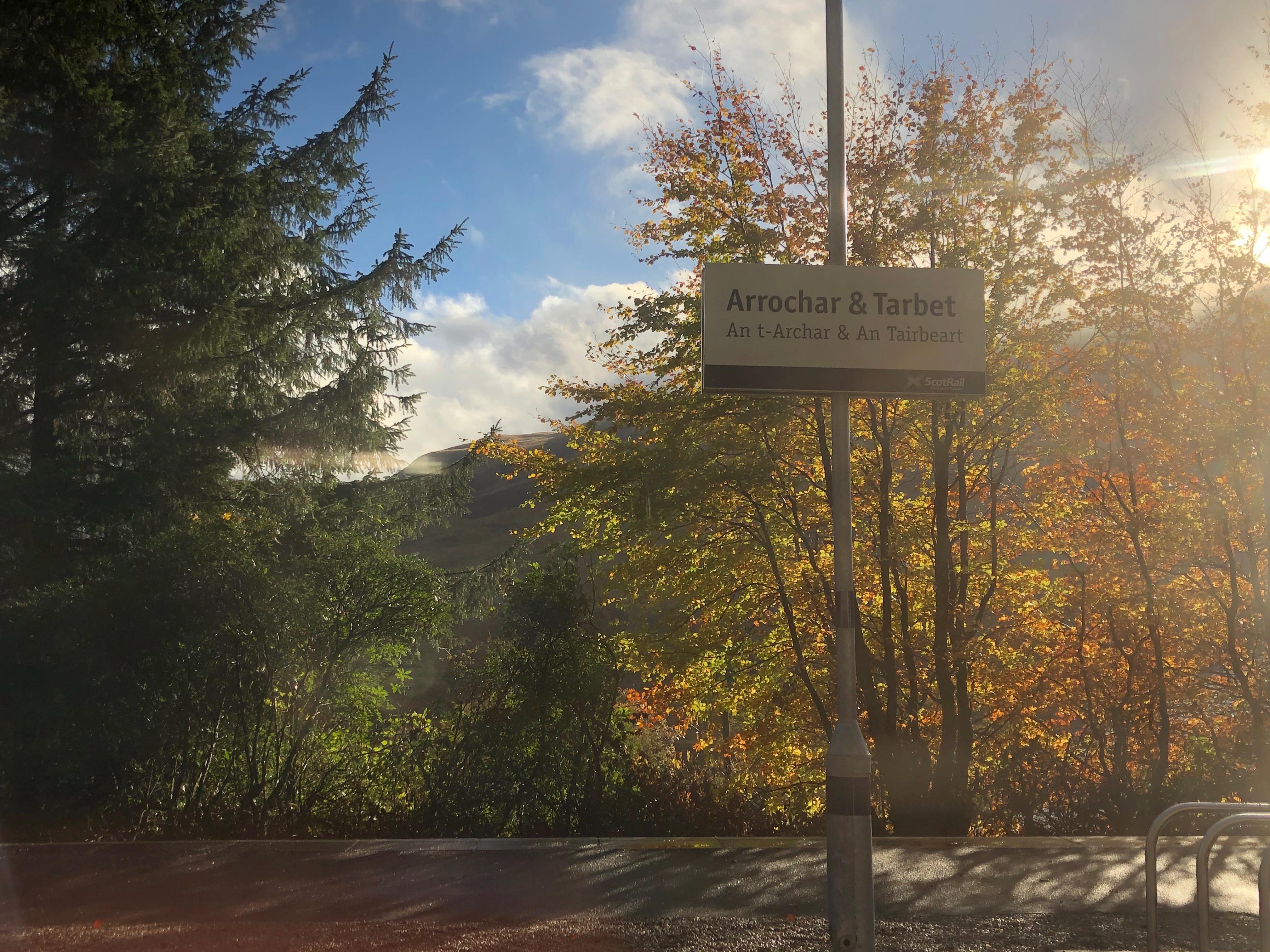
The colours and light made even a mundane station sign seem dramatic.

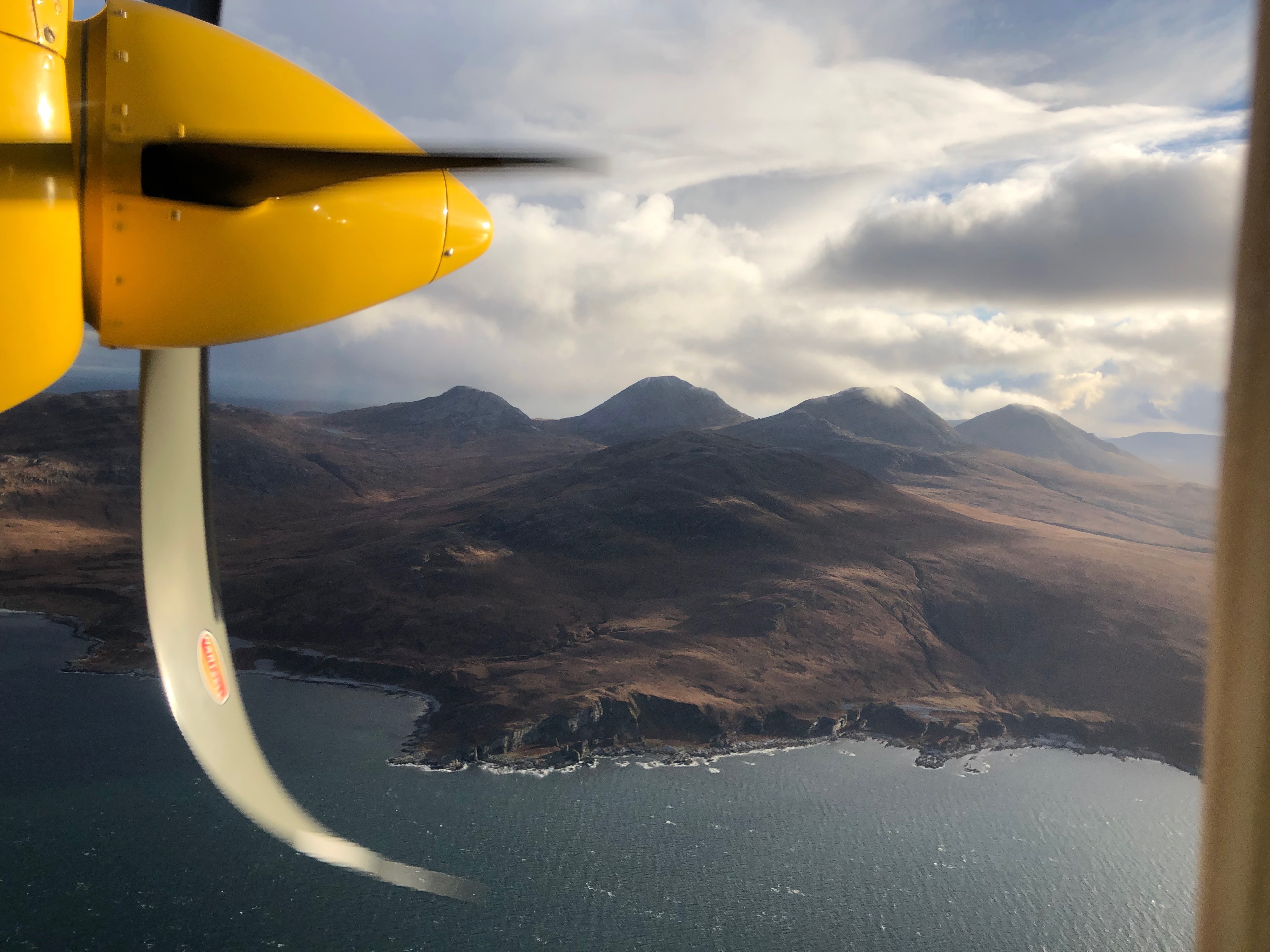
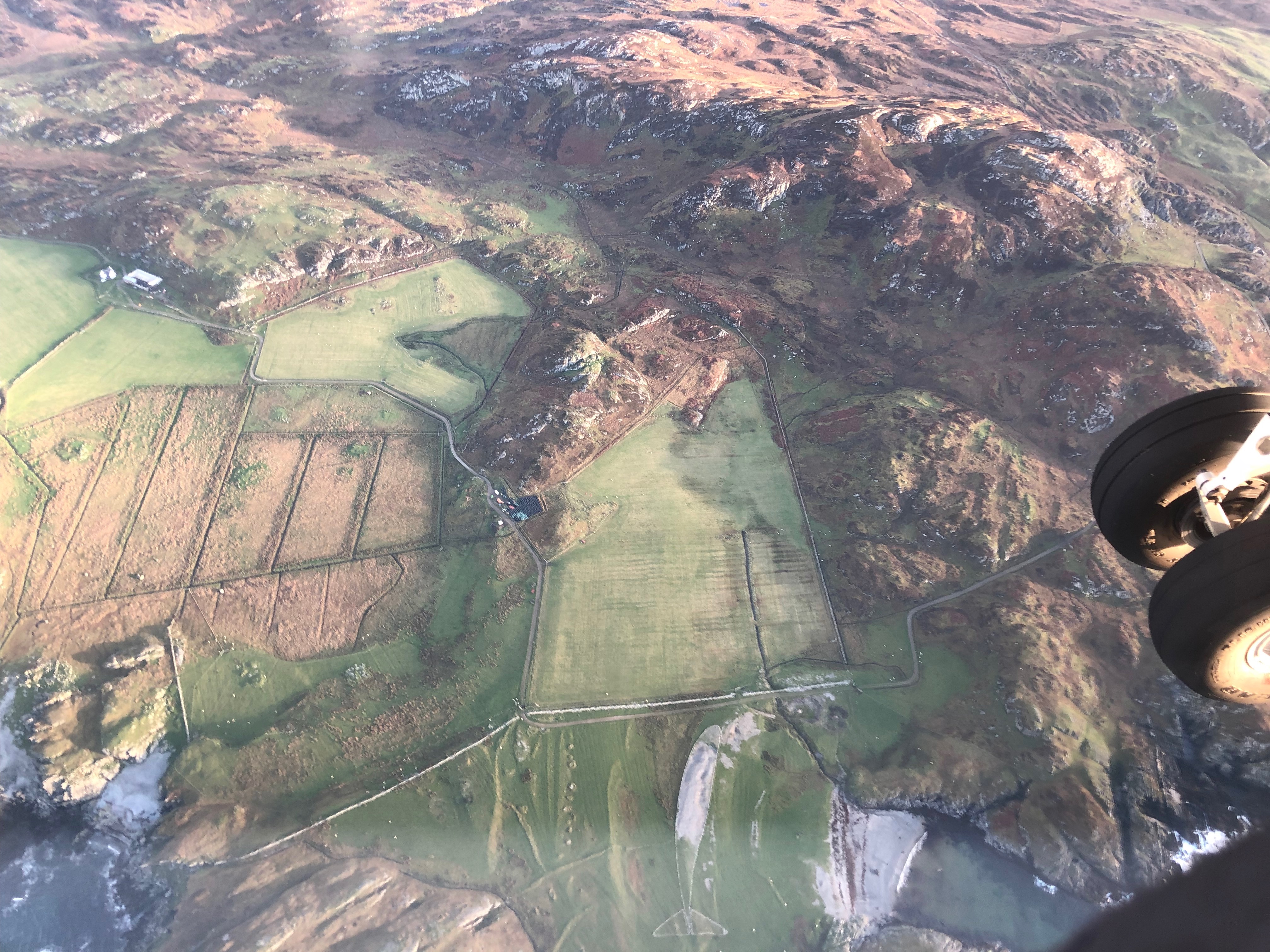
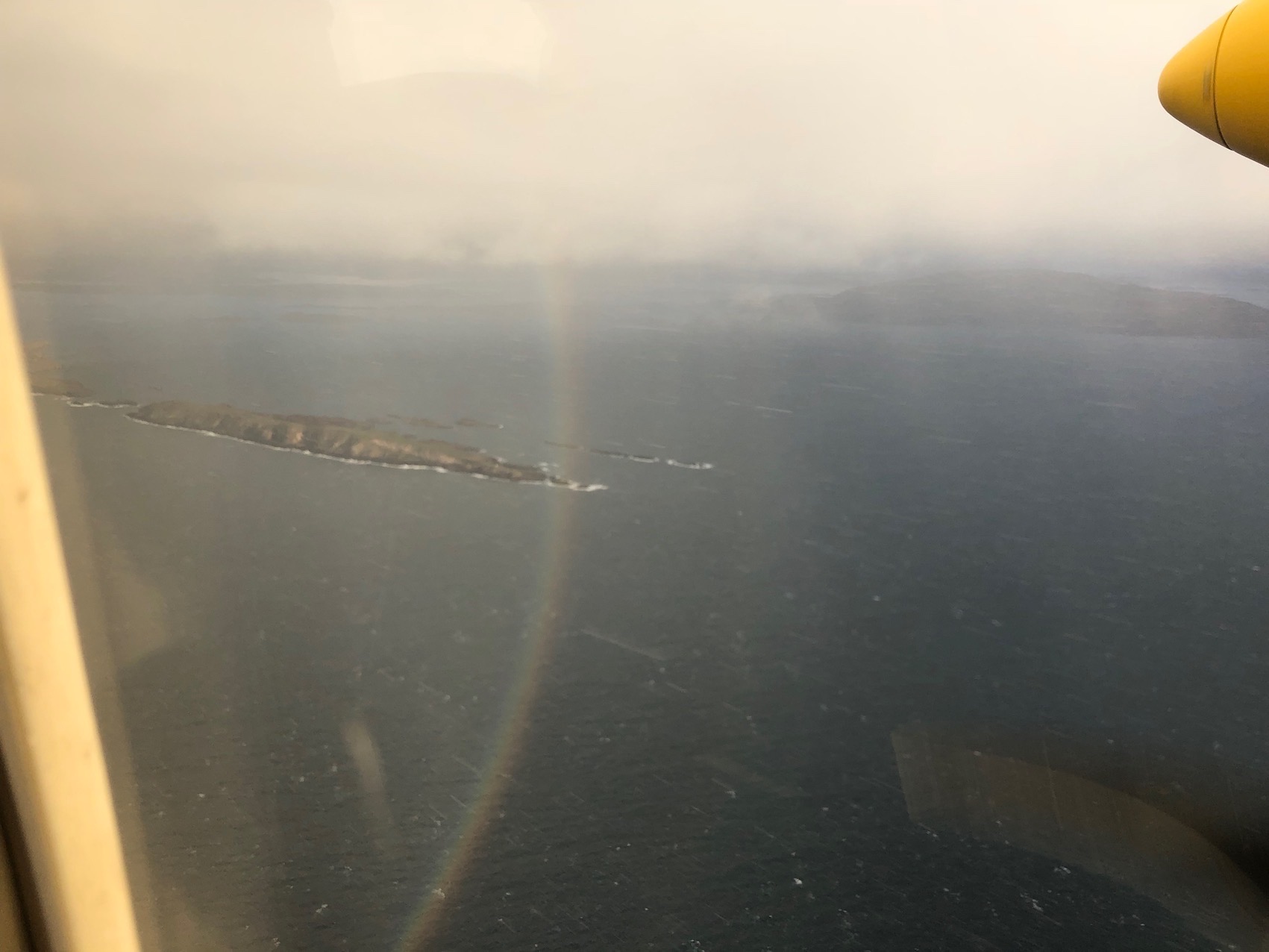
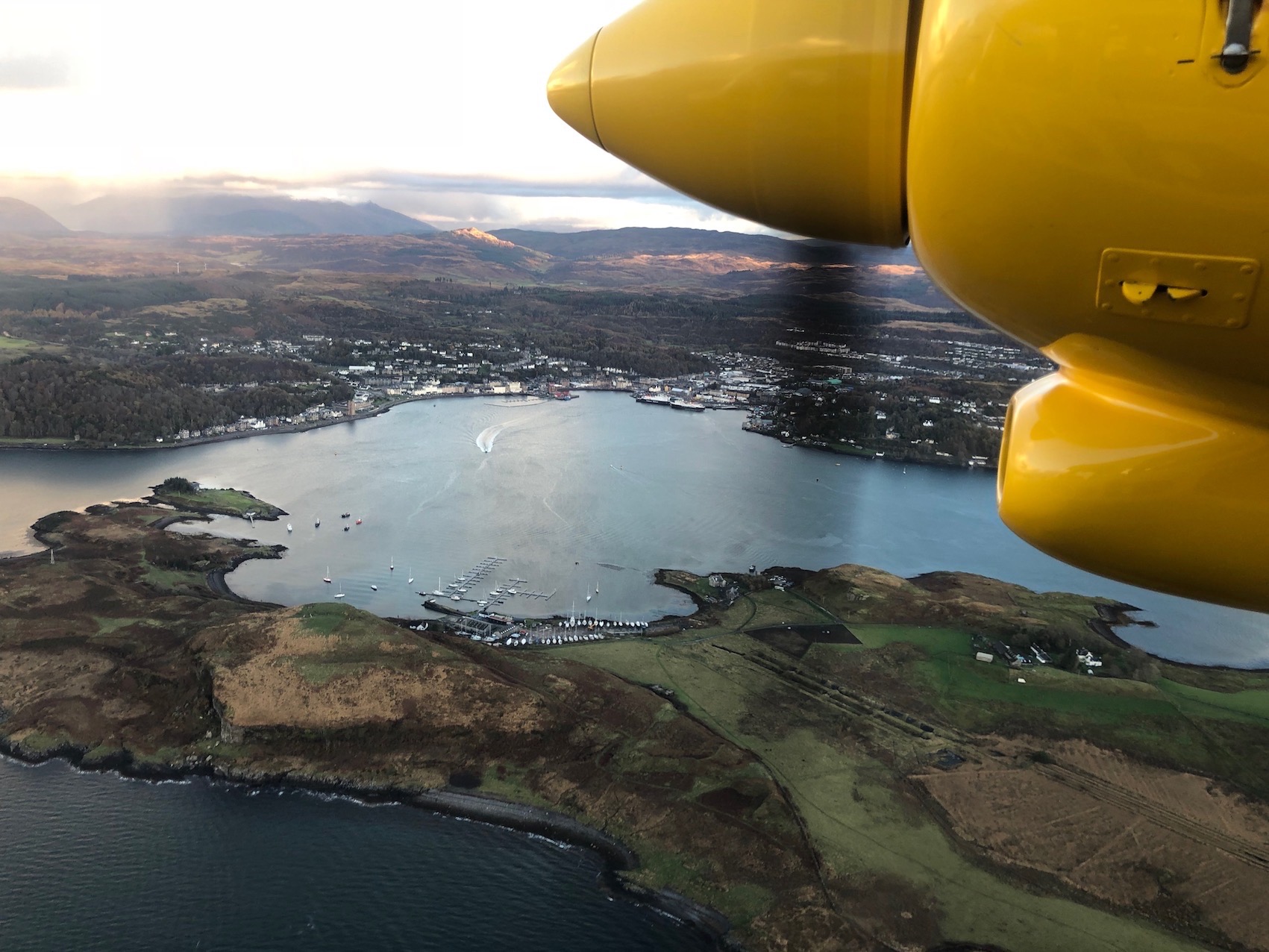
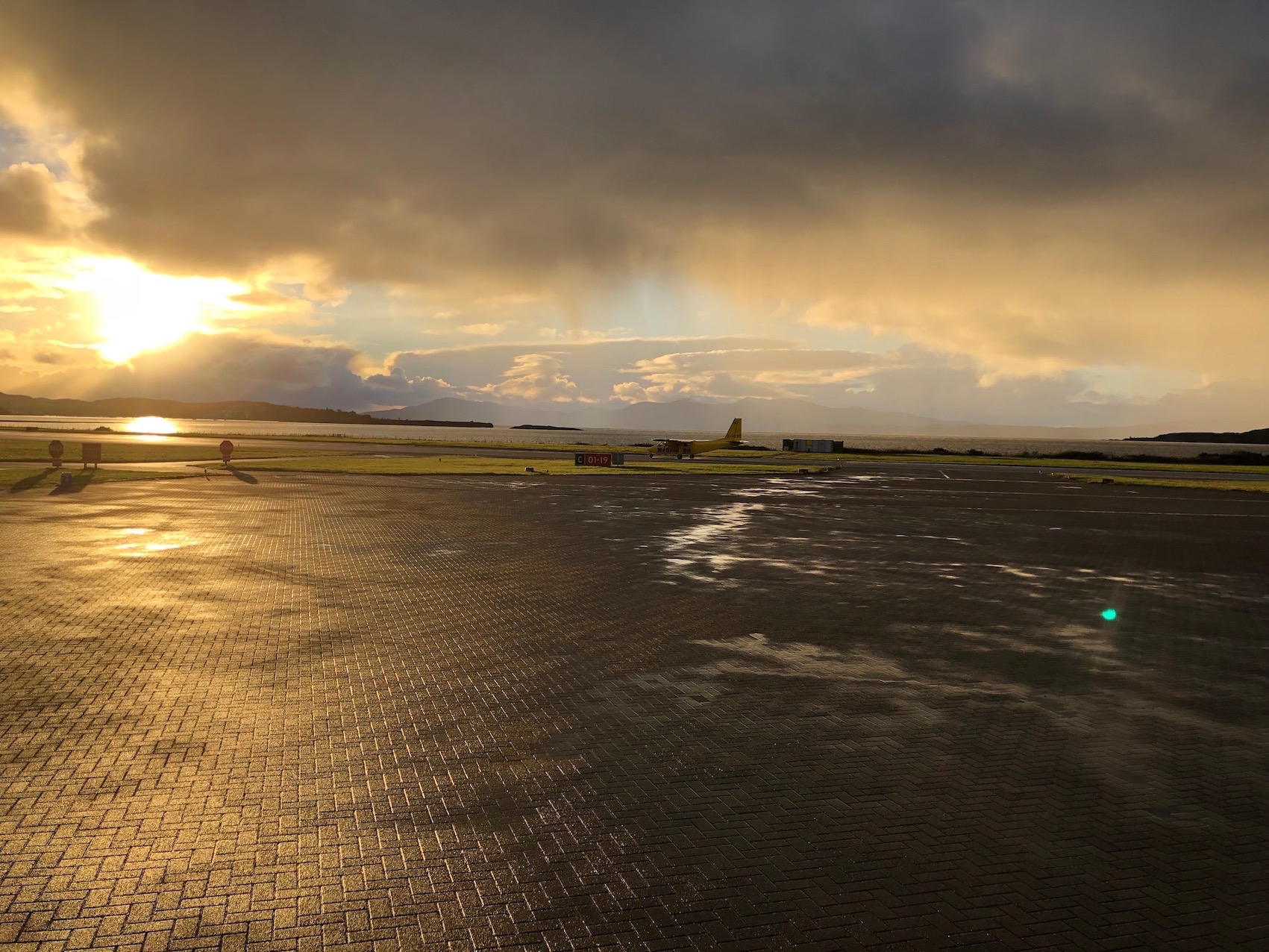
It was a bridge I needed to cross and due to the tight timings involved I needed to cross it in a hurry. Awaiting me at the station was my pre-arranged taxi with the instruction to whisk me to Oban Airport. This 1.7 mile journey, across the afore mentioned Connel Bridge, took five minutes and cost me twelve quid. It made both the train journey – £17 return with my Scotrail Club 50 card – and what was to come seem an absolute bargain. Indeed, the journey up whilst spectacular only served as a precursor to the main event of the day. I was to take a trip with Britain’s smallest airline, Hebridean Air Service. Here’s the background bit – if you find these bits boring please skip to the next paragraph. A few years ago Oban Airport was a runway and a Portacabin. Then the local council spent not an insubstantial amount of money building a proper terminal building and getting it up to the standard required to operate scheduled services. Highland Airways rose to the challenge and commenced services to nearby islands. A few years later they went bust and Hebridean Air Services was set up to fill the void. This they have been doing since 2011 flying two triangular routes from the airport. On Mondays and Wednesdays they fly  to Tiree and Coll twice a day and on Tuesdays and Thursdays the route takes in Islay and Colonsay,  twice each day again. They also do a school run where high school age children from Coll and Colonsay are transported to Oban on a Sunday where they board for the week, flying back to their home islands on the Friday evening or Saturday morning, depending on the time of year. By my calculation that means they run a total of twenty four revenue flights a week, thirty during school term time. The aircraft they use is a Britten Norman Islander, a rugged twin piston engined machine that seats one pilot and up to seven passengers. Something of a British success story, the Islander first flew in 1965 and they are still making them. It was designed precisely for the type of operation that Hebridean Air Service undertakes, connecting small island communities with larger centres of population. The only problem is that the service makes no financial sense whatsoever. There are only seven seats for sale on each flight and, if the flights I was on were anything to go by, they are rarely completely filled. The only way they continue to operate is down to them being designated Public Service Obligation services. Argyle and Bute Council subsidise the services to Tiree, Coll and Colonsay with the Islay route being operated at the airline’s own risk. The advantage for an avgeek like me is that Hebridean Air Service are more than happy to sell the empty seats to those who just want to go along for the ride. And what a ride it is.


The receptionist at Oban Airport is also the lady who deals with reservations. I’d spoken to her a few times as my efforts to do the trip last week were thwarted by the weather and train problems. It’s highly unlikely you’d get the same sort of help from a big airline no matter what your frequent flyer status is. The threat of bad weather had receded and the flight was to operate as normal. Along with me there were two passengers, one to Islay, the other was going on to Colonsay. This was good news for me as it meant they would fly the full route. Had no one wanted to go to or from Islay that afternoon the aircraft wouldn’t have gone there and I’d have had to settle for a Colonsay and back. That would not have been a bad thing but the extra landing, take off and flight time made the £65 she charged me as a sightseer an absolute steal. My co-passengers were elderly and had possibly been in Oban for a visit to some clinic or other. I’m guessing a sizeable proportion of the passengers that use these services are visiting Oban for similar reasons. The pilot, Wolfgang, introduced himself to us in the terminal and gave us a quick brief on how to use the life jacket. He then led us to the aircraft which was parked right outside the door and allocated us our seats. Colonsay bloke in the back, Islay lady in the middle and me in the row behind the pilot which afforded me a view only surpassed by that enjoyed by Wolfgang himself. In the seat pocket we were informed that there was a set of foam earplugs and a barf bag – a 787 Dreamliner this isn’t – and Wolfgang fired up the engines. Well, one of them at least. The other took several attempts before it spluttered in to life. A quick taxi and noisy power check later and we were backtracking Runway 19 before turning and lining up. Twelve hundred meters of tarmac lay ahead; the Islander needed about two hundred of them before breaking the surly bonds of earth. Islay was half an hour away and between it and Oban Airport lay a wonderland of remote and not so remote islands, sea, rain showers, sunshine and the noise of a Lycoming piston engine just a couple of feet to my right. Soon we were flying to the west of Jura, a large island with a small population. Towards the southern end of the island, the three Paps of Jura rose from misty firmament like, well, paps. ‘Paps’ is an old Norse word for breasts and whichever Viking was responsible for naming them must have seen them and immediately thought of his wife back in Denmark, assuming his wife had three tits of course.

IMG_2565.jpeg
The three Paps of Jura. The shape of the hill on the left was presumably not deemed to be booby enough for that homesick Viking to declare it a Pap. 

With the paps behind us we found ourselves over Islay and before long Wolfgang had plonked the Islander down on the airport’s runway that once saw Prince Charles bend one of the Queen’s Flight BAe146s. He should have flown an Islander, there was plenty of runway for one of those. Somewhat strangely we taxied past Islay’s terminal, which handles a couple of Glasgow flights a day, to a different part of the airfield where what can only be described as a five bar gate and an old Portacabin were situated. This was Hebridean Air Service’s own ‘terminal’, a situation I felt was totally bizarre. It must have been something to do with handling fees but quite why the proper terminal is ignored is beyond me. There isn’t even anywhere to go for a wee. With Islay lady gone, whisked away by a waiting car on the other side of the gate, Wolfgang fired up the Lycomings once again and having spent a total of six minutes on Islay from the time we touched down, we were back in the air for the short flight to Colonsay. Colonsay is an island of just a hundred and twenty folk. Quite what they do there I’ve no idea. It welcomes tourists in the summer but the rest of the year the residents have it to themselves. It looks nice, especially from the air, but living there would drive me nuts. The airport is a short strip of tarmac and a wooden hut which might not have looked much but was a distinct upgrade on Hebridean’s Islay shack. I said goodbye to Colonsay man and was expecting to be the only passenger on the flight back to Oban but no, a new man emerged form the terminal hut and took the place of the departing old bloke. Within no time Wolfgang had us airborne again for a flight over the Colonsay Whale and the Sound of Mull back to Oban. Colonsay Whale? Yes, this is a huge work of art on the island where visitors are invited to add some stones to fill in the outline of a whale. I saw it quite by chance.

Version 2
Spot the Whale. 

Leaving Colonsay behind to its tiny population we flew over the Sound with the Isle of Mull to the left and the mainland to the right. We passed close to some heavy showers, two thousand feet above the unwelcoming waves. With the sun behind us and the rain ahead, this had the effect of us seemingly flying into the centre of a circular rainbow. It was quite a sight that unfortunately, despite many attempts, I couldn’t catch well on camera. Soon the town of Oban passed by on the right and we turned to line up with Oban Airport’s runway 01, landing some ninety minutes after we had left the same stretch of tarmac. It had been marvellous.

Version 2
Flying through a rainbow.

Version 2
Oban. Nice place for a haggis supper.

As the sun set over the Sound and the Islander taxied to its hangar for the night I turned my thoughts to the journey home. A bus ride in to Oban got me there with time to treat myself to a haggis supper before the train to Glasgow. I felt that in a place so Scottish the road signs are in Gaelic as well as English that it was the right thing to do. The train back departed on time at 18:11. Alas, having experienced the advantage of Autumn travel on the trip up, the disadvantage soon became evident on the way back. Deprived of light, the journey through all that wonderful scenery became nothing more that a slightly tiresome trip on a shabby rattler, its lack of speed and leisurely stops now more annoyance rather amusement. Three hours later I was hoofing it across a chilly Glasgow to Central Station for the 22:00 train back to Barassie and the ten minute walk home where the cats were waiting, demanding food which they didn’t eat. I’m going to do the trip again some day, this time take in the Tiree/Coll route. I might leave it to the summer so I can enjoy the train journey home that bit more. I’m sure the scenery will be almost as good without the autumnal shades. Almost perhaps, just not quite.

Version 2
The Islander heads off into the sunset.


Mercury

Queen-Bohemian-Rhapsody.jpg
Nothing really matters…

Whilst Elaine falls a bit short in my love of Prog Rock, our musical tastes have been known to overlap. Back in 1986, just a couple of months after we got married, we had a trip to London and took in a concert at Wembley Stadium. A number of bands were performing – I seem to remember Status Quo were doing their fifteenth farewell tour and performed a set as part of it. INXS had also popped over from Australia, treating us to some antipodean rock. However, the only reason we, and a hundred thousand other people had congregated on the venerable old stadium in a, not particularly lovely suburb of the capital, was to see Queen. Not The Queen, no this Queen had no need for the definite article to precede it. Queen was a rock band and by 1986 it was arguably the biggest rock band on the planet. Whilst definitely part of the Rock family, Queen are hard to pigeonhole. The music they produced had hints of metal, prog, glam and many other sub-genre’s you  may care to mention. They even side tracked into disco and were influenced by classical so all in all, they had a pretty unique style. As album sales will attest, it was very popular despite the fact that with the punk ‘revolution’ of the late seventies, Queen became mightily uncool along with other stadium rock bands. So it was that we, along with all those other uncool people, got ready to enjoy the headline band on that July evening.

From 1971 to 1991, Queen consisted of the same four members. John Deacon was the bass player, Roger Taylor the drummer, Brian May the guitarist and Freddie Mercury, vocalist and pianist. Mercury was an extraordinary character. Born Farouk Bulsara in Zanzibar to Indian Parsi parents, his huge overbite, caused by an extra set of molars, gave him a distinctive appearance and, he claimed, his huge vocal range. It is his personality as much as his teeth, however, that stood out. It was certainly evident at that concert. He had 100,000 people in the palm of his hands for the entire two hours. I’ve seen other rock stars control the audience but none have been quite so good at it as Mercury. Unfortunately the tour of which that concert was part of was to be Mercury’s last. The following year he was diagnosed as having AIDS and his health failed over the next few years. He died in November 1991at the age of 45.

Last night we went to see the film Bohemian Rhapsody. This was a biopic of Queen from when Mercury met May and Taylor in 1970 to the band’s performance in the Live Aid concert of 1985. To be more precise it was a biopic of Mercury. The other band members were superbly portrayed by Gwilym Lee (May), Ben Hardy (Taylor) and Joseph Mazzello (Deacon) but as in real life, Mercury took centre stage. Rami Malek was cast in the role of Mercury. Being an American of Egyptian extraction, Malik was utterly convincing as an Englishman whose roots lie from beyond that country’s shores. The original choice to play Mercury had been Sacha Baron Cohen but ‘artistic differences’ saw him leave the project before it had really got started. Thank goodness for that. I can only imagine Cohen would murder the character. Malik brought him back to life. Mercury was a complex character, supremely confident on the outside, terribly insecure on the inside. He desperately needed love but seemed unable to give it in return and it took him many years to come to terms with his sexuality. Once he did he embarked on the ultimate hedonistic lifestyle that never seemed to bring him any satisfaction and ultimately hastened his demise. Yet despite all this he would come alive when on stage in front of thousands of people. This was brought home throughout the film but climaxed at the Live Aid concert where Queen’s twenty minute set was stole a show that included such rock giants as Led Zeppelin, Pink Floyd, U2 and The Who. The cinematography of that concert was, and I can’t think of another word here, amazing.

queen reel and real.jpg
Only their mums can tell the difference

I will not go into finer detail about the film – you will just have to go and see it. I’m not claiming to be an authority on the subject as despite liking the music I would not put myself into the uber-fan category. I’m aware that the film is not totally factual. I noticed that some of the songs were performed at a time in the movie before they would had been released in real life. Also, the EMI executive Ray Foster, played by Mike Myers in a nod to his promotion of the song Bohemian Rhapsody in the film Wayne’s World, appears to have been a made up character. Artistic licence was also in evidence when Mercury informed his bandmates of his AIDS diagnosis on the eve of Live Aid when in fact it he got the news two years later. Whilst things like this make you question the rest of the film I have to say that with my limited knowledge and having done a little investigation, the story was entirely believable. It was a good film. Go and see it. Unless you are cool of course. Some media movie reviewers are cool and didn’t think much of it. Sod them.

Thirty-two years ago Elaine and I left Wembley Stadium having been thoroughly entertained by Freddie Mercury and the other members of Queen. What had been our first time was also our last. There are many tribute acts, some of whom are very good, but there will never be another Freddie Mercury, the ultimate showman. Perhaps it is just as well.


Time

clocks.jpg
Time is an illusion, lunchtime doubly so.

Time is a fascinating concept. It is said that in our three dimensional universe, time is the fourth dimension which just goes to show that theoretical physicists have a sense of humour. It does weird stuff too, like move at different rates according to how fast the observer, or indeed the observed, is moving with the result that airline pilots age quicker than their sloth like companions back on terra-firma. Or is it slower? The whole subject is a difficult one for we mere mortals to grasp, stuck as we are in time’s unerring grasp. Time played a big part in my job. There were clocks everywhere and both actual and predicted times were fundamental in keeping the planes apart. You would have thought that now I don’t have to do that stuff any more I could let the arrow of time do its thing without worrying about it too much. Not true I’m afraid. Now I’ve got more time on my hands and more time to fill. Virtually any retiree you speak to will say they don’t have enough time, they don’t know how they managed before when they had to allocate so much time earning a wage. I hope I will be saying the same thing after I’ve given this retirement thing my best shot.

One thing retirement should have given me is the chance to have a stable sleeping pattern. Shift work puts the mockers on that and I’d been doing shift work for thirty-six years. Having said that I was working a wholly predictable shift pattern so my body did get into some sort of routine, even if that routine was spread out over ten days. The most disruptive part of that cycle was the night shifts of which there were two. Studies on shift working have shown that working just two consecutive night shifts is probably the worst combination you can do so it is a surprise that any of my colleagues and I have survived beyond fifty. I went part-time a year before I retired which meant losing the night shifts and I have to say it was a great move. I never realised how much they disrupted your life until they were gone and it was a great way to ease me into the situation where the morning and afternoon shifts were gone too. Six or seven weeks into retirement, however, and I’m still waking up too bloody early.

6am is not a time to be lying awake and being unable to get back to sleep. Of course the virtuous thing to do would be to get up, eat a few dried grains covered in yoghurt then nip out for a six mile run and be back in time for Carol Kirkwood’s weather forecast on BBC Breakfast. Some people actually do that. I used to pass them my way to a morning shift at work, the silly sods. No, civilisation has dictated, probably wrongly, that we should go to bed about eleven o’clock at night, read for about half an hour, sleep for a solid eight hours, wake up at half past seven, lounge about a bit under the warm duvet and get up at eight. We still get to see Carol reading the weather whilst we munch our toast and jam and can always go for that six mile run a bit later after the school run has happened. Maybe. Waking up at six means you just worry about stuff, mainly the fact that you feel you haven’t had enough sleep. There will be a reckoning of course. That usually comes in the afternoon when the inevitable snooze happens. These insidious little episodes can attack you at any time. I’ve been known to nod off whilst in the middle of writing one of these blogs. The most common scenario, however, is that I’ll just go for a sit down in the conservatory, recline the seat and zzzzzzzzzzzzz. It might be for just five minutes, it might be half an hour but it is going to happen. As a Vogon spaceship guard would say, resistance is useless. I try to justify this brief period of unconsciousness by calling it a ‘power nap’ but I’m fooling no one. I know that you all will be thinking ‘lazy git’. I do too.

All of which brings me on to the reason I’m writing this nonsense at half past six on a Sunday morning. It should be half past seven. British Summer Time ended last night and we reverted to Greenwich Mean Time, or UTC as we knew it at work. Why on earth do we go through this charade twice a year? It is referred to as ‘daylight saving’. What a load of cobblers – we get exactly the same amount of daylight no matter how we set the clocks. Earth doesn’t care. It orbits the sun once a year, the angle axial tilt barely changes and it is that and only that that governs the amount of time that elapses between the sun rising and setting on any particular day. Changing the clocks saves not one second of daylight. It is utterly pointless. I believe that Morocco has recently agreed with my assessment and decided that they aren’t going to change the clocks any more and Moroccan Summer Time will reign in Marrakech for evermore. A fine set of chaps, the Moroccans. I really need to go there sometime.

So there you have it. I have at least filled the ‘extra’ hour we get today by doing something worthwhile, ie, moan about the fact there is an extra hour today for no good reason. There is a move by the EU to put an end to daylight saving and say what you like about that institution, that would be a damn good idea. It is, however now 07:48 GMT or 08:48 according to my body clock and I’ve been awake for hours. I’m off to get my toast and jam. No Carol though, she doesn’t do the forecast on Sundays.


Armstrong

At the time of writing this I am three days short of completing my fifty-seventh orbit of the sun. So much has happened over those years that the world today is a much different beast to the one I entered. The year I was born saw the first manned space flight when the Soviet Union’s Yuri Gagarin shocked the West, and the USA in particular, by orbiting the Earth. This prompted, or at least accelerated the space race which, just eight years later, culminated in what is arguably man’s greatest achievement, setting foot on another celestial body. The first foot was placed on the moon at 02:56 GMT (as it was known then) on July 21st 1969, though you may see it said that it happened the day before due to the timezone where Mission Control was situated being some six hours behind GMT. Earthly time conventions don’t really work on the moon. Whatever the official date was, it was just a tad before 4am in Huddersfield, England, where I was an impressionable seven year old. I am told that I was woken up to see history in the making on our black and white rented television set. I certainly have memories of it but whether those are of repeated footage or the live event I can’t be sure. Either way, I was, along with virtually the entire population of the planet, utterly captivated by what was happening. One thing in particular made my childhood self exceptionally proud: I shared a christian name with the first man on the moon.

neil armstrong.jpg
The Greatest Neil in History

Neil Armstrong’s name is of course well known. Only eleven other men have done what he started and the last of those was in December 1972 when Eugene Cernan mounted the steps of the Lunar Module of the Apollo 17 mission. Had I been christened Eugene I guess I would have been quite proud of that fact too but as a Neil, having that extremely tenuous link with the first gave me bragging rights over, well, no one really but it was important to me. Neil Armstrong would always claim that the first lunar landing was a team effort and many thousands of people should take the credit. Neil Hughes, aged seven and three quarters however, knew it was all down to Neil himself. Armstrong was a great choice as mission commander of Apollo 11 and not just because he was called Neil, though to my mind that was definitely a bonus. He was a brilliant engineer, pilot and astronaut of course, as were all the other Apollo crews, but he had one more quality that his NASA bosses needed: stoicism. This was partly down to his natural introverted nature but also his absolute dedication to the job in hand. On several occasions prior to the Apollo 11 mission he had found himself in situations that were getting out of hand. His ability to keep a cool head when he was within seconds of dying a horrible death was incredible. It proved a handy personality trait on the moon landing mission itself when it was clear that the landing site was not suitable. With fuel rapidly running out he manually flew the lunar module to what appeared a safer area and simply plonked it down there, a little over twenty seconds before the tank ran dry. What a guy. And he was called Neil! On his return to earth Armstrong and his crew, Buzz Aldrin who will forever be known as the second man on the moon, and Michael Collins who is often forgotten as he remained on the command module in orbit round the moon as the other two visited the surface, were rightly feted as heroes. What they had done was expensive, dangerous and done primarily for American pride but let’s be honest here, they landed on the moon. That’s the Moon for goodness’ sake.

So why the sudden interest in those momentous days forty-nine years ago? I went to see the film First Man on Tuesday. This is a biopic of Neil Armstrong covering the years 1962-69. His story prior to that would have been worth a movie in itself but of course this period covered the most momentous years of his life. Spoiler alert: I may give away some of the plot here though in truth we all know he made it to the moon and back. If you are planning on going and wish to avoid the finer detail, give the rest of this paragraph a miss. It starts with Armstrong flying an X-15 experimental plane and nearly dying in the process. Then follows an immense tragedy with Armstrong nursing his toddler daughter Karen who is being treated for a brain tumour. The treatment does not work and Karen dies leaving Armstrong distraught. The film depicts Armstrong haunted by the event throughout the subsequent years after being accepted for the Gemini astronaut program with his first, nearly disastrous spaceflight in Gemini 8 through to him making history on by setting foot on the moon. It plays heavily on the uneasy relationship with his wife Janet and two sons. Throughout the movie death is never far away with colleagues dying in aircraft and the Apollo 1 tragedy where Ed White, Gus Grissom and Roger Chaffee died in the capsule on the launchpad during a system test run. White and Armstrong’s family were particularly close. Neil and Jan’s relationship becomes particularly strained on the eve of his departure for the Apollo 11 mission. Jan has to virtually force Neil to speak to the boys about the risk that he may not return. It is quite a difficult scene to watch when someone you have always assumed to be superhuman is depicted with human failings. Of course he made it to the moon and said those immortal words about it being one small step for man. There was some controversy that the planting of the USA flag was not shown but the Stars and Stripes can clearly be seen in one scene as Armstrong looks back at the landing site from a distance away. Then follows the sad, poignant bit. Armstrong, with tears in his eyes behind the spacesuit visor, opens his gloved hand up to reveal a bracelet bearing Karen’s name. He tosses it over the edge of a crater where it will presumably remain for ever. By all accounts this particular scene is made up. There is no record of Armstrong having taken up any memento of Karen, let alone leaving it on the moon. The time he and Aldrin spent on the lunar surface, just two and a half hours, was all scripted in to the mission. Except – according to one account I’ve read he did spend a minute or so off script at the edge of a nearby crater. We will never know what he was thinking or if indeed he did leave anything there but I guess the film had to make something of his grief over the loss of Karen which had been such an important theme throughout. The film ends with Armstrong back on Earth in isolation trying, and perhaps succeeding in reconnecting with the long-suffering Janet. Their marriage survived for another twenty-one years when they separated, divorcing four years later.

armstrong on moon.jpg
Neil Armstrong making Neil Hughes very proud

There was much I enjoyed about the movie though I did leave with one or two reservations. I was a tad uneasy with Ryan Gosling’s depiction of Armstrong. Armstrong’s utter dedication to the job would have certainly affected his relationship with Janet and his boys but I’m not sure it would have been quite as strained as the film made out. Armstrong came across as a somewhat selfish character, mitigated by the bottling up of the undoubted grief of Karen’s death. Had the build up to the mission and the moon landing itself taken place in the 2010s then this would have been entirely believable. It happened in the sixties, however. People were different back then. In subtle ways, perhaps, but emphasis has changed. Armstrong would have certainly been devastated by the loss of Karen and her death would have haunted him until the day he died. His dedication to the job, however, would have been set in stone long before the dark day’s of Karen’s illness. His professionalism would have almost certainly precluded him from shedding tears for Karen on the moon and most likely the depositing of the bracelet as depicted by the film. It is also unlikely that Janet would have been as critical of her husband’s lack of communication. Back then it was the norm that the husband went to work and the wife looked after the home and kids. Of course Janet had the extra worry that Neil was in a job in which there was a real possibility that he might not come home but even so my guess is that she supported Neil both publicly and privately no matter how frustrated she felt. That there was frustration and no little fear there is not up for debate though. Men back then rarely showed emotion and, more importantly, were not expected to. Having said all that the film certainly presented the action in a dramatic way and was beautifully filmed. For the most part it was technically accurate. The director took a couple of liberties for dramatic reasons – there were twenty seconds of fuel left when Armstrong landed the lunar module, not two as depicted, and for the fatal fire on Apollo 1 we see it contained in the capsule when in fact it spread out so much a number of the ground personnel were injured attempting to get to the hatch – but overall the film was an accurate portrayal the space program. It captured what for most of us would have been the sheer terror of being strapped inside a tiny metal box whilst the incredible violence of the launch is going on all around. I’ll never be sure if the scenes on the moon were anything like reality, not without going there myself at least, but to me they had the feel of what it must have been like.

Personally, I think the film Apollo 13 with Tom Hanks remains the ultimate space docudrama but maybe that is just the science nerd in me. Much as I enjoyed First Man it could not compete with the drama of the Apollo 13 and the race against time to find a way of getting the astronauts home. As with First Man everyone knew the ending of course but the movie still managed to have the audience on the edge of their seats. Perhaps my reservation about First Man is a personal thing. Armstrong has always been a hero of mine. Just maybe there is still a seven and three quarter year old boy inside me that believes that by virtue of our shared christian name, Neil Armstrong and Neil  Hughes have some kind of bond. That boy would not want to see his hero depicted as the brilliant yet flawed character we saw in the film. No, to that seven and three quarter year old boy, Armstrong was the perfect Neil.