I got a phone call this morning. Normally I would have ignored it as it was an international number and I had a pretty good idea it was an unsolicited call that would try and liberate me of a substantial amount of cash, either legally or not. However, I thought for a change I’d answer it. Needless to say it was a gentleman with an Indian accent who asked “Is that Mister Hughes”. To his credit he didn’t ask if I was Mister Hugs so I felt that this guy was on the ball, I’d better be careful. If I do answer these calls this is normally how far it gets. I confirm that I am in fact Mister Hughes/Hugs and let them give their introductory spiel about whatever disaster they are supposedly trying to save me from. Once they have finished I don’t respond. I then hear “Mr Hugs… Mr Hugs…Mr Hugs….” Beeeeepppp. Satisfied that I’ve wasted a couple of minutes of their time I can tackle whatever else the day has to offer with a bit of smug satisfaction. Today was different though, I don’t know why, but I decided to play along for a bit.
As they frequently do, today’s caller, who called himself Brian, claimed to be form Microsoft Security. Apparently my computer was showing as playing up and he asked me if I’d noticed it running slow or any suffering from any errors lately. I said no not really but this didn’t put him off. He asked if I was sat by my computer. I needed to play for time a bit so said not yet but eventually I ‘admitted’ that I was there and the computer was starting. This took another minute or two. What I failed to inform Brian was that I don’t have a Windows computer, I have a Mac which was already switched on and ready to quickly do a Google search of anything I was asked to do. This was good as the first thing was to identify the button next to the CTRL key on the keyboard, a bit tricky when you’ve only got a Mac keyboard as reference. I played it a bit dim whilst I Googled Windows Keyboard. Having ‘identified’ the appropriate key, it was the one with the Windows logo on it, I was asked to press it along with the ‘R’ key. Another bit of procrastination was required whilst I quickly googled what CTR/R brought up so I could continue to play along. It was the ‘Run’ window. By now I had discovered a page that detailed this precise scam so was able to follow it stage by stage.
“Enter ‘eventewr’ into the window” he asked.
“I’ve done it” I lied.
According to the scam report webpage I was viewing, a window with a big list of tech stuff should pop up, some of which had little warning and error symbols by them. I informed Brian of this and he used the information as conclusive proof that my non-existent Windows computer was playing up! It then got a little bit confused as he asked me to click on something that didn’t quite match the script that I was following, so more procrastination was required by playing the ‘thick as mince’ card, something I find worryingly easy. Eventually it became clear that he was wanting me to download a program called ‘Anydesk’. More Google searching… Ah, right. Anydesk is a perfectly legal program which allows you to remotely access your computer from another. Handily, the page I’d accessed went through the installation process so I could play along a bit longer.
“Enter anydesk.com into the search box” my new Indian friend asked.
“Done it” said I.
“What can you see?”.
“It’s asking me for a password” I responded. This is where it all started to unravel. I don’t think this was the response he was expecting. He asked me again what I saw, I repeated that it wanted a password.
“No, that must be the computer user password”.
“Oh, right, let me try that”. Wait a few seconds…
Suddenly a new voice came over the line: “Hello Mister Hughes”.
“Are you new” I asked? “You sound different”.
“I’m Nick the supervisor” he said. ‘Nick’ had a slightly more aggressive tone than Brian. He wasn’t really buying the fact that I had a password to enter and by now I was running out of ways to play along with a Windows scam when I didn’t have a Windows computer.
“Can you speak louder?” asked Nick.
“Not really” I said.
“Are you British?” he asked. That question came out of the blue but I quickly rallied.
“Yes, very much so” was my response.
“You don’t sound it, you sound Canadian or Indian”.
“Not as Indian as you do” I accurately responded.
“Are you wasting time?” he enquired.
“No, I think it’s you who might be wasting my time” I said, still playing it a bit dim.
“Get off the line motherfucker” was his final charming retort.
“Thank you, have a nice day” I said in a cheerful manner that I hoped would piss him off even more. The call ended there some twenty minutes after it had started. I know I won’t get that twenty minutes back but I take great comfort in that it’s twenty minutes less time for Brian and Nick to scam other people.
Further Google searches revealed this to be quite a serious attempt to scam. Sometimes they just ask you to Paypal them $299 to fix the issues. If so, you’ve got off lightly. If you end up downloading Anydesk, the next thing they will try and do is get you to allow them to use it to access your computer. They need you to reveal passwords and suchlike but if they’ve convinced you enough to get that far, they can persuade you to impart the sort of information you should always keep to yourself. Once in they can then raid your online bank accounts and anything else that might cause you grief. Of course I was never going to fall for it even if I had the appropriate Windows computer. Most people wouldn’t but there must be a small number that do. Not everyone is tech savvy and older people in particular are more likely to fall for the ‘look at all those errors’ nonsense. Lives have been destroyed through scams like this. So Brian and Nick, you may well live in the slums of Calcutta but you are still filthy, thieving, scummy bastards. Don’t fall for it folks. It isn’t Microsoft or BT phoning you. Ever.
I’m unlikely to leave Britain any time soon. I know the place is in a bit of a mess at the moment, the dark forces of the extreme left and extreme right are waiting to pounce on the Brexit mess, nationalism is out performing patriotism in certain regions and frankly, the weather is a bit shit, but I still feel the pros outweigh the cons even if I can’t really put into words what those pros are at the minute. If, however, I was forced into exile then I’ve got a pretty good idea where I’d like to spend the rest of my days. From the title of this piece you will have realised by now that this place is Canada and be wondering why when the weather there is probably worse than here but having spent over three weeks in the country recently, interspersed with a couple of weeks back home, I’ve become rather smitten with the place.
First of all the bleeding obvious: Canada is big. Huge. Enormous. Massive. Only Russia can claim to be a bigger country and I’ve no desire to go and live there. I’ve visited bits of it before but it would take rather a long time and some seriously thermal underwear to get the feel of all of it. My recent visits have been restricted to the West and even in three weeks I only really scratched the surface. But what a surface it was. The reason I went there at the beginning of May was to support my daughter who had entered the Vancouver Marathon. She currently resides in Victoria which is three or four hours, no time at all in Canadian terms, by road and ferry from the large cosmopolitan city of Vancouver. In the end I entered the Half Marathon and you can read about that event in the blog two before this. Here’s a link so you can avoid the trauma of scrolling past the Sunday Swim blog: https://gladtobegrey.blog/2019/05/15/run/
Away from the race I spent most of the time staying with Rebecca in her boyfriend Warren’s flat in Victoria itself and got to like the place. It is the capital of British Columbia and whilst quite large – over 300,000 live in the Greater Victoria metropolitan area – has the feel of a smaller, more friendly place than it’s expanding neighbour of Vancouver across the water. It has, in Canadian terms at least, a mild climate. It also plays on its British heritage being named after Queen Victoria and with architecture, gardens and place names proudly remembering its colonial past. There are social problems of course – homelessness is a big issue as it is in the other cities we visited – but it came across to me as a genteel place where most people live happy lives. This comes at a cost as house prices have rocketed lately but that only goes to prove what a desirable place it is to live.
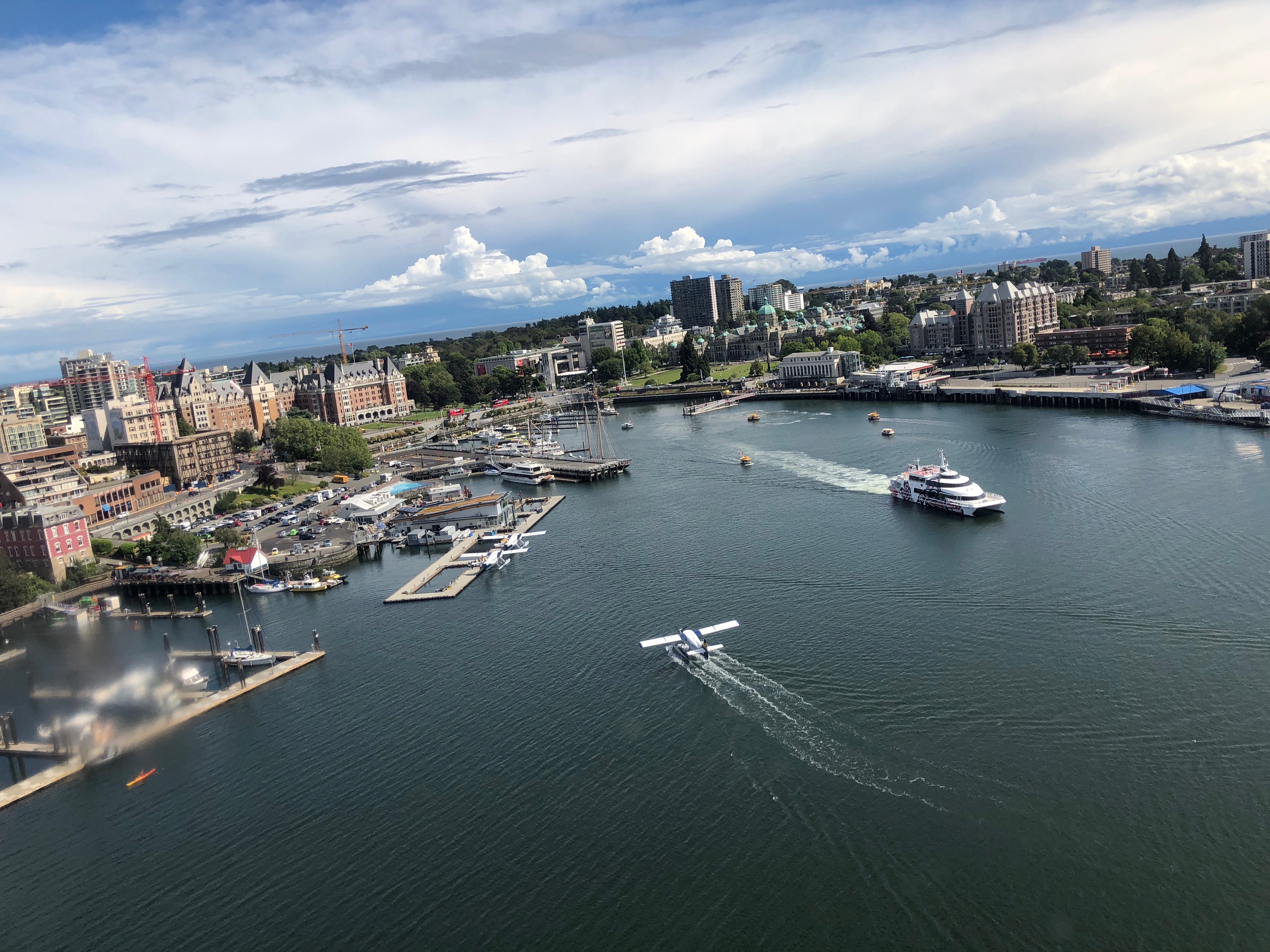
Victoria Inner Harbour
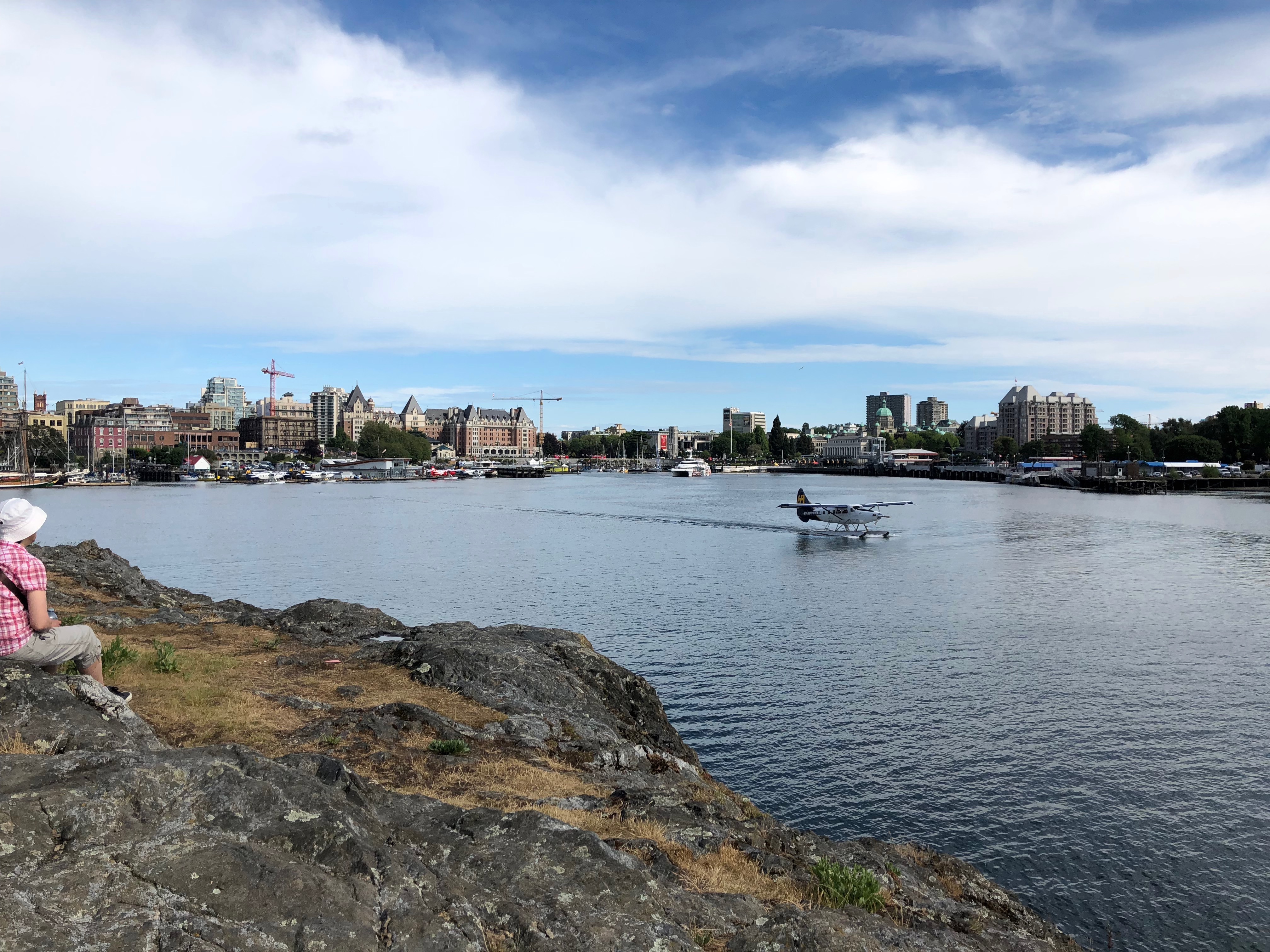
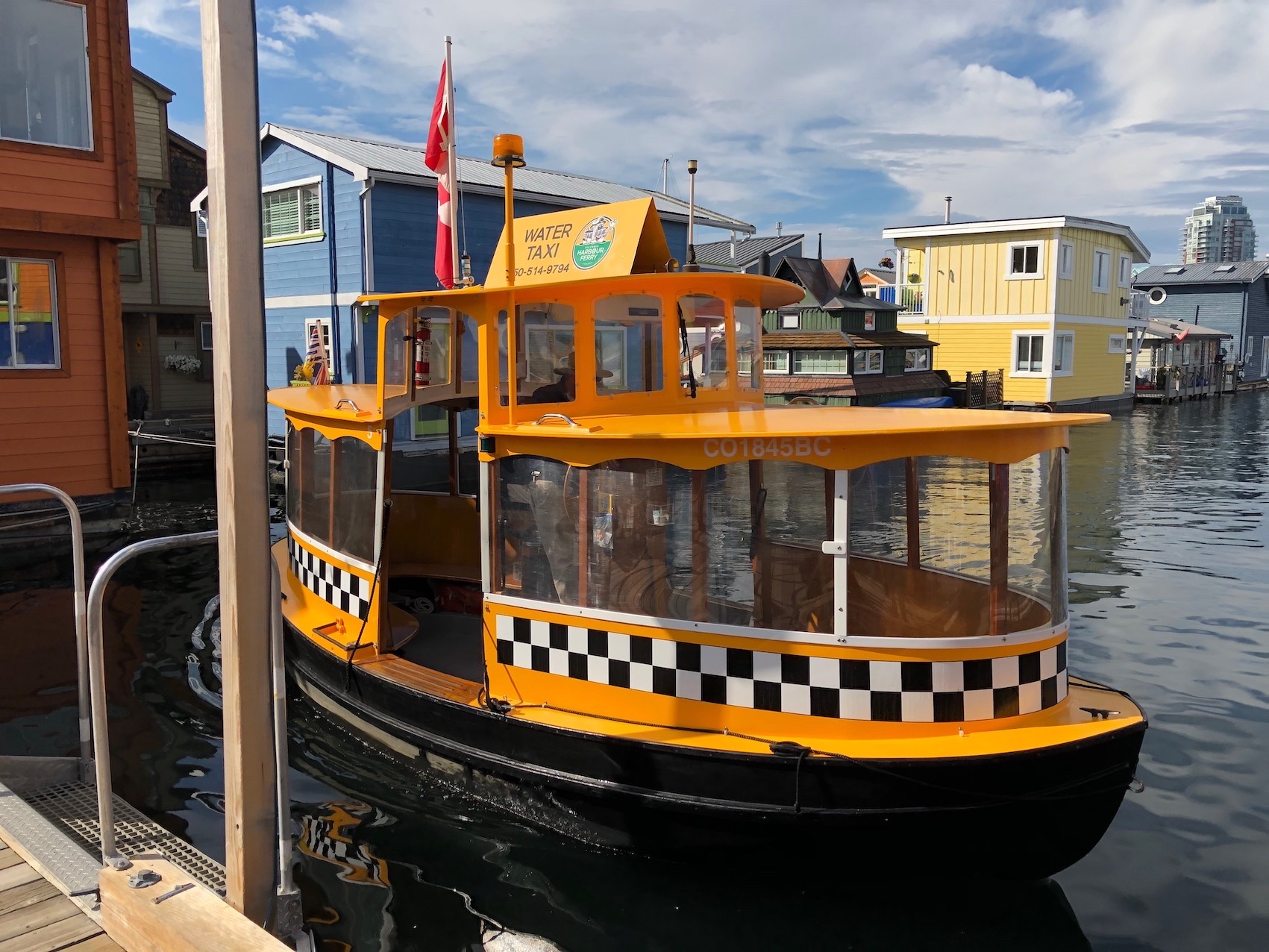
A couple of weeks after that trip I returned with Elaine and our friend Caryn for a two week holiday. The itinerary was as follows: three nights in Victoria, fly to Calgary and pick up a hire car and drive to Canmore in the Rocky Mountains. Three nights were spent there before we moved on to Kelowna in the Okanagan Valley. Another three night stay was spent there before a two night stop in Whistler. After that we were to spend three nights in Vancouver before heading back to Victoria for a night and flying home. Rebecca was to accompany us on the road trip. Victoria again proved to be a most pleasant destination despite it raining quite heavily on the first day. There’s plenty to do there – we visited the Emily Carr House and the Royal BC Museum which kept us out of the rain. With the sun out, wandering round downtown was pleasant, Fan Tan Alley off Chinatown is supposedly Canada’s narrowest street and a popular place; in particular the Kid Sister ice cream shop impressed me no end on both occasions I visited it. The harbour is a great place to wander around and the unique water taxis are a fun way of seeing the city from the water. The harbour also serves as a floatplane base – more of floatplanes later – and if you are lucky you will see seals in the water and dogs on boats trying to out stare each other. Staying a couple of miles from the centre meant we got a feeling of what suburban Victoria was like and the pleasant theme continued there too. We watched Rebecca compete in the Oak Bay 10k to a backdrop of the Olympic Mountains in the USA, just across the Straits of Juan de Fuca. Large houses with well kept gardens, numerous specialist coffee shops and cafes and the odd babbling brook suggested a very nice place to live. Outside the city there are plenty of hikes – on my first visit we went out to the Sooke Potholes, a riverside trail a few minutes west of the city – and gardens to visit. The Butchart Gardens are well known but the HCP Garden, which we visited, is less so. Bald eagles circled overhead, hummingbirds buzzed around and, unusually, wild deer could frequently be seen in people’s gardens nibbling the lawn. As an avgeek I was also delighted with the BC Aviation Museum up at the airport. As you might have gathered, Victoria impressed me greatly. It is popular with Canadian retirees attracted by the mild climate and year round golf, though maybe not the deer eating their rhododendrons.
The Yellow Taxis of Victoria are rather quaint.
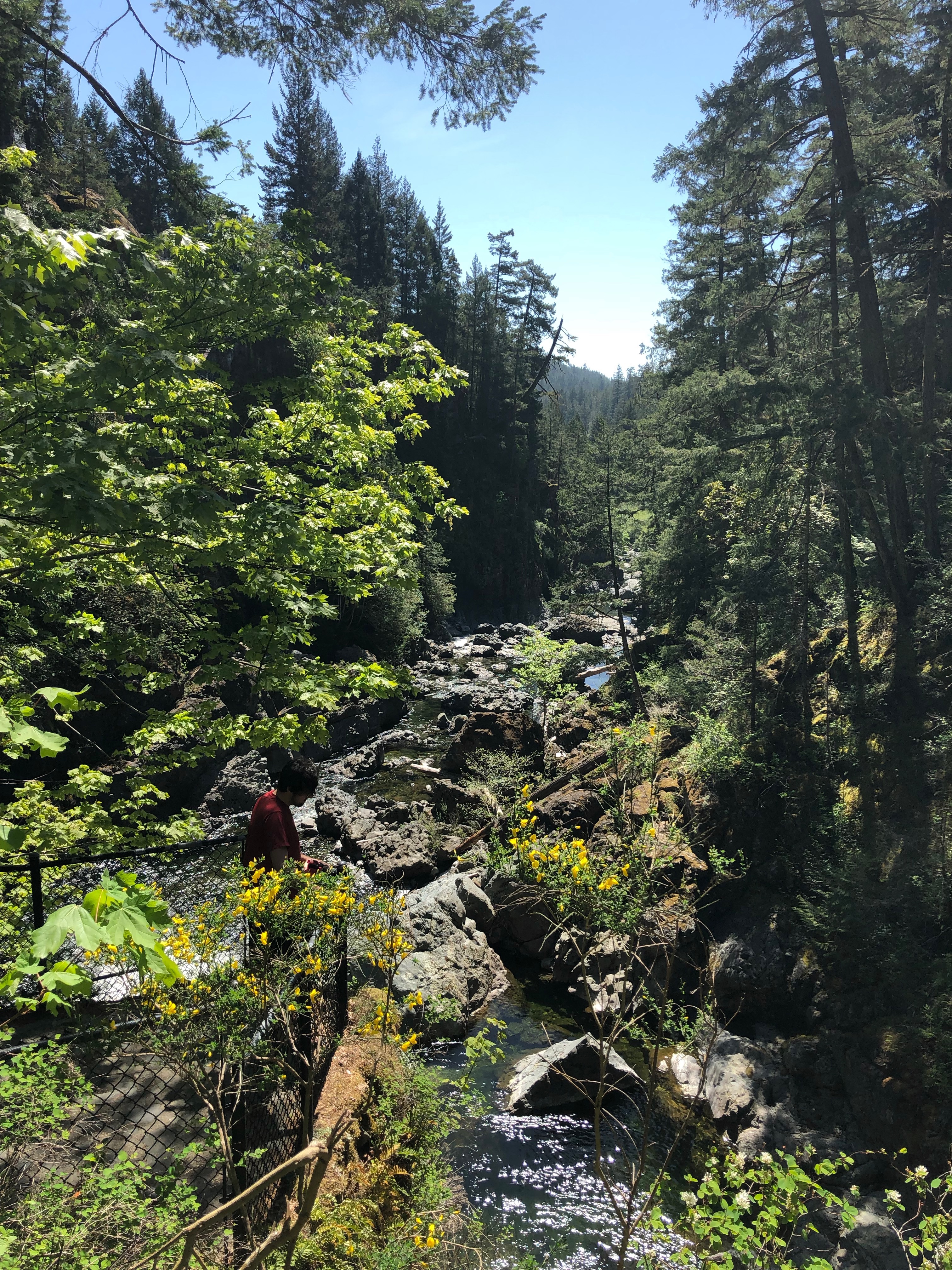
Sooke Potholes
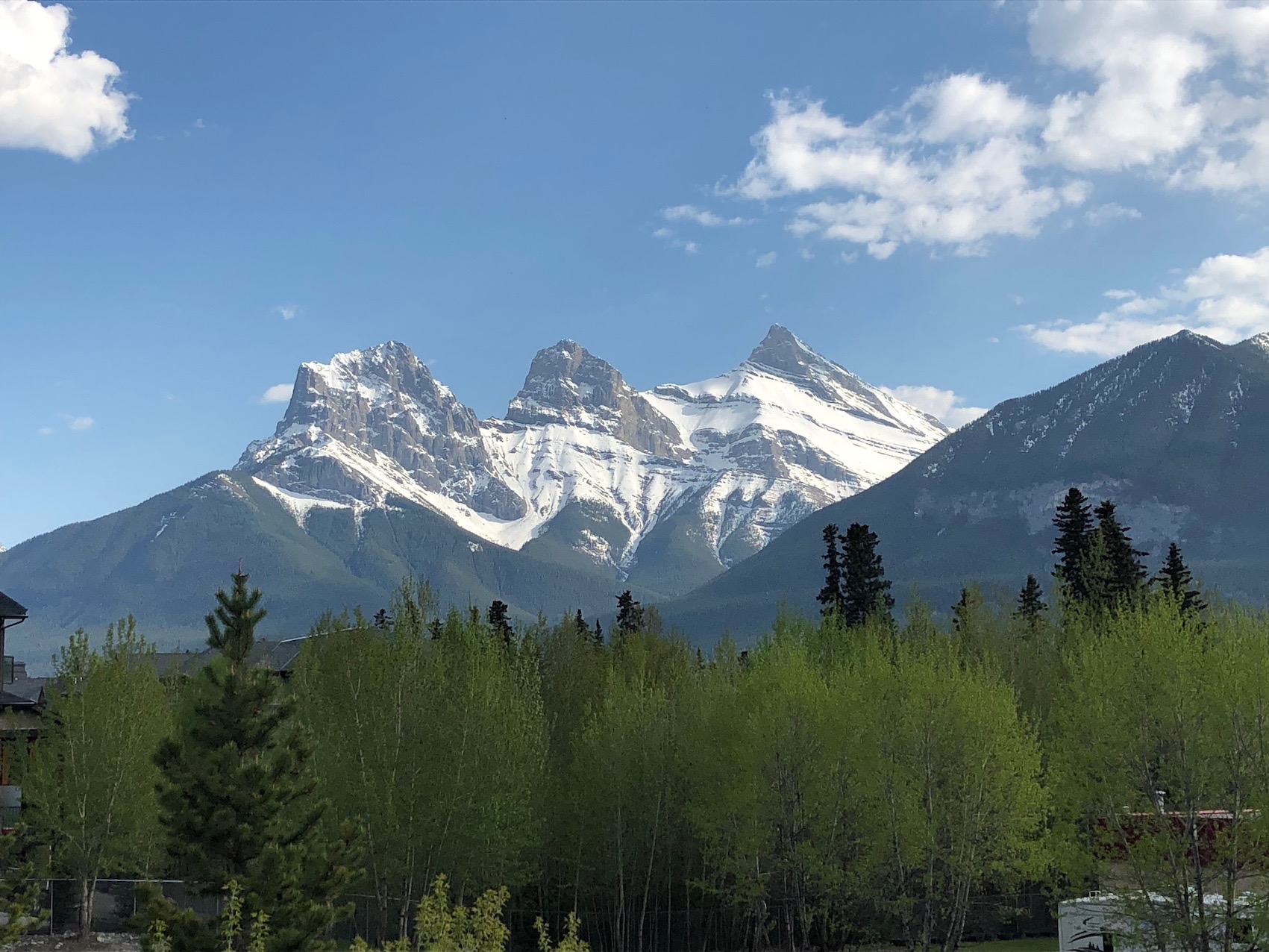
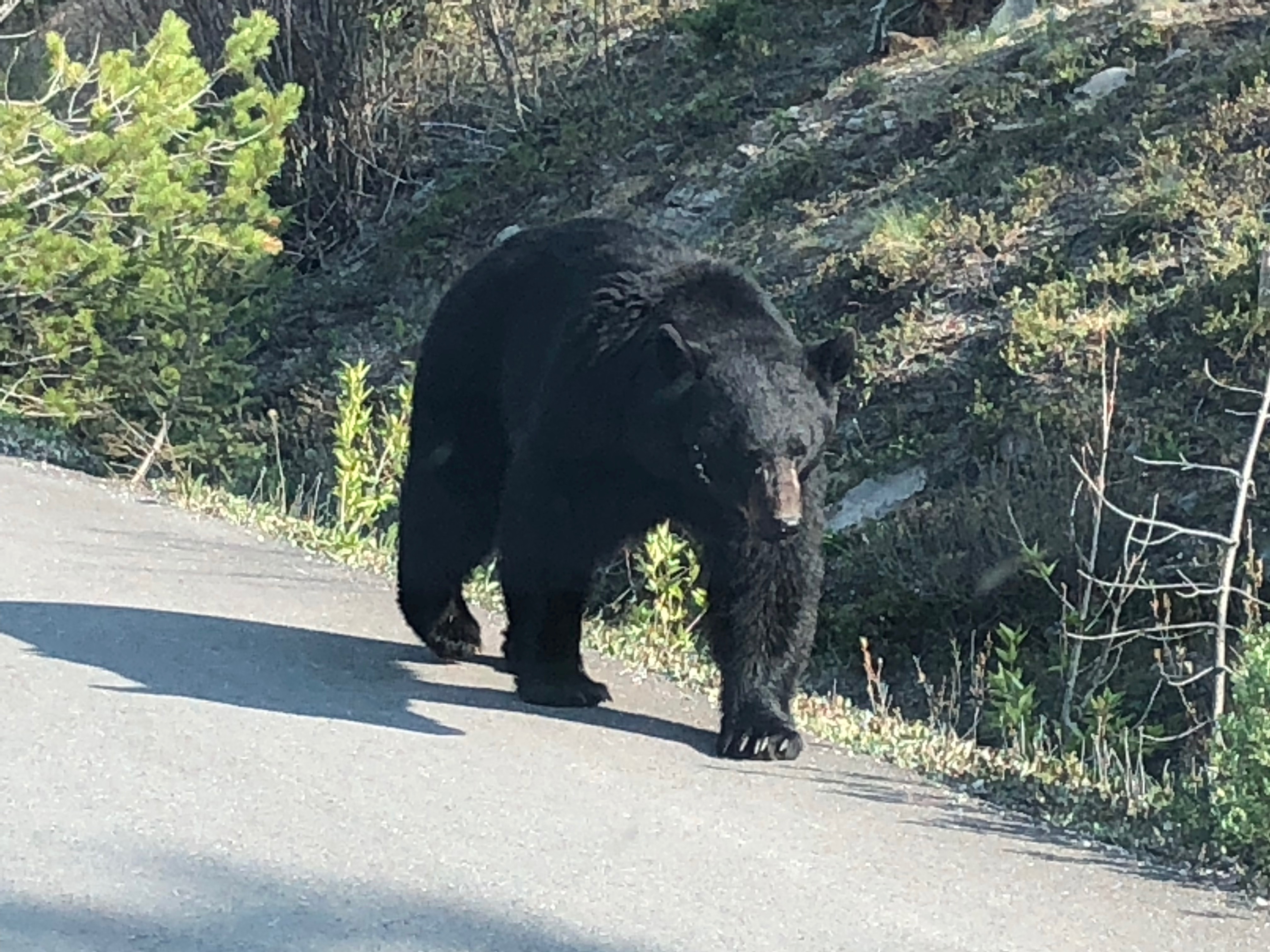
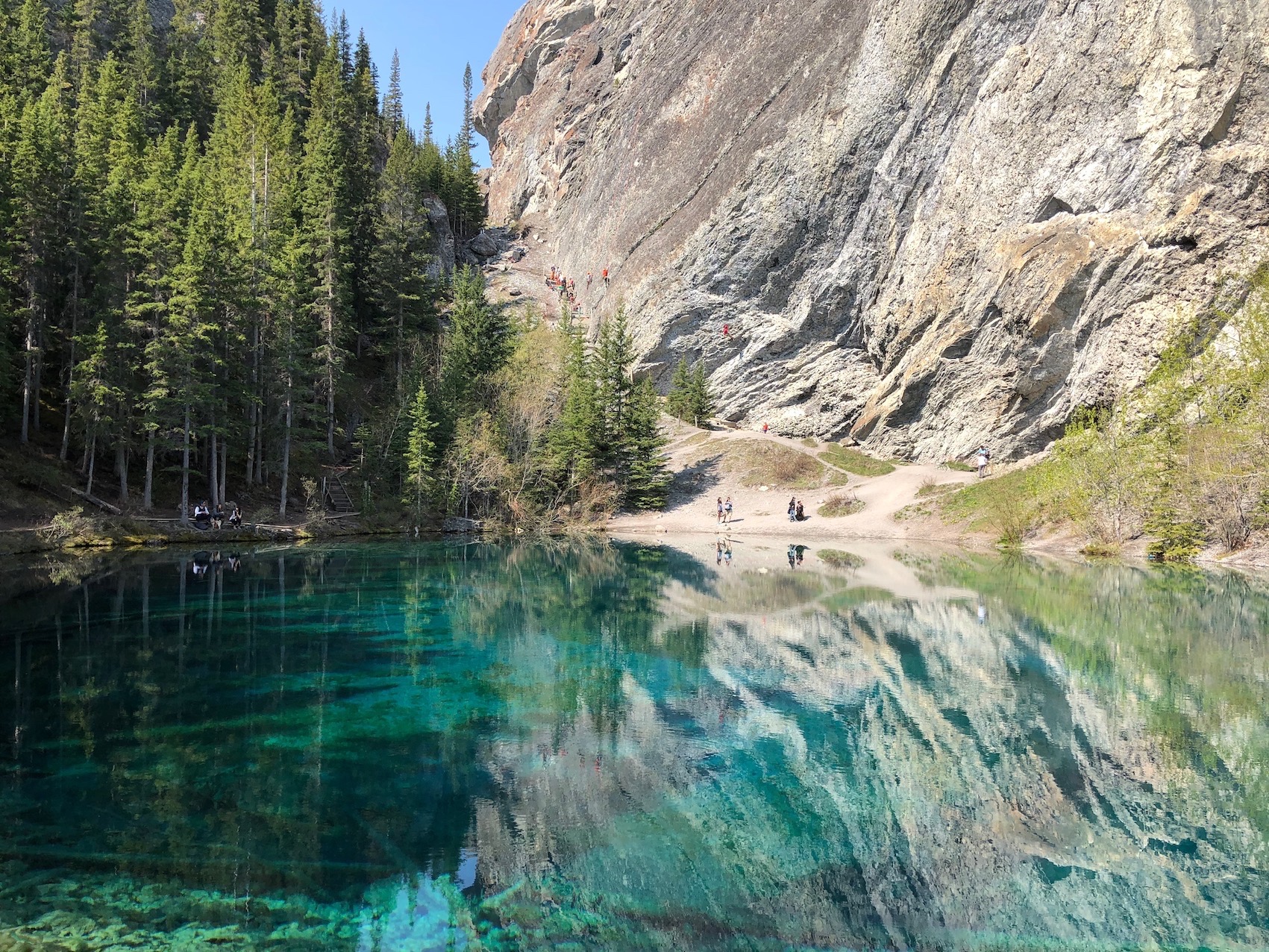
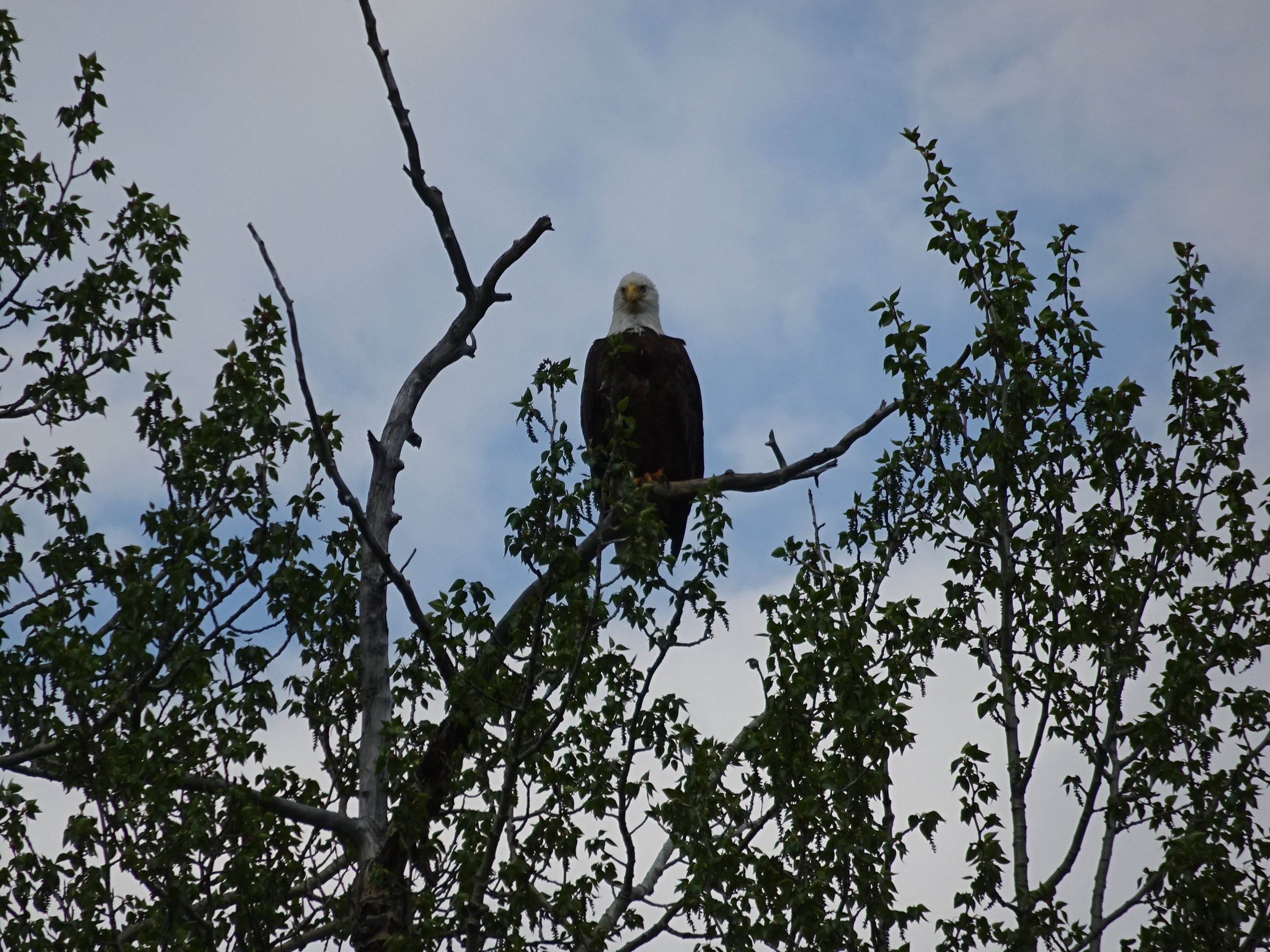
Our flight from Victoria’s small airport to Calgary turned out to be an hour and a half’s delight. There was barely a cloud in the sky all the way and the views were stunning. They were also a reverse order prelude of what was to come with Point Roberts, the Okanagan Lake and the Rocky Mountains all looking at their best from 25,000ft. With a rather large hire car collected, there was much luggage to be carried after all, we immediately headed back west eschewing the delights of Calgary, a rapidly expanding city from what we could see. Our destination was Canmore. Located in the Rocky Mountains, it is some twenty miles from the larger and more well known Banff. A former mining town, the Trans Canada Highway passes through it as does the Canadian Pacific Railway. It is becoming a popular tourist destination in its own right and is situated just outside the Banff National Park meaning it is a cheaper option than it’s rather well to do neighbour. We were billeted in an Airbnb in a holiday village complex with views of the Three Sisters peaks. It proved to be an ideal base. The stars of the show are the mountains themselves and there are many activities to keep visitors happy. We drove the ridiculously scenic Icefields Parkway to visit the Athabasca Glacier where large snow buses take you on to the ice and later you can walk the glass floored walkway over the edge of the valley. Whilst in itself this was worth the early start and long drive, the sight of a black bear nonchalantly strolling down the hard shoulder of the road was one we will all treasure for the rest of our days. We saw several other bears that day though none as close as this one. We visited Banff on the way back. We avoided the hot springs but did discover the Bow River walk from the town to the huge luxury Banff Springs Hotel. It was delightful in the early evening sunshine. The following day Canmore itself provided the entertainment with a hike up to the small yet glorious Grassi Lakes and a raft trip along the Bow River. Here our fauna count increased significantly with, amongst others beaver, elk, ospreys and a Bald Eagle who appeared to be the boss of the area. Rebecca was particularly taken with Canmore and after only a short visit I can see why. It’s a very nice place in the summer, though I can only imagine how cold it gets in the winter.
Three Sisters
Just a passing bear, thankfully not too hungry.
Grassi Lake
Bald Eagle
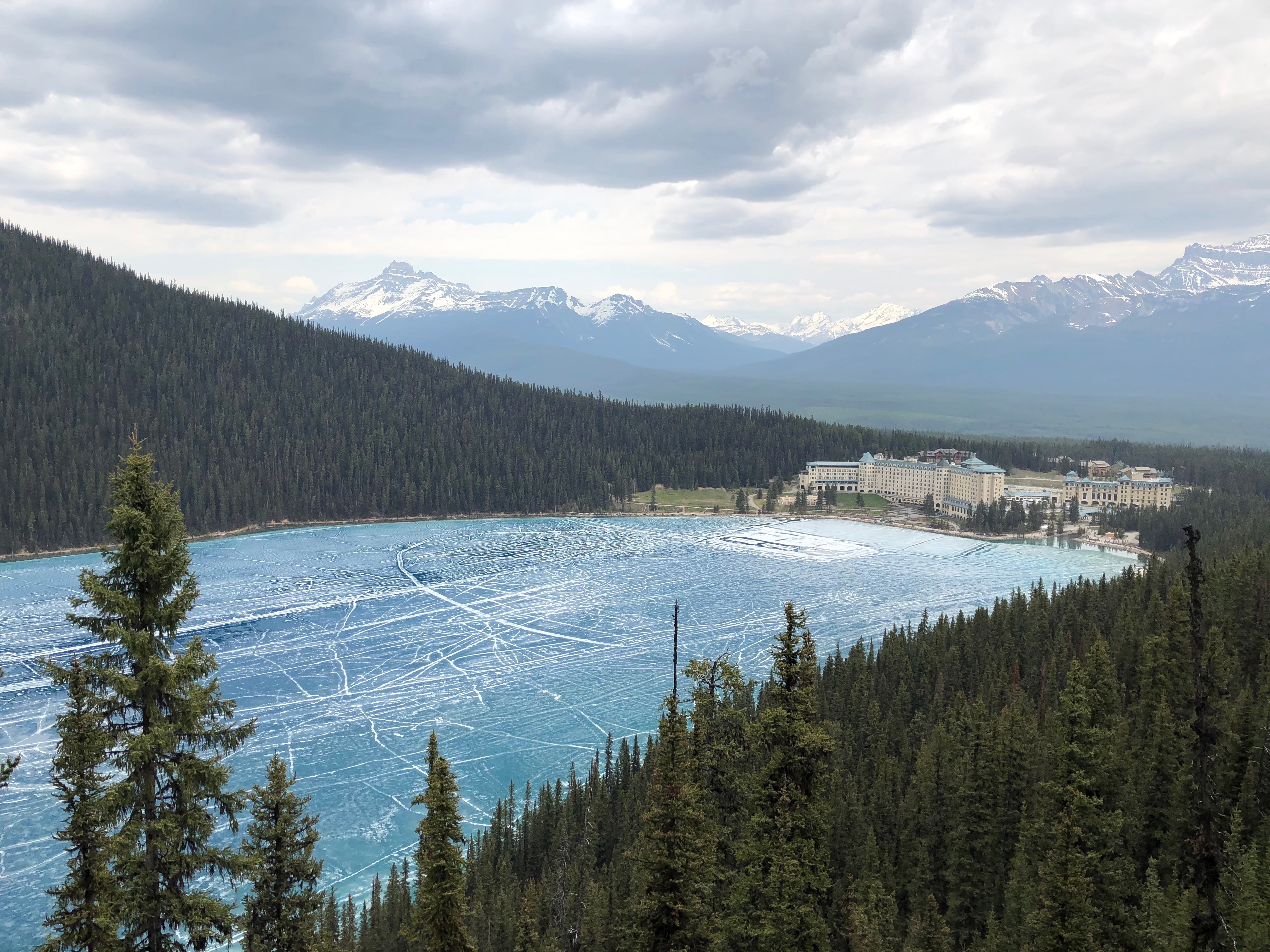
It took us a long time to get to West Kelowna. That was partially due to us stopping at Lake Louise. This is a popular stop on any tour of the area. It is extremely easy on the eye and the vivid turquoise colour of the water makes for a special photograph. The preceding winter had been harsh, however, and the lake was still covered in ice for our visit. It didn’t really matter, it was still outrageously picturesque, especially if you hiked up to the Fairview Lookout. This was made tricky by patches of ice and snow but Rebecca and I made it up and almost down again before I slipped and inelegantly landed in the slush. It was still worth it though. Much of the rest of the day was on the road. We passed from Alberta into British Columbia and later from the mountain to the Pacific time zone. The extra hour we gained came in useful. The Trans Canada Highway is being widened along the stretch we were driving on leading to some roadwork delays, and an accident caused a ninety minute hold up. As previously mentioned Canada is big. On a day like this it seemed it. Eventually we rolled into our accommodation in West Kelowna, another Airbnb with a view not quite as spectacular as the one in Canmore but not at all bad.
Lake Louise Skating Rink
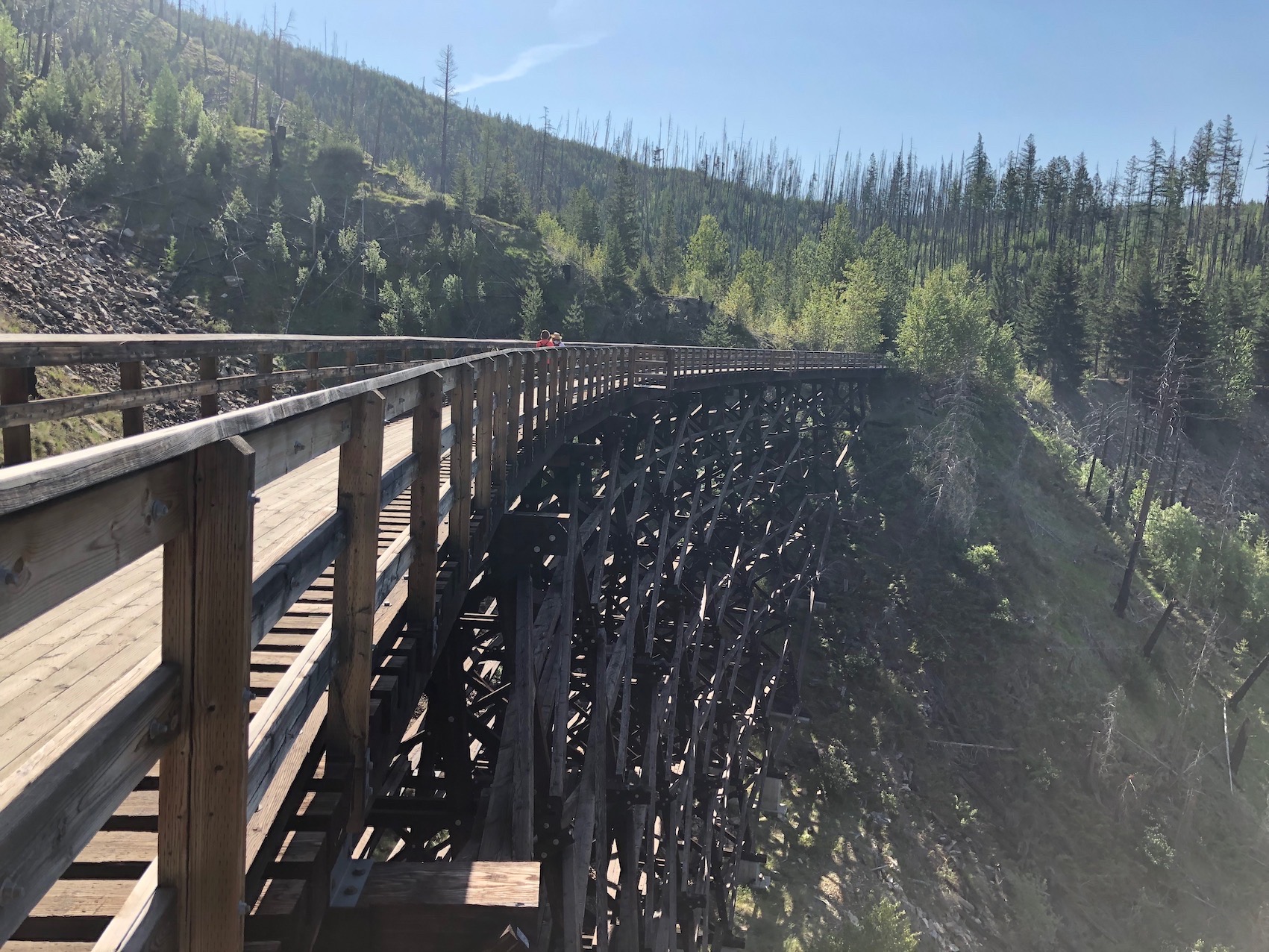
The Okanagan region of southern British Columbia is the area around the large Okanagan Lake. It has its own micro climate which is milder than the rest of the country. Indeed, whilst we were there the temperature hovered around the 30C mark. A fertile region, it was popular with fruit farms and still is today, though the major fruit produced is now the grape rather than the apple. Vineyards cover the slopes that rise from the lakeside. Sampling all the wines that are produced could take a very long time indeed though it doesn’t stop people from trying. Kelowna is the major city and is somewhat larger than we had expected. It has a lovely aspect, however, with the lake on one side and mountains on the other. Up in those mountains once ran trains. The Kettle Valley Railway connected the region with the main Canadian Pacific line further north. For some reason known only to the surveyors it was built high in the hills, through forests and across canyons, so high in fact that it didn’t even visit lakeside Kelowna, the largest town in the region. The last train ran in 1973 but since then a section has been restored as a cycle and hiking track. We walked some of it which entailed a drive up a distinctly dodgy access road to its start. The route across Myra Canyon is spectacular and all the more impressive being where it is. Tunnels and cuttings were carved out of the rock as the track clung to the hillside but the standout attractions are the eighteen trestle bridges that traverse the chasms that shoot off the sides of the Canyon. Further south there is a section of the railway that is still operational as a heritage line. We didn’t get to try it unfortunately but did view it as we sampled cider in what was a break from the vineries. Like Canmore and the Rockies, Kelowna and the Okanagan is a place that warrants further attention.
Trestle Bridge, Myra Canyon, Perfectly Safe
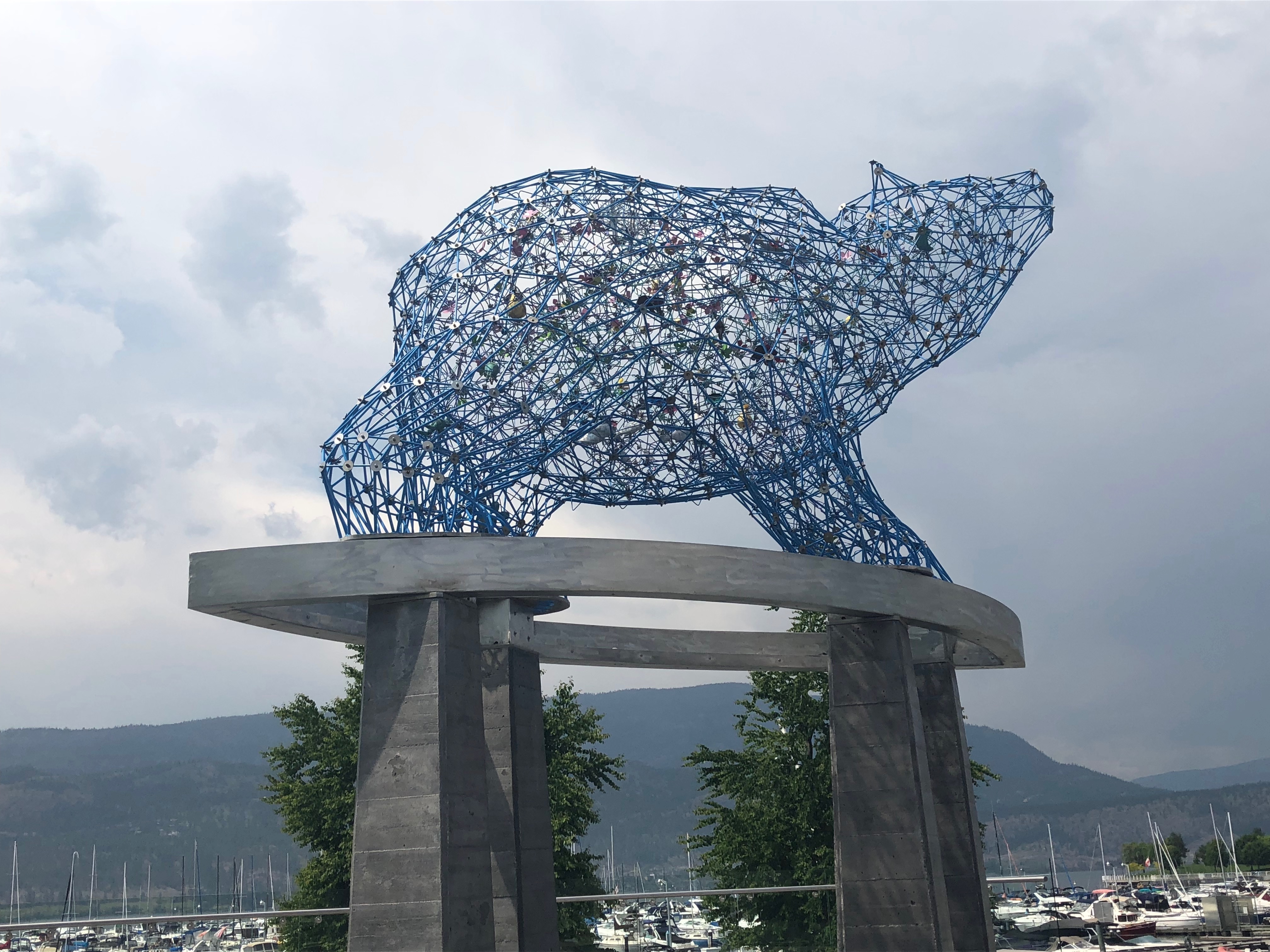
Blue Grizzly, Symbol of Kelowna
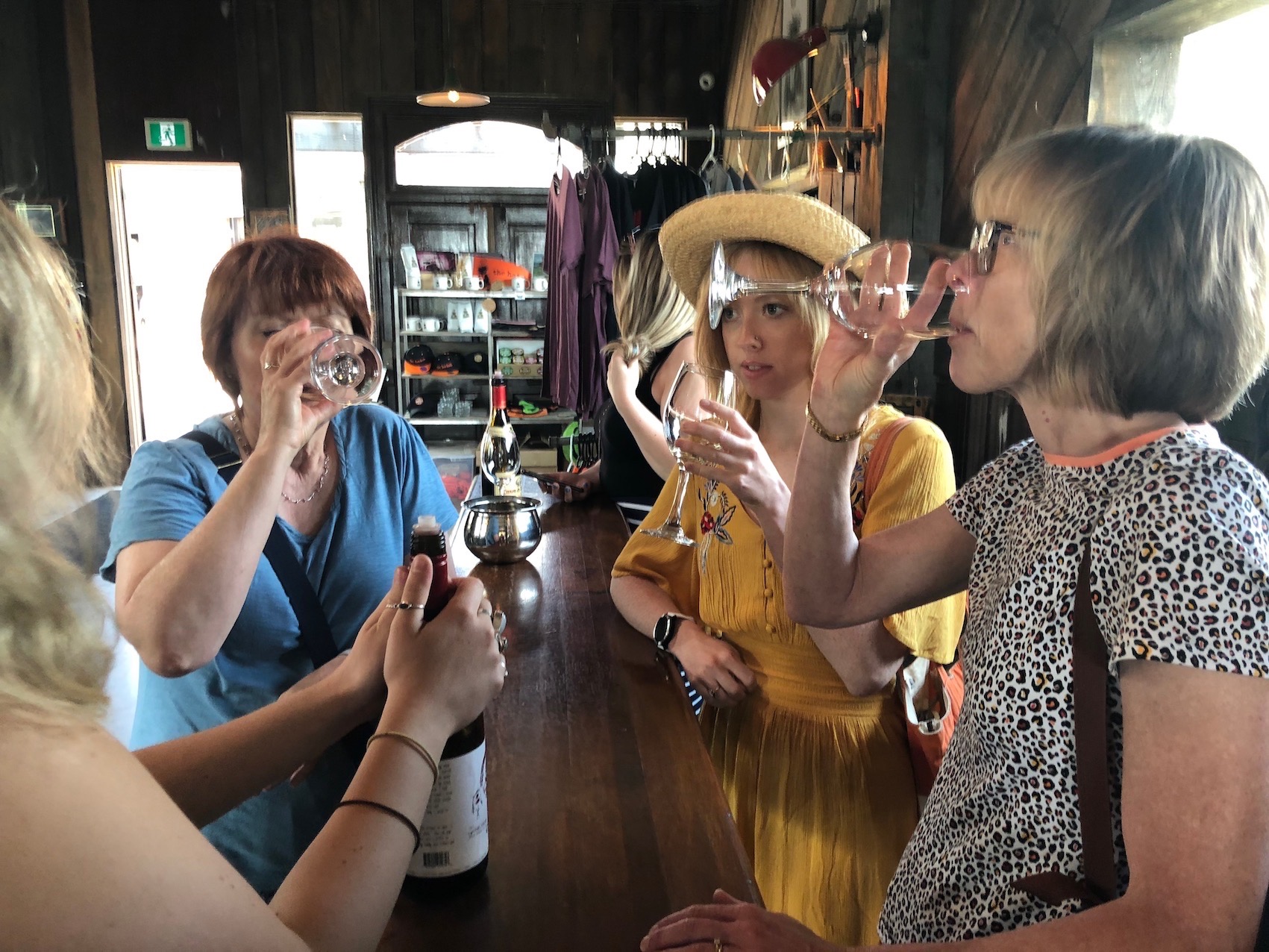
Drinking Wine, Symbol of the Okanangan.
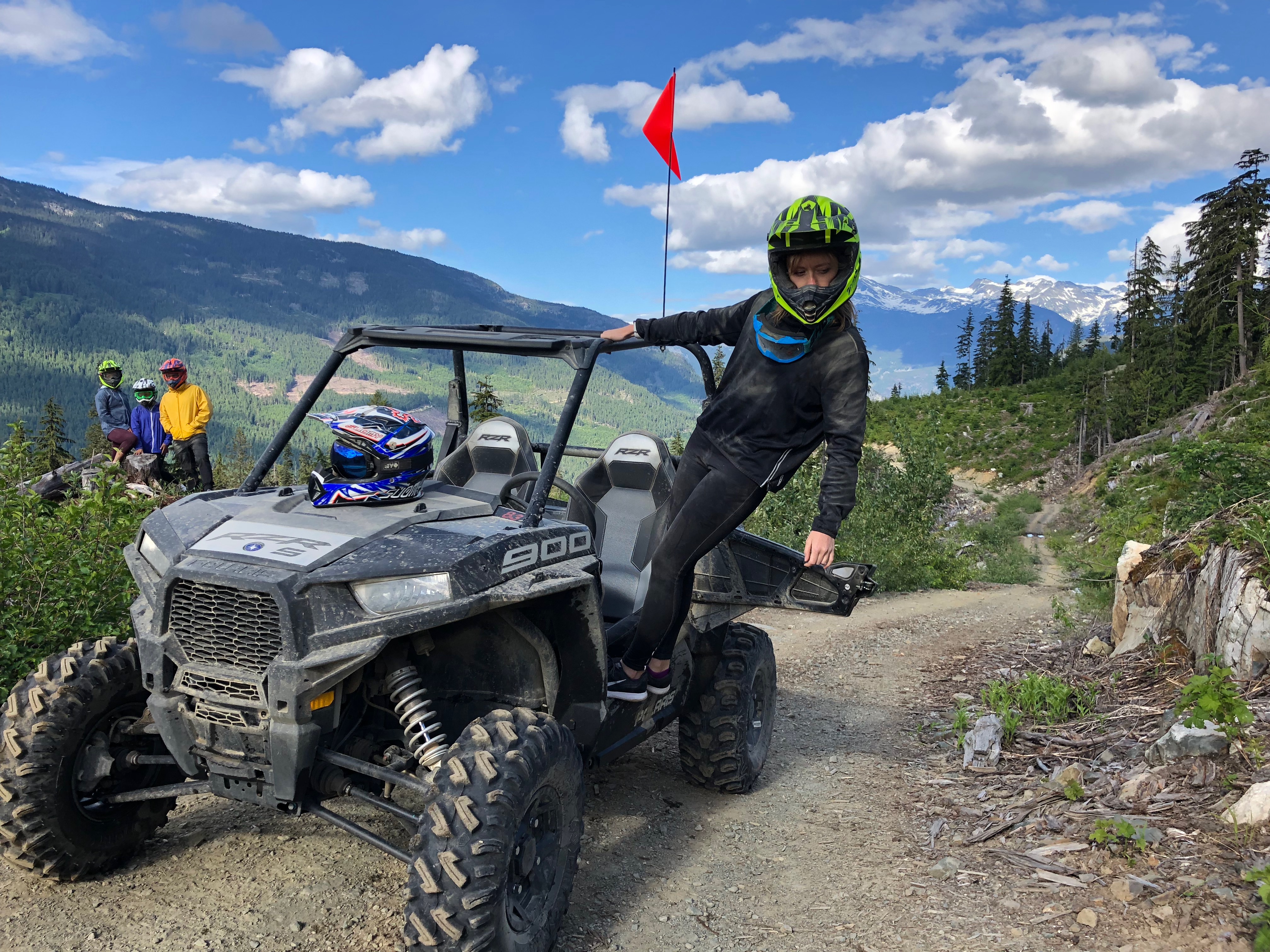
It was another long journey to our next destination, Whistler. The quickest way would to have stuck to the freeway and passed through the Vancouver suburbs. For a short time penalty you can also go the scenic route via Cache Creek and Lillooet. The views on this route are spectacular and if you can, take it in turns to drive so everyone gets a chance to enjoy the views. You can also do worse than stop at Historic Hat Creek just outside Cache Creek. This was a roadhouse on the Cariboo Trail goldrush of the 1860s and remains as a tourist attraction, and a handy refreshment stop, to this day. Thankfully there were no hold ups on what was a quiet road, though the temptation to stop and just take in the views was high, and we arrived in Whistler for a couple of nights of R&R. Whistler is a ski resort and the village itself is less than fifty years old. Out of the ski season it still receives hoards of tourists drawn to the mountains for the many outdoor pursuits that take place, or just the scenery. It is a party town and sometimes those parties go on a bit too long. Our hotel was in the middle of the village and just across the way from our room was one bar that proved rather noisy. Lesson learnt, stick to out of town accommodation next time. The cable car up the resort’s two mountains, Whistler and Blackcomb, is expensive and as the hiking trails up the top were not yet open we gave it a miss choosing a walk that commenced in the village itself. Zip wire runs, white water rafting and mountain biking were just three of the activities that could be sampled. Rebecca and I decided to try the RZR off road adventure. These 4×4 buggies bounced us around trails through the forest where no vehicle should have been able to pass, covering us in dust and affording us some spectacular photo opportunities. It was great fun and I’d do it again in a heartbeat. If that doesn’t really sound like R&R then the hotel pool provided that but I was sad to leave Whistler with the zip wires untested.
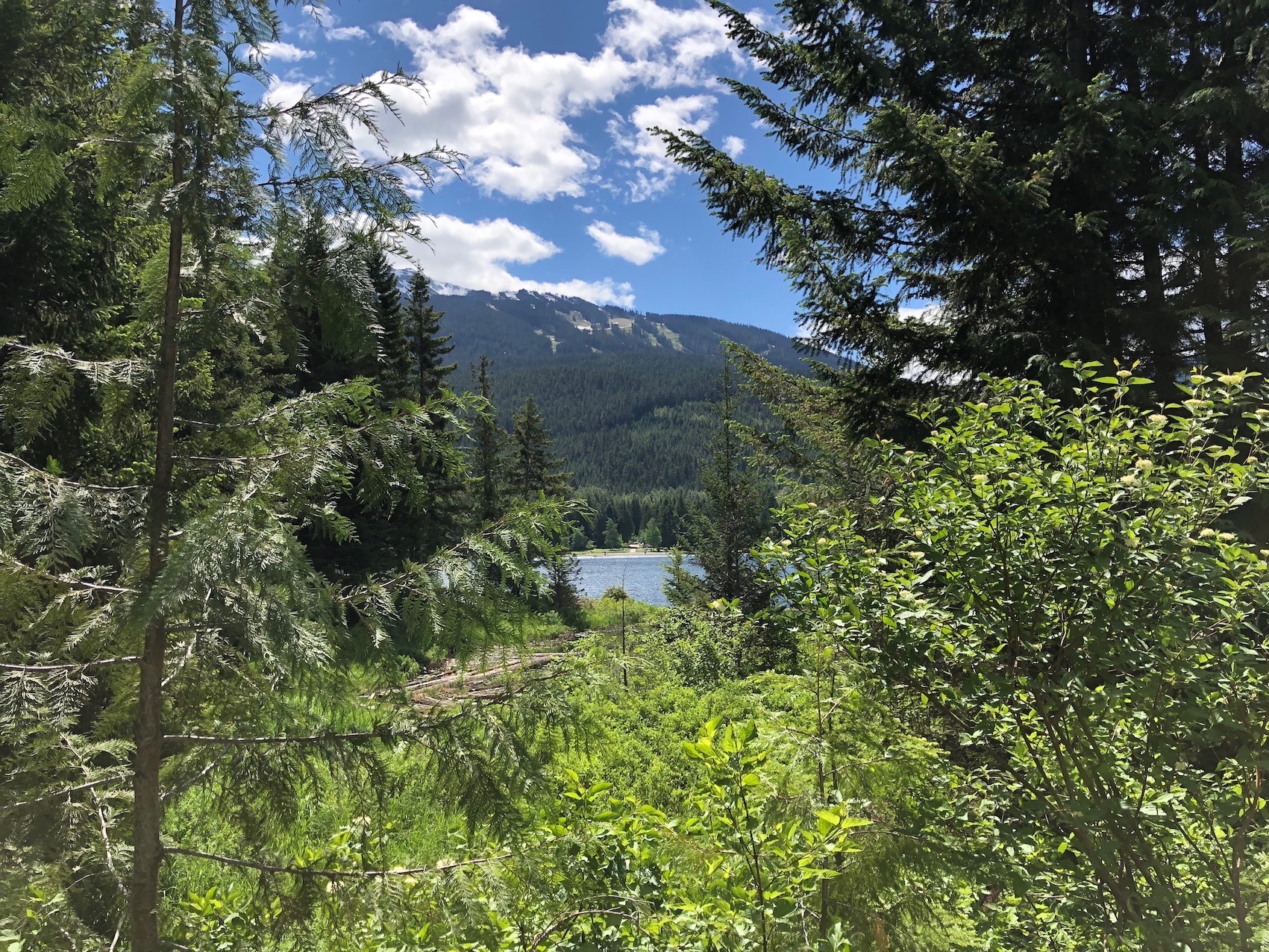
We Found the Lost Lake.
RZR Fun
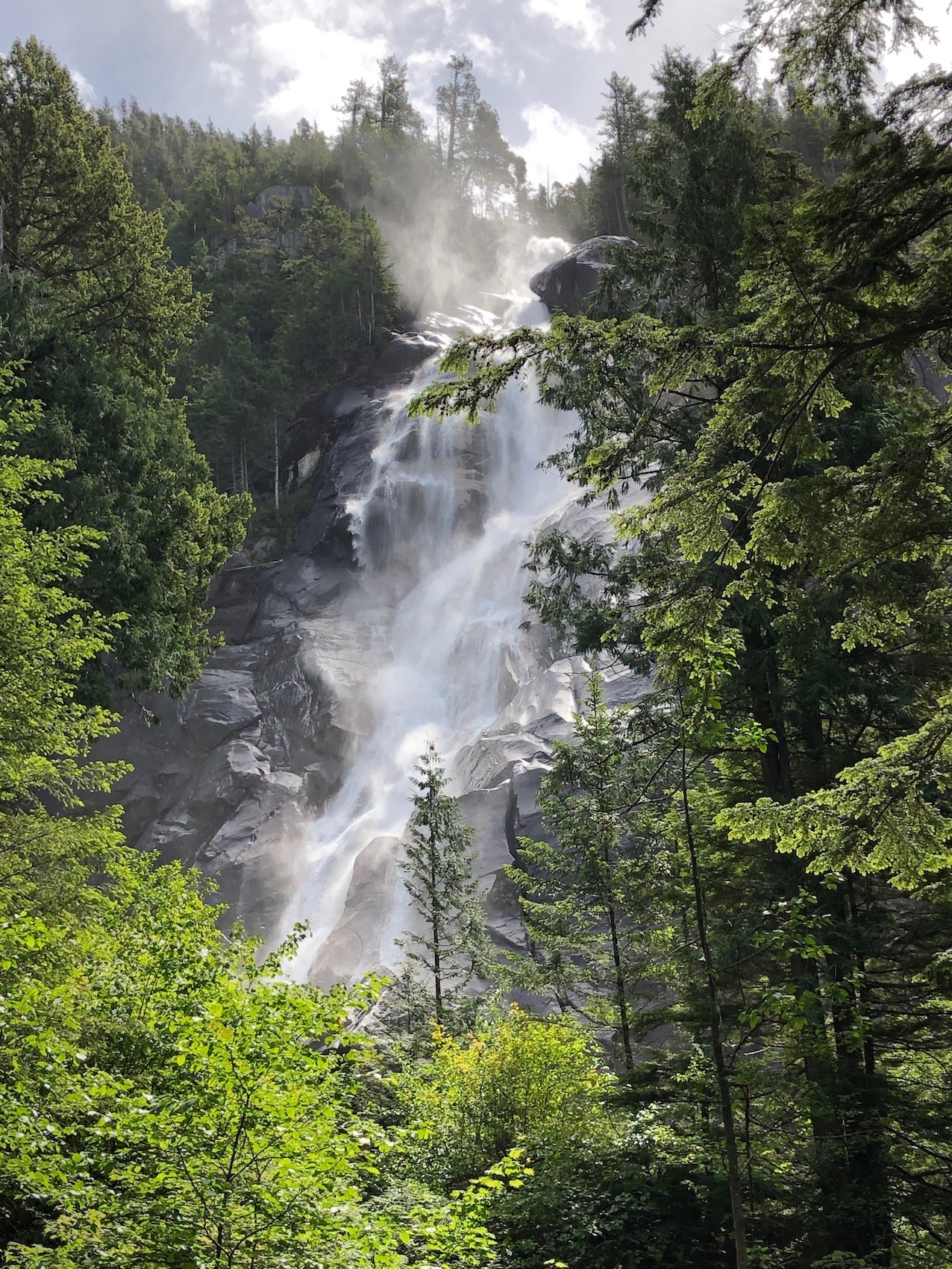
Shannon Falls
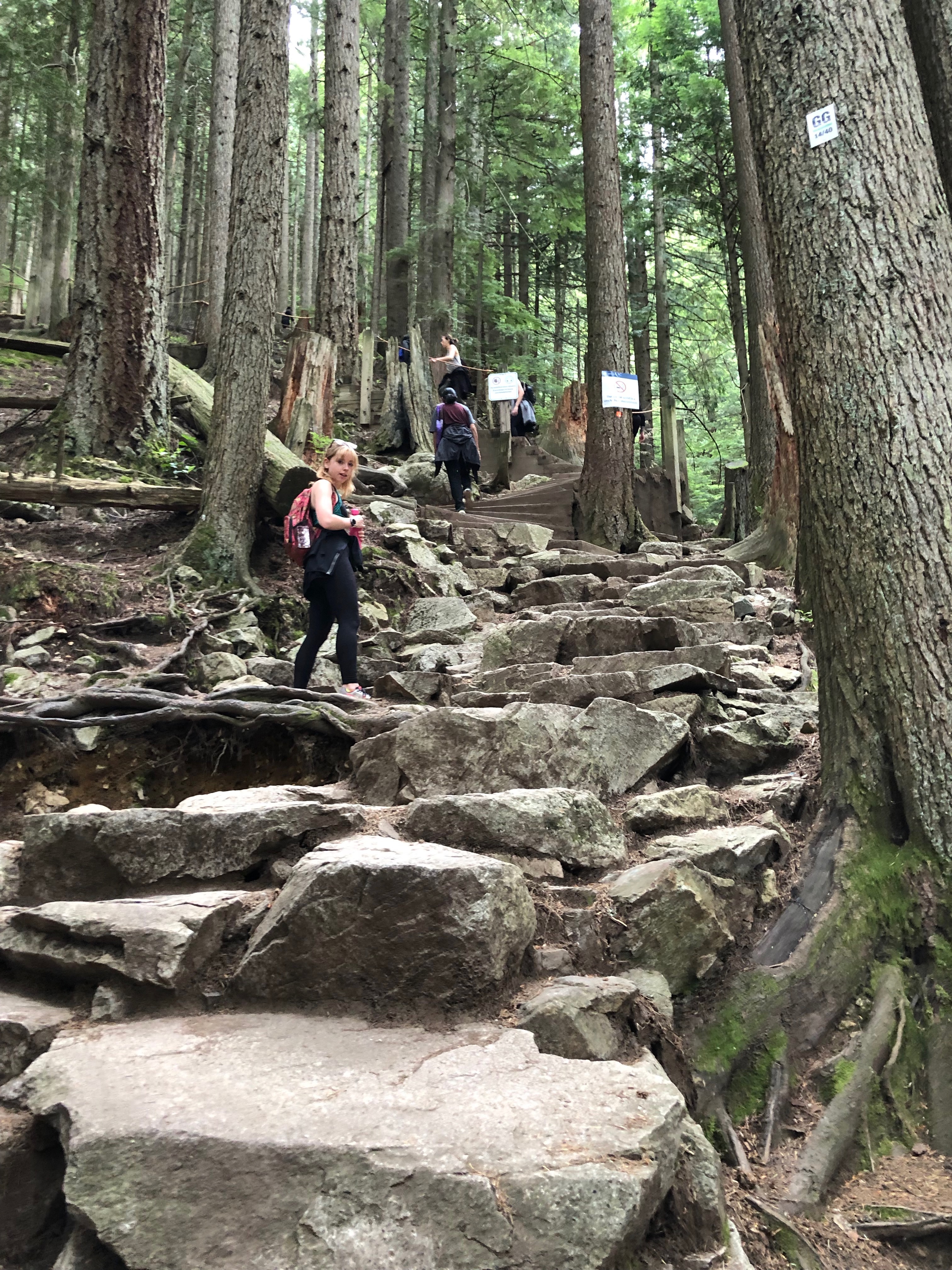
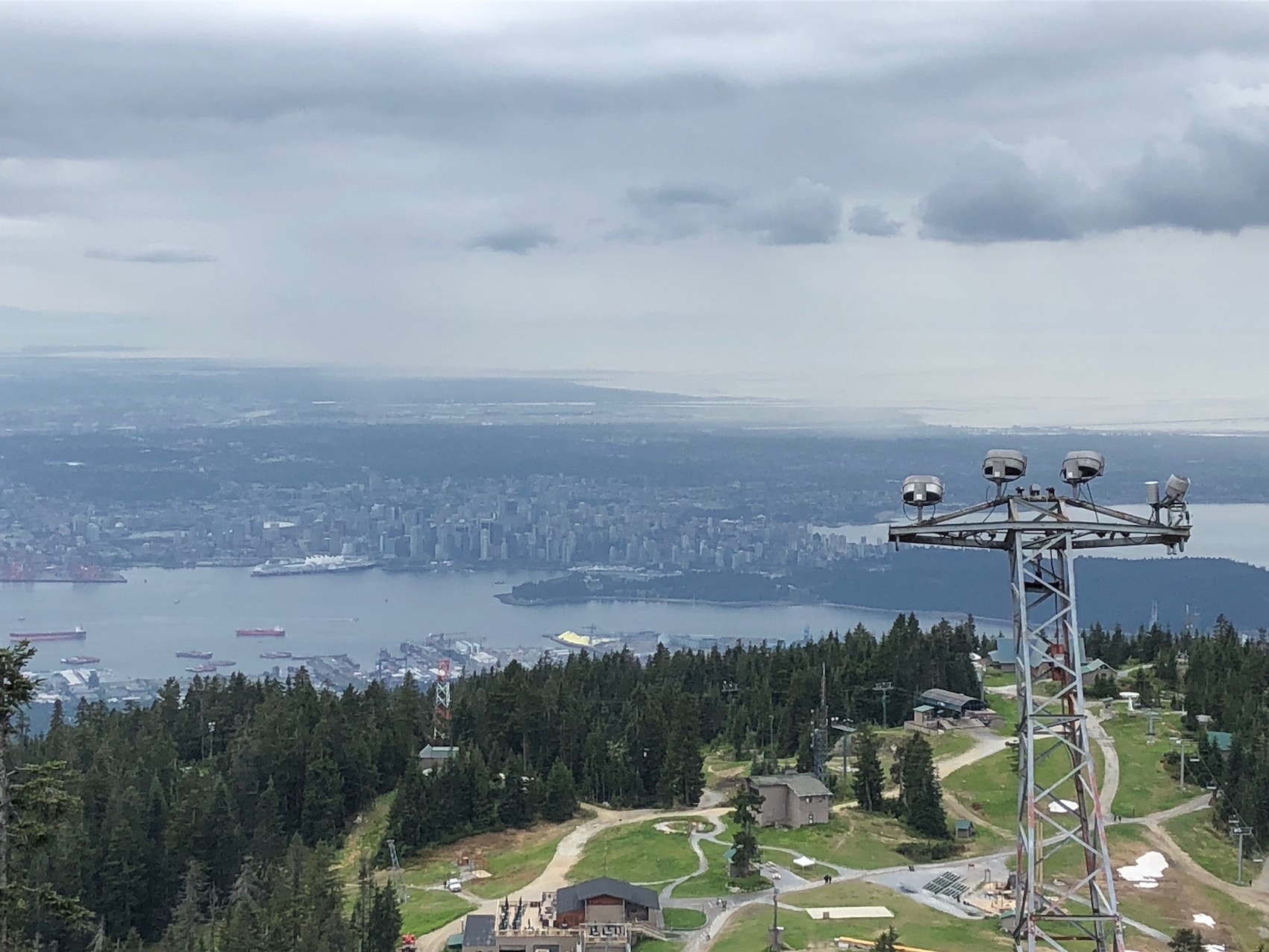
The drive to Vancouver was a short one but, as with just about any drive in BC, scenic. The Sea to Road Highway offers a direct connection between the popular resort and the huge metropolis and, after a brief stop to admire the Shannon Falls just south of Squamish, we hit the inevitable traffic before reaching our Airbnb in a suburb just a few minutes southeast of downtown. Vancouver frequently pops up as people’s ideal city. It’s true that it is located in a lovely setting with the harbour backdrop being mountainous, the other side of downtown having English Bay with the large green space that is Stanley Park to the north. The city itself is, however, a fairly typical north American grid, the blocks populated with high rise office blocks and numerous apartment buildings to accommodate a burgeoning population. To the south the suburbs seem a nice place to live but go on for many kilometres, again in a grid pattern of named streets and numbered avenues. One tip is to avoid East Hastings street on the edge of downtown. We went down it on the bus and we were shocked at the amount of people living rough there. Homelessness is a big problem everywhere it seems. Here it appears to be monumental. I had run one street away in the Half Marathon and was completely unaware of what was happening just a block away. Vancouver does have its attractions, however, beyond the aforementioned setting amongst water and mountains. Grouse Mountain is one of the peaks that provide the backdrop to the harbour. You can ascend it by cable car or, if you are feeling energetic, you can take a trail that is worryingly called the Grouse Grind. We did. It was serious hard work. You climb 2800 ft over less than two miles. It is stepped, though the word step has a rather loose meaning here. It took Elaine and I an hour and a half, Rebecca with youth on her side did it in twenty minutes less. It’s not a task to be taken lightly but it is some sense of achievement when you reach the cafe and a welcome beer at the top. Once there you have a choice of activities to enjoy – falconry and lumberjack displays, chairlift to the peak, zip wires, a full waiter service restaurant amongst others, or you can simply admire the views. Don’t even think of walking back down, however, it’s dangerous and against the rules. A one way ticket on the cable car gets you back to the car park in six minutes.
Grouse Grind. Relatively Easy Section.
Vancouver From The Peak of Grouse Mountain
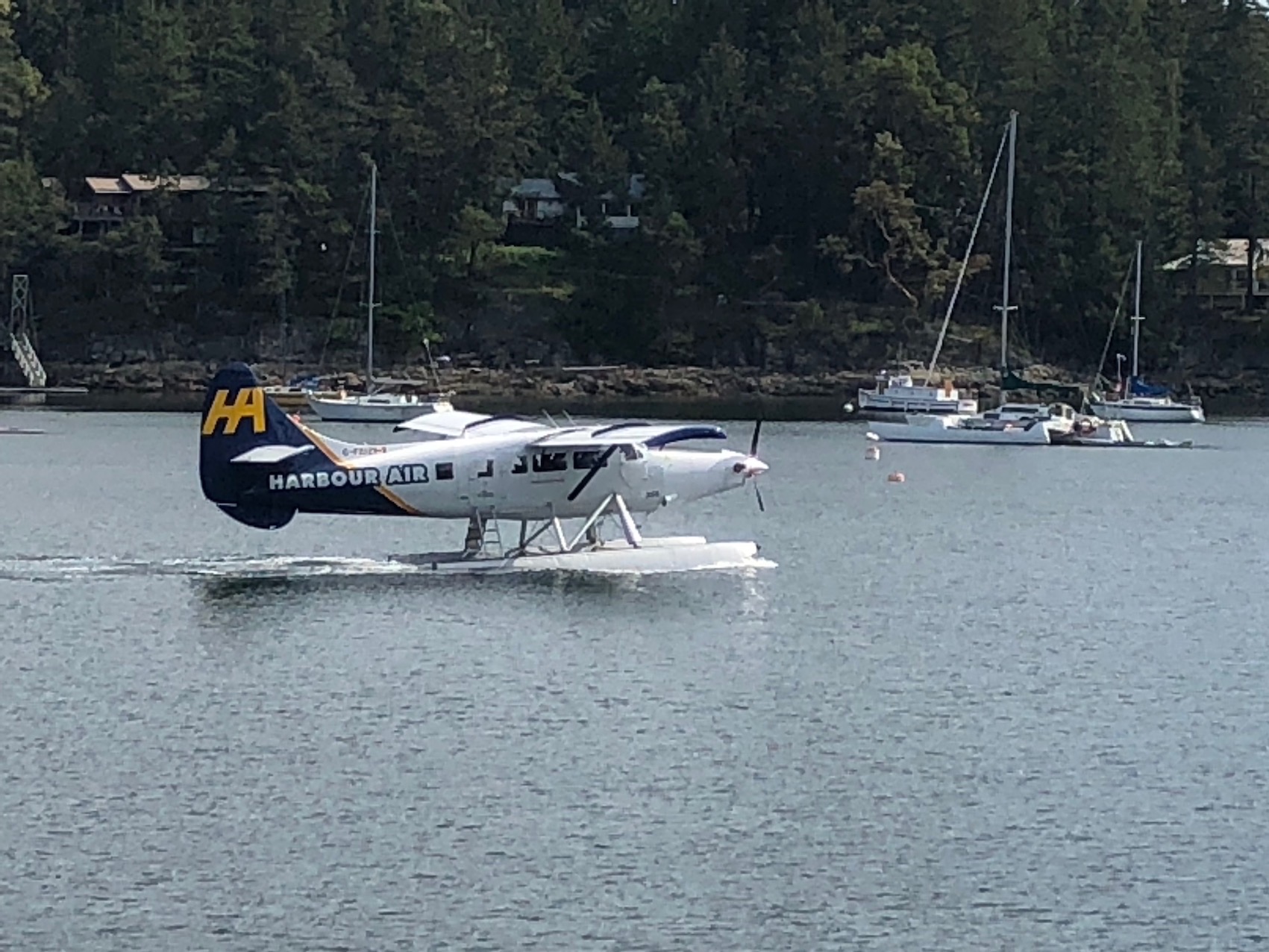
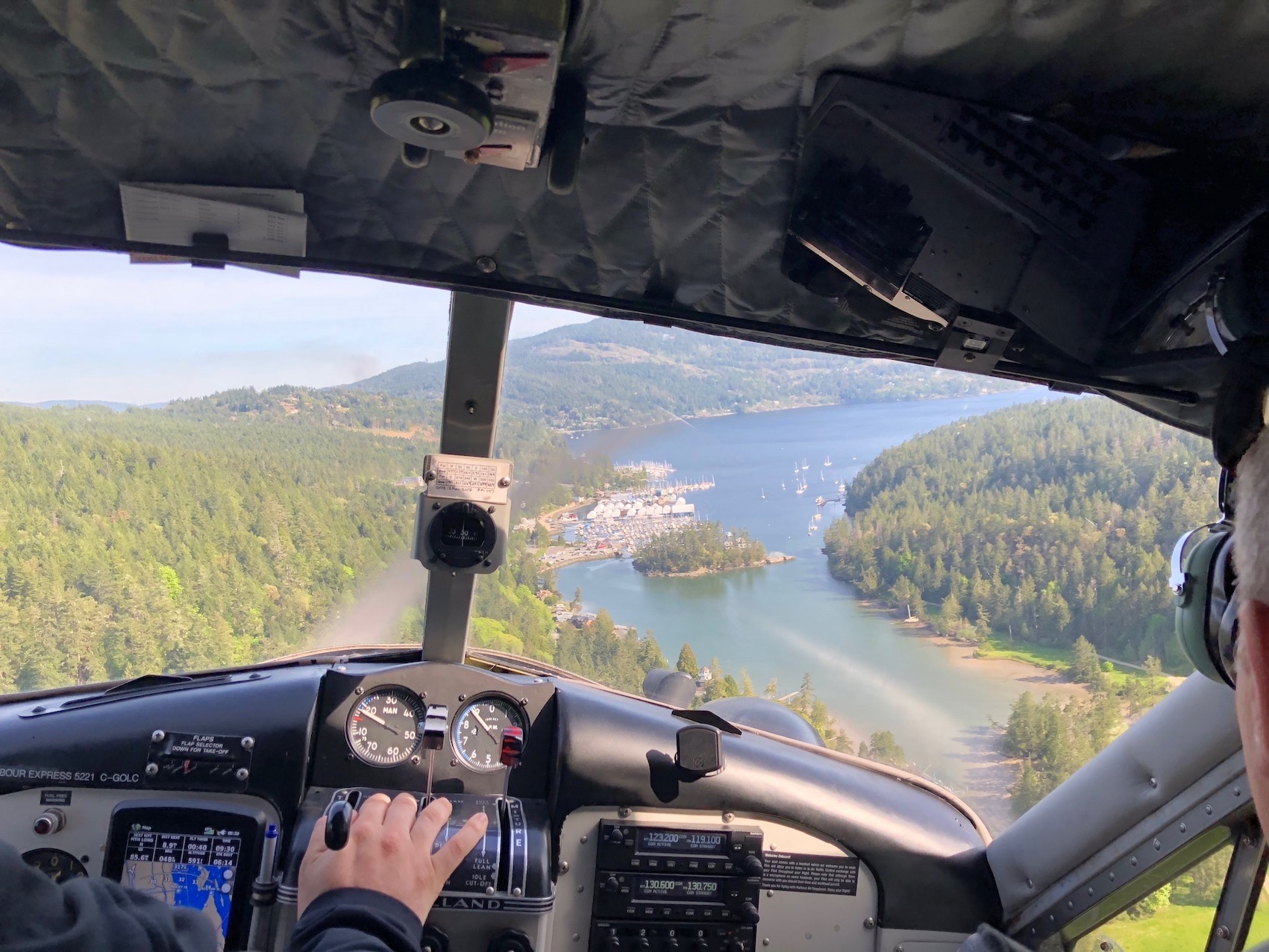
I previously mentioned the seaplanes in Victoria Harbour. This neck of the woods is a seaplane heaven and both Harbour Air and the smaller Seaair operate services out of Vancouver Harbour. There are many scenic flights operated alongside scheduled services. On my first trip, the day after the Half Marathon, I indulged in Harbour Air’s ‘Mail Run’. This involved an early start with an 08:40 departure from Vancouver Downtown Airport (ie, the harbour) but was a magnificent experience. I flew to Ganges on Salt Spring Island. There I transferred from a fourteen seat Otter to a six seat Beaver to make the short hop to Maple Bay on Vancouver Island. The stay there was brief before returning to Ganges where I was left to discover the town for two or three hours. That’s plenty of time, believe me, nice though the place was. Then you take the scheduled flight back to Vancouver completing a memorable morning with four water take offs and landings. I don’t know why but there is something special about taking off and landing on water.
Seaplane Heaven
Short Final, Maple Bay Airport
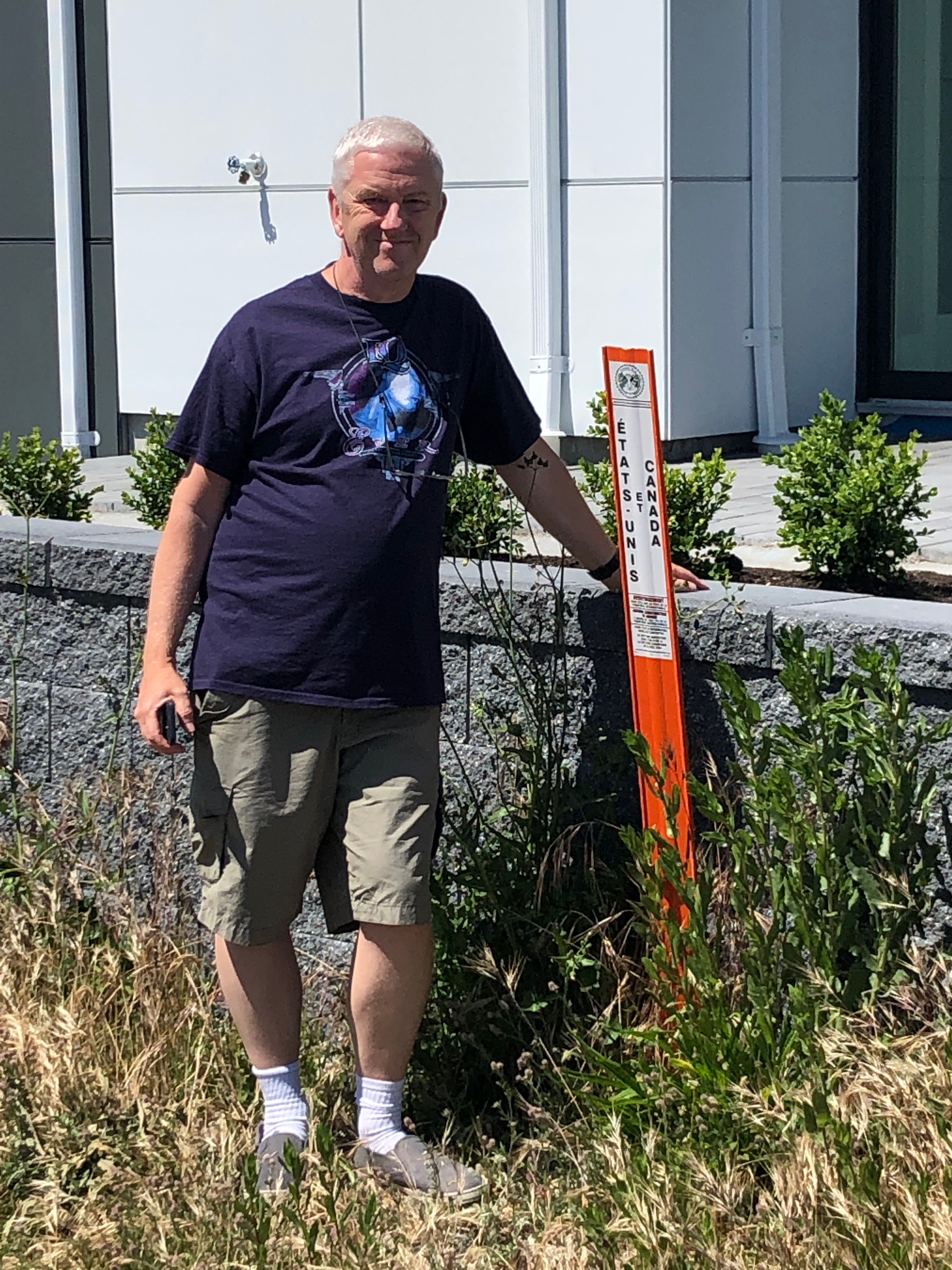
If you happen to be in Vancouver in the summer you can take in a Bard on the Beach performance, a Shakespeare festival that has been running for thirty years now. We just about made it – the performance of Taming of the Shrew was the festival’s first preview of the season. We enjoyed it greatly but if Shakespeare is not your thing there is another open air theatre in Stanley Park that performs shows like Mama Mia. Remember to take a few layers as it can get a bit chilly in the evening. Our final day in Vancouver saw us do a day trip to the USA. Point Roberts is a geographical oddity, a Canadian peninsula south of Vancouver that dips below the 49th parallel meaning the five square miles of it are in the USA. This tiny piece of land is the home to 1300 people and full border checks take place both ways at the one point of entry. It costs $6 for the visa waiver – your ESTA does not apply on land crossings -, a recording of your fingerprints and an honest answer to the question “why are you visiting Point Roberts?” Tourism worked for us. Once you are cross the border there really isn’t a lot to see but just being there felt strange, a US enclave where the 5th grade and over kids have to travel 27 miles through Canada each way to get to and from school at Blaine in Washington State. It is possible to walk along the border on Roosevelt Way, a road where the demarkation line is the northern grass verge. Whilst it is illegal to cross the border without presenting yourself to the border officials there really isn’t much stopping you. Just for a photo I stood in the USA with my left hand on a low wall in Canada. I wasn’t arrested. Having crossed legally back into Canada we met up with my third cousin for dinner. That’s the thing about Canada, you are almost assured to have relations there. My family and hers found out about each other through genealogy a few years ago, I share a common great great grandad with Donna on my mother’s side.
Left Hand in Canada, Rest of Me in USA
And that was about it. We needed to get back to Victoria for two reasons – firstly to deliver Rebecca back home and secondly because our flight went from Victoria Airport. It meant a scenic cruise through the Gulf Islands on the ferry, a night in a traditional B&B which was an interesting but comfortable experience. The girls took the opportunity to go to the Fairmont Empress Hotel for afternoon tea as one really should when in Victoria – hint, the Earl Grey wasn’t very good – whilst I went on another seaplane ride, a forty minute jaunt round the local area, just for the hell of it.
Short Final, Victoria Harbour International (Really) Airport
Canada is a magnificent place for a holiday. It has so much in its favour it is almost embarrassing. It’s easy to get to, the scenery is beyond compare, it might be big but the travel is generally easy, there’s activities aplenty to try and the people are warm, hospitable and speak very good English! In the bit where we were the weather was good, though it can of course be harsh in winter in the mountains. I get the feeling that the Canadians deal with the harsh conditions well, they have had enough practice by now. I’ll maybe have to go in the winter just to experience it. The country is, of course, more than just what lies west of Calgary – there’s an awful lot of North of course but the other areas that are likely to be visited are quite a long way to the East. I visited in Ottawa and Niagara last year and have also been to Toronto and Quebec in the past. I hope at some stage to visit the Maritimes, the eastern extremities of the country and nearer to where I live in Scotland than they are to where Rebecca resides in Victoria. As I said, Canada is a big place. I love it.
I’ve never really been into swimming that much. I’m not a great swimmer and unlike other activities I’ve never had any desire to improve. I can do a couple of lengths if I put my mind to it but I’ve always found that swimming takes a lot of effort for little reward. I don’t mind splashing around in a pool though. Indeed, some of the best holidays we have had have been where we have rented a villa with a pool. The thing is though that when you are in warm climes even a tepid pool can be a bit of a shock to get into and the worst bit is when the swimming costume got wet and started clinging to your sensitive regions. A few years ago we had a villa that was quite secluded and the pool afforded us some privacy. Hmmm, I thought, it is worth a try. I removed my swim shorts and climbed in. Ooh, that’s better I thought. In fact the whole thing was a bit of a revelation. Skinny dipping appeared to be much more fun than swimming with your bits all trussed up. Not that Elaine was overly impressed with the sight and neither was she persuaded to take up the challenge herself. I, however, took a number of dips in the scud that holiday and just hoped to god that the villa owner didn’t have a hidden webcam somewhere. If he did I doubt he made much money by selling the video to the special interest websites.
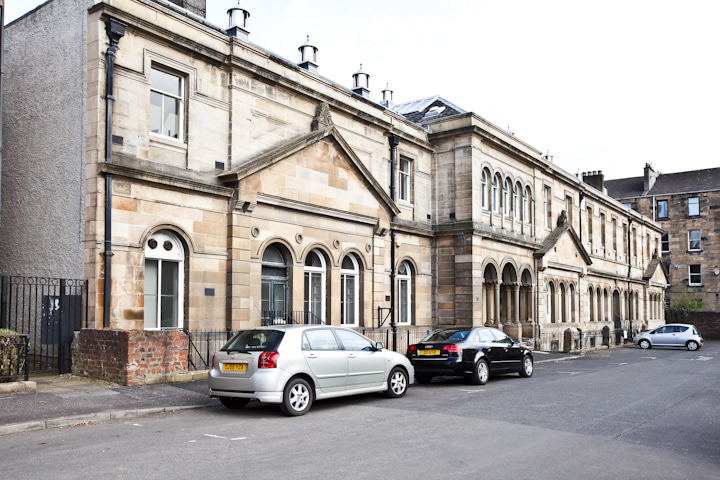
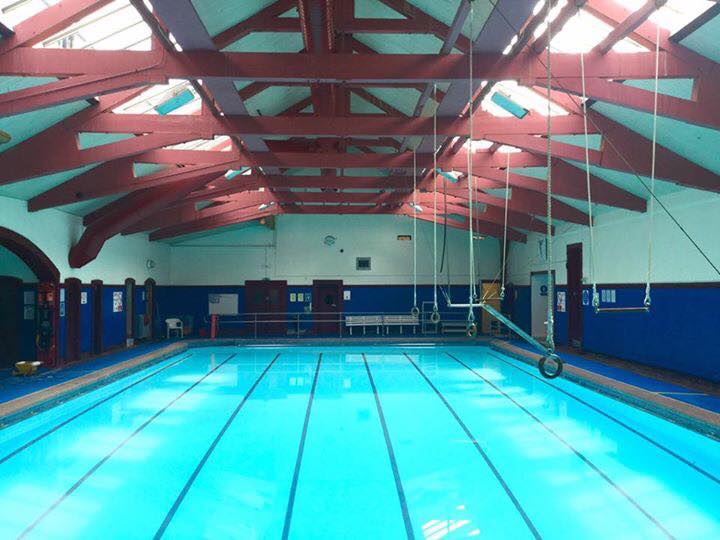
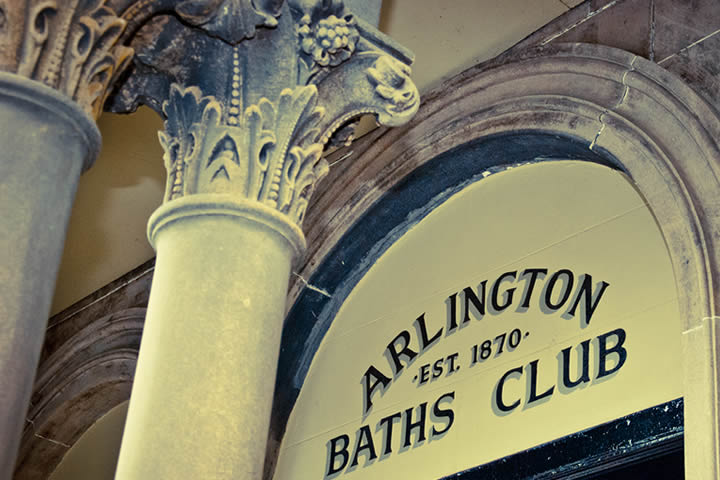
A few months ago I came across an article about the Arilngton Baths Club in Glasgow. It is a private health club that is situated in an original Victorian baths in Glasgow’s West End. It is quite an interesting place. Founded in 1870, it houses a 21 metre pool, a Turkish suite, saunas, steam rooms, a fully equipped gym, rooms for yoga and other classes and a rather splendid member’s lounge. Strangely, the pool has a trapeze and a set of travelling rings suspended above it from the impressive wooden beamed ceiling. All in all it is a very nice, interesting and unique place which you can enjoy for the reasonable fee of £616 per year or £1000 for a couple. It has been featured in Glasgow’s Open Doors weekend in the past and should it do so again it would be worth going and having a look. But, I hear you ask, what has it got to do with the first paragraph? Surely the members don’t all swim in the nuddy? Well, no they don’t. On a Sunday evening, however, the building is given over to a group called The Sunday Swim. For just a ten pound joining fee and another ten pounds each time you go, you can enjoy all the facilities that Arlington Baths has to offer without forking out for full membership. The catch? It’s a naturist club.
The pool, complete with travelling rings and trapeze.
A few weeks ago I had a free Sunday evening. The hockey season was over, Elaine was away for the weekend, and watching Countryfile on the telly wasn’t appealing. Having dipped my toes (literally) in the waters of swimming sans cossie on those earlier holidays I must admit I was quite interested in trying The Sunday Swim out. I am aware, however, that having lived for 57 years in Britain, nudity remains a case of ‘ooer missus’ and Barbara Windsor’s bra flying off in Carry On Camping. I was a little nervous and even driving up there I wasn’t sure if I would go through with it. I parked up, wandered through the door and entered the lounge where the Sunday Swimmers congregated before being allowed access to the facilities. Somebody was sat at a desk.
“Hello” I said. “I’m a newbie, what’s the routine?”
That was it. Any potential embarrassment about getting naked with a lot of strangers was well and truly trumped by the embarrassment I would have felt admitting to them I didn’t feel like it after all and chickening out. I filled in some forms, handed over a tenner for the membership, had my photo taken (clothed before you ask) and was told that once the Swim got underway there would be a short induction held for the newbies which consisted of me and a couple who were up in Glasgow on holiday. Another tenner was paid to the Arlington Baths staff – yes, the employees of the Arlington Baths Club, mainly young folk, remain on duty for The Sunday Swim, clothed – and we met up with the chap who showed us around. The regulars had quickly got into the mood. It shouldn’t be but it is quite difficult to concentrate on what’s being said when you first enter a room full of naked people. The chap doing the induction was very good though and we were fully briefed, which is more than can be said for the other members, (sorry, Carry On style joke, I’m ashamed of myself) with how things work, the dos and don’ts of the club and, importantly, where you HAD to be naked (in the pool) could choose to be naked (just about everywhere else) and HAD to be clothed (in the gym). There was a naked yoga session at 7pm if we were interested (good god, no) and we were informed about the etiquette of the club. Basically this meant no intimacy with anyone, even if you knew them. This was a club for naturists and naturism is not about sex. Swingers were not welcome. Well, apart from those who chose to use the trapeze and travelling rings perhaps.
With that we were pointed in the direction of the changing rooms. Naturally there are two, one for the ladies and another for the chaps. For the Sunday Swim you could choose either. I chose the men’s changing room as I just couldn’t make the leap of faith and enter the ladies’. In there I found a vacant peg and, well, took my clothes off. I, along with every participant, had been given a towel for drying off at the end and what was basically a bed sheet. This was to accompany you wherever you went and to be used as a barrier between you and whatever you chose to sit on. Naked bottoms on chairs, loungers and so on is understandably frowned upon and a thin layer of cotton is considered to be a sufficient barrier. Clutching said sheet I emerged from a changing room containing naked people into the pool area which was full of naked people. It wasn’t much of a threshold but it was something of an achievement to cross it. OK, I thought, let’s get in the pool. This meant walking past a young female lifeguard who was fully clothed. I felt very awkward and at the same time a bit sorry for her. Not that she was the slightest bit bothered of course. I descended the ladder into the pool which was a degree or two cooler than I’d expected but, as previously mentioned, this was less of a problem than it might have been had I been wearing swim shorts. I decided to do a couple of lengths. Just after I turned and was heading back to the shallow end I witnessed the rather bizarre sight of a naked lady swinging along above my head on the travelling rings. I have to say I was impressed with her athleticism but at the same time my weekend had just got a bit weirder.
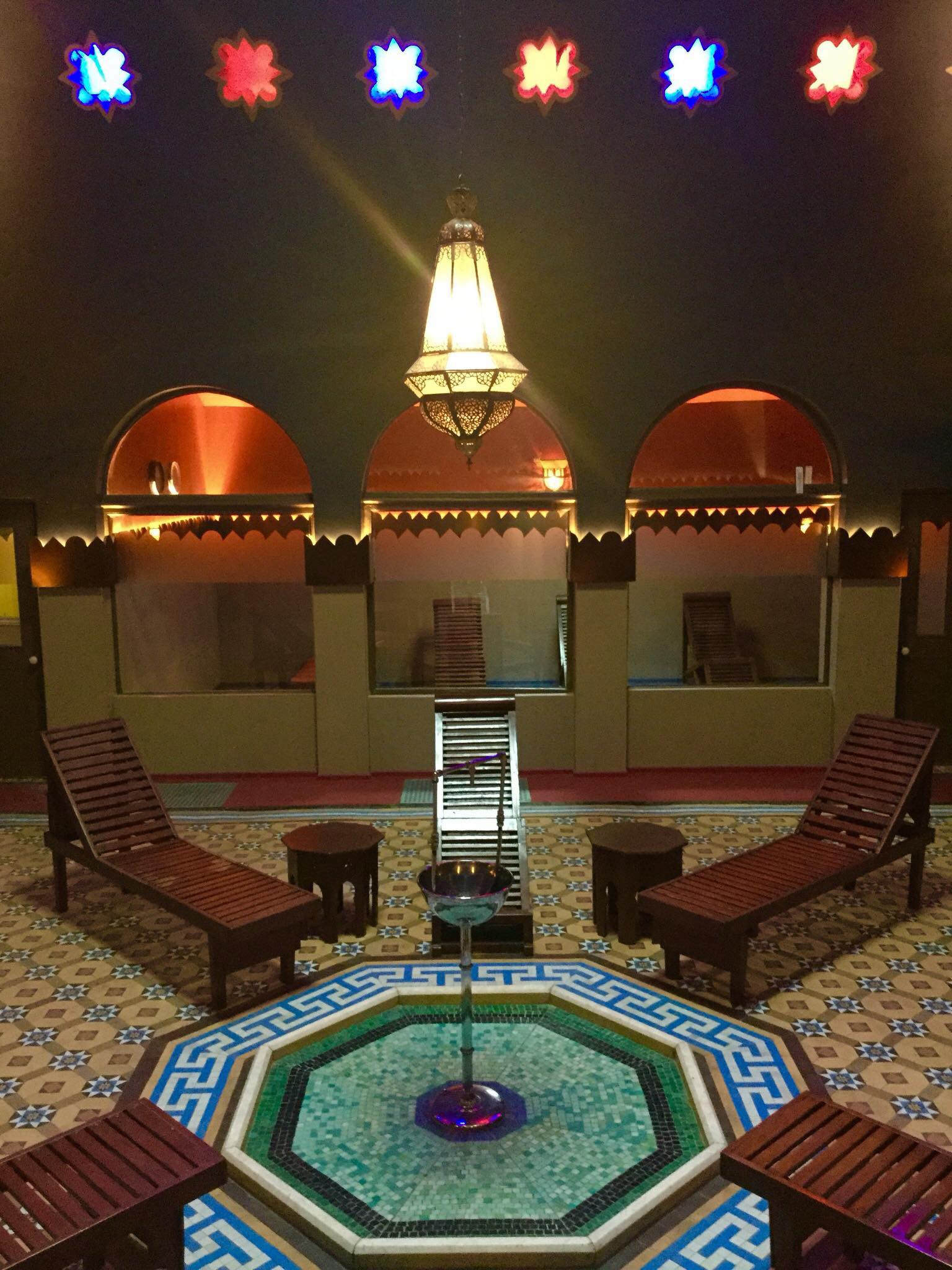
Turkish Suite with surprisingly uncomfortable loungers
My next port of call was the Turkish Bath. This was a large room, decorated on a Moorish fashion, where it was quite warm. A number of wooden slatted loungers were arranged in a symmetrical manner around the room. The idea was to sit or lie on one of the loungers and enjoy the serenity. In for a penny I thought. I carefully laid the sheet on the one free lounger and lay on it. The peace and calm was quite relaxing at first, even though I was surrounded by naked bodies, but after approximately two minutes the wooden slats were proving to be rather uncomfortable. Perhaps I should have used the towel as well as the sheet. Whatever, I left the room to those who found laying on uncomfortable furniture and doing precisely nothing ( I think one guy might have been doing a crossword) relaxing and continued my exploration. I found the showers. I think I should have maybe found them before I went in the pool but I had a lot going through my mind at that time. Amongst the showers was a curious contraption which basically meant standing within an almost complete circle of several concentric pipes. These shot out water like pin pricks which, strange as it may seem and once I’d got the temperature right, was quite a pleasant sensation. Yes, had those water jets been focused just a little lower it might have been a tad uncomfortable but I’d visit that facility again later.
It was the sauna next. The main sauna was under renovation and getting into the small back-up was a bit of a squeeze. Everyone was quite understanding though and with a bit of shifting a space became available. I quite like saunas. I’m not sure why as they are pretty uncomfortable places after a while but no pain, no gain I suppose. It was the only place I actually conversed with other people. There was a conversation going on about the Emirates A380, recently timetabled on the Glasgow route, and I felt I had some knowledge to impart on the subject. Strangely, conversing about aircraft whilst bollock naked and sweating profusely didn’t at all seem odd. Saunas are one place above all others where you really don’t need clothes. The Scandinavians have that one right. Next on the agenda was the steam room. I don’t normally like steam rooms. I still don’t like them naked and only stayed there a couple of minutes, leaving before the steam scalded my thighs. I tried the Turkish Room once more, it was a bit better once I’d folded the sheet over a couple of times, but whilst I’m all for relaxing, it got boring really pretty quickly. If I were to do it again I’d take some reading material or a book of sudoku or something. And maybe some cushions. Another go in the pool, the sauna and that funny shower thing and I was exhausting all the possibilities the place had to offer. A nice touch with The Sunday Swim is that in a room upstairs off the pool area is set aside for free tea, coffee and, you couldn’t make this up, Ginger Nuts. Whilst I was getting used to the sights in the pool and spas, seeing a load of naked people sat in comfy chairs drinking tea and munching biscuits whilst talking about day-to-day matters was one of the weirdest experiences of all.
I don’t drink tea or coffee so after just one Ginger Nut I headed back downstairs. It was just after 8pm and the Swim went on for another hour. Having sampled the facilities at least twice I felt I’d seen enough and believe me, I’d seen plenty. It was time, I felt, to get cleaned up, dressed and away home. There was an alternative to another shower though. The original Victorian slipper baths and hot tubs were still operational. I ran myself a bath and got in. In the same room, several other tubs were filled with bathers. For some reason, this seemed just as weird as the naked tea and biscuits but it was a nice way to rid yourself of pool chlorine and sauna sweat. With that I headed back to the changing room, dried myself off, got dressed, returned both towel and sheet, walked out of the door and drove home. As the journey takes three quarters of an hour I had time to reflect on what had just happened.
I’d just travelled to Glasgow and got naked with several dozen strangers whilst utilising a Victorian pool and spa. Whilst it felt distinctly strange at first, by the end it seemed fairly, though perhaps not completely, normal. Here’s the thing though: everyone has some hang-up or other about their body. I’m no exception having fallen victim to the middle-aged spread. I’m not particularly vain but even I try to hide the double chin and the overhanging belly whenever I am photographed. Body image has become a big issue lately with all media, both printed and electronic, full of images of ‘beautiful’ people. This becomes a problem when people feel they can’t live up to those ideals. Eating disorders, depression and even self harming can be the result of self loathing. At the Sunday Swim, however, it becomes clear that people actually come in all shapes and sizes. Whilst men form the majority of the membership, plenty of women attend too and across both sexes young and old, tall and short, fat and thin are all represented. For example there was a very well spoken and undoubtedly very respectable old bloke displaying an impressive array of metalwork through all his bits and pieces – you couldn’t miss them, they reflected the lights – something you would never have remotely suspected had he been clothed. I’m no fan of piercings, I mean really, why would you, but good on him. A young girl who was rather large was in the sauna. I suspect she had more self-confidence than she might have done back in the world of clothes as there she was accepted for what she was. Perhaps most impressive of all was the chap with the colostomy. There he could be himself, just like everyone else was his or her self. He was also the most athletic person there, effortlessly swinging across the pool on the rings.
I may have only spent a couple of hours there but I think I get what naturism/nudism, call it what you will, is about and it is a positive thing. It won’t be for everyone. – the history from religious disapproval to nudge nudge, wink wink humour is hard for some folk to shake off even if they wanted to – but those that indulge seem to find a happiness in shedding both clothes and their hang-ups. All your ‘flaws’ are there on display along with everyone else’s and that’s that. Will I be going back? I am now a member of the Sunday Swim for a whole year so maybe. But then again maybe not. To be honest I’m not the sort of person who gets much out of spas. A quick splash in the pool and a few minutes in the sauna is good but I soon get bored. Fine if it is nearby but not a thing I’d normally undertake a sixty mile round trip for. Would I encourage anyone else to give it a try? Yes, absolutely. Once you have got over the initial unease you will most certainly feel better about yourself, if only for the couple of hours you are there. It might be a cliche but it was quite liberating.
Footnote 1: Until recently the event was arranged by a club called Glasgow Continental which allowed families to attend. This is all very natural in naturist circles but a group called Woolf Pack Hunters campaigned to get it shut down. This group claims to protect children from predatory adult grooming and felt that a club where naked adults and children mixed was an obvious magnet for paedophiles. Protectors of children or interfering busybodies? You decide. Consequently the Arlington Baths Club ended their arrangement with Glasgow Continental. The Sunday Swim was immediately formed to take its place and is strictly for over 18s only.
Footnote 2: The photos are not my own, they are taken from the Arlington Baths Club website. Taking pictures was understandably not an option. For those who find this disappointing then the next photo is for you.
I was never much of an athlete. Growing up in Yorkshire in the seventies it was virtually compulsory to play football in the winter and cricket in the summer which I did, enthusiastically at first, but with a growing realisation that I wasn’t much good at either it became more of a chore and eventually I gave up. At secondary school we tried out different sports but I wasn’t much good at those either. I did manage to represent the school in the triple jump but that was basically down to the fact that I was just about the only person in my year that could string together the hop, skip and jump in the right order. I didn’t win any medals though and my athletic career quickly fizzled out. Just about the worst sport we did at school was the cross country run. This was the nightmare of heading out along roads, across fields and through snickets in the pissing rain with the cold wind blowing right up the Pennines. I’ve no idea how far they made us run, it was probably just a couple of miles, but it seemed like an eternity. Needless to say I was pretty hopeless at it and it put me off running for many, many years.
This lack of athletic prowess meant that through my twenties and into the thirties I never really did much exercise. Eventually, after dire and almost certainly accurate warnings from Elaine about the premature fatality rate amongst couch potatoes, I joined a gym. It wasn’t much fun but in theory it got the heart pumping three times a week. I was hardly getting myself well ripped but it was better than nothing. By my late forties, however, I was getting extremely bored of the gym. Then, some nine years ago the Sport Relief charity was encouraging people to ‘Run a Mile’. I’d done a bit of running on the gym treadmill though not much. However, I thought that I could possibly manage it and one evening I asked Elaine to drop me off a mile from the gym and I would see her there. I did it and a very reluctant seed was sown.
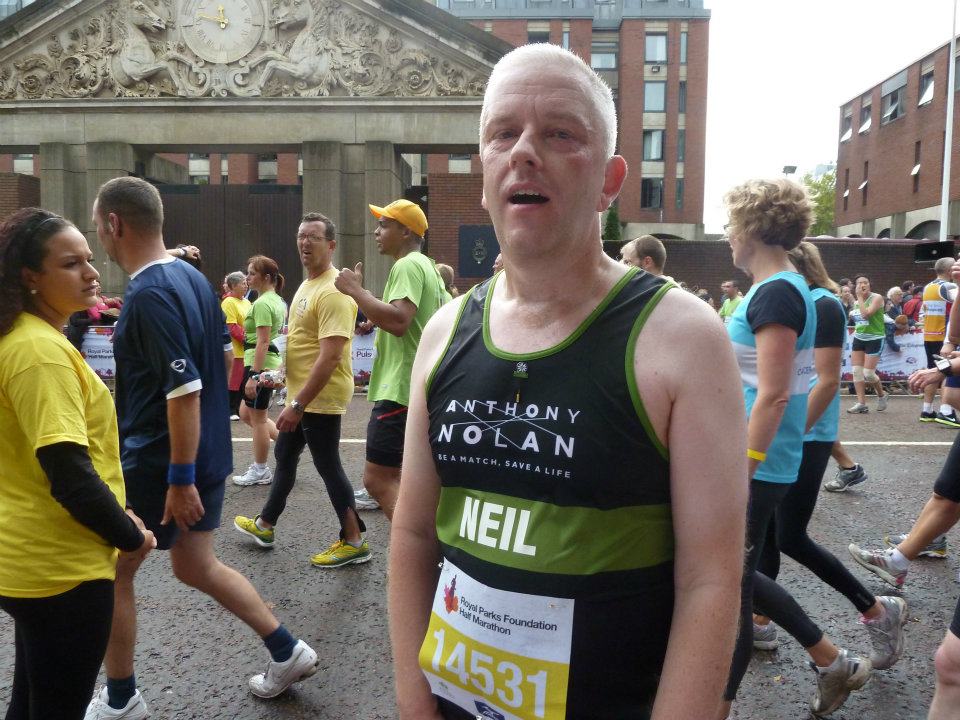
Every year in May Troon hosts a 10k run that is very well patronised. I decided to enter. I had about three months to build myself up from that one mile jog to six and a bit miles of running. That distance seemed huge but I got there and ran the race in a time I’ve failed to match in the subsequent two or three Troon 10k races I’ve competed in. I could hardly call myself a ‘good’ runner but I was happy with what I’d achieved in a short space of time. In a fit of optimism, probably misplaced, I entered the Edinburgh Half Marathon for the following year, 2011. It was a spring event but during the preceding winter as I tried to build up the distance I did my groin some mischief and had to pull out due injury. I did, however, grab a charity place in the Royal Parks Half Marathon in London the following October. Once recovered from the injury I built up the distances I was running and come the day, just nine days before my fiftieth birthday, I felt in good nick. I completed the race in 2 hours, 4 minutes and 7 seconds. This was much better than I’d expected. I do all my training runs solo and found that being in a race situation gives extra encouragement. I put it down to the fact there’s always a lady’s shapely Lycra clad bottom in front of me to try, usually unsuccessfully, and catch up with. Either way, I thank those unsuspecting pacemakers.
The end of the Royal Park Half Marathon. Apologies for the vest, it’s a charity thing.
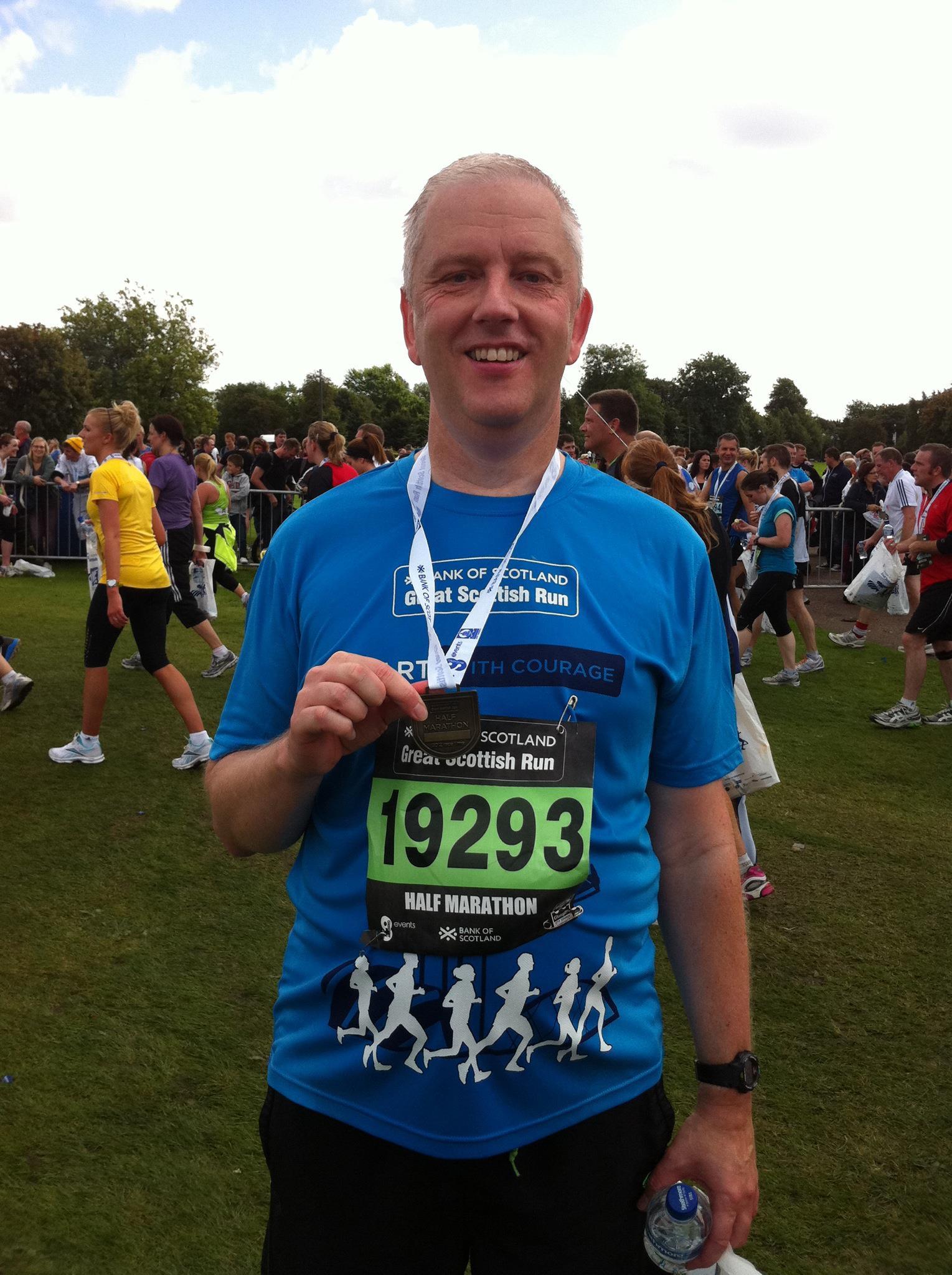
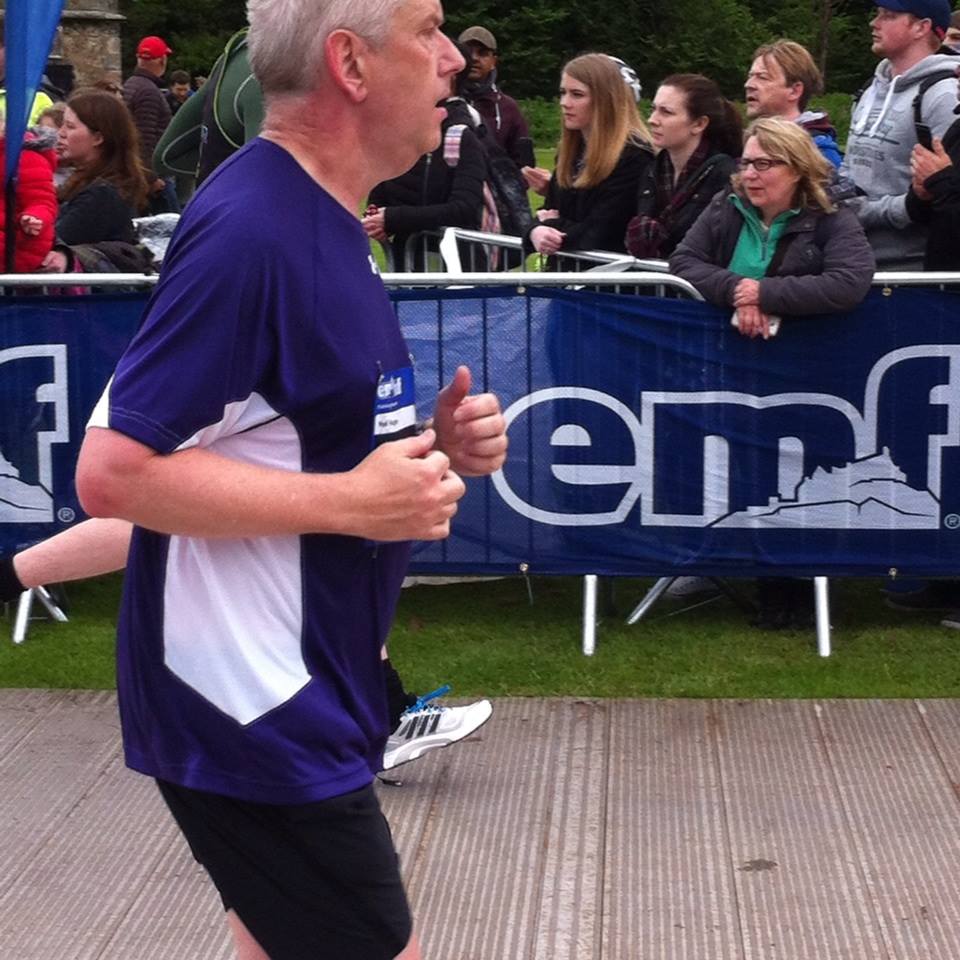
That race was a rarity in that I actually enjoyed the run. It seemed to go on for ever but being part of a large event like that and passing some iconic sites in London meant it was fun. Although running was now my primary source of fitness, my gym membership ultimately lapsing, it was nearly always a chore. I persisted with it though. I was sure the Grim Reaper awaited me if I didn’t. I competed in two other half marathons. In September 2012 I ran the Great Scottish Run in Glasgow. It didn’t go well. I hadn’t prepared well for it at all and only decided to run at the last minute. I completed it in a rather pathetic time of 2 hours, 20 minutes 30 seconds but at least I did it. I hated every second. By 2015 my daughter Rebecca had taken up running, and living in Edinburgh at the time had entered the Edinburgh Marathon Festival half marathon. I thought I’d give it a go too. Thanks to a better build up I finished in a time of 2 hours 10 minutes 44 second which I was quite pleased with. It wasn’t a particularly enjoyable run though. Starting in the middle of Edinburgh the route quickly passed the foot of Arthur’s Seat and then failed to pass anywhere of interest on its way out to Musselburgh where you had to run a mile up a road to nowhere before heading back down it to the finish in a nondescript park.
The face belies the fact that I utterly hated the Great Scottish Run
Finishing the Edinburgh Half Marathon, thank God.
Since then, however, I’ve avoided races. Partially through injury – I did my ankle on holiday three years ago and couldn’t run for eight months – and partially through laziness. It was stupid as there is nothing quite like a race to encourage you to don the trainers and get out on the road. Well, in theory anyway. Last September Rebecca moved out to Victoria in Canada and promptly entered the Vancouver Marathon, to be run on May 5th this year. She had done her first full marathon in Paris a couple of years ago and this was to be her second. As a newly retired gentleman with some time in my hands I decided to go out to support her and promptly booked a flight. A few weeks later I had the idea that maybe I could do the marathon too. I quickly scotched that idea as I didn’t want to steal her thunder (that’s my excuse and I’m sticking to it) but I did feel I had the time to build up to the half marathon which took place on the same day. I filled out the online application form, paid quite a few Canadian Dollars and hey presto, I was a runner in my fourth half marathon.
I had six months to get into shape. Less when you consider I spent much of my first few months of retirement travelling and forgetting to take my running shoes. In fact training started in earnest at the turn of the year. My kids had cleverly got me a Garmin GPS watch for Christmas which recorded my runs and allowed me to see just how badly I was doing. There are many websites, books, magazines and pamphlets that inform a potential runner just how to plan his of her training in the run up to a big event. I read precisely none of these and just made it up on the spot. I could run five miles, I knew that. By the end of January I was to have run six. By the time February was over I’d have run eight at least once. March would see me top ten whilst in April I would do a twelve miler at some stage. All these targets were achieved and I’d run every two or three days, never on consecutive days though. The more I did it the better my pace was which is just as well as had I run the race at the pace I had been achieving in those early days I’d probably would have been caught up by the race’s paddy wagon and get disqualified. My run strategy was not exactly the approved way either. Conventional wisdom is that you run ten miles for pace then three miles to race. Sounds good doesn’t it? No, for me it was to run five miles like a winner, eight miles like a wanker. Fast miles at the start were seconds in the bank as far as I was concerned as I was definitely going to slow up towards the end no matter what. The first time I’d do the full distance, 13.1 miles or 21.1 km, was on the day of the race itself.
The Garmin watch was a revelation. As well as recoding time and distance, it beeps every 1km to give you ‘lap’ times. Not only was I improving my times. I could see where I was improving. This was certainly encouraging and meant I could set myself targets for the race itself. The first was to simply complete the distance without stopping or walking. The next target was 2 hrs 11 mins. That meant an average pace of 10 mins/mile and early on was a realistic target. More challenging was 2 hrs 6 mins 30 secs which would take the pace to under 6 mins/km. As my training progressed keeping 1 km lap times under 6 mins became important and I was achieving it for the first eight miles (13kms) or so, not so much for any distance beyond that. Still, seconds in the bank and all that. In my sights was the 2 hrs 4 mins and 7 secs, the time I’d achieved in the first half marathon and of course a personal best. The next target was two hours. Highly unlikely but a man can dream can’t he?
I flew out to Victoria on the Wednesday before the race. A long journey and an eight hour time difference is hardly the greatest preparation but I did my best to use it to my advantage. The half marathon was due to start at 7am on the Sunday so it was early to bed and early to rise on the preceding days. I did one five mile run on the Friday as final preparation which went well enough and we set out for Vancouver that evening. On the Saturday we went to collect our race numbers in the middle of town. We then checked in to our Airbnbs near the start line in the suburban south of the city. An old fashioned diner provided us with our pre race meal and we retired for an early night.
6am, fresh as a daisy, an hour before the start.
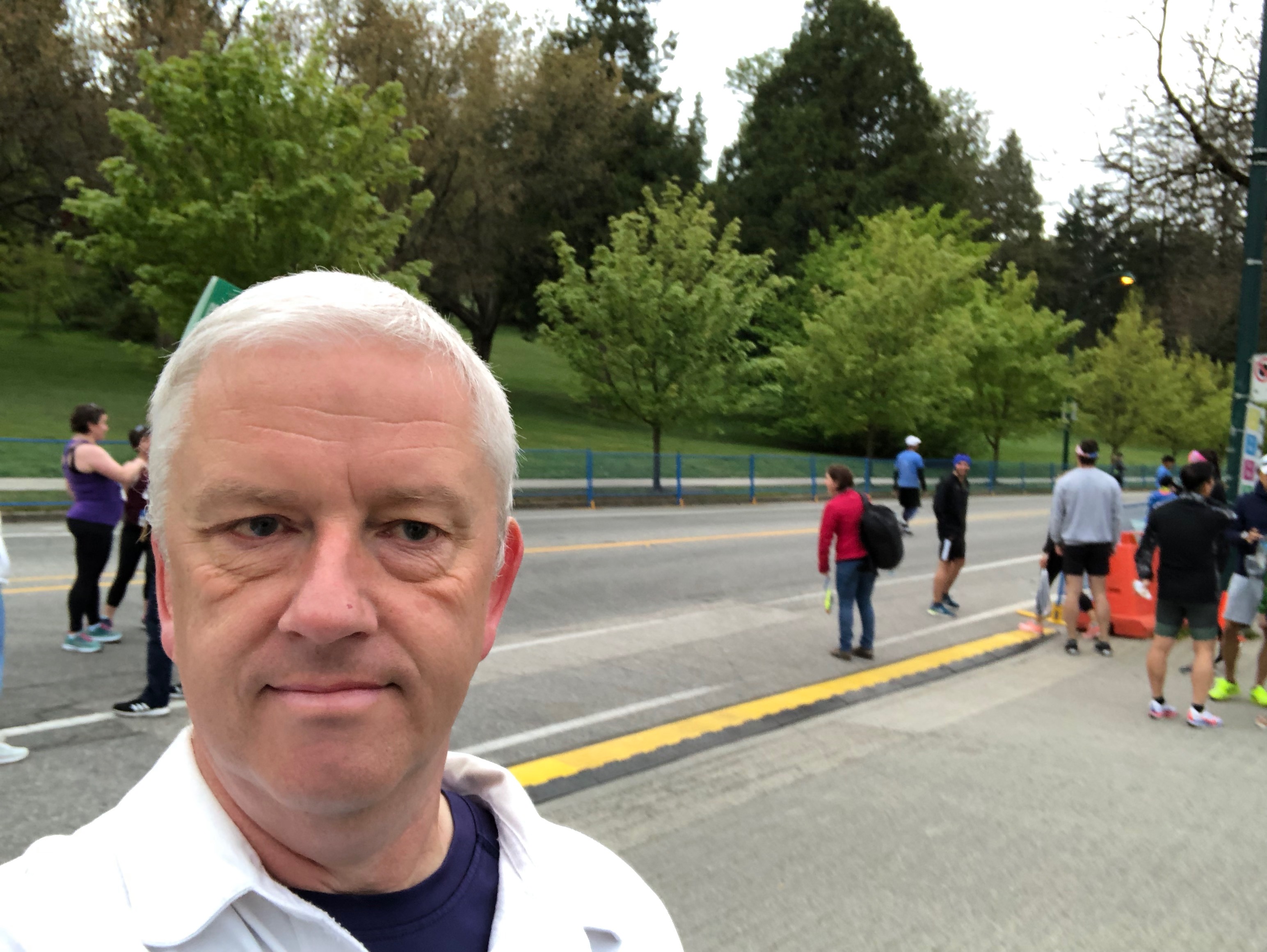
It was a 5am alarm. A bowl of granola was consumed and, in a bit of a change to my pre-run routine, I had a shower. As a solo runner there’s not much need for showering until the run is over but in a race there’s a fair bit of hanging around with loads of other folk. I’d been informed to arrive at the start an hour before the race. I had to check in a bag of post race essentials (iPhone, wallet, spare shirt, just about my whole life at that point in time) which would be available for collection at the finish line. Having done that there was indeed a whole load of hanging around but at least I smelled nice. Fifteen minutes prior to the start I was stationed in my starting coral. On applying to participate in the race you have to give an expected finish time. I’d given a conservative 2 hrs 15 mins and was corralled with others in the 2:05-2:15 group. There was someone bellowing warm up exercises over the tannoy, duly ignored, some psycho babble, duly ignored, the Canadian National Anthem, duly ignored and not just by me, by most competitors. At 7am on the dot the starter’s gun went bang. Off went the elite runners. We went nowhere. A couple of minutes later the first coral was sent on their way, then the next coral after that. My coral was the third and it wasn’t until ten past seven that we were allowed to start. Across the line I went, starting the Garmin as I did.
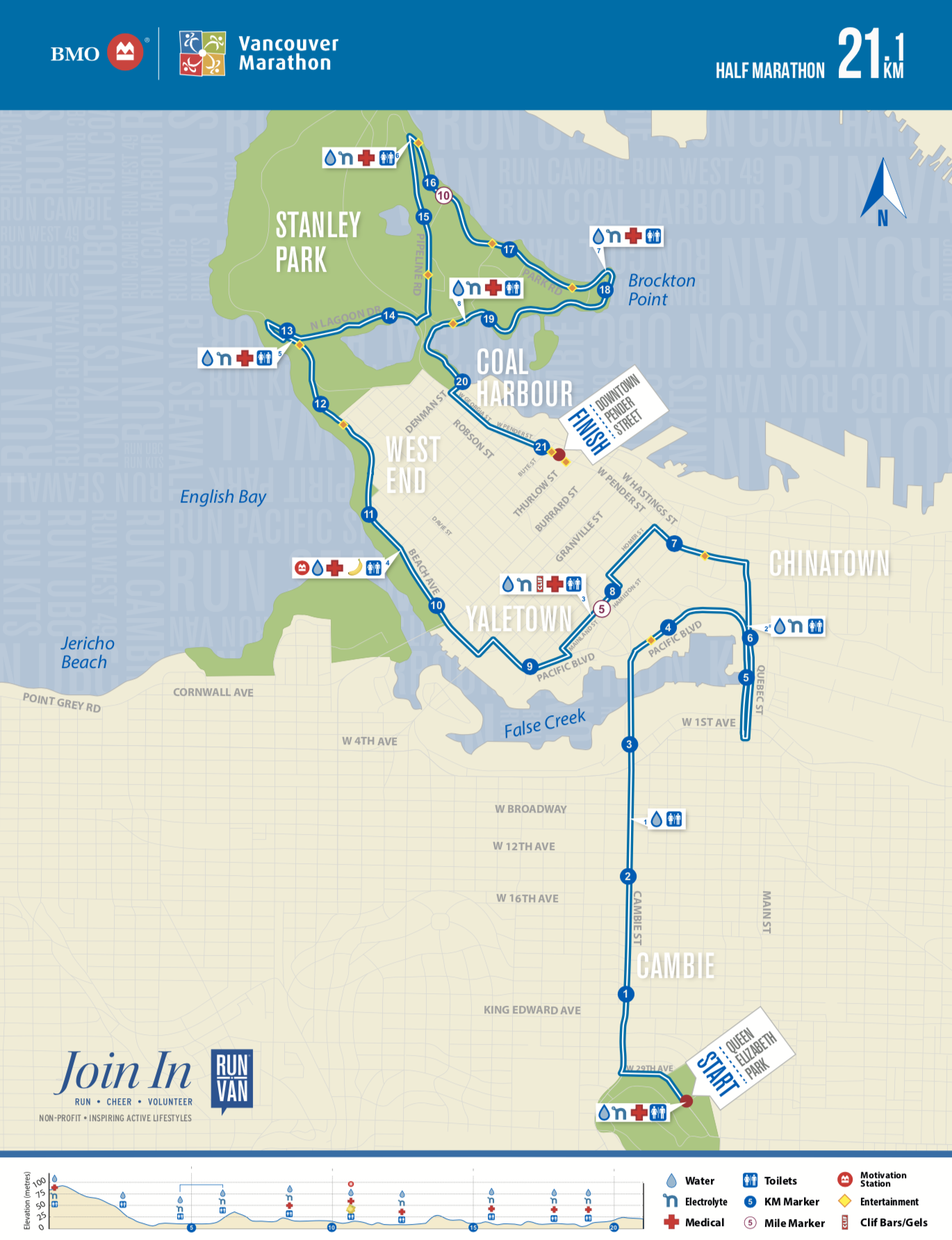
The route. It won’t mean much to those who have never been to Vancouver.
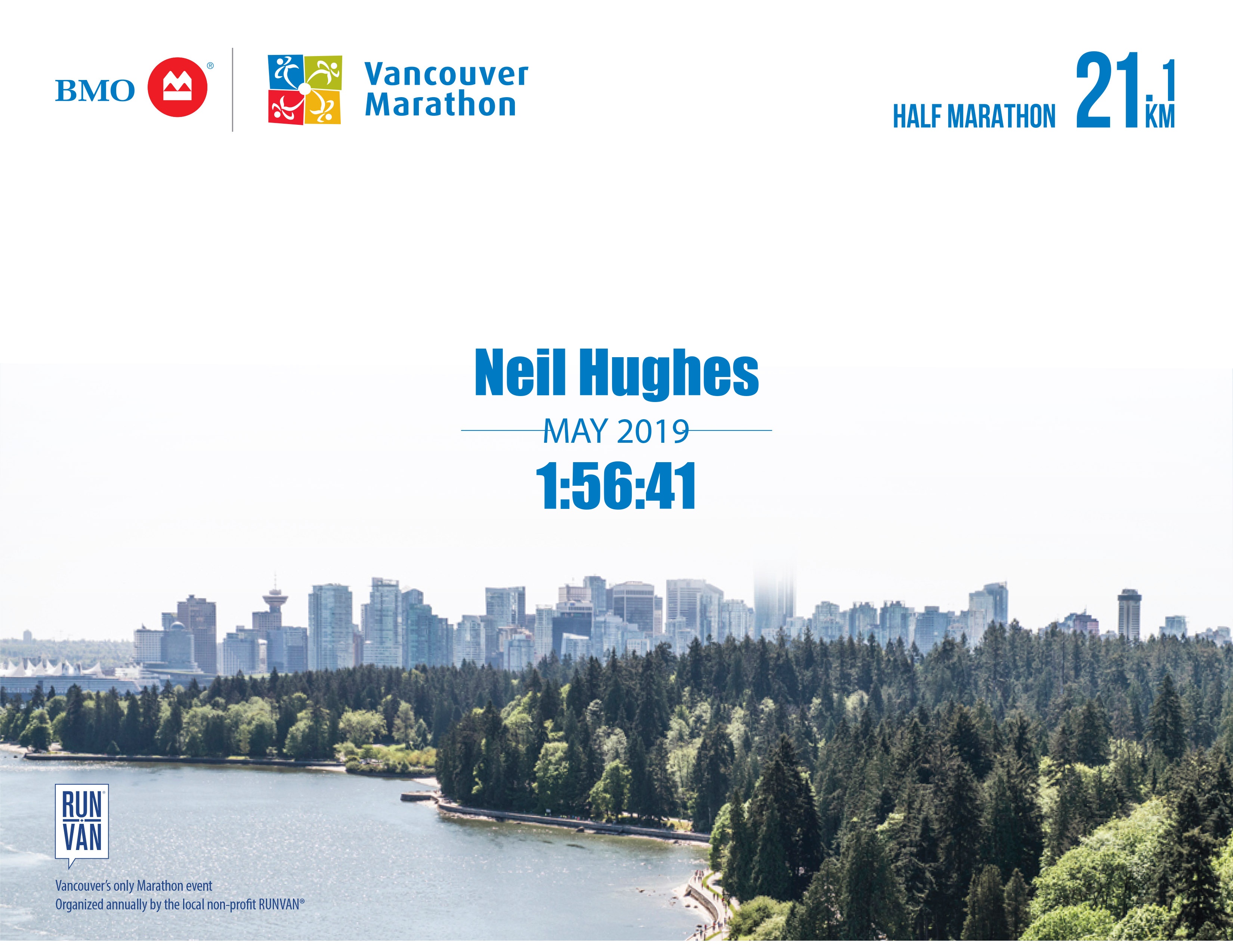
The half marathon course in Vancouver starts in Queen Elizabeth Park. After a minute you leave the park and head down Cambie Street towards downtown. This is a long, straight and above all downhill road. Running downhill can be a bit if a strain on the knees but the gradient was just right for a rapid start and having fought my way to the front of our coral I fairly flew the first three or four kilometres recording ‘lap’ times ten or twenty seconds less than I’d ever managed before. On crossing the bridge into the downtown area the course flattened out and all gravitational assistance ended. There was an up and down section in Chinatown, which of course could be any part of Vancouver but is the area north of that big stadium thingy. I nearly came to grief at the bottom of the down bit where the ground fell away a bit further than I’d anticipated but I managed to stay upright by swearing quite loudly. It doesn’t always work but I feel it helps. Continuing along Beach Ave and past English Bay we entered Stanley Park at the 12km marker. Here, a couple of other up and down sections awaited us, nothing too serious but a bit painful by then, as we snaked our way around the park. Eventually, the course emerged from the tree lined boulevards of Stanley Park where they had somehow crammed in 8 km which left 1 km (1.0975 km to be precise) to go. The finish was on the straight West Pender St in the middle of town and could be seen from 700 m away which I felt was a little cruel. My regular time checks had revealed that I was going a lot faster than I had anticipated by that point. Surely that couldn’t be right? It was hardly a sprint finish but I crossed the finish line and stopped the watch. I had beaten all the targets I had set myself including the fantasy two hour one. In fact I had smashed it by over three minutes. The official time was 1 hour 56 minutes 41 seconds.
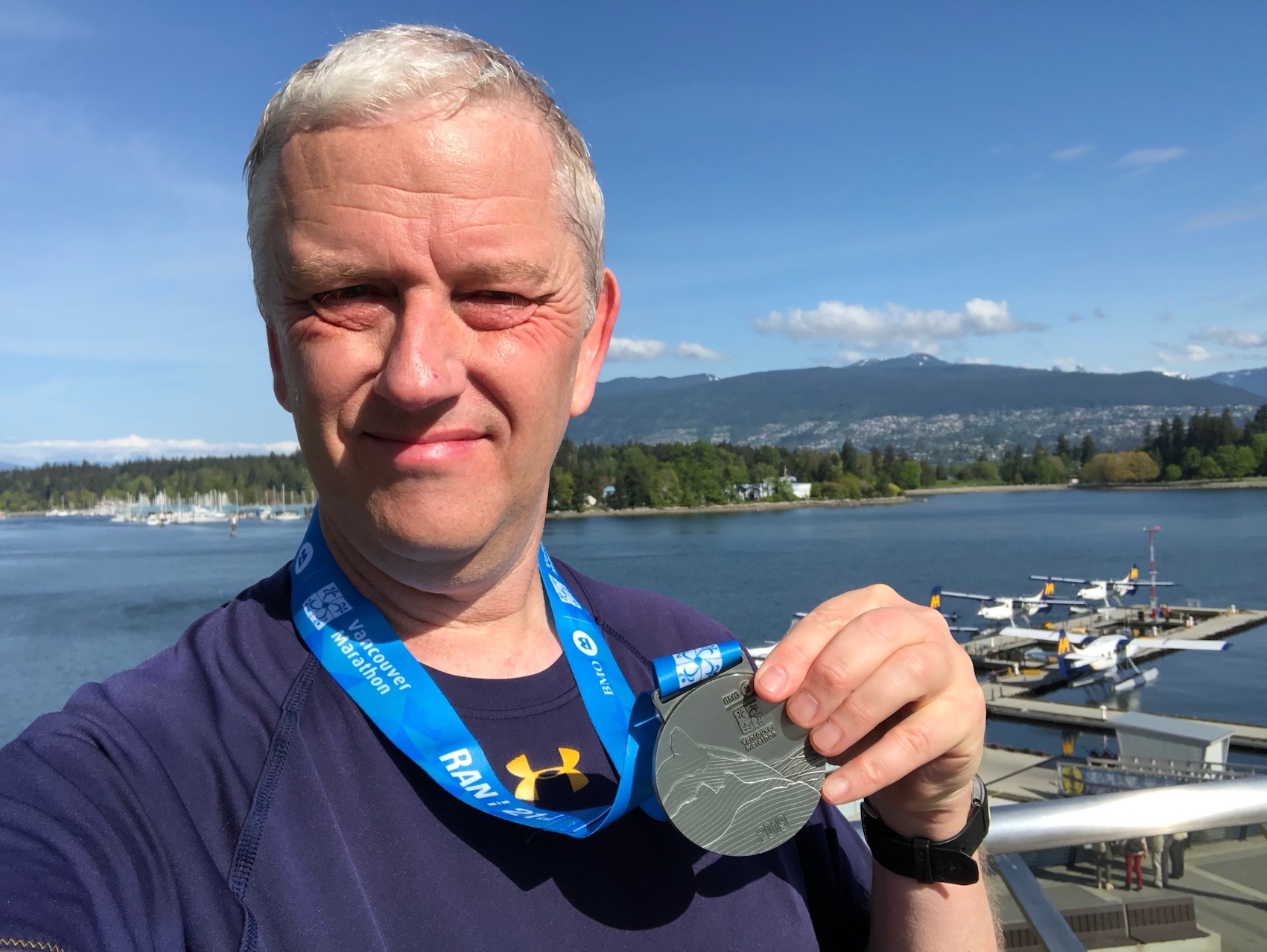
I had planned my celebration should I achieve a good time. It was to involve jumping up and down, waving my arms around and shouting exaltations with no little amount of profanity. What actually happened was I stopped running, checked my watch and thought thank goodness it’s over. It wasn’t an anti-climax, far from it, I was shocked yet delighted with time. I was just needed to collect the medal and other handouts, retrieve my goody bag and go somewhere reasonably quiet to reflect on what had just happened. And of course tell people via social media, I wasn’t going to keep it to myself for very long, this is 2019 after all. So it was that the tourists wandering round Coal Harbour by the cruise ship terminal and the seaplane base got to see me remove my sodden shirt and replace it with a dry one, then sit on the wall in the glorious sunshine (and slightly chilly breeze) informing the world via the miracle of the mobile interwebs what had just happened.
Half an hour after the end. Not quite as fresh as a daisy.
Thanks to the early start the day was still young and it soon became a case of watching Rebecca in the full marathon. She duly completed it but not without going through a lot of pain – she had picked up a virus a week previously which she hadn’t completely shaken off and suffered badly form the effects of the continuous sunshine. It was quite upsetting to see her hurting like that. By the time I flew home four days later she was only just getting over it.
What of the future? I’ll almost certainly continue running. Not because I get a kick out of it other than setting new personal bests in races, but because it is an ‘easy’ form of exercise. Easy in that you just need some kit, a decent pair of running shoes and a stopwatch and you can set off from your front door. No need to go to a specific facility, arrange an opponent or become a member of a team. I will need to set myself further challenges though as without them it is easy to think I’ll give it a miss today. I’ve done a couple of runs since returning home. Both five miles, both very slowly. It seems the body is feels it needs a bit of a rest.
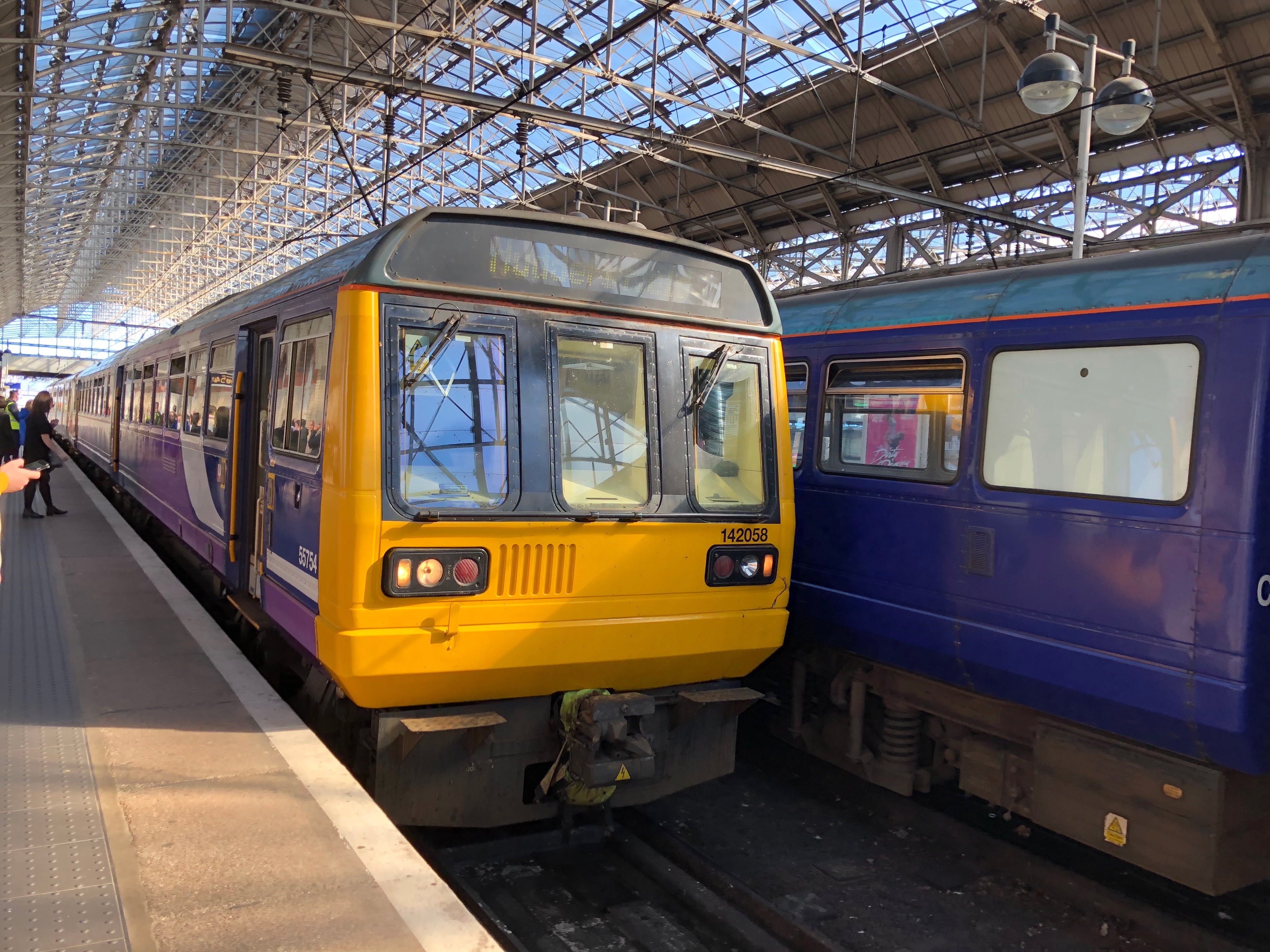
A week or so ago I found myself riding a number of trains in Northern England. Two of these were Pacers. What possibly can be interesting about a boring old commuter train I hear you ask. Nothing much as it turns out other than the fact they are truly abysmal trains. They were introduced in the mid eighties and were abysmal trains back then too. So abysmal in fact that they’ve never seen service in the fashionable southeast region and most of them have spent their lives plying the highly unglamorous routes in Wales, the South West and above all, in Northern England. Initially with British Rail, they have long since worn the colours of the Northern Trains franchise, the poor a’poth of train operating companies. They truly are so bad that I actually enjoyed the journeys I took in them in the same way one might enjoy a trip from Mumbai to Delhi in third class.
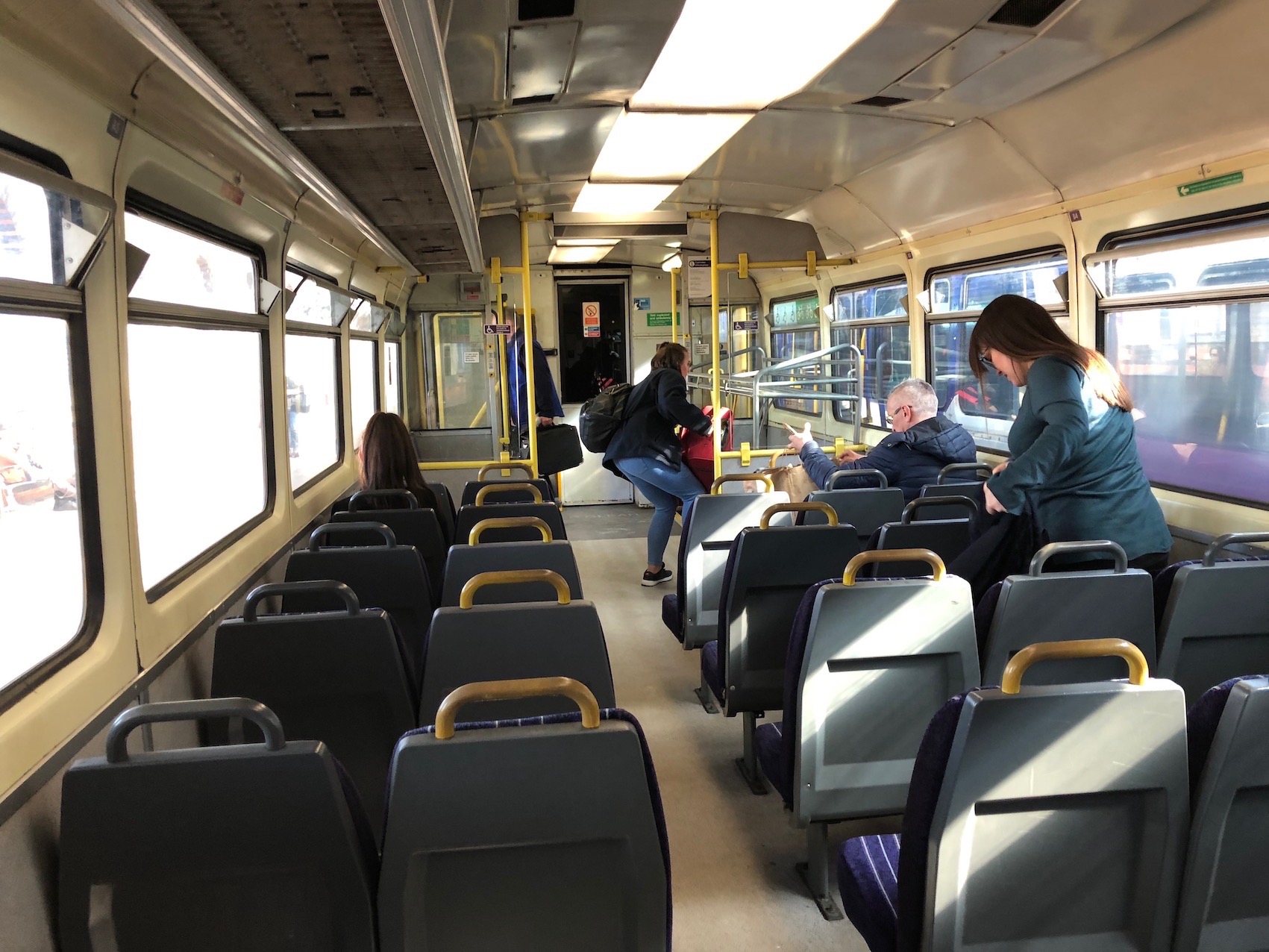
Upgraded seats, ideal for folk with no legs.
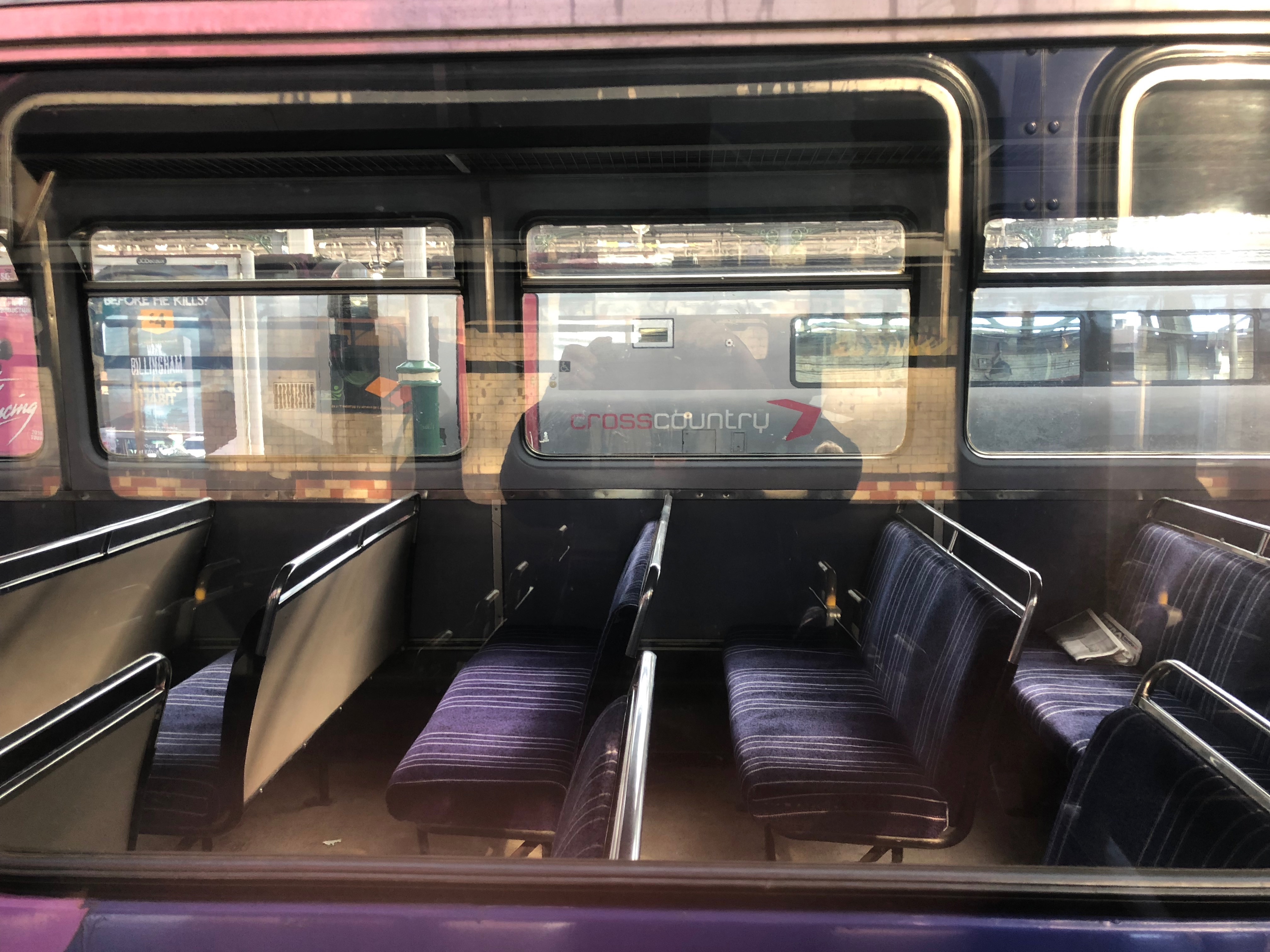
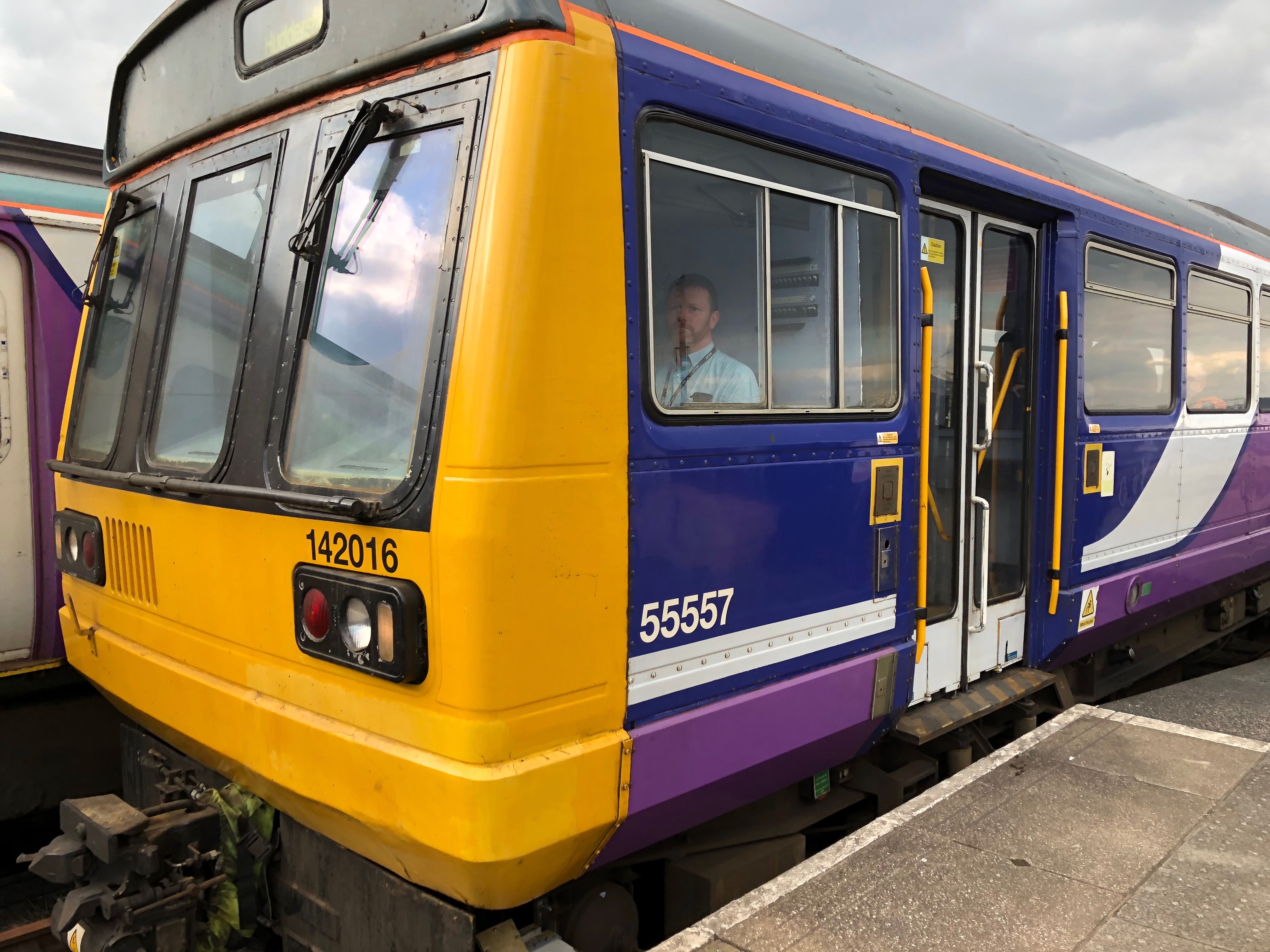
A quick history lesson courtesy of Wikipedia: The Class 140, 141, 142, 143 and 144 diesel multiple units were given the generic name “Pacer’. Built between 1980 and 1987, Pacers were basically Leyland buses plonked on top of a four wheel freight wagon under frame. They were deliberately designed on the cheap as a stopgap measure to replace ageing rolling stock and were only supposed to last twenty years at the most. Each carriage runs on four wheels set on two axels rather than the usual two sets of four wheel bogies which means the 165 Pacer trains built suffer from excessive squeal when cornering. They also suffer from a bumpy ride and earned the nickname ‘nodding donkeys’ and having now ridden a couple, I can state it is not a name that is unwarranted. The bus theme was carried through to the fittings. Bi-fold doors are still the portal of choice for the Pacer passenger and even the bench seating was the same as what you would have found on the Number 42 bus to Kirkburton. Whilst most sets have had a bit of an upgrade, bench seating still exists on some trains though luckily not the ones I sampled.
An adjacent Pacer complete with original bus seats.
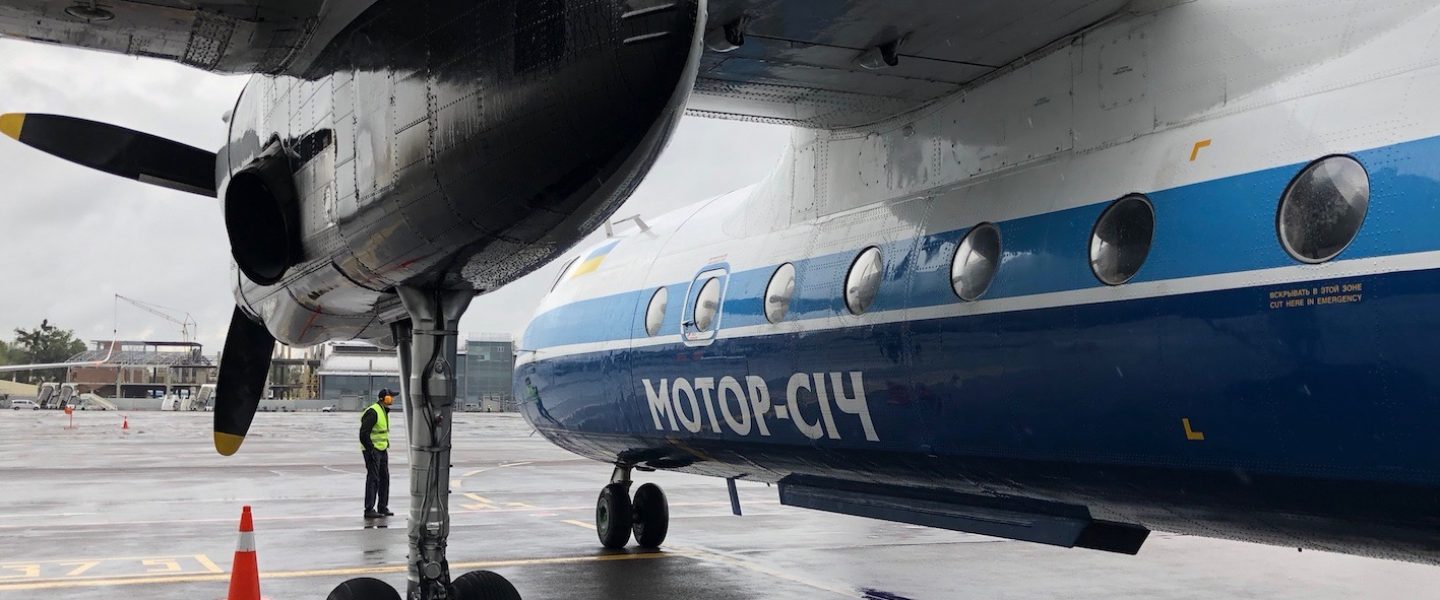
My first journey was from Manchester to Huddersfield. To be fair I could have taken the more usual Transpennine Express service and enjoyed their newer, if frequently overcrowded, trains but being a tight fisted Yorkshireman returning to God’s Own County I was particularly taken with Northern’s dirt cheap (£4.50, thanks for asking) advance fare. The journey was just five minutes longer thanks to the Pacer’s 75mph speed limit, a speed it only managed to reach after it had passed through the Standedge Tunnel high in the Pennines and started to go downhill, and the fact it had to stop at places like Mossley and Greenside. These are the sort of places the Pacer was made for. On boarding through the infamous bi-fold door I was greeted with an aroma that seemed familiar. Then I remembered – the 45 year old Antonov I’d flown on in Ukraine six months and many blogs ago smelled similar, that musty scent you often find in museum pieces. The seats that had replaced the original bus benches provided enough knee room for a dwarf with a growth defect but I got a couple to myself so spent a pleasant three quarters of an hour sitting sideways whilst being bounced around and deafened by the occasional squeal from the wheels. The second journey was a couple of days later from Huddersfield to Wakefield Kirkgate. Different seating made it a touch more comfortable and it was definitely less smelly but the rest of the Pacer experience was much the same.
Having said all that, being the geek I am I’m glad I took the journeys. Having passed their sell by dates some ten to fifteen years ago, the Pacers’ days are finally numbered. They will fall foul of the latest accessibility rules by the end of the year and be withdrawn from service. Northern have some brand new Spanish built trains joining the fleet which won’t replace the Pacers directly. Instead they will displace Sprinters, themselves a mere 30 years old, which will be cascaded down the company’s network to the services so unloved that they are currently operated by a 35 year old bus on rails. I hope the National Railway Museum preserves a working example, just so future generations can have a good laugh.
Another Class 142 Pacer with driver filling in his Eurostar Driver application form
Hockey is a serious business. There are only two officially sanctioned jokes that you can use when it comest to the British game. The first is I went to a boxing match last night and an ice hockey game broke out. Oh how we laughed at that one. It is becoming less relevant nowadays as fighting has become something of a rarity in recent years but hey, we honour the game’s traditions and all that. The second joke is hockey is a game of three halves. For those of you that don’t get it a game of hockey is played over three twenty minute periods. Glasgow Clan’s 2018-19 season can also be split up into three distinct ‘halves’ of approximately twenty league games each and can be described thus: Average, Fantastic and Disappointing. The story of the season is, however, a tad more complicated than that including as it does the Challenge Cup campaign and the briefest of stints in the Play Offs. Compared with the horror show that was the 2017-18 season it was a huge improvement and for a while promised to be something special. That it all rather fizzled out should not take away from the fact that the club finished fourth in the league, a credible result, regained the conference trophy, a rather pointless piece of silverware following changes to the league structure but better Clan having it than Fife, and played a much more entertaining brand of hockey.
In the summer of 2018 there were many changes for the Clan fans to ponder. A new coach was appointed, Pete Russell. Having enjoyed success as the coach the GB team, Russell joined from Milton Keynes. Joining him would be a whole new set of players with only Brits Matt Haywood, Gary Russell and Zach Sullivan and import Michael Gutwald returning from the squad that had so miserably underperformed the previous season. Three of the new arrivals were well known to the Clan faithful. Scott Pitt and Matt Beca returned after a year in Manchester. Both were points machines during their previous stint at Braehead and had carried that form with them down to Manchester so getting them back was something of a coup. The other was Zack Fitzgerald, returning after a couple of years in Sheffield and being appointed the captain’s ‘C’. As the rest of the squad was recruited the fans could only hope that they would click together and give them something to cheer about. Cheers had been thin on the ground for several seasons. Another change was that Braehead Clan was now Glasgow Clan. This change in moniker was long overdue and with it was a new logo, not to this observer’s taste unfortunately, and hopefully a new direction.
The other big change was the league format. Edinburgh’s exclusion from the league meant an eleven team competition. The existing three conferences of four became two of four and one of three but were competitions in name only and held little significance. There would be no conference bias in the fixtures – each team in the league would meet the others six times for a sixty game season. This makes direct comparisons with previous season tricky as Clan played the wealthy ‘good’ sides more and the poor ‘bad’ less or not at all but improvement is obvious – 4th place in the league as opposed to 9th, 67 points from 60 games compared with 54 from 56 (16 of which came in eight games against the hapless Edinburgh). It could have been even better had it not been for the ending but more of that later. Four pre-season games took place at Braehead towards the end of August against foreign opposition as a warm up to the season proper which as usual saw Clan play the month of September on the road as Disney took up residence on the hallowed ice. That month and the following saw a mixture of league and Challenge Cup group games.
The Challenge Cup campaign saw Clan in a group with Fife, Dundee and Belfast. The first competitive game of the season took place in Fife where a controversial ending saw the hosts take the game into overtime and claim the victory. Defeats in Dundee and Belfast followed before Fife pitched up at Braehead on 5th October for Clan’s first competitive home game of the season. A 2-1 victory finally got the cup campaign underway though a defeat at home to Belfast meant that qualification for the quarter final looked unlikely. The last group game saw Clan take a 5-4 penalty shot victory over Dundee and after several days wait for other clubs to finish their group games, Clan had sneaked into the quarter final by the skin of their teeth as eighth seeds. That two legged affair saw them face Cardiff as the top seeded Belfast elected to face Dundee in the competition’s pick your opponent rules. The game took place at the end of November and beginning December, Clan coming back from a 3-0 deficit after just one period of the home first leg but losing the game 4-3. In the return leg and completely out of the blue Clan outplayed the highly fancied Cardiff and after sixty minutes the score was 5-4 on their favour, 8-8 on aggregate. The game went to overtime and Matt Haywood scored the winning goal to put Clan in the semi final. Another two legged affair, Clan faced Belfast initially at Braehead at the end of January. A 2-1 victory gave them a slender advantage going into the second leg two weeks later. Alas, the impressive Belfast were too strong and ran out 6-3 winners on the night taking the tie 7-5 on aggregate. Belfast would go on and lift the trophy beating Guildford in the final. Clan could reflect on getting further in the competition than they had done in all bar one other season of their existence.
The Challenge Cup is all well and good but for most fans the league provided the games that mattered. Comparing Clan’s record against each of their opponents shows improvement in just about every case. Whilst the Gardiner Conference was still there its significance was much reduced but Clan’s record against the other two conference members meant that they claimed the trophy with several weeks to go.
Belfast and Cardiff dominated the league and proved to be difficult opponents to all the clubs, not just Clan. Not obtaining a single point against Cardiff was tempered a little by the Challenge Cup Quarter Final victory. Clan had more success against the eventual champions Belfast with two victories, one a particularly pleasing 5-0 thumping in the middle of February when the club were at the height of their powers. Of the other wealthy clubs, the spoils were equally shared with Nottingham whilst Clan completely dominated Sheffield including 6-0 and 6-1 victories in South Yorkshire. Although Sheffield were having a particularly grim season Clan’s record against the big four was as good as it has ever been. The four opponents from the Patten Conference proved to be a mixed bag with 50% records against Coventry and Manchester, both an improvement from last season and a healthy record against league wooden spoonist Milton Keynes. Again, Guildford proved to be something of a bogey club, a point emphasised when it came to the Play Offs. Despite Guildford’s dominance, Clan finished the regular season on the same points as their Southern England foes and one place higher in the standings due to a higher number of regulation victories. Against the two Scottish clubs Clan proved particularly effective, dominating Dundee and posting a record against Fife that expunged the nightmare of the previous season where a 1-7 league record against the hated Flyers was for many fans just about the worst aspect of that season.
So what of those three halves? Clan’s first twenty or so league games were a so-so mixture of reasonable results and some horrors. The record wasn’t much of an improvement on the previous season and the fans that had initially been willing to let the team and coach settle in were beginning to get a little restless. In early December a poor performance in a home defeat to Manchester drew much criticism but a few days later Clan won that Challenge Cup Quarter Final in Cardiff and the season changed right there. Over the course of the next two months Clan became the form team in the league. Of 22 games played Clan lost just six, only three of which were in regulation time. They flew up the standings into third place and whilst Belfast and Cardiff were never threatened, Clan’s best finish for four years looked likely. Elimination from the Challenge Cup in mid February is seen as the second turning point in the season though Clan did win two of their next three league games which included that 5-0 victory against the Giants and a 6-1 win in Sheffield. It was after this game that the form book was thrown away and the season went into a steep decline. Of the next eleven games Clan won just one, ironically their sole victory against bogey club Guildford, as the regular season wore down and Nottingham claimed third place in the league. The final game of the regular season was away in Fife who had won in Braehead the previous evening. A temporary reprieve from what had been going on in the previous few weeks, Clan claimed a 4-2 win, their first in eight games, and by the narrowest margins took fourth place in the league table.
As a result Clan would meet Guildford in the Play Off Quarter Final. The two legged affair commenced in Guildford and Clan returned home with a slender advantage after a 3-2 win. Could it be that their luck was changing and the form had returned? Alas, no. At Braehead Guildford soon cancelled out Clan’s advantage, and were 3-0 up. 5-3 on aggregate, as time ran out. With the last throw of the dice Clan pulled the netminder and inevitably Guildford scored into the empty net. Rubbing salt into the wound they went and added another in the last few seconds to win 5-0 on the night, a fully deserved victory even if the final scoreline was extremely flattering. Whilst two legged, aggregate score games are not a very hockey way of deciding play off match ups, they are what they are and Clan’s abysmal record in six period hockey games continues. Clan’s absence from the postseason party was extended by another year.
It’s quite hard trying to analyse a season like that. The first part can perhaps be explained by the fact the team was basically built from scratch and whilst it took longer than it might have done, players took their time to get settled with their linemates and Russell’s systems. Around the time of the dramatic improvement in form, Clan released headline signing Josh Gratton. Whilst his reputation as a tough man had been barely tested in the early part of the season his points production had been surprisingly good but for whatever reason he was deemed surplus to requirements. Without him the team performance immediately improved and whilst that might be something of a coincidence, the decision to release him certainly appeared to pay dividends. Two or three games later he was replaced by Guillaume Doucet, a known goal scorer from his time in the league and what seemed to be a perfect fit in the gap left by Gratton. The ‘new’ Clan played with joy and freedom and scored goals, plenty of them. It was a great time to be watching hockey. As to why that form changed again no one seems to know. Yes, the club had a difficult run-in with multiple games against Belfast, Cardiff, an improving Nottingham and a mysteriously troublesome Guildford but the goals just dried up, especially at home. Defensively Clan were prone to lapses in concentration but had been all season – you just tend to notice them less when the forwards are smacking in loads of goals at the other end. Goaltending never really hit the heights. Joel Rumpel didn’t have the greatest of starts to the season but bucked up during the club’s good run. However, the season ended modestly for him. Whilst Rumpel was by no means a donkey like a couple of the previous minders of the Clan net, a more assured netminder could have earned the club the three or four more points that would have meant a third place finish.
Whatever the reason for the loss in form, the season was a qualified success. The dreadful slide down the standings over the previous couple of seasons was arrested and for a time we were treated to some of the best hockey and run of results as we have ever witnessed at Braehead. Pete Russell has cut a popular figure over the course of the season and everyone was delighted when he committed to the club for another twelve months immediately after this season ended. It may well have been a season of three halves but overall it was one where being a Clan fan became fun again.
Postscript: I saw one of the four preseason games but those aside I missed twelve home games this season. Coventry 20/10 (Retirement do), Belfast 3/11 (Huddersfield), Sheffield 16/11 (USA), MK 17/11 (USA), Guildford 24/11 (Czech), Cardiff (CC) 28/11 (Personal), Coventry 30/11 (Personal), Sheffield 23/12 (Finger operation), Manchester 27/12 (Finger), Belfast 29/1 (Antigua), Fife 1/1 (Antigua), Manchester 9/2 (Personal). Five were victories, seven were defeats. I got to no road games but watched three webcasts. I missed the live TV game in MK which was just as well.
Nobby Stiles was a no-nonsense midfielder in Matt Busby’s Manchester United side of the 1960. He is fondly remembered for many things but two in particular stand out. Firstly, his dancing a little jig with the Jules Rimet Trophy in one hand and his false teeth in the other during the lap of honour that followed England’s victory in the 1966 World Cup Final. The other is that he lends his name to an insidious human ailment that is literally a pain in the arse. Haemorrhoids are more commonly known as piles, probably because it is easier to spell. Through rhyming slang those unfortunate enough to suffer from the problem can now be said to be complaining about their Nobby Stiles or, as rhyming slang so often progresses, a bad case of Nobbys. There are many other names for piles, presumably for humorous reasons as in Britain at least all things pertaining to bottoms are fair game for a laugh. Unless you happen to be suffering from them. Believe me, your chuckle quotient goes down by quite a large factor when you got the dreaded Nobbys.
Nobby Stiles. Not the subject of this blog.
So what exactly are Haemorrhoids/piles/Nobbys/bum grapes/Chalfont St Giles/Emma Freuds/anal speedbumps etc, etc? According to the NHS website they are defined thus: Haemorrhoids, also known as piles, are swellings containing enlarged blood vessels found inside or around the bottom (the rectum and anus). Most of the time these remain hidden and asymptomatic, in fact many of you reading this will have the little blighters and be completely unaware. For some people, however, the damn things pop out of the warmth and safety of their admittedly rather grim home and make a bid for freedom that is only going to end in tears. For some sufferers it will result in an intense itch, others will find it quite painful. The blood vessels can also burst and one can become acutely aware that blood is seeping out and making a mess of one’s undergarments. It is said that in most cases they will go away of their own accord but you just know at sometime in the future, maybe next month, maybe next year, the little buggers will be back to provide you with supreme discomfort and others with something to laugh at you about.
Emma Freud. Not the subject of this blog.
As you may have gathered by the fact I’m writing this, I’m suffering from a case of Nobbys, ora to be precise a single huge Nobby, right now. No bleeding has occurred yet but the pain is all too real. Everyday tasks suddenly become a bit more complicated. Even sitting at the computer is not the easiest of jobs as you constantly have to think about weight distribution. If you find a comfortable position you just know that at some stage you will have to move and the Nobby is going to get angry about it. Lying in bed is no better and sleep gets disturbed as another twinge of botty pain reminds you of your predicament. There are a number of over the counter treatments that are supposed to help. Creams and ointments are the most common. Rub these on the offending object, not a task to be taken likely, should give pain relief and reduce the swelling. You can also get suppositories. I don’t know about you but I’m not so keen on things going up my arse. I feel that particular part of my anatomy is a one way street and flinch at the idea of anything not obeying the no entry sign. Apparently the French are particularly fond of this method of taking medicines and not just for ailments of that particular region of the body. Silly sods. Ointment it is then, applied liberally if a little gingerly. It helps the pain a little bit though not much. If it has shrunken the Nobby I have no idea. I’ll await the next application to assess the situation and see if it is anything less than the bloody enormous thing that got covered in the active ingredients of zinc oxide and lidocaine hydrochloride.
Chalfont St Giles. Not the subject of this blog.
Ok, it is now tomorrow. The formerly cricket ball sized Nobby is now the size of a golf ball. I might be exaggerating there but it has definitely shrunk. The pain hasn’t gone away but is not as intense and I appear to be able to sit down without too much thought being put into the operation. Whether this is down to the ointment or not I’ve no idea. I think perhaps that the fact the bloody thing exploded whilst I was, erm, at stool this morning might have something to do with it. Much cleaning of the bathroom was required to prevent it from looking like a murder scene. This did not improve my mood much but hopefully it’s a sign of the thing giving up the ghost and retreating to whence it had come. I know you shouldn’t kick a man whilst he’s down but the retreating Nobby got another coating of ointment just to make sure it has learnt its lesson.
Haemorrhoids alone are proof that we evolved and were not created by an intelligent designer. Genesis 1-27 states that God created man in his own image which suggests to me that if He did indeed do that He must have been suffering from a bad case of piles at the time. “If I’ve got ’em, sure as hell they are going to get ’em” must have been his line of thought. No, evolution wins, as it always does, by not caring whether humans have a sore arse or not as long as the DNA gets passed on. There’s no evolutionary advantage to not having them apparently, so a thing they remain. It might be retreating this time I’ve no doubt the Nobby will be back, bigger and angrier than ever. Maybe he will bring some of his friends with him next time…
The Kintyre peninsula in the southwest of Scotland is famous for two things. Firstly, the song Mull of Kintyre by Paul McCartney and Wings which was the UK Christmas Number One in 1977 and seemingly for many months afterwards too. McCartney owned a farm in the Mull of Kintyre, the very end of the peninsula, and the song suggested he was rather fond of the place. The other thing is that it is shaped like a penis. True, it is a penis with a rather nasty gash near the top caused by West Loch Tarbert but it looks like a penis nevertheless. To add to the rather juvenile humour the island of Arran lies adjacent to Kintyre and together they give the impression of a giant cock and bollock. This may well be unique in the limited world of phallic-shaped geographic promontories though please feel free to suggest others. The land around that area was shaped by glaciers in the last ice age and despite being within sight of the shapely Paps of Jura, Kintyre has remained resolutely flaccid ever since. Indeed, it is said the British Board of Film Classification utilised the Mull of Kintyre Test whenever nudity appeared in movies to gauge an acceptable level of tumescence for the male genitalia. If the angle from the vertical was higher than that made by Kintyre on a standard Mercator projection map then that penis had to be cut. Ouch!
It looks like a willy doesn’t it?
I really must apologise for the childish toilet humour in that first paragraph. I should really have higher standards than that. Three quarters of the way down Kintyre, just before the, erm, bell end (aargh, sorry, I can’t help myself) lies the town of Campbeltown. It is in fact the only town on Kintyre and as such is the centre of all things Kintyrish. It lies just 58 miles from the centre of Glasgow as the crow flies yet driving there would put 140 miles on your car’s odometer. Initially you head northwest before winding round a number of mountains and sea lochs before finally heading southwest in the vague direction of Campbeltown. The roads are by and large decent but certainly not motorways. Allow yourself three and a half hours to get there. Alas, the rail building boom of the Victorian era never got as far as Kintyre so getting there has always been a challenge. Apart from a seasonal weekend ferry service from Ardrossan, an extension of the regular Arran crossing, you’ve got just two choices of public transport: bus or plane. Being the sort of chap I am I thought it would be quite a good idea to compare them. Perhaps March wasn’t the best time to undertake this task as severe weather can affect both forms of transport but I was in luck. The day I chose was a brief respite from wind, snow and rain. So it was that I found myself at Glasgow’s Buchanan Bus Station on a bright Monday morning awaiting the 09:15 Citylink service number 926 to Campbeltown.
This is not Buchanan Bust Station in Glasgow.
A rather moody Rest and be Thankful
Ah yes, buses. With the exception of London buses for some reason, I can’t say the thought of bus travel really appeals to me. Once, in the dim and distant past, Elaine and I did one of those holidays where you travel for a day on a coach to your destination, in our case it was the Austrian Tyrol, had a week’s holiday, and then have a 24 hour journey back. The experience of the first journey meant the thought of the second put a severe dampener on the intervening week. Whilst not every bus journey involves overnight travel of course, the experience rather put us off coach travel for life. Add to that the stories of the strange people that traverse the country by National Express and long distance bus travel has become a definite no-no. Of course those stories are almost certainly apocryphal and I should stop being snobbish but old prejudices die hard. As it happens my fellow passengers on the bus were perfectly normal people who just had the need to get from A to B. Well, apart from the bloke who got on in Clydebank and sat in front of me. He had a subtle, yet slightly concerning odour which got stronger whenever he scratched his scalp. I wasn’t too displeased when he got off at Tarbet. The tedium of over four hours on a bus would have been overwhelming had we been travelling down the M6 but this particular long haul had a redeeming feature. About fifty minutes into the journey we escaped the clutches of urbanisation and entered the scenic bit which would last all the way to Campbeltown. Tracking north along Lomond’s bonnie banks, Ben Lomond on the other side of the loch looked superb, its snow covering somehow magnifying its magnificence. At Tarbet we cut through the hills to Arrochar and Loch Long before heading west over the stretch of road called the Rest and Be Thankful. There we briefly climbed above the snow line before descending again to round the tip of Loch Fyne. In Inveraray we had a brief stop allowing us to utilise the facilities – there was a toilet on the bus but no one appeared to get so desperate that they had to use it – then we continued southwards to Lochgilphead. Here, many passengers got off whilst many others replaced them, that’s what happens on buses apparently, and we continued south to finally enter the Kintyre peninsula. At Kennacraig there was another mass exodus from the bus, those travellers heading for the awaiting ferry to Islay in a desire to get home before the forecast storms hit later that day. The road then took us down the western side of Kintyre before cutting across the peninsula into Campbletown and journey’s end bang on schedule. As spectacular as the scenery had been I was happy to get off the bus.
Campbeltown Harbour
I had four hours to kill. I’m going out on a limb here but I strongly suspect that Campbeltown on a March Monday morning isn’t the best place to kill them. It seemed a nice enough place, a bit bigger than I’d expected, but there was really not much going on. The cafe I thought I might lunch in was closed on a Monday and there didn’t seem to be many other options. I found another one though, a small, basic place but the proprietor was friendly and did and decent jacket potato with tuna so that was good. Cash only though, none of this Apple Pay nonsense. There was a marked absence of big high street names on the not so big high street and the independent shoe and clothes shops, hardware stores and so on gave the town a feeling of a bygone age. It didn’t take long for the novelty to wear off, however, and I set off out of town westwards. My destination was three miles away and followed the main road and then a single track road to Campbeltown’s other transport link to civilisation.
Campbeltown Airport
Campbeltown Airport serves around 9000 passengers a year. You would think an airport with that limited amount of throughput would be tiny and indeed the terminal is rather bijou. The airfield is, however, huge. Its sole runway is over 10,000ft long, the longest in Scotland. Or rather it was. Formerly known as Macrihanish after the nearby village, an airfield has occupied the site since 1918. In the Second World War it was a naval air station and remained so until 1963 when it became RAF Macrihanish. Despite the RAF prefix, the station was used by the US Navy as a weapons store and a base for the special operations Navy SEALs. Throughout this time there were many conspiracy theories about what exactly took place there. It was claimed that the top secret spy plane, the Aurora, was based there. This was denied of course as is the existence of the Aurora itself, but the airfield’s location many miles away from a major population centre just seemed to fuel the theories of covert operations. Whether there’s any truth in the rumours or not I’ve no idea.The US Navy left in 1995 and the following year Highlands and Islands Airports Ltd (HIAL), the government owned company that operates a number of small airports in Scotland, received a licence to operate the airfield as a commercial airport. It was still owned by the MOD until 2012 when the western half was sold to the Macrihanish Airbase Community Company for a nominal £1 to be developed for commercial use. The eastern half still has over 5000ft of runway at its disposal, more than enough for the Loganair Twin Otter that operates its only scheduled service.
Twin Otters are not faster than many things but they certainly beat the bus.
Loganair connects Campbeltown with Glasgow twice a day. The service is operated under a public service obligation (PSO) with Scottish Government subsidises. Barra and Tiree are also served by PSO flights and two Twin Otter aircraft are owned by HIAL specifically for Loganair to operate these services. It was one of these, appropriately registered G-HIAL, that would transport me back to Glasgow. I was the first of the eight passengers on the flight to arrive. A good old fashioned cardboard boarding pass was issued and I was informed that they don’t do security checks at the airport. We would, however, be met by security at Glasgow and escorted into the building. This seemed a little odd but I was more than happy to go with it. The inbound flight duly arrived and eight passengers got off and within a couple of minutes we were escorted on to the aircraft to take their places. A briefing by the First Officer was given and with that the engines were started and off we went. Despite the runway being half the size it used to be the backtrack of runway 11 seemed to take a long time but once we’d turned, lined up and the throttles were opened we were airborne in a few seconds. The flight to Glasgow took 30 minutes from take off to touchdown. Due to cloud the views on the way back were not quite as spectacular as those going but with more than three and a half hours saved it would be churlish to complain. We’d departed early and arrived 25 minutes ahead of schedule.
Nearly home in just half an hour.
What then to make of it all? To get to Campbeltown without driving you can take the bus or the plane. The bus cost me £22, though had I left it for two and a half years it would have been free with my wrinklies bus pass. For that you get a nice trip through the some of the finest scenery Scotland has to offer. It is still over four hours on a bus though. The plane cost me £33 and would still cost me that if I was over 60. For that you get the journey over and done with in a jiffy. Also, flying in a small aircraft like a Twin Otter is rather good fun. True, the bus takes you from city centre to town centre but not everyone needs that convenience so for me the plane wins. Will I ever feel the need to go to Campbeltown again though? Probably not. The most spectacular scenery I passed was further north. Kintyre, whilst pleasant enough, wasn’t really any better than the countryside around where I live. Paul McCartney may like the isolation he finds in the Kintyre, but for me it remains no more than an amusingly shaped geographic feature on the map of Scotland.
Back in the seventies the promotional department of British Rail, the nationalised rail company, commissioned an advert that ran on the one commercial television station, ITV. In those days there was no chance of recording a programme and whizzing the playback on during the commercial breaks so this type of advertising was very effective, especially if it utilised a catchy tune. Despite it being aired over forty years ago I can remember the advert and the beginning of the song quite clearly. A woman on a train starts singing:
We’ll travel InterCity like the men do
Inter City Sitting Pretty all the way…
The camera pans out to reveal a carriage load of ladies who all join in with the song which mentions getting away from the kitchen sink and suchlike. It ends with the line:
Away from it all and home again
The advert finishes with a view of a train crossing a viaduct in the sunset. It is hard to imagine an advert like that being aired today. Surely there would be a Twitterstorm of outrage at such blatant misogyny even though the advertisers of the day would claim it was a small step on the road to women’s rights. Women were allowed to travel Inter City before of course, it was just something that maybe they hadn’t thought of, being weak and feeble women and all that. Whatever, if the advert increased the amount of ladies taking the train to London, for that is where most Inter City routes went, I have no idea. Cringeworthy though the advert was, British Rail’s later attempts to curry favour with the British public involved hiring Jimmy Saville as the frontman and that didn’t turn out well, did it?
Class 43? No, it will always be an InterCity 125 to me.
It was a train journey I made last week that brought that advert to mind. It wasn’t because I found myself in a carriage of singing ladies, no, it was because the train I was on was some forty years old and of a similar vintage. The train in question was had a Class 43 diesel power car on each end and four Mark 3 coaches between them. Those rather dull designations hide the fact that this was one of a type of train that used to be called InterCity 125. Back in the mid seventies British Rail was in a bit of a mess. Passenger numbers were falling, hence the attempt to entice women on board, and the service was lousy. Running on a Victorian infrastructure, ageing rolling stock was coming to the end of its life and needed replacing. To halt the slide the BR engineers came up with a two new trains, one to run on the electrified West Coast Line and the other on the non-electrified East Coast and Western Region lines. The former was the original tilting train, the Inter City APT, and was something of a disaster. The latter was the Inter City 125 and was a big success. It is said it saved the railways in Britain, a bold claim perhaps but it certainly was a rare bit of good news for a failing service.
At the time it was a big deal. High speed trains had been running in Japan for ten years but no other country had any claim to speed. The French would go on to develop the TGV network and other countries have followed suit but the Inter City 125 in the mid to late seventies was cutting edge. In testing one of the prototypes reached 143.2MPH, a world speed record for a diesel train that stands to this day. Its maximum operational speed, limited by the ancient rail infrastructure, was 125MPH (hence the Inter City 125 name), a speed that shaved an hour off the journey from Edinburgh to London. Prior to their entry into service, the speed limit on Britain’s railways was 100MPH. The trains entered service in 1976 on Western Region and the East Coast Mainline a couple of year later. Living to the east of the Pennines a trip to London suddenly became rather appealing. Catching the train from Wakefield Westgate, the metropolis was just two hours away and the journey was remarkably smooth and quiet. Yes, the British Rail sandwich was just as bad as it always was but who cares when you are travelling at 125MPH through Newark North Gate? The trains did sterling service on the ECML until the line was electrified in 1989. On the line to Bristol, South Wales and the West Country, however, they provided continual service until a year or so ago when they were finally replaced with dual powered Hitachi Class 800 sets. In other words, shiny new trains. I’ve been on one. It was very nice.
Slam doors. Very hard to operate.
All of which is very nostalgic but probably of little interest to most of you. Bringing the story up to the present, Scotrail, the company that provides nearly all the rail services within Scotland, connects the country’s major cities with a fleet of Class 170s, diesel multiple units that date from the early 2000s. Perfectly adequate, if a little dull, these trains were showing their age and consisting of just three carriages got full very quickly. It was time for a change. The solution was to replace them with trains more than twice their age. Twenty six of the retiring Inter City 125s that had served the Western Region/GWR for forty years were to be acquired, refurbished and put to work linking Glasgow and Edinburgh with Inverness, Aberdeen, Dundee, Perth and Stirling in what was to be branded Inter7City. As the speed limit on those lines is 100MPH, utilising the ‘125’ suffix might have been seen as taking the piss so it is not used. The refurbishment of the power cars has gone well; that of the carriages has not. As a consequence a number of non-upgraded units have been pressed into service. It was one of those I found myself on last week, travelling from Dundee to Glasgow. As a geeky sort of chap I was delighted.
All important door opening instructions.
These trains remain as they were when they ended their days with GWR, minus the branding but retaining GWR seat moquette. They had been upgraded from the original specification in the nineties but still seemed a bit tired, even compared with the Class 170 that had delivered me to Dundee earlier that day. Once upgraded they will have electric doors, new seats properly aligned with the windows and toilets that flush into tanks and no longer onto the tracks. This last point is quite a sore one with those employees of Network Rail who now have to maintain those human ordure covered tracks. You can’t really blame them for that. The old slam doors on the unmodified trains have given Scotrail a bit of a headache as they are having to teach passengers how to use them. Announcements are made and leaflets are available as it is a long time since Scotland’s rail passengers have had to open the window, lean out and open the door using the external handle. Despite all this it was really very pleasant to travel on one of these groundbreaking trains, still as smooth and quiet as they were back in 1978. The sandwiches are better too.
Some might say that Scotland is being a bit short changed when it comes to the railways. I say poppycock! Recycling is all the rage nowadays and the Inter City 125s are too good a train to be broken up. Refurbishment (whenever it is complete) isn’t a cheap option but it has to be better value than buying a whole new fleet of trains. I don’t suppose many people actually give a monkey’s about the story behind the train they are travelling on but the extra capacity, slightly shorter journey times and a smooth ride might just make them decide to ‘let the train take the strain’. Oh, that was a Jimmy Saville tagline, sorry.
I had quite a lot of interest in the blog about my finger operation before Christmas. It would appear people are much more interested in my discomfort than my views on Laurel and Hardy, a fact I hardly find surprising. I mentioned the healing process might take a while so here’s an update. I spent a week over Christmas permanently wearing the splint that the physio had produce for me. The only time it came off was to do the finger exercises which could be quite painful though seemingly not quite painful enough as I was to find out. Shortly after Christmas I returned to the hospital to have the stitches removed. The nurse said that the wound was looking quite good though I had to disagree – it looked utterly horrible to me. Miss Gibson was away presumably having a well earned Christmas break so one of the registrars was on hand to give me the news that I could take the splint off and start wiggling the finger as much as I could. The splint still had to be worn overnight, however, but the best news of all was that I could drive again, carefully.
Big knuckle
The offending digit felt really quite weird. It was understandably swollen at the base where the incision had been made and it didn’t quite fit between the little and middle fingers either side of it. Added to that the whole of the side next to the pinkie was numb with no sensation whatsoever along its length. Though the stitches had been removed the wound still oozed blood from time to time and I still had to exercise the bloody thing. Eventually the wound cleared up leaving behind an impressive scar that would improve my reputation on the mean streets of the city, should I ever decide to frequent those areas. I had another visit to the physio a couple of weeks into the new year. It was the same one who had seen me and fitted the splint and she was quick and to the point: it’s recovering well but keep bending it. Like this… Owwwwwwwwww!!!! It would appear I had not been flexing it enough. Keep the splint on in bed until six weeks post op she told me then it can be ditched for good. It turned out that was the day I set off for Antigua so that was advice I gladly took when the time came.
Not quite straight…
So what of it now? Despite it being wiggled this way and that way with regularity the finger is still not quite straight. It has about a ten percent bend when I straighten it out as much as I can. It seems as though the knuckle deformed slightly as the Dupuytrens took hold so it is the bone structure rather than the now removed palma fascia that is causing the finger to flex. It isn’t much though so I’m not unduly concerned about it. The swelling has gone down a lot but that knuckle and the scar tissue still means the finger feels fatter than it should. I’ll get used to it no doubt. The numbness has all but disappeared which I’m really pleased about as it felt very weird before. What I’m most unhappy about is the ability to clench. It seems I’ve gone from a finger I couldn’t fully unclench to one I can’t fully clench. I’m not sure that is a good trade off. It might improve; indeed it already has from the days after the stitches were removed. I was, however, hoping that by now the digit would be operating like its Dupuytrens-free sibling on my right hand. That might have been an unrealistic aim. It might not be the most important finger of the ten I’ve got but you tend to miss it when it can’t do the things it used to do.
I can clench the middle finger fully but that’s as far as the dodgy digit behind will go.