
Troon to New York

Back in the days of pandemicmania, the seed of an idea planted itself in my brain and began to grow. Would it be practical, or indeed possible at all, to visit my daughter Rebecca without the use of aircraft. Although she lived in Victoria, Canada, some 4500 miles of ocean and continent away, it didn’t take long to realise that it was entirely possible. As for practicality, that depended if you had a spare couple of weeks and could justify spending the money to pay for such a trip. I’m retired so I had the time. As for the money, well that was a different matter. Crossing the North American continent by train was not exactly cheap but getting across the Atlantic using the one remaining scheduled ocean liner crossing was prohibitively expensive. In the end I decided to take the shortest flight across the Atlantic I could, to Halifax Nova Scotia, and then get a train, or three trains to be precise, from the Atlantic to the Pacific and then a ferry to finish the job. I completed the trip in the August of 2022 and loved every minute of it. You can read all about it here: Atlantic to Pacific By Rail. Get yourself a cup of tea first, it does go on a bit. Or just read this blog but get a cup of tea anyway.
Fast forward to the summer of 2023. Elaine mentioned to me that she didn’t want to go away on a long-haul trip the following summer so if I wanted to do one of my solo adventures, that would be a good time to go. I revisited the idea of getting to Victoria by surface transport and nervously opened the Cunard website to see if there were any deals going for a transatlantic crossing on the Queen Mary 2. I was pleasantly surprised. Solo occupancy cabins for a six night crossing in June 2024 was much less than the prices I had been quoted two years previously and the fare includes not only the passage but also six days of food (but not drink), entertainment, someone making your bed each day, an iconic arrival into New York and the opportunity to pretend you are important. The latter point seems to be the clincher for some people. I thought it was decent value even if it did mean an inside cabin on Deck 6 right at the very front of the ship. I booked it. How would I then get from New York to Victoria? I could have got a train to Toronto and taken The Canadian train again and believe me, I was sorely tempted, but in an attempt to experience something a bit different and also save a day’s travel, I headed to the Amtrak website to plot a route across the USA. It wasn’t a difficult decision. On the day of arrival into New York there was an overnight train to Chicago where another train would take me to Seattle over the course of two more nights. I booked myself in a roomette. I could have saved money by travelling on a regular seat in coach class but there are limits to my thriftiness. There was just the small matter of getting to Southampton from home and then to Victoria from Seattle but there are trains and ferries that can be used to ensure the surface transport rule is honoured so all I had to do was wait ten months for the journey to begin.


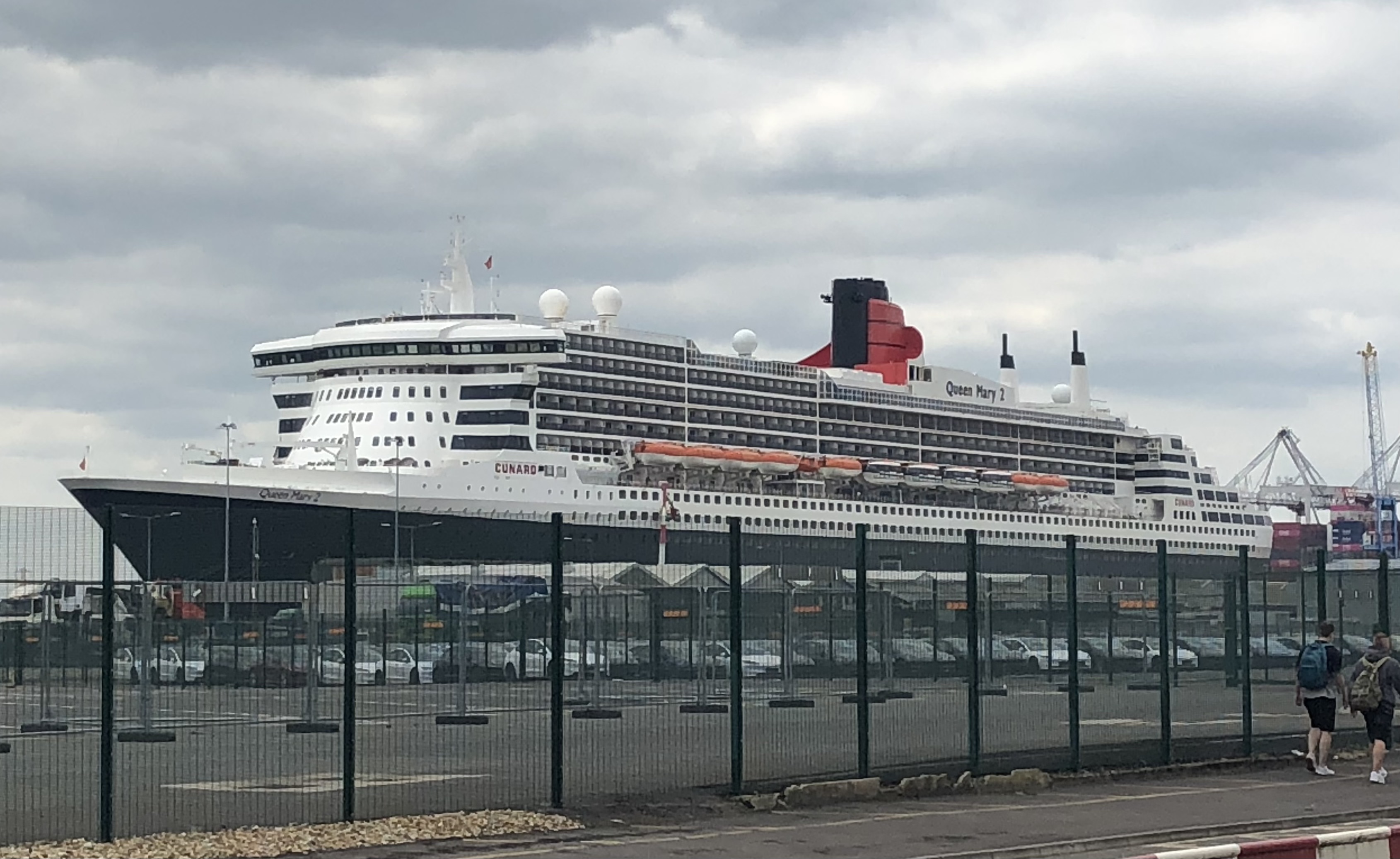
The journey commenced on June 8 when I was given a lift to Barassie Station by Elaine. I had two well packed suitcases, one with my stuff and another which was in effect a Red Cross Parcel for those imprisoned by the high price of things in Canada. We said our goodbyes and I got on the 10:48 to Glasgow Central, a busy train on which I somehow managed to sling the bags on the overhead rack. At Glasgow I lugged them across the concourse (via Boots where I purchased the required Meal Deal) for the next leg. That was the Avanti West Coast 11:56 departure to London. It was one of the services that routes via Birmingham so there were plenty of stops before I reached Birmingham International Station. There was a forty minute wait before a very busy Cross Country train turned up which would deliver me to Southampton. All trains ran on time and I arrived just before 8pm. I had booked the City Centre Premier Inn for the night and decided it wasn’t far enough away to warrant a taxi, and with my two heavy suitcases in tow, walked the three quarters of a mile to said establishment and checked in. Had the ship been departing any other day than a Sunday I would have utilised the Caledonian Sleeper overnight down to London and a train from there to Southampton in the morning but the Sleeper does not run on a Saturday night. There was an overnight Megabus coach from Glasgow to Southampton but I’m not mad enough to even consider that option so travelling down the day before and a night in the Premier Inn was the best plan. After a decent night’s rest I was very happy I had done it that way. I had been allocated a check-in time of 3pm by Cunard so had a few hours to kill. I had a wander round the city and took the opportunity to work out how to get to the Mayflower Terminal at Southampton docks. It was a mile and a half away from the hotel so I went for the walking option rather than pay an inflated taxi fare. This proved to be another good decision. I headed past the station where many taxis were waiting to transport those arriving on the day to the QM2 and three other different cruise ships that were scheduled for departure that afternoon. I walked down the entrance road to the docks, turned right and there she was, the Queen Mary 2. Walking had given me my first view of the magnificent looking ship that would be my home for the next six nights. Yes, I would have seen it from the taxi but by walking I had another ten minutes to admire her classy lines from a distance, something you can’t quite do whilst on board. I was the only person walking and it was a privilege to do so.


At the Mayflower Terminal I deposited my bags on a conveyor belt and hoped I’d see them again soon. I then joined the massive check-in queue. It was 2-30pm, half an hour before my allocated check-in time. By the time I reached the front of the queue it was 3-30pm. An hour in the queue was perhaps a bit longer than I would have liked but once it was my turn to check-in, it took approximately 30 seconds. There was a further airport style security check which only took a few minutes and I was ready to follow the ‘To The Ship’ signs. A walk up the covered gangplank led me through the door on Deck 2 into the atrium. I was welcomed on board and shown to the lift, then left to find my cabin on Deck 6. It wasn’t difficult but I can see how some folk may have found this a bit overwhelming. Whilst I hadn’t expected to be walked to my room I did feel the whole boarding process could have been a bit better. Anyway, when I found my cabin, which I will now refer to as my stateroom, the two suitcases were already sitting outside and an envelope with my keycard was sat in a little letter rack thingy. I opened the door and stepped in.


I’ll pause the travelogue here to talk about the Queen Mary 2. Built in Saint-Nazaire, France, she was launched on 21 March 2003, christened on 8 January 2004 and commenced her maiden voyage four days later. Her construction was marred by an accident on 15 November 2003 when a gangway collapsed during an event where shipyard workers and their families had been invited to inspect the ship. Sixteen people died and thirty-two injured after falling 15 metres into the dry dock. She is designed as specifically for the Transatlantic Crossing and as such is the only operational ocean liner in the world. All other cruise ships are just that – cruise ships. QM2 is sleeker, faster and cuts through the waves much better than even the largest cruise vessel. When she entered service she was the largest passenger ship ever built. With the advent of the super cruise ship over the past twenty years she isn’t even in the top forty any more but still clocks in with a gross tonnage of nearly 150,000, more than double that of the Queen Elizabeth 2, the ship she replaced. (Gross tonnage is a measure of internal volume, not weight) The external appearance is in keeping with the Cunard Line heritage and, as I mentioned above, she looks stunning. The heritage themes continue on the inside. The decor, whilst not always to my taste, is in keeping with the golden age of transatlantic travel and much is made of the history of Cunard and those who have sailed with the line in the past. She was refurbished in 2016 and has been kept in good order since then. Amongst the public areas are numerous restaurants and bars, a theatre, cinema/planetarium, ballroom, nightclub, library, shops, casino, gym, spa and, for use on Transatlantic services only, kennels. There is a covered pool and another two on deck at the rear of the ship. The promenade deck wraps round Deck 7, three laps equals 1.1 miles. There are open decks at the top of the ship and over several decks at the rear. Power comes from four diesel engines with two supplementary gas turbines. These generate electricity to power the ship and drive the four propulsion pods. Top speed is 30 knots and she generally cruises at 24 knots. Whilst there are many larger and newer passenger carrying ships now, I don’t think any of them are as impressive as the Queen Mary 2.


Back to the travelogue. Having watched the lifeboat drill on the cabin TV and checked in at the appropriate muster station, a compulsory feature of all cruises, I headed up to the top deck of the ship, known as The Lookout, to observe the sail away. There was no brass band to play us off or fireworks, this was just a run of the mill departure as far as Southampton was concerned. With several blasts of ship’s impressive whistle – more a hooter than a whistle – we slowly moved away from the dock and set sail down the Solent. Three other cruise ships were in port. QM2 towered above Seven Seas Splendour and P&O Arcadia but was dwarfed by Arcadia’s new sister ship, Arvia. We could hear the passengers on Arcadia being encouraged by the onboard DJ to make some noise to show us on the QM2 how to have fun. I think, perhaps, that DJ had the wrong idea of what the average Cunard customer would consider fun. Once out of the Solent we passed to the east of the Isle of Wight before turning west and that was the last land I would see for five days. That is quite a long time with noting to see but the sea. I’d occasionally look out at endless ocean and lose myself in the vastness of it all but the awe only lasted for so long and I had to find other stuff to do. This leads us to life on board a transatlantic liner.


The Queen Mary 2 is a big piece of kit. It took a while to get used to everything it had to offer and I was still finding nooks and crannies that I had missed right up until the end of the journey. First thing to discover was my stateroom, number 6003. This was the most basic type of accommodation for the fare paying passengers, an inside cabin. Basic is a relative term, however, it was perfectly well appointed. It had a comfortable double bed, a desk and chair, two USA and two UK plug sockets, a TV, a not particularly efficient fridge, plenty wardrobe space containing a safe and slippers but no bathrobe, and an en suite containing a vacuum lavatory, sink and shower. The room was attended to twice a day by Alan, the cabin steward, a Filipino chap who knew my name before we introduced ourselves to each other. I was more than happy with the cabin and the service. I could have paid more for higher standard stateroom, either at the time of booking or by bidding for an upgrade in the run up to the voyage. I’m glad I didn’t. There were times when I thought a bit of natural light would have been nice but not a couple of hundred pounds worth of nice for the stateroom across the corridor which had a window. A balcony stateroom would have given me a balcony on which I could watch the unchanging scenery go past but at an extra £800 I’d have spent much of the cruise trying and failing to justify the extra expense. Those are just the normal staterooms. For the full luxury Cunard experience you could spend several thousand pounds more for a Princess Grill or Queen’s Grill Suit. They look really nice in the pictures and you even get to use exclusive restaurants (Princess Grill and Queen’s Grill, hence the name) and lounges that we cheapskates were barred from. 85% of the passengers are cheapskates, however, and they occupied the range of ‘normal’ staterooms and most of them would have got much the same as I had, with or without the benefit of a window or balcony. And maybe a bathrobe. I should have asked Alan for one.


As mentioned above, in addition to passage and accommodation, your fare includes all the food and most of the entertainment on board. Whilst you could make the crossing without spending an extra penny, it is more likely that you will incur a few expenses along the way. The currency on the ship is the US Dollar which rather goes against the traditional British style that the Cunard try to recreate. Not that you see any actual greenbacks as the ship is cashless. You lodge a credit card either before the cruise or at the purser’s desk soon after departure and your stateroom keycard becomes your payment card for everything on board. The fare I had chosen included $125 cabin credit which was handy though it didn’t last long. During the fist night $96 was debited from that total for the gratuities for the hotel services staff at $16 per day. This was a surprise to a number of folk I spoke to although it was quite clear in the Cunard literature. It was odd though as we’d only had one night’s worth of service thus far and the whole idea of gratuities is a bit alien to we Brits anyway. You could get the purser to remove the charge from your account and choose to tip, or indeed not tip, in the old fashioned way at the end of the cruise. I just left it and hoped that Alan would get his fair share. In the end I charged $300 to my stateroom account which meant $175 was charged to my credit card at the end of the voyage. Much of that was for drink. Whilst you could get tea and coffee for free in the buffet and maybe fruit juices too, all other drinks had to be paid for. The prices were not extortionate but they mount up. Also, 15% is added to all those prices as a gratuity to the bar staff. Like most cruise lines, drinks packages are available to purchase in advance, or even on the ship. The full package was a whopping $75 per day. This meant you could drink all bar the top end wines and spirits. By my calculations you would need to knock back eleven alcoholic drink a day to make it worthwhile. I know some folk who could get more than their money’s worth from that but not me. I decided to take the pay-as-you-go option along with a bit of smuggling. The contraband was sixteen cans of Diet Coke that I had purchased in Southampton on the morning of the departure. I had managed to stuff them into the suitcases and they were still in them when I was reunited with the cases on board. Whilst I felt I was doing something slightly clandestine, there isn’t any rule against taking soft drink on board although there are limits on alcoholic drinks. I drink a lot of Diet Coke and a bottle of the stuff on board was nearly $5 with the gratuity. I drank all of them over the six days saving my stateroom account $90 at the initial outlay of £9. Sorry to mix up the currencies there but it’s clear my smuggling activities saved me a few dollars/quid. A man can’t live by Coke alone, however, so a few vodkas, in to which some of the smuggled Coke was poured, and beers into which it wasn’t, were bought and consumed as I went.

A big part of this and indeed all cruises is the food. You are not going to go hungry on your transatlantic voyage. The main dining room is the Britannia Restaurant, an impressive space over three decks. It is where the 85% of passengers not travelling Grills Class can formally dine for breakfast, lunch and dinner. For dinner you can choose a particular sitting or do what I did and opt for open dining. I never had any wait to be shown to a table. You are asked if you would be prepared to share, I always said I was. Even if you prefer to eat alone it will be on a table that is just a couple of inches from the next so it is likely you will end up chatting to other cruisers anyway. The food was good. Not amazing or extraordinary but a good choice of quality dishes. The service staff were smart and attentive. My only gripe would be the food sometimes took a while to arrive and when it did it could have been a bit hotter but my overall experience of the Britannia Restaurant was positive. It isn’t the only option when it comes to dining. The King’s Court is a large buffet style restaurant that is open all day and possibly through the night too, I never checked. It was extremely popular, especially for breakfast and lunch. There was a wide selection of dishes to choose from and the quality was good but I could never shake off the idea that it was more of a canteen than a restaurant. I used it often, sometimes through necessity as the Britannia Restaurant was off limits to me on Gala Nights. Part of the Kings Court was reserved for speciality dining. I visited one night when it was turned into Coriander, an Indian restaurant. This cost an extra $20 but was worth it as it was the best meal I had on the ship. Another optional extra was the Verandah, an a la carte steakhouse. This could be anything up to a $50 supplement. I had booked in advance for a lunch there one day for $20 but when it came to it I really didn’t fancy a steak lunch and cancelled the reservation. The money was refunded and I never got to sample Verandah. All I can say is that I heard good reports about it. A big thing was made of Afternoon Tea, served every day in the Queen’s Room. This is the ship’s ballroom, transformed into a large dining room every afternoon. Finger sandwiches, scones and cakes are served along with a choice of teas or, if you don’t drink tea, they’ll bring you a fruit juice. Champagne is served too but you have to pay for that. A pianist or a classical string trio plays and it is all very civilised. I was never very hungry at 4pm but I visited it just the once purely so I could report back. Naturally I had to sample everything on offer (apart from the tea) and after the fourth or fifth cake decided that everything was very nice and I could maybe give dinner a miss that evening. The scones with jam and clotted cream were sublime. I later discovered that you could do a DIY Afternoon Tea in the King’s Court which was handy as I had missed out on the mini treacle tart in the Queen’s Room only to find some sitting in the buffet the following day begging me to eat one of them. I did. It was lovely.


Those were the main dining options but there were others. The ‘British Style Pub’, the Golden Lion, served some pub grub classics at lunch time. I tried the fish and chips one day which was not a bad effort. Some of the bars would have sandwiches and nibbles and there was a place up on deck, the Boardwalk Cafe, that would serve food to the sun worshippers had there been any. I think it remained closed for the entire voyage. If none of these options appealed to you there was always room service at no extra cost. I’d have personally gone a bit bonkers had I remained in my stateroom to eat but judging by all the trays with half-eaten plates of food that lay in the corridors at any time of the day, this option appeared to be a popular one. The main bar/lounge was the Carinthia Lounge on Deck 7. This seemed popular and would host quizzes and other events throughout the day. On one afternoon there was a performance of Twelfth Night in there, not perhaps the best place for it as the layout of the place meant I could hardly see any of it. My favourite bars were the Golden Lion as mentioned above and the Commodore Club at the front of the ship on Deck 9. It had good views over the pointy end, not that there was anything to view other than sea of course. There was a cigar room, Churchills, next to it if you happen to enjoy puffing on a smouldering dog turd. Off the top of my head the other bars were The Chart Room, Champagne Bar, Terrace Bar and Pavilion Pool Bar but there may be one or two others tucked away that I missed. The good news for those of us smuggling Diet Coke on board is that the bar staff will happily, or maybe even begrudgingly, will bring you a glass with ice.


Whilst food and drink take up a large part of any cruise, there are is still a lot of time to fill with other activities. With watching the scenery pass by not one of them, Cunard have a whole load of stuff to do throughout the day and into the night. Every day a list of the following day’s activities is included so you can plan your day. I should have saved a copy to show you an example but neglected to do so. The picture below was from cruise last year which I discovered on the internet and used without permission as, frankly, I doubt they’d got permission from Cunard to use it in the first place. It is absolutely typical of what to expect but not precisely the same what I had to choose from.

It looks a full programme but there were times when I was struggling to find something to do. Maybe I’m a bit too choosy. However, the Cunard Insights lectures, which were on different topics to those in the picture, kept me going. There were four different lecturers on my cruise. I passed on the American Politics and Art History/Architecture ones but attended those by Steve King and Captain Chris Rigby. Steve was a lovely chap, who I’d met the first evening at dinner. He had a lifetime of working in radio behind him and his talks were mainly about 60s music. Not really my thing but interesting enough to pass an hour each day. Captain Rigby’s topic was aviation. He was a former pilot with BA, Britannia, Ryanair and possibly another couple of airlines. His lectures were about aviation so I obviously had to go to them. Most of them were aimed at an audience less, well, avgeeky than me so I didn’t really learn much. One was specifically about his thoughts as to the disappearance of flight MH370 which seemed a little bit conspiracy theory to me but as he freely admitted, we will never know until they find the thing and that might never happen. The lectures took place in Illuminations, the ship’s cinema and planetarium. I’d been hoping for some sort of planetarium display but for some reason there wasn’t one on my crossing. The seats were cozy though and I admit to nodding off during a couple of the talks. There was also a Q&A session with both speakers that took place in G32, the ship’s nightclub. Not, in case you were wondering, at the same time that the DJ was spinning the decks or whatever it is that DJs do.


I went to most performances in the Royal Court Theatre. Two were song and dance extravaganzas by the ship’s on board entertainment staff. Others were visiting acts such as Piano Showman Chris Hamilton, comedian and impressionist Foggie Flax and tenor Shimi Goodman. Despite his name Foggie Flax was actually quite funny and the two musicians were talented. All the shows were 45 minutes long and were performed twice each night. I enjoyed them but was happy they weren’t any longer. There was plenty of music performed throughout the ship in bars and public areas and I even went to a classical guitar recital in the theatre one afternoon which was mercifully short. The guitarist was good but one classical Spanish guitar piece sounds much like another to me. The only other ‘organised’ entertainment I attended was the pub quiz in the Golden Lion. Forming a team of one named Norman No Mates, I entered three of them and came second in two. Pleasing yet frustrating at the same time.


For the rest of the time I was either walking around Deck 7 which got rather tedious after the third lap, sat in a bar or on one occasions sat on a sunbed by the covered Pavilion Pool. It wasn’t for long as it was a bit chilly. Some folk sat outside if they could find a sheltered spot and it wan’t too foggy but it didn’t look much fun to me. I did spend some time in the spa one day. This cost me $59 but I figured it was worth it. The hydrotherapy pool and jacuzzi were very nice and there was a suitably hot sauna, a warm herbal sauna and a broken steam room. I enjoyed it. This and the $25 tee shirt I bought in one of the shops was the only thing to be charged to my onboard account other than the drinks and service charge. You can also visit a well equipped gym if you wish or if you fancy something a little less energetic there is a large library on the deck above it. The ship has WiFi featuring internet from the Starlink satellites. Access to just the WiFi is free and is useful for visiting the Cunard pages where you can find things like the daily programme, make reservations and keep an eye on your stateroom account. Full internet access needs to be paid for and isn’t cheap but I bought a whole voyage pass several months earlier when Cunard had a sale on. It cost $108. It was money well spent as I would realise later on the train part of this journey when I inadvertently went ‘off grid’. The WiFi signal was nearly always good with just the occasional period with slow download speeds. I may have struggled to avoid boredom had I had no internet access. I don’t mind being a solo traveller but I do like to remain in contact with friends, family and above all Elaine. A word about dress code. Most of the time it is pretty relaxed. They do say that smart casual is required in the evenings with long trousers and a collared shirt for the chaps. On Gala Nights, however, dinner jackets with ties or bow ties are ‘compulsory’ in most areas on the ship. I didn’t take a tuxedo or indeed a tie. That meant dining in the Kings Court and being restricted to a couple of bars. I didn’t mind. In fact I felt a bit rebellious by not conforming to the Gala Night dress codes.


That is how I passed my time on board. The ship followed the great circle route to New York at a steady 24 knots. I barely felt any motion, even in my cabin at the front of the ship. Most crossings last seven nights but some, including this one, take six. With the time zone changes the clock was put back an hour on five of the six nights. If nothing else, crossing the Atlantic on a ship is a great way to beat the jet lag of a transatlantic flight. Our arrival into New York was scheduled for 07:00 Eastern Time. Unfortunately a couple of incidents on the way led to us arriving four hours late. On the first night of the cruise I was awaken from my slumbers at 01:30 by the dulcet tones of the captain. I thought hello, this is a bit over friendly but he hadn’t entered my stateroom of course, he was making an announcement on the ship’s public address. A passenger was ill and required a helicopter evacuation to Plymouth. For safety reasons we needed to be told this even though nearly everyone would have slept through the incident. A course adjustment was made to rendezvous with the coast guard helicopter and the poor sod was whisked off the ship and hopefully make a recovery from whatever malady he was suffering from. Some folk reckoned they’d seen his distressed wife prior to the evacuation. We were left wondering if she had been winched onto the helicopter with her husband or if she had to remain on board for the rest of the trip. The delay this caused wasn’t much. However, on the morning of the fourth day we received another PA from the captain. During the night the ship had broken down. It was an interruption with the electric supply apparently and as the propellers are turned using electrical energy it was quite important to get it fixed. He mentioned that we had stopped overnight to fix the problem but a look at the live map display suggested we had sailed a racetrack pattern, hopefully under some sort of control. Anyway, he said the problem was fixed and we were on our way again. We would, however, not make it to New York by 7am. Eventually they secured an 11am berth at the Brooklyn Cruise Terminal and kept their fingers crossed that the problem would not resurface. It didn’t.

This delay would prove to be a pain to those with connecting flights, trains or buses. My connection should have been fine as I wasn’t due to leave New York until 15:30 although it did cut things a bit fine. The advantage, however, was that I didn’t have to get up at four in the morning to witness the highlight of the cruise – the arrival into New York. It was a lovely morning. Even the relative 40kt wind could not stop me from grabbing a position on The Lookout deck to witness the arrival. The southern shore of Long Island was already in view and soon we were passing beneath one of the flight paths into JFK Airport. Abeam Brighton Beach we began our turn to the north towards the Verrazzano Narrows, spanned by the mighty Verrazzano-Narrows suspension Bridge. The iconic Manhattan skyline hove into view beyond it. The QM2 passed beneath this bridge with just four metres to spare, in fact the reason the ship’s funnel is shaped the way it is to ensure this absolute minimum clearance under the Verrazzano Narrows bridge. It certainly looked close from The Lookout deck, a few metres lower than the top of the funnel. Once through, Manhattan was clearly visible along with all the traffic in Upper Bay. Having slowed down to a crawl it still took another two hours to reach the dock. The Statue of Liberty appeared in the distance to welcome us and slowly grew, remaining off to the left as we turned towards the Brooklyn Terminal. Eventually we turned through 180 degrees and edged to the dock. By 11:00 we were, as my mate John would say, all fast, F&A, FWE. I really need to ask him what that actually means. I guessing it means ‘parked’. It wasn’t quite the end of the cruise though. Disembarkation is by the colour of the tags they gave you to put on your bags the previous day. It wasn’t until 12:40 that my group was called and then followed quite a long wait to get through immigration in the large shed that is the Brooklyn Cruise Terminal. Once through that I joined a taxi queue which seemed to go on for ever, got into a discussion with the couple behind me – the chap was the ship’s bridge (cards, not the place where they drive the ship from) instructor – and we agreed to share the price of an Uber to the Moynahan Train Hall in the centre of the city. I arrived just over an hour before my train was due to depart. I wouldn’t say I was worried but I was concerned that I might be getting concerned.


So to summarise this part of the journey. Is taking the Queen Mary 2 a practical way of reaching the New World? Yes, it absolutely is. Is it a convenient way of doing so? Absolutely not, at least as far as I’m concerned. You’ve got to put aside a week or so of your life to make the crossing as opposed to seven or eight hours by plane. There is the advantage of gradually getting used to the time zone changes and of course if you are afraid of flying it is the only way to cross the pond but most people don’t do it for practical reasons. They do it because it is an event. The crossing is part of their holiday and in some cases all of their holiday. I spoke to people who were getting the first flight back to Blighty, hopefully they disembarked the ship in time. Is the experience worth it? I can only speak for myself when I say yes it is, but only the once. I enjoyed the experience but have no desire to repeat it. As a cruise holiday it is a bit of a dead loss – one of the things about cruise holidays is visiting different ports. Five days of endless ocean is a bit, well, boring. Sure, the ships activities are many and varied but I was definitely getting a bit of cabin fever by the end of the journey. What about Cunard? I thought they were good and are probably worth thinking about if you fancy a cruising holiday. They pay homage to the golden age of ocean liners and all the things you expect are up to scratch. The different class system might put you off but it wasn’t really a factor to me. My suggestion is yes, go with Cunard but unless you really need to be in New York, choose a ‘normal’ cruise to Norway or something that looks a bit nicer than endless ocean. All four Cunard ships do normal cruises but only one of them, the Queen Mary 2 also does the regular transatlantic crossing.
Part Two of this journey to follow. It took half the time so you will be glad to hear shouldn’t be as long. I will reveal the cost of the entire enterprise at the end.


Hi Neil,
<
div>
<
div dir=”ltr”>
<
blockquote type=”cite”>
LikeLike
Alas, my printer is broken and I’m old and retired too so I don’t know how to fix it…
LikeLike