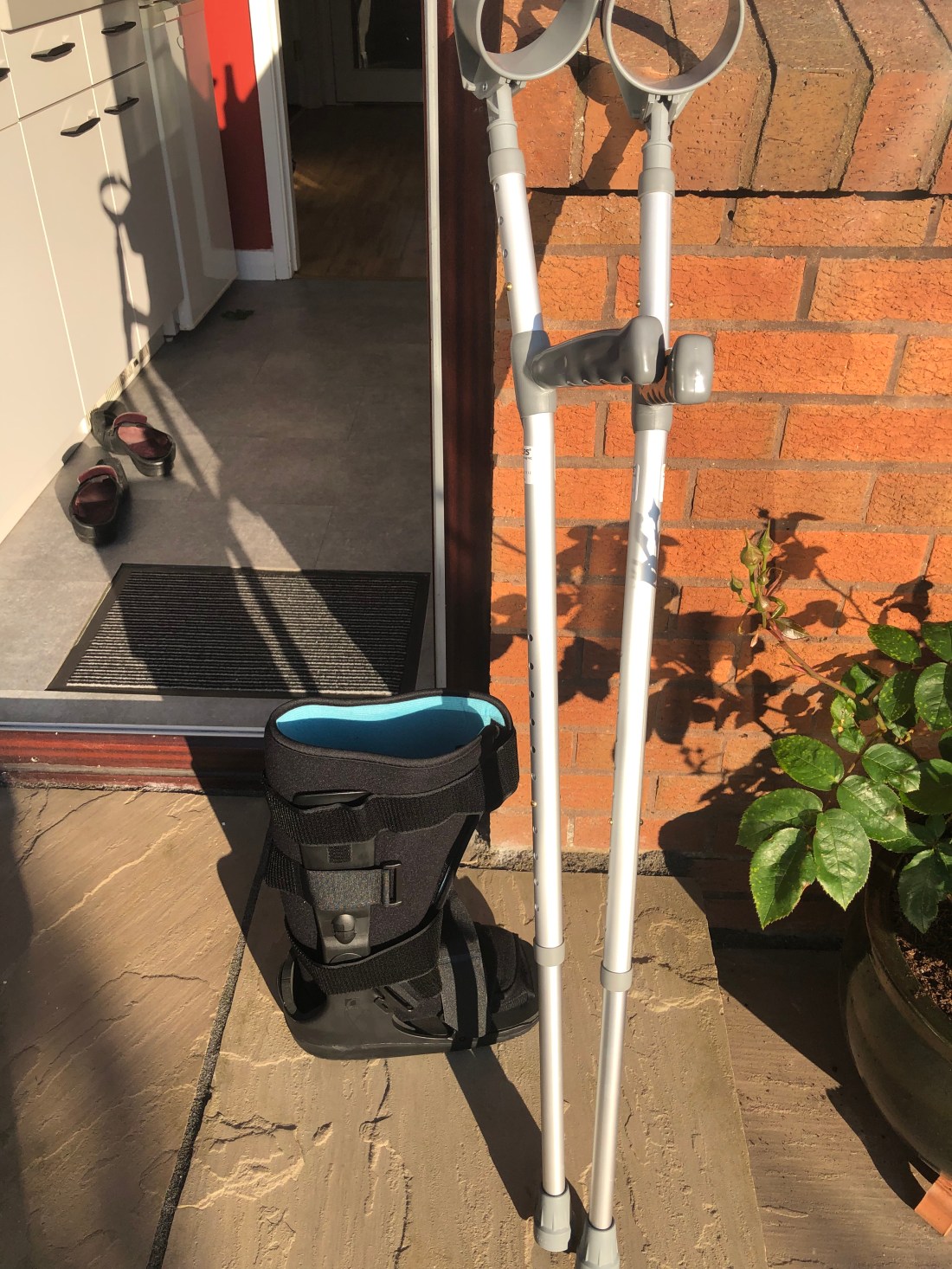
Moon Boot

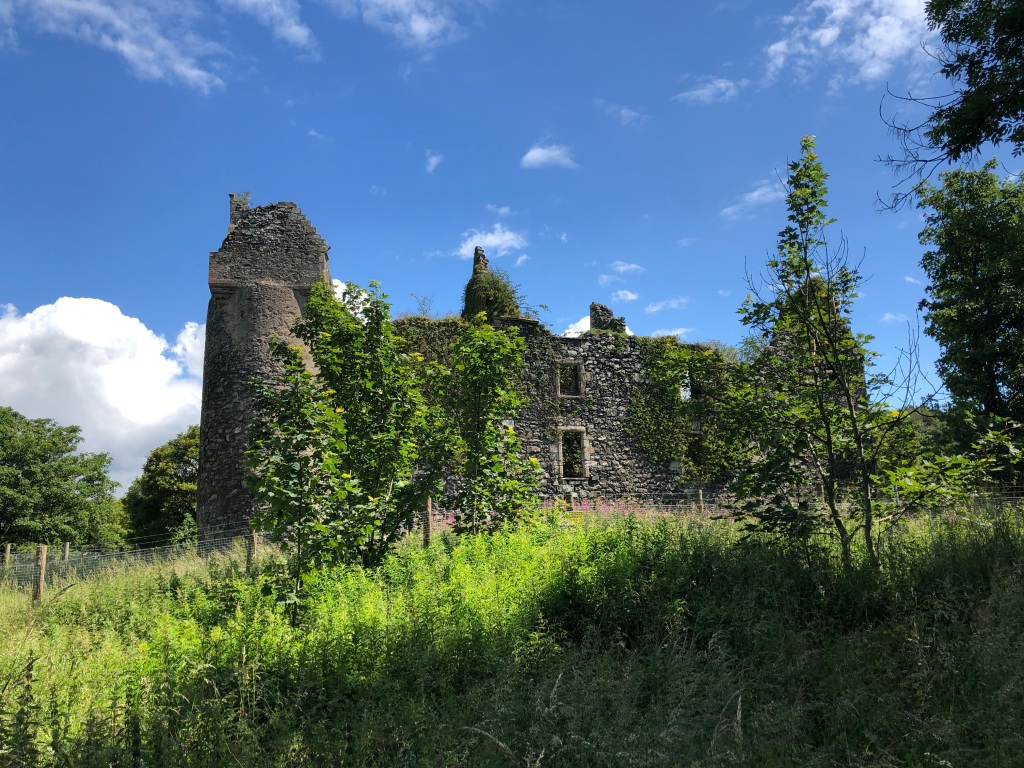
A few weeks ago, on the 28th June to be precise, I decided to go for a walk. I’ve been on plenty of those before of course and not many of them are worth blogging about. Had this one gone to plan I may well have had an interesting tale to tell about discovering 77 year old aircraft wreckage but unfortunately it didn’t go to plan at all. In the Ayrshire countryside there are the remains of quite a number of crashed aircraft from the 1940s and 50s. Nowadays air crashes are thankfully few and far between and investigators endeavour to collect any bits of wreckage that remain to try and piece together the events that led up to the accident. Back in the war, and the years following it, there were not the resources to do that and as such wreckage remains in the more remote locations to this day. One such wreck is that of a Hawker Hurricane which crashed to the south of Loch Doon on 24th March 1944. Sadly, the pilot, FO Roswell Murray MacTavish of the Royal Canadian Air Force lost his life in the crash. He was 24 years old. A bit of internet searching revealed that a small amount of wreckage including the Merlin engine, along with a recently built stone cairn memorial, is in forestry commission land near Loch Doon. So it was on that Monday back in June that I decided I’d go and find it. Spoiler alert: I didn’t. If I ever do I’ll write another blog about it.

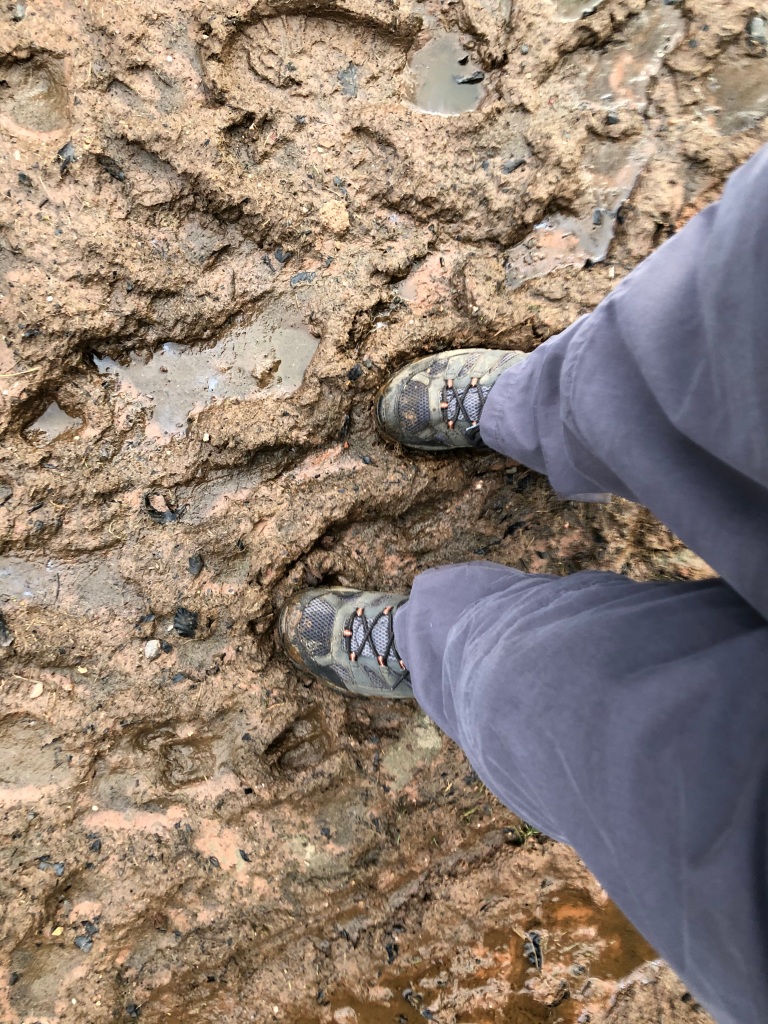
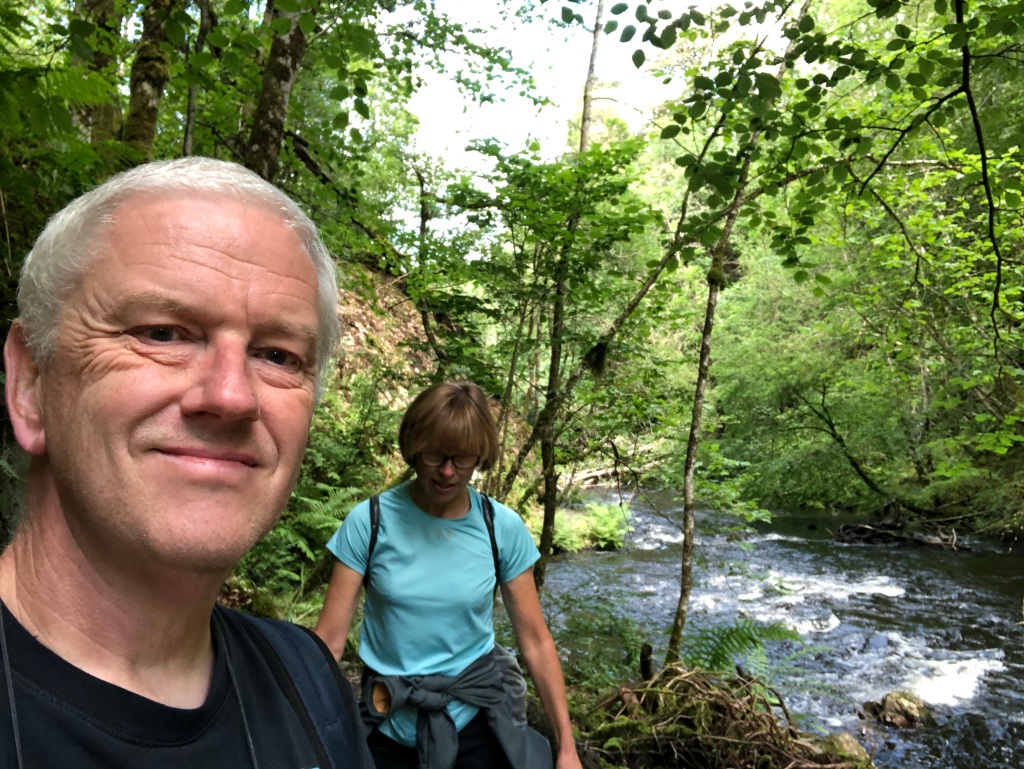
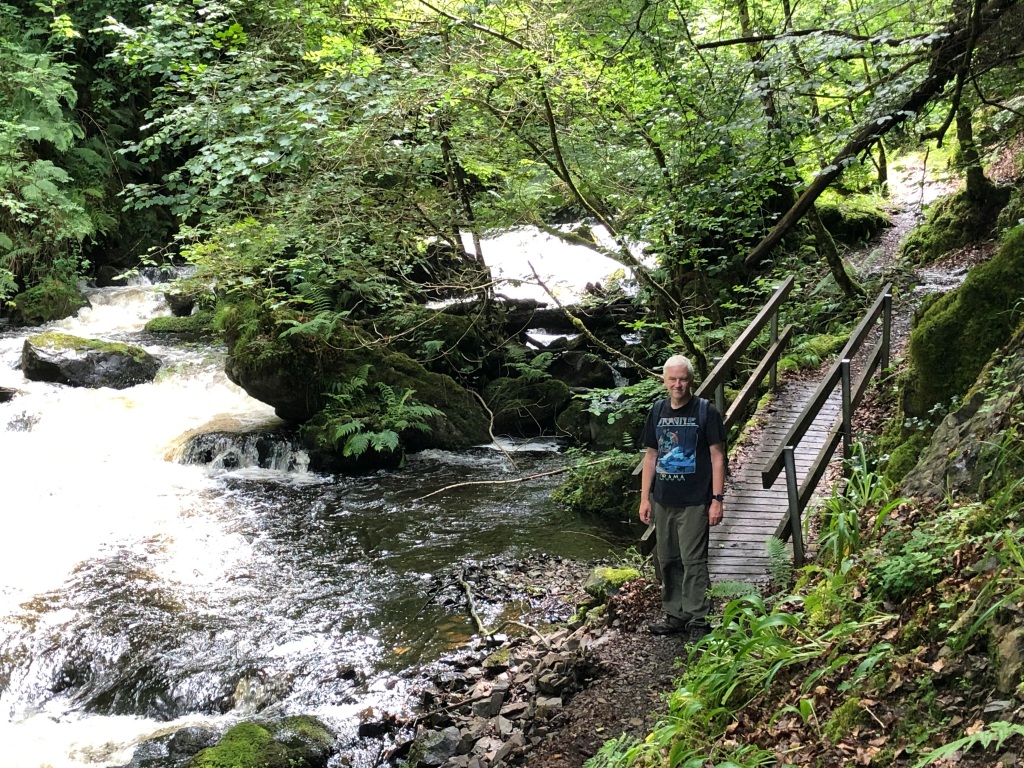
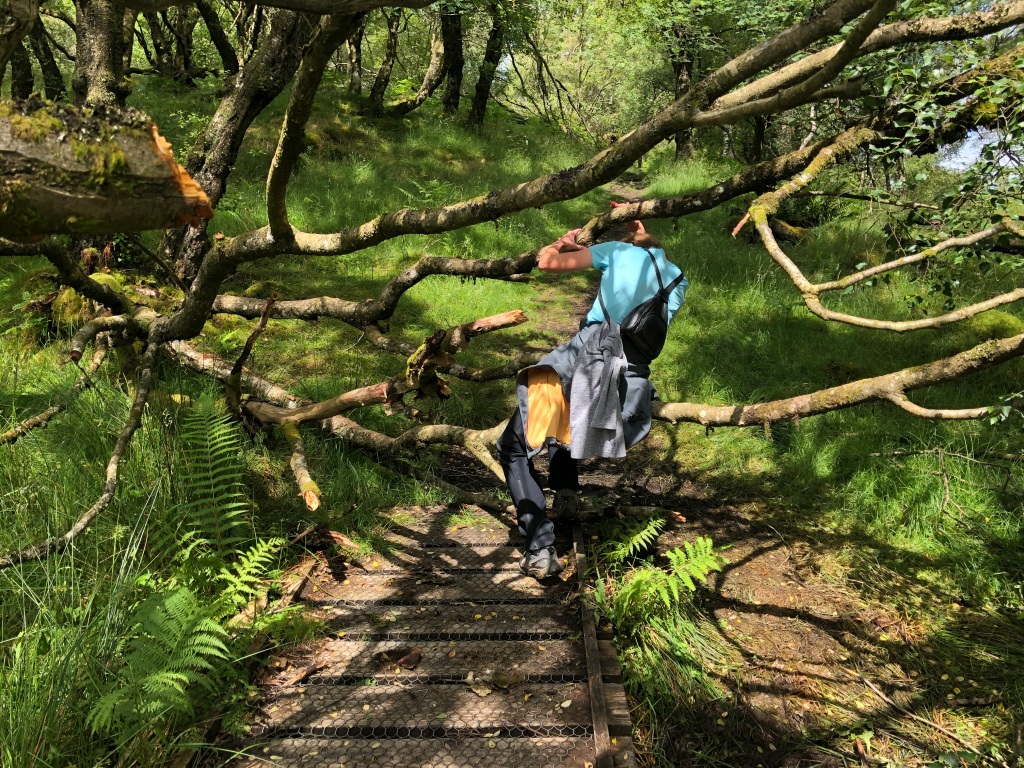
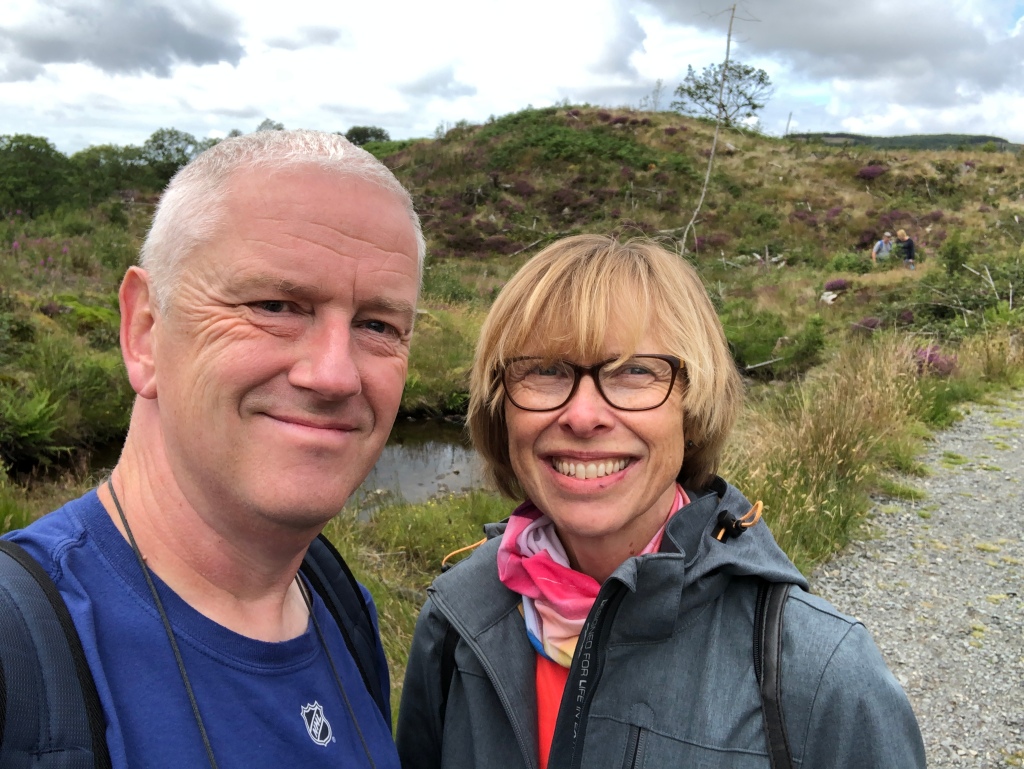
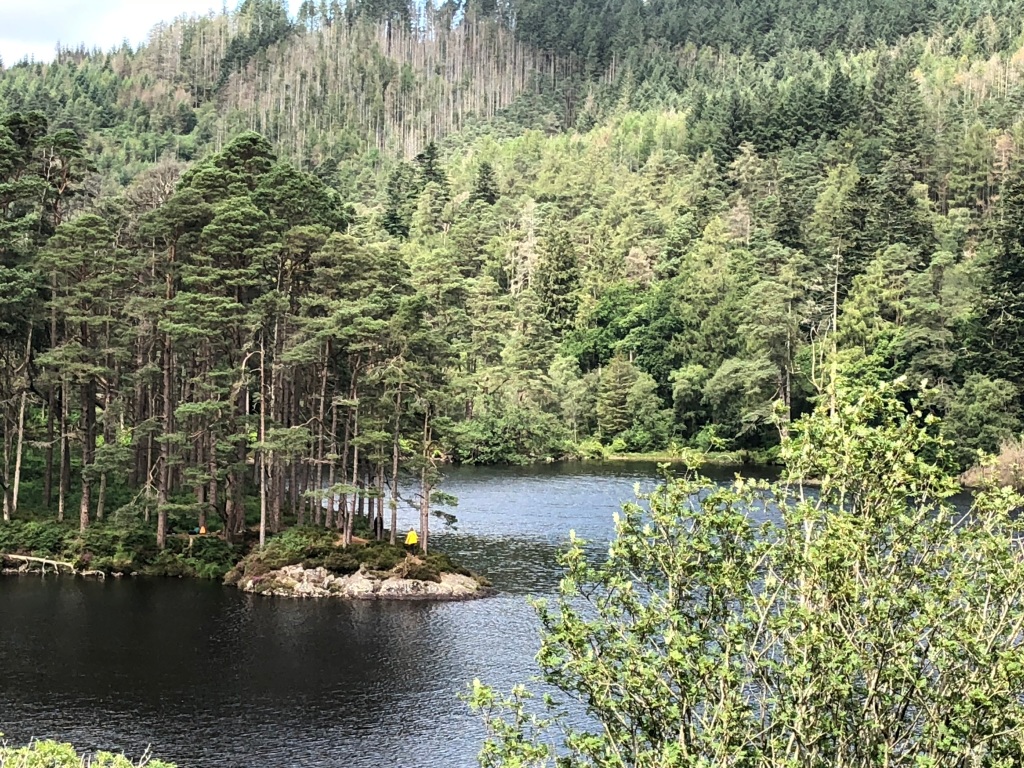
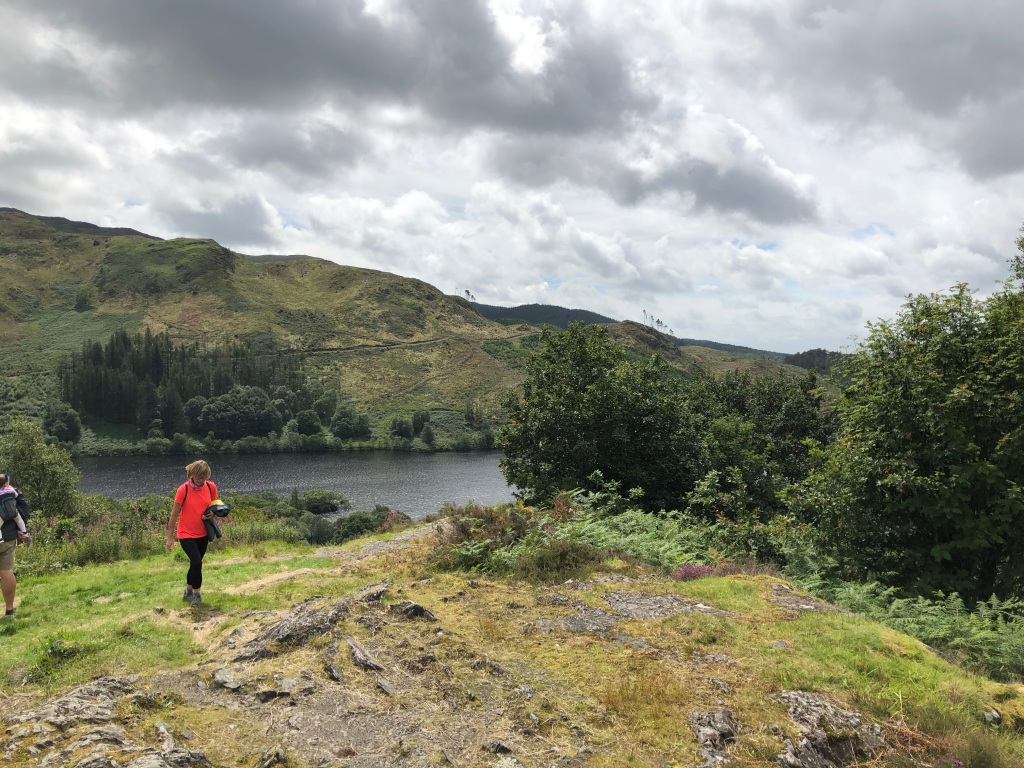
There was one thing different about this walk. I was going to do it solo. Normally I have Elaine as a walking companion as it is decidedly more fun walking with someone. On this occasion, however, as she was working I thought I’d set off by myself on the eight mile round trip from the car park by Loch Doon Castle. It was a nice day with broken sunshine, pleasantly mild temperatures and I had packed an extra Mars Bar so was all set. The route is nearly all on gravel forest tracks with gentle inclines but nothing challenging. The views of the loch are fantastic and whilst it was a there and back walk rather than the preferred circular, I was quite enjoying myself. Once past the southern limit of the loch I didn’t see another soul and I dare say I was actually appreciating the solitude of the place. Eventually you have to leave the gravel road and traverse an area of felled woodland. There is a rough track to follow which I did. This should have quickly led me to the wreckage but in hindsight I must have walked straight past it without realising. The trail split. I followed one of the forks. I had to negotiate some small burns and piles of forest debris before the trail ran out. I turned around to retrace my steps, leapt over a small burn, caught my right foot in some of the forest debris and went over on my left foot, twisting the ankle in the process. I swore a great deal in the hope that it would help but it didn’t. After the intense pain had subsided a bit I took stock. I tentatively got up and discovered my right leg was good. Putting some weight on the left foot, however, proved much trickier. I could do it though, just about. I hobbled forward a few steps. Not easy but doable. A hundred thoughts went through my head, one of which was to call for help. I looked at my phone. No signal. Could I wait until someone else pitched up and hope they could help in some way? It could have been a few days before anyone else ventured out that way and I only had one spare Mars Bar. No, I was going to have to try and hobble back to the car some four miles away.

The wreckage is, apparently, visible in this photo. I somehow walked past it and ended up near those unfelled trees on the right which is where the fall happened.
Not ideal terrain for walking with a broken ankle.

I am, of course, an idiot of the highest order. I still hadn’t found the wreckage and even with my damaged ankle I felt it would be a shame to not see it now. I hobbled back to that fork in the tracks and went up the other one. In my catalogue of foolish things I’ve done, this decision has to be up near the top. It was painful, the path was dangerous to walk on and it was taking me away from where I really needed to be. What’s more, it proved fruitless. I’d already unknowingly passed the wreckage before the fall. I admitted defeat, which if I’m honest was almost as upsetting as knackering my ankle, and did my best to negotiate the horrible forest trails back to the road, obliviously passing the wreckage once again. Once on the gravel road I hoped the going would be a bit easier. It was, but only a bit. Every second step was a sheepish one, every bit of loose gravel was to be avoided and there was plenty of that. Had a forestry commission chap driven past in his pick up I would have flagged him down and asked for a pick up. Not a soul came by or near me. I made it back to the car, hugely relieved. It had taken a while, time for me to reflect on all the what could have beens. It was actually quite scary. Still, I’d made it back to the car and thanks to it being an automatic, I could drive it home with a redundant left foot. It was a fifty minute drive and by the time I arrived the ankle had swollen up so much I could barely get out of the car. Eventually I settled down with my leg up, ice on the ankle and a dose of ibuprofen to quell the inflamation. Yes, my tendons and ligaments were nobbled but they would get better over time.

Things are never that simple. Sharing my cautionary tale with the world led to calls for me to go and get it seen at A&E. I resisted at first as it was ‘only’ a sprained ankle but the clamouring got to such a level that the following day I reluctantly phoned 111. Come and see us at 2pm they said so I drove out to Ayr Hospital to be assessed. A quick prod and an x-ray later I was given the diagnosis. I had broken my ankle. To be precise it was the distal fibula which is the bottom of one of the two bones that make up your lower leg. Thankfully, this was not a weight bearing bone. Had it been I’d probably still be on the hillside right now. It did, however, need to be fixed. To be precise, it needed to be protected so it fixed itself which meant no ibuprofen – I didn’t even get that bit right – and the wearing of a contraption called a Moon Boot. It’s probably got another more clinical name but Moon Boot makes people smile so I’ll stick with it. It is designed to restrict movement and redistribute weight on the offending bone allowing it to heal quicker. It also helps prevent any strained ligaments from further damage so all in all it’s a good idea. A pair of crutches were also provided to help me walk. I wasn’t particularly happy receiving these NHS freebies and it took a while to get used to being an invalid. You don’t have to wear the boot all the time – it’s not exactly practical to sleep or shower in it – and I didn’t wear it about the house very much. This was probably a mistake but hey. A week later I had to attend the fracture clinic where doctor sent me off for another x-ray and confirmed the diagnosis made as A&E. The bone was indeed fractured and that I needed to wear the boot for six weeks. Oh great I thought. I did make the assumption that one week had already passed so set the boot free day some five weeks hence.

Ironically, following months of Covid restrictions, things had started to open up and I had things to do. A number of those were walks which were right out but I was buggered if I was going to let a damaged ankle get in the way of others. Eleven days after the accident I flew down to London – my first trip on a commercial airliner for seventeen months – to go to a cricket match at Lords. So many things had happened that suggested this trip might not happen, a broken ankle being just one of them, but I wasn’t going to be denied something I’d been looking forward to for many months. By then I’d ditched one of the crutches as it only complicated the walking process. I’d got used to walking in the boot. It had taken a few days to get used to it but once I’d begun to trust it, it became relatively straight forward. The single crutch was useful occasionally but was actually more use in clearing a path and showing everyone else that there is a cripple in the vicinity so mind how you go. At the cricket it proved useful to get me, and my sister Jill who I’d met up with down there, to push in to the front of queues. After a delay due to the English summer weather the cricket started and it was just wonderful to be at an event again, even if my left leg was getting in other people’s way. A few days later I went to another cricket match. This was at Old Trafford and I was accompanied by Jill again. By then I wasn’t even using one crutch. One of the stewards still took pity on me and led us to the front of the queue which was good. Not so good as I’d break my ankle again on purpose but good nevertheless.

EasyJet doesn’t have the greatest legroom in the world but you can just about squeeze in a moon boot.

That game was a prelude to a five night holiday I had planned with Jill and our mother. That was down in Dorset and off we set the following day. A word about my mum. She’s getting on a bit and is not the most mobile of people. As such we took both her walking frame and wheelchair. As a result both tourists and locals alike were most amused to see a man in a moon boot pushing a lady in a wheelchair along the promenade at Weymouth every day. One evening I swear we were the cabaret act in a Weatherspoons pub we’d popped in to for a gentle half pint. Despite mum’s protestations at being propelled around Dorset by someone with a dodgy ankle, we made the most of the time there, riding on boats and trains, visiting military museums – I somewow managed to get inside a tank which was probably a daft thing to do – taking in National Trust properties and even reliving the French Lieutenant’s Woman in Lyme Regis. The boot put in some hard miles and despite it starting to shed bits and pieces, stood up to the challenge well.

Me, my mum and a tank. Only one of us managed to make it inside.
The French Lieutenant’s Woman would, I think, have been improved had Meryl Streep been wearing a moon boot.

By the five week mark I was back at home. I must admit that I wore it little, if at all, in the seven days prior to Boot Freedom Day. To be fair I didn’t do much. We had the decorator in and the Olympics was on the telly so no major journeys were planned. On the day itself it was unceremoniously chucked in the bin as it was of no great use to anyone any more and it now presumably resides in the local landfill site. The crutches were returned to the physio department at Ayr Hospital, much to their surprise as most people tend to keep them, and I faced a future without medical aid of any kind. Most of the time it feels ok as long as I don’t try and flex it too much. I’ve been on a few local walks, building the distance up each time. At the moment, some eight weeks after the event, I can comfortably cover five miles on an even surface before the ankle starts to suggest that it has had quite enough exercise for the time being, thank you very much. I hope to increase both distance and severity of the terrain over the coming weeks. Who knows, by my birthday in October I might be hiking up Munros once more, though realistically that is more likely to be a 2022 pastime. If it is, I won’t be doing it solo.

After six weeks I think I’d probably got as much use out of it as I could.
Farewell old friend.

Troon’s Lost Railways

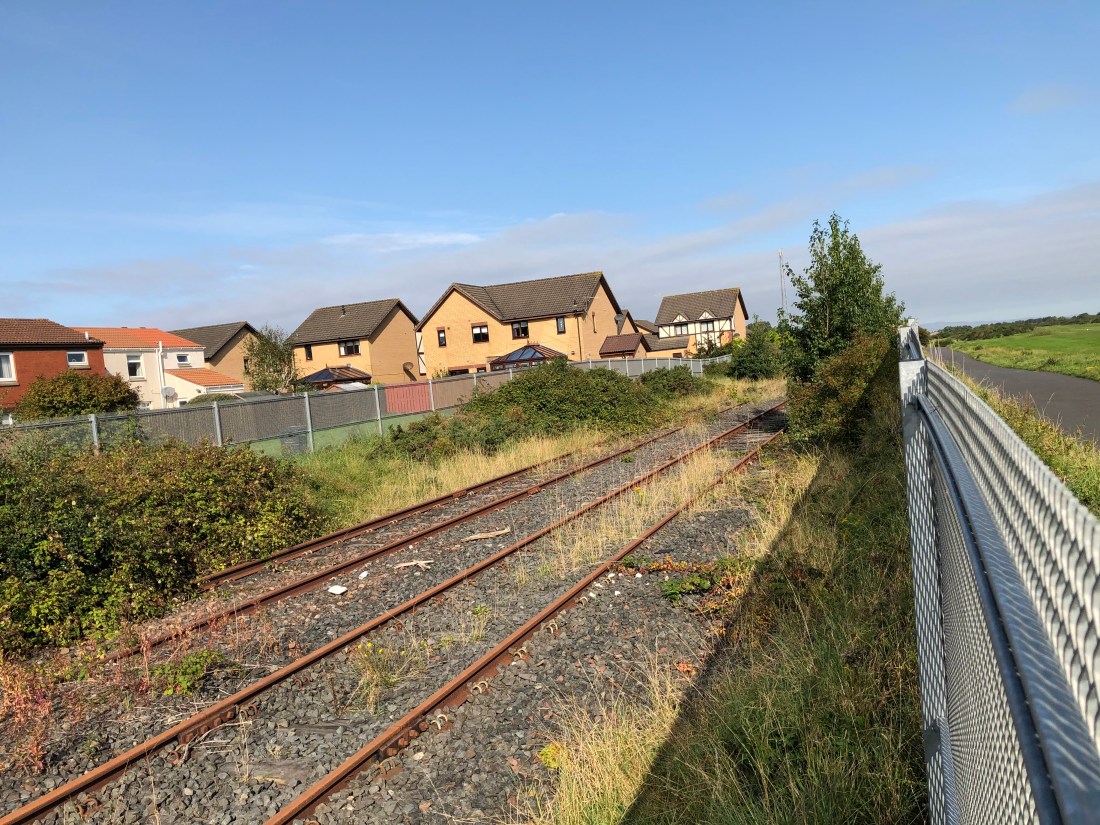
Abandoned track by Marr College.

I’ve walked a lot this year as regular readers of these blogs will know. Through necessity, many miles have been logged around the streets near to where I live and I’ve got to know Troon more intimately than I’d ever managed in the 37 odd years I’ve lived here. Troon is a small town on the Ayrshire coast, some thirty miles southwest of Glasgow. It is famous for golf with The Open Championship taking place at Royal Troon every nine years or so. Golf aside, however, Troon serves as a dormitory town for nearby large towns and the metropolis of Glasgow forty minutes away by train. Whilst a small amount of industry remains, it is hard to comprehend that the town used to be a busy place with factories, busy docks and shipbuilding being the major drivers of the local economy. In the first decade of the nineteenth century, William Henry Cavendish Bentinck, The Duke of Portland, the major landowner in this part of Ayrshire, commissioned a ‘plateway’ to run from Kilmarnock to Troon. (A brief history of the Kilmarnock and Troon Railway coming up – feel free to skip to the next paragraph if you wish.) Bentinck’s intention was for the railway to be used to carry coal from the many mines he owned in the area to Troon Harbour for onward shipment. Ireland was the primary destination for the coal. Whilst railroads were not new to Scotland – there is evidence of railways serving mines going back at least half a century earlier – the Kilmarnock and Troon railway would be different in that it crossed land, rivers and turnpike roads that were not under the Bentinck’s ownership. An act of parliament was required and in 1808 the Kilmarnock and Troon Railway was incorporated , the first railway line in Scotland to be so. The line was opened in 1812, possibly with wooden rails, but if so these were changed for iron rails just a few years later. Being a ‘plateway’ the guiding flange was on the L-shaped rail itself rather than the wheels of the wagons. The gauge was four feet and all wagons were horse-drawn. As part of its construction, a viaduct was built over the River Irvine near the village of Gatehead. The Laigh Milton Viaduct lays claims to be the first railway viaduct in Scotland, if not the world. In 1813 a regular passenger service was started, another Scottish first for the line. In 1837 the line was upgraded to allow the use of steam locomotives, an earlier attempt to utilise steam power having been unsuccessful. In 1846 the line was leased to the Glasgow, Paisley, Kilmarnock and Ayr Railway. Their line from Glasgow to Ayr ran just to the east of the town, crossing the KTR at Barassie. In 1899 ownership of the line passed to the Glasgow and South Western Railway, the successor to the GPKAR. The line still remains today, under the ownership of Network Rail. Passenger services between Kilmarnock, Ayr and Stranraer still ply the line along with goods traffic.
Thanks to the railways, by the end of the 19th century Troon was a busy place. The main line from Glasgow to Ayr now ran through the town with the original Ayr line acting as an ‘avoidance’ line. The section of the original Kilmarnock and Troon Railway continued to service the harbour along with a link from south of the new Troon Station. The harbour itself was a mass of sidings serving the port and other industries in that area. In addition, Barassie Works was a sizeable manufacturer and maintenance provider of railway wagons and coaches. The town itself grew and was shaped partly by the railways that had fuelled its expansion. In the early 1960s, however, the infamous Dr Beeching’s axe closed many railways and Troon was not immune. The curve to the harbour from the south was first to go in 1966 with the lines from Barassie to the harbour closing in 1973. Barassie Works closed at the same time. The Troon avoidance line closed in 1982, though some of the track remains for use as sidings. The Glasgow-Ayr line was electrified in 1985 and remains an important rail link for Ayrshire. The old rails have long since been removed and much of the track bed, once alive with the sound of steam and pistons, has been built over. Industrial heritage swept beneath the asphalt of human progress.

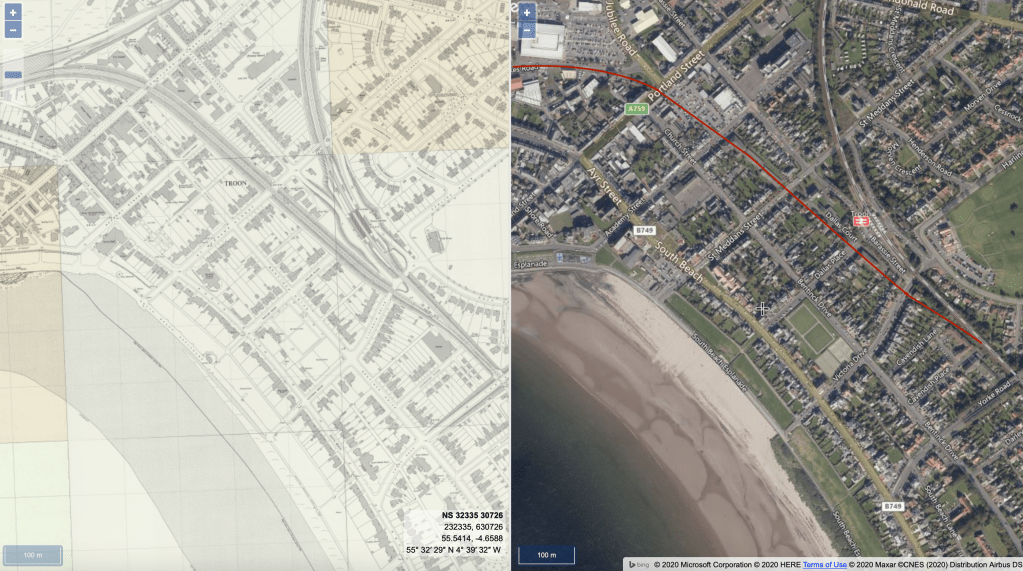
Whilst it’s hardly as exciting as shinning up Ben Lomond, one of our walking routes takes us along a cycle path that runs north to south to the east of the town centre. This runs for two miles alongside and then on the old Troon avoidance line. The fact that a railway used to run along there is quite obvious but it definitely piqued my interest in Troon’s old railways. I’ve got a couple of books about the railways of Ayrshire and discovered a website called Railscot full of interesting information. In addition to this there is a fascinating resource provided by the National Library of Scotland. On their Map Image website they have a side-by-side viewer that allows the user to have one of dozens of old maps on the left hand side and a modern satellite image on the right. Hover your pointer over one of the maps and a curser appears on the the over in the equivalent place. This works for all of the UK, not just Scotland. The maps go back to the late 19th century and provide history buffs with many hours of entertainment. For railway history buffs in particular, it is an invaluable tool for searching out long lost railway lines and infrastructure. I decided that I’d use the maps to search out Troon’s other lost railways. The old map I used was the OS 1:1250/1:1500 1944-1969. This was the most detailed and covered the time when the railways were at their most extensive. I started with the easy one.

Troon Avoidance Line

Avoidance Line North.
Avoidance Line South

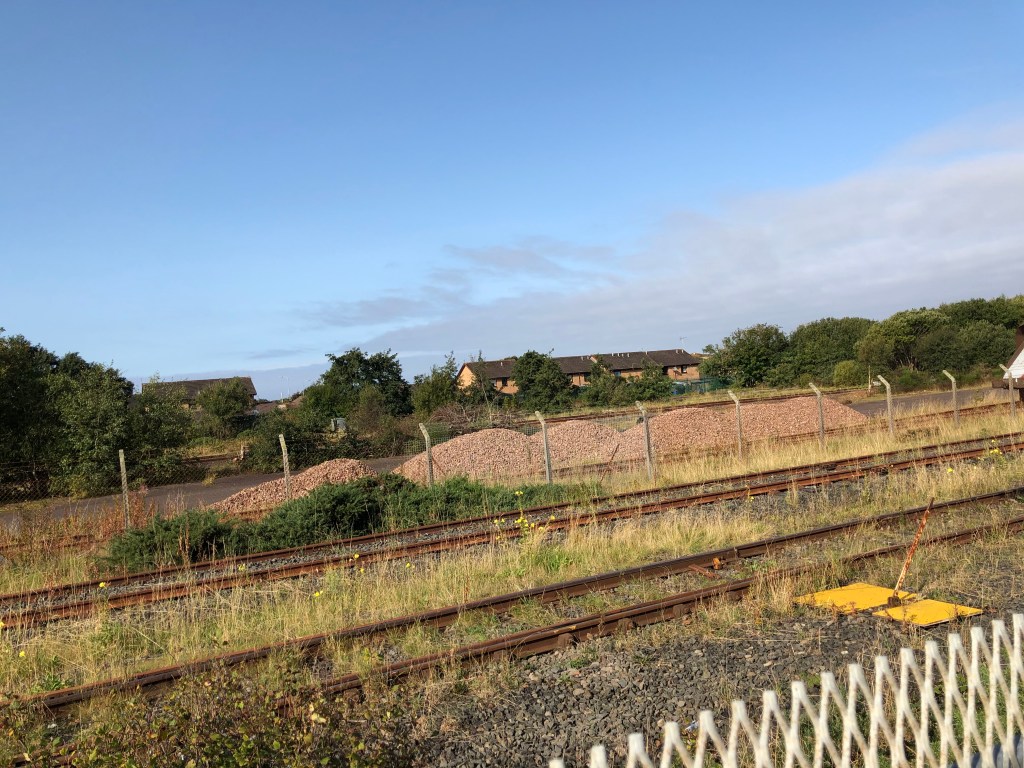
The Troon Avoidance Line was never really lost but the maps revealed things about it that I’d been unaware of. As mentioned above, this was the main line to Ayr until 1892 when the loop through the town was completed. It remained as a bypass for freight traffic and the occasional express passenger service. The line ran from Barassie Junction, past Troon’s municipal golf courses and Marr College. To the west of the line were extensive sidings and Barassie Works. Troon’s original station as situated just before the line passed under Dundonald Road with the station buildings, still in use as private dwellings, staggered. This closed to passengers in 1892 when the current station opened following the completion of the loop through the town. The old station continued as a goods yard. South of Dundonald Road the line continued between the municipal golf courses and the houses of Fullarton Crescent. Passing underneath Craigend Road the track rejoined the main line at Lochgreen Junction by Royal Troon’s Portland course. Closed in 1982, the track from Barassie Junction to Marr College remained as a siding along with some of the old Barassie Works sidings. Much of the Barassie Works site has been redeveloped for housing but a large area of abandoned sidings remains between the avoidance and main lines. Three or four sidings are still in occasional use. A small section of the avoidance line’s track bed by Marr College has the houses of Old Station Wynd on it whilst immediately south of Dundonald Road the track bed is overgrown as it passes the cemetery. After the line passes Willockston Road, once the site of a level crossing, the track bed has been tarmaced and is now part of a local cycle path which continues all the way to the former Lochgreen Junction.

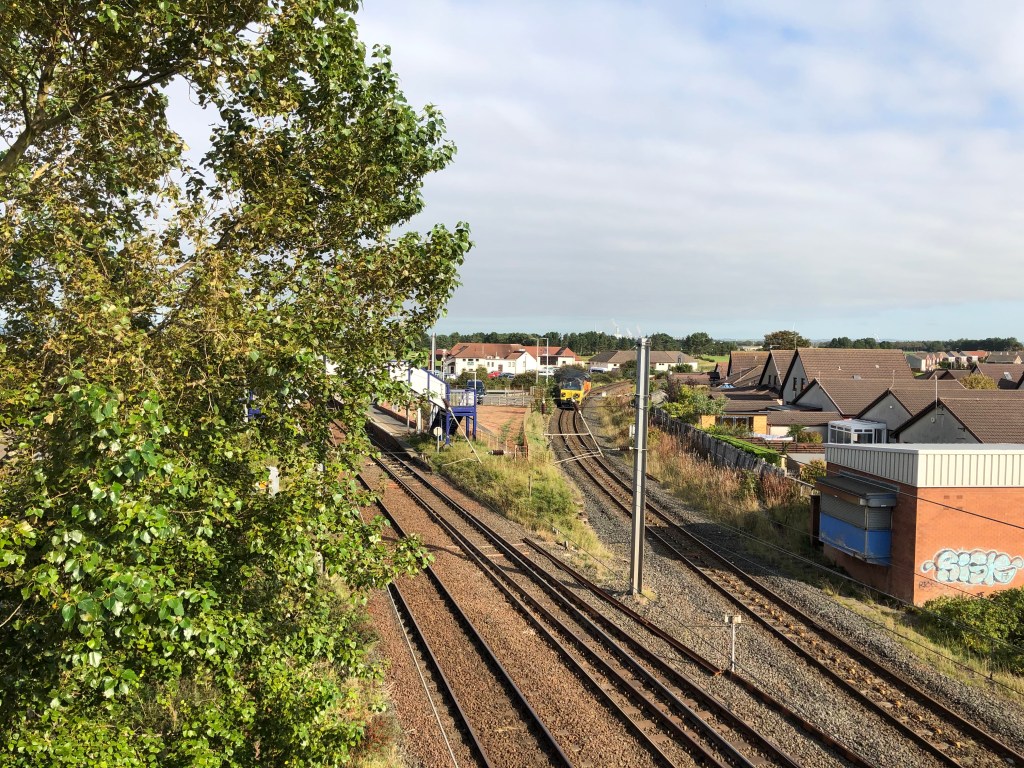
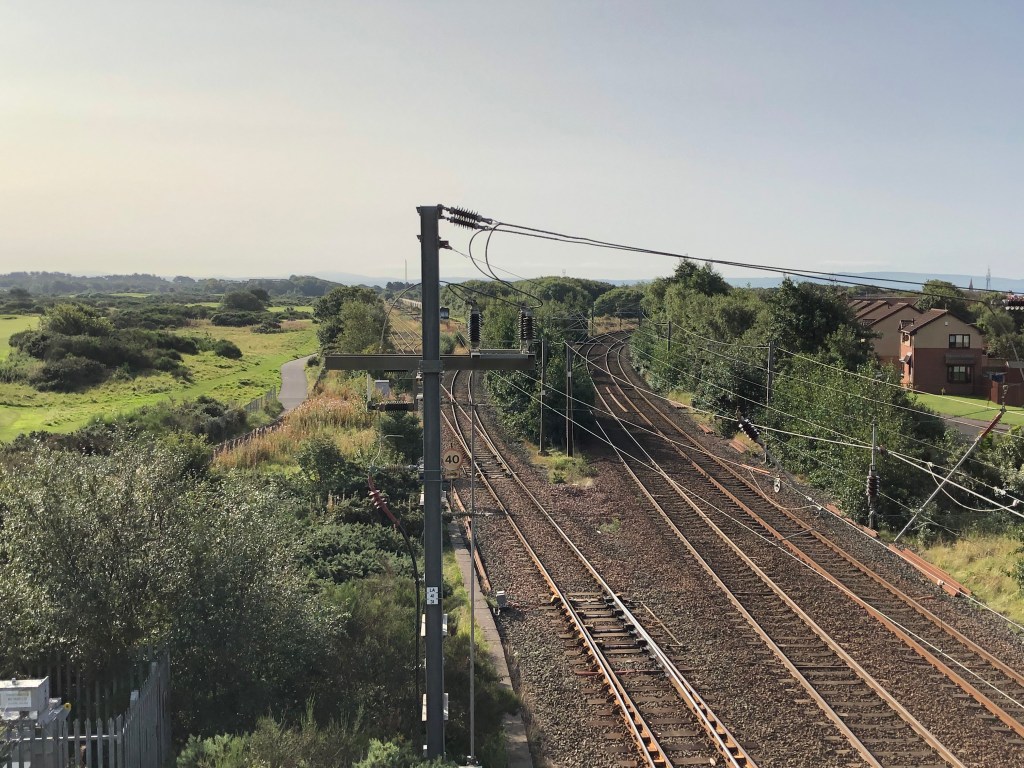
Barassie Junction looking north. The old Kilmarnock and Troon Railway branches off to the right, the main line to Glasgow to the left.
Barassie Junction looking south. Main line to the right, the Troon Avoidance Line to the left, now sidings.
Troon avoidance line, now sidings. The site of the Barassie Works behind.
Troon’s original station on the Glasgow-Ayr line.
The bridge that carried Dundonald Road over the line. One of two road bridges over the line. There was a footbridge at Marr College too but that is long gone.
Site of former Willockston Road level crossing.
Cycle path on the original track bed behind Fullarton Crescent.
Lochgreen Junction looking north.

Troon Harbour Branch

Troon Harbour Branch 1. Formerly Kilmarnock and Troon Railway.
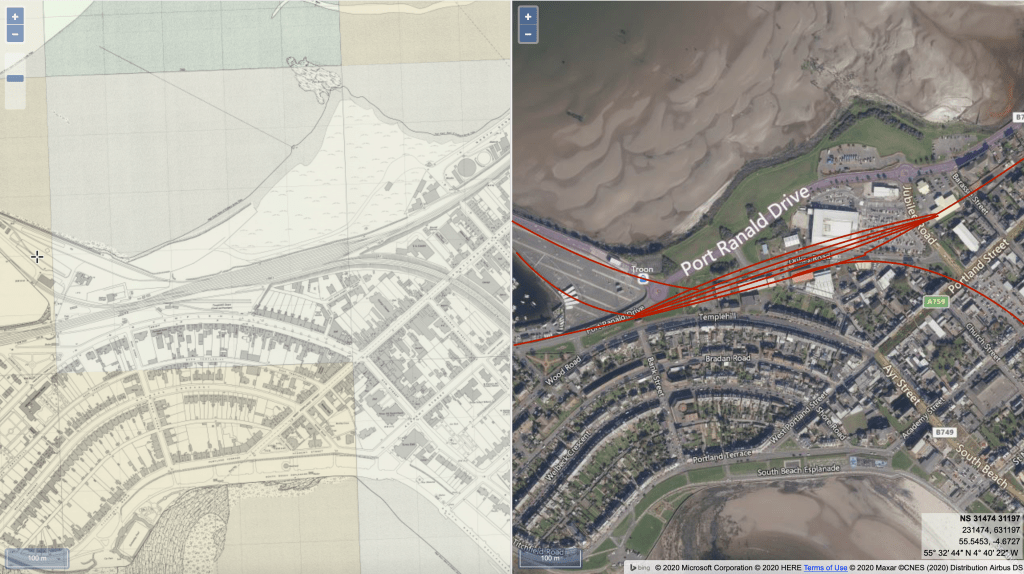
Troon Harbour Branch 2 – Templehill Junction.
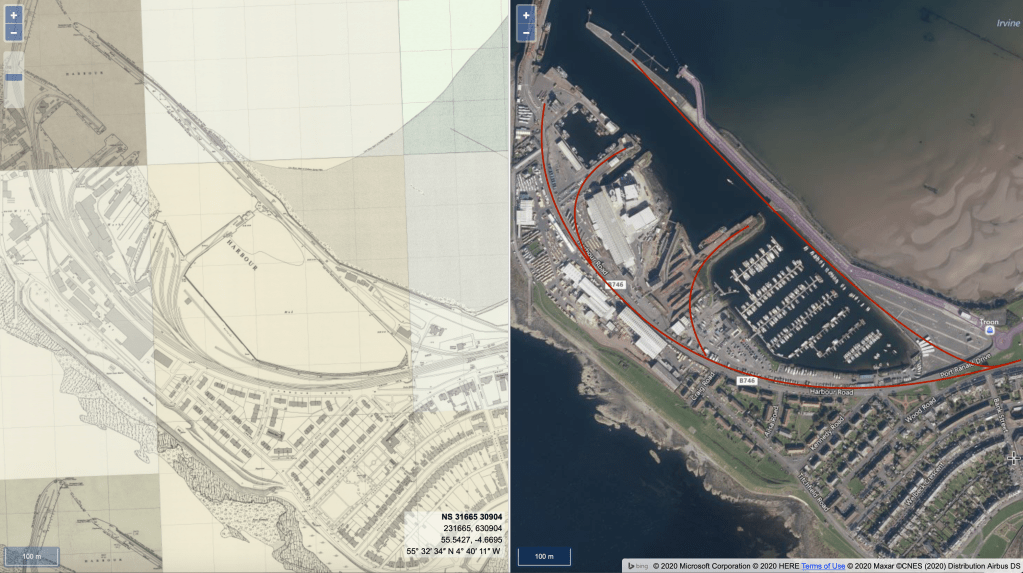
Troon Harbour Branch 3 – multiple sidings to service the harbour and allied industries.

The branch to Troon Harbour followed the route of the original Kilmarnock and Troon Railway south from Barassie Junction. Running alongside the ‘new’ main line for half a mile, the track began to diverge behind the houses on North Shore Road. It curved westwards along what is now North Shore Lane, past the northwest corner of Portland Park football ground and through land now occupied by new sheltered housing and a Scottish Water facility. A bridge took it over Barassie Street and along an embankment where Troon Pool and Morrisons car park now stand. Here, the line split into multiple tracks, joining the curve from Troon Junction at Templehill Junction. The line then split further into a multitude of sidings connecting all parts of the harbour. Little evidence remains of this branch. For a number of years after I first arrived in Troon in 1983, one of the pillars of the bridge over Barassie Street remained alongside the old gas tower that sat next to the track. There has been much development since then and there is little to suggest Scotland’s first incorporated railway used to run there.

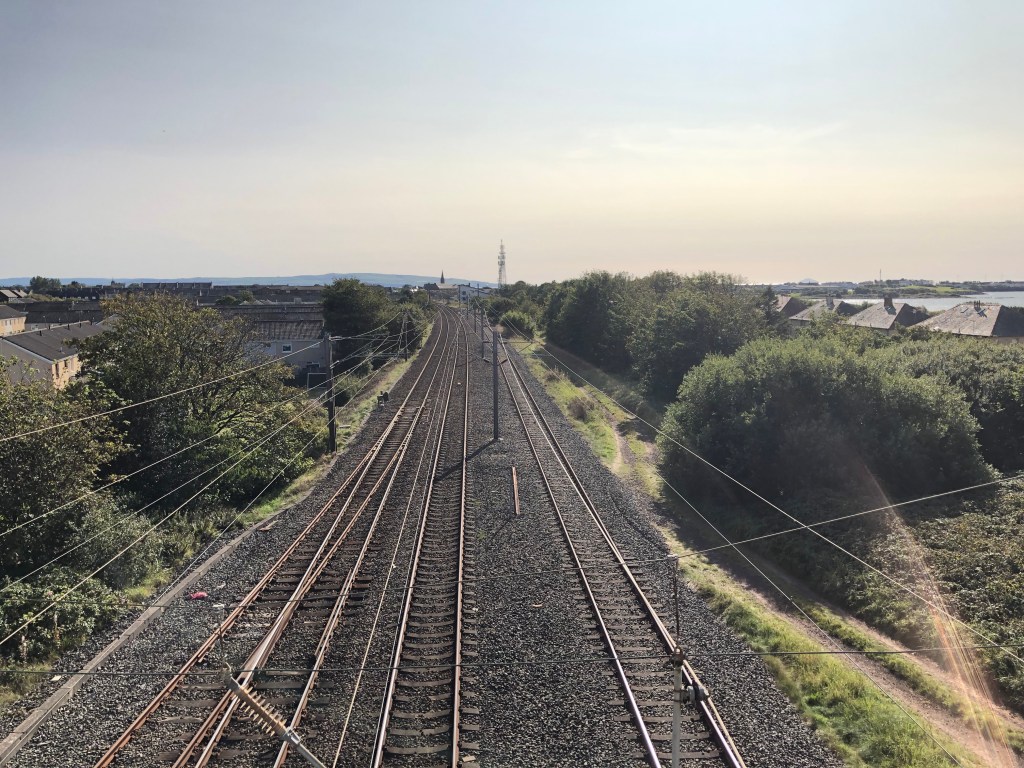
Mainline between Barassie and Troon. The branch to the harbour peeled off to the right here.
North Shore Lane follows the alignment of the branch line embankment.
Scottish Water building, site of the bridge over Barassie Street.
Troon Pool, the branch ran here on an embankment.
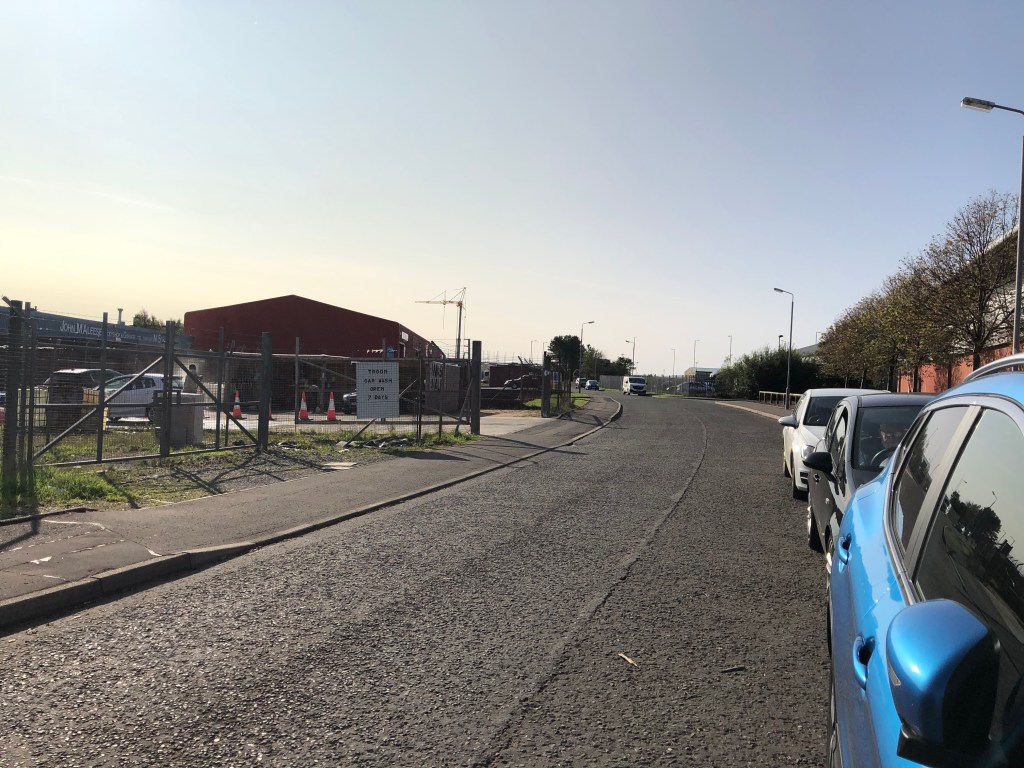
Dukes Road, built on the site of Templehill Junction.
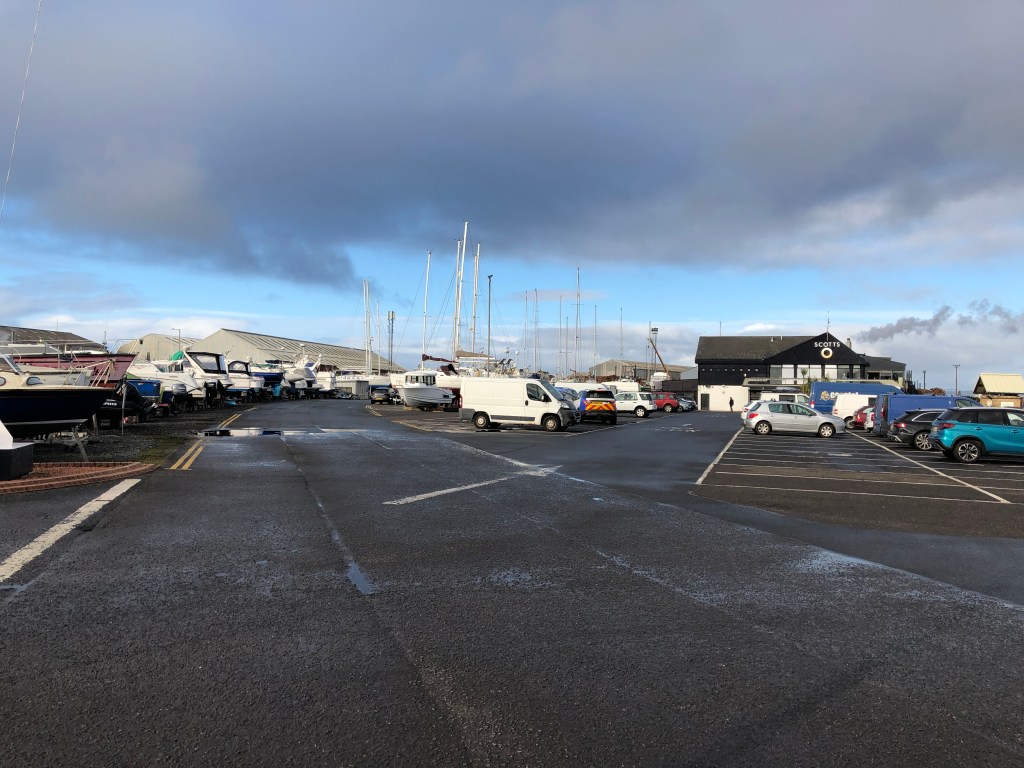
Scotts car park. The branch split into many sidings here.
McCallums Restaurant and Wee Hurrie chip shop at Troon Harbour. This building used to be the Kilmarnock and Troon Railway’s powerhouse.

Troon-Templehill Curve

The Troon-Templehill Curve. Elevated on an embankment, if it were still here today it would chop Troon in half.

Whilst I knew of the Troon Avoidance Line and was aware that the harbour was served by a branch that had historical significance, the line from Troon Junction, just south of Troon’s ‘new’ station, to Templehill Junction, site of the current Dukes Road, was a complete surprise to me. The curve ran for two thirds of a mile along an embankment, crossing three roads on bridges, through what is now more or less the town centre. Being elevated above the roads and houses, this length of track must have held a commanding presence in the town. Once it was closed in the mid sixties, not only was the track lifted but the embankment and bridges were cleared too. Troon Junction was situated next to Cavendish Place with the embankment peeling off to the northwest. A bridge carried the line across Victoria Drive, the line continuing to the west of the ramp up to Troon Station and the Scout Hall along the line of what is now Dallas Court. Another bridge took it over St Meddans Street along the site of what is now Academy Court old people’s home. There was no bridge over Academy Street, the road coming to an abrupt end at the base of the embankment, which continued across the ground where the town centre car park now sits. Another bridge carried the line above Portland Street and the embankment curved to the left where the doctor’s surgery and the industrial units of Dukes Road now stand. Here it joined the harbour branch line with Templehill Junction being situated where the aptly named Branchline Industrial Estate now stands. The alignment of buildings, some roads and a few walls are the only clue as to where this railway used to be.

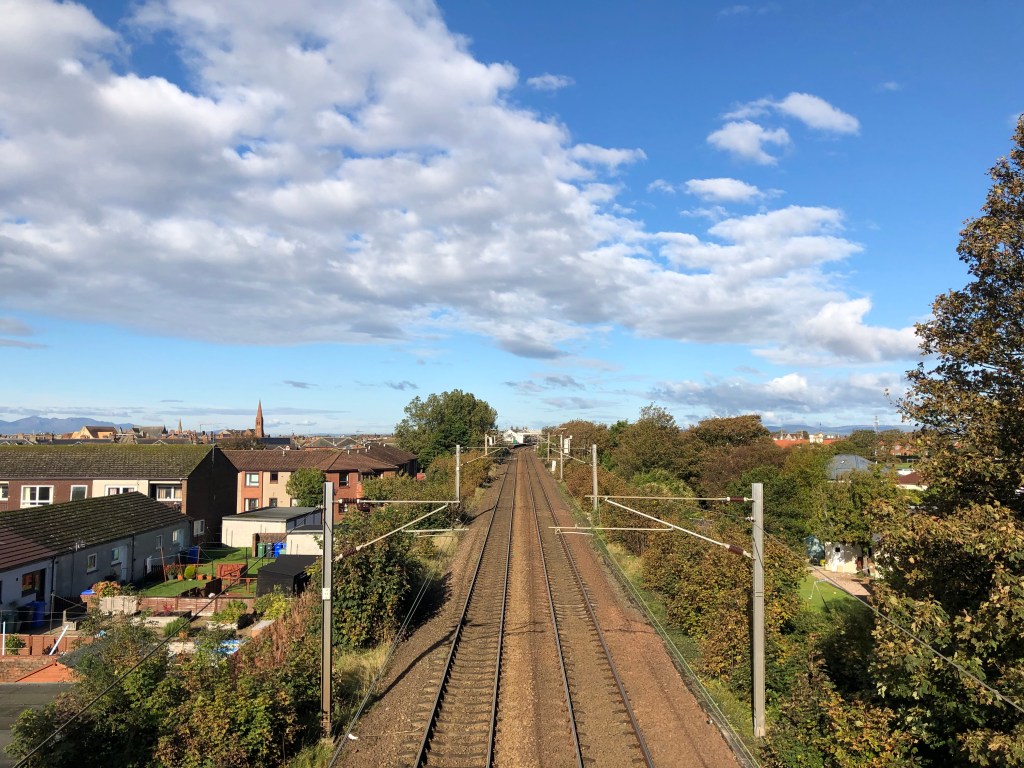
Site of Troon Junction from the Yorke Road bridge. The line to Templehill branched off to the left from just north of here.
The houses stand where the embankment once stood.
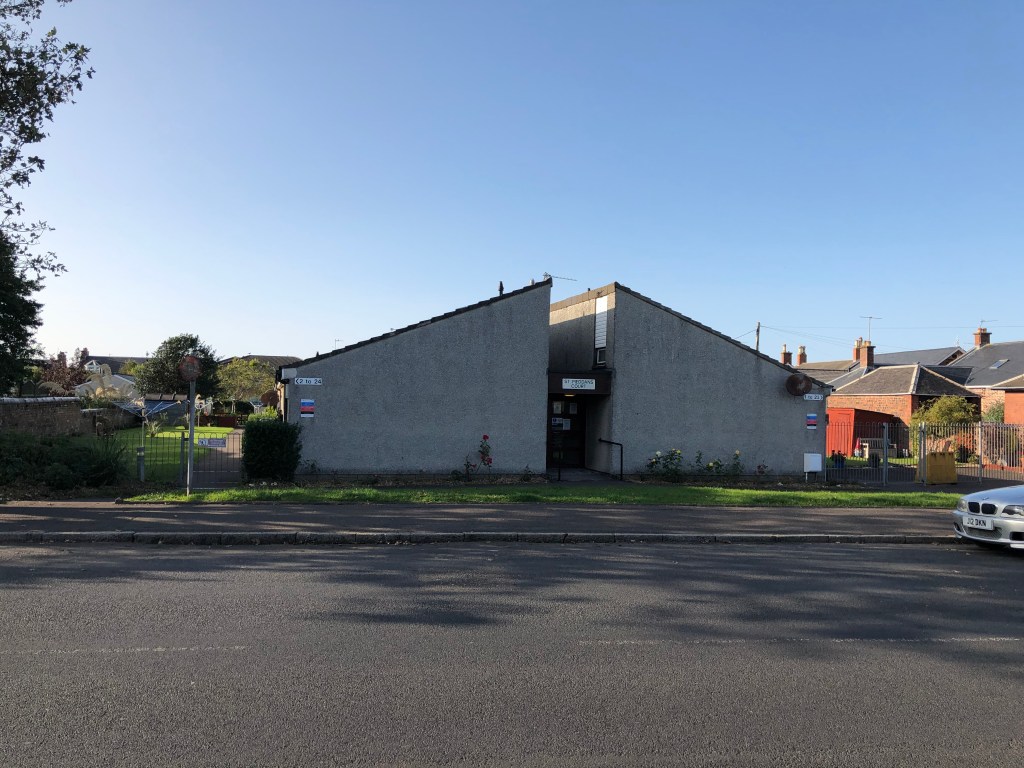
Academy Court stands where the curve ran and give an impression of the shape of the embankment cross section.
The site of this unremarkable car park once vibrated to the sound of passing goods trains.
The wall between the car park and Portland Street. I suspect it used to be part of the support for the bridge over the road and a retaining wall for the embankment.
Union Street Lane. Part of the embankment at Templehill Junction. This and the previous photo is the only physical evidence of the Troon-Templehill curve that I could find.

Troon might be a small place but it has four or five miles of old railway if only you know where to look. Even if you do you might not find much but it’s quite fascinating to think that steam engines were too-ing and fro-ing along where familiar roads and landmarks now stand. At least it is to me, anyway.

If you are remotely interested in railway history in Ayrshire I recommend the following books:

Railways of Ayrshire by Gordon Thomson published by The Crowood Press.

Ayrshire’s Forgotten Railways A Walkers Guide by Alisdair Wham, published by The Oakwood Press.

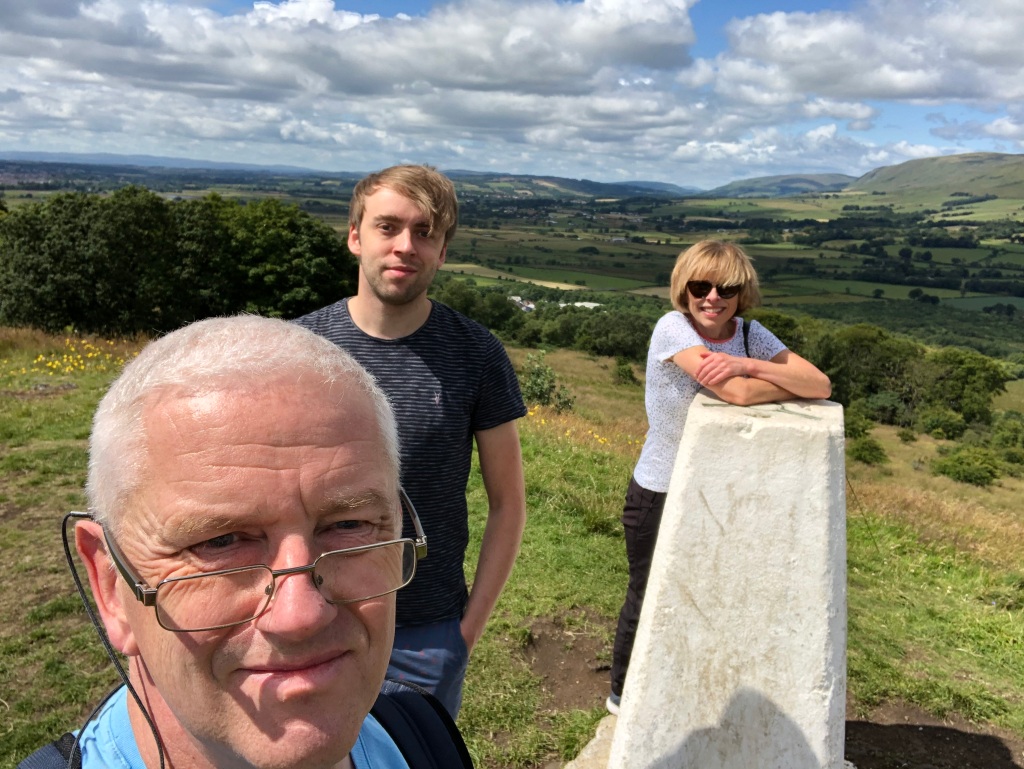
Walk

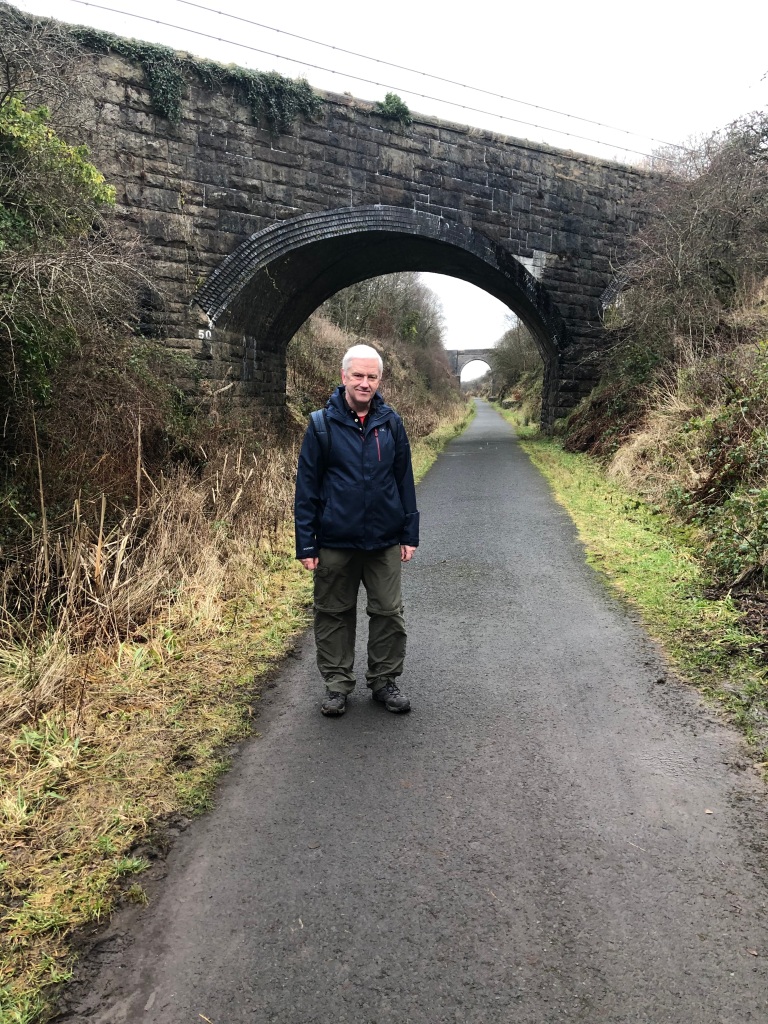
Me, walking, New Year’s Day 2020. Just 999 miles left to go and, like everyone else, totally unaware of what was to come.

The bloody Proclaimers have a lot to answer for. Once the bespectacled brothers from Leith recorded a song about walking five hundred miles, and then five hundred more no less, anyone who admits to walking said distances was going to be called a ‘Proclaimer’. And frankly, I’d rather not be one as I can’t stand those speccy twonks. Such a label is, however, a small price to pay for walking five hundred miles and then five hundred more, especially when such an activity has been the one thing that has kept me sane through lockdown. Country Walking magazine and an associated Facebook group have set a challenge for readers and followers to walk 1000 miles in a calendar year. Last year Elaine decided to do it and completed the challenge by the middle of August. Whilst I accompanied her on many of the walks I didn’t do the challenge myself as I was training for a half marathon. This year she decided to go for it again and despite me having signed up for another half marathon, since cancelled of course, I thought I’d go for it too. You can make up your own rules for this challenge. Some people count all their steps. Others only count ‘boots on’ walks in the country. Our own rules were to count the miles we covered on walks and any others where we might have walked somewhere rather than go in the car, such as the local Morrisons which is a handy four miles to add to the total. I wasn’t counting my running miles. We started the challenge with Walk Number One on New Year’s Day when we walked from Glengarnock to Lochwinnoch and back along an old railway. Once completed, we only had 990 miles left to go. It was a good start.

Walking is, perhaps, the most convenient form of exercise for able bodied people. Just put on some shoes and off you go. You can go as far as your fitness will allow and if you do it regularly you will quickly build up the distance you can cover. It helps if you’ve got a nice environment to walk in. Whilst simply walking on its own is not without merit, having something nice to look at whilst you do it certainly helps to maintain your enthusiasm. That usually means countryside and luckily for us there is plenty of that around here. Country Walking magazine is forever upping the benefits of a walk in the country, no surprise there of course, the clue is in the title. Not only does it help your physical fitness, it aides your mental wellbeing too. Certainly a lot of the contributors to the Facebook group relate stories of how walking has helped them deal with depression and sad episodes in their lives. Whilst I’d enjoyed walking up until this year, I’d never considered its therapeutic effect on my mental health as, quite frankly, I didn’t think there was anything wrong with my mental health. I’m still not convinced there is, though others might not agree! I will admit, however, from feeling quite low on occasions recently. When lockdown started I saw my plans for this year’s trips and events quickly get cancelled one by one. Not only that, the instruction was to stay home for everything other than what was considered essential. I was well aware that I was in a better place than many to sit out lockdown. I’m retired so I had no job to worry about. The house was plenty big enough with just the two of us and it has a decent garden to sit in. It quickly became clear just how much our lives were going to change though and I soon started to feel trapped. Whether I was depressed or not I have no idea. Those poor souls who suffer from clinical depression don’t need a major change in their lives to start feeling down (though I’ve no doubt something like this can trigger it or make it worse) whereas my little episode was definitely caused by the situation. Whatever, for the first week or so of lockdown, and on one or two occasions since, I was not the happy, cheerful chappie that I normally am. Those who know me, stop tittering. I am generally quite a happy person, it’s just my face fails to convey the fact.

Our walks started with leafless trees…
…but that didn’t last long.

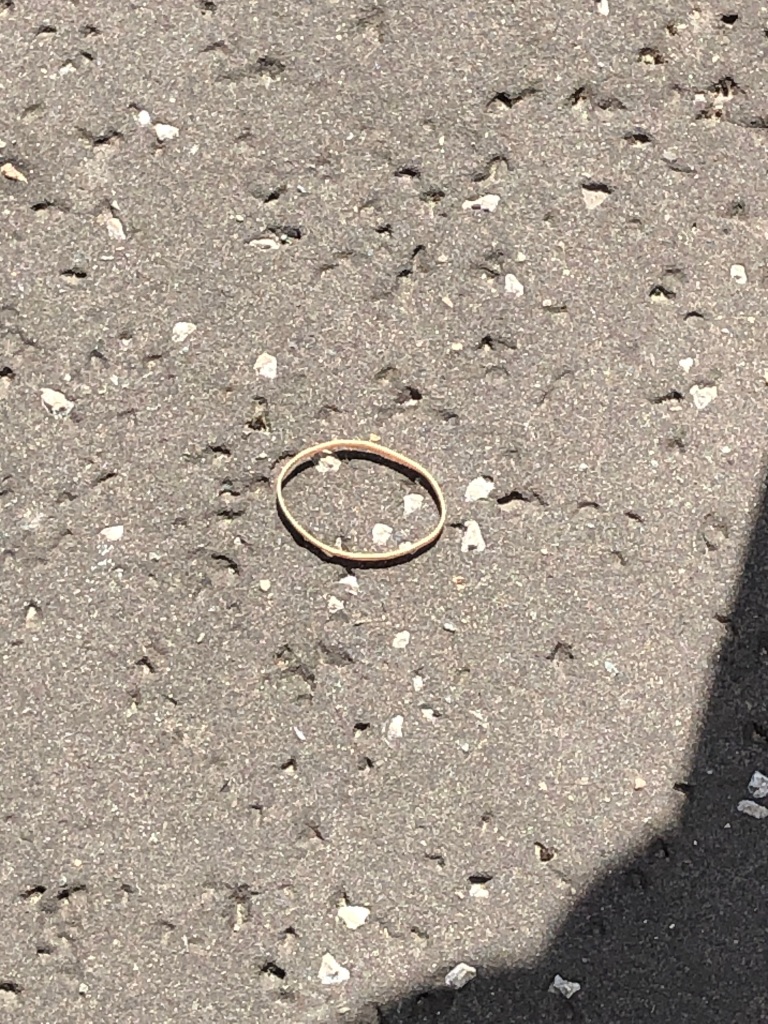
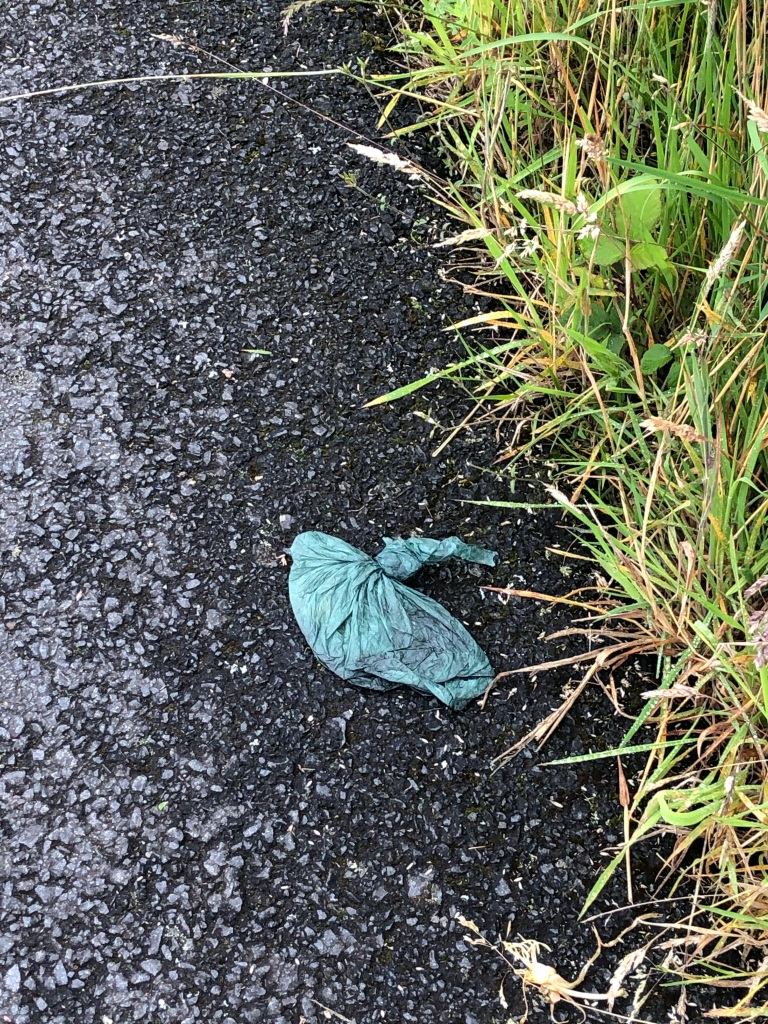
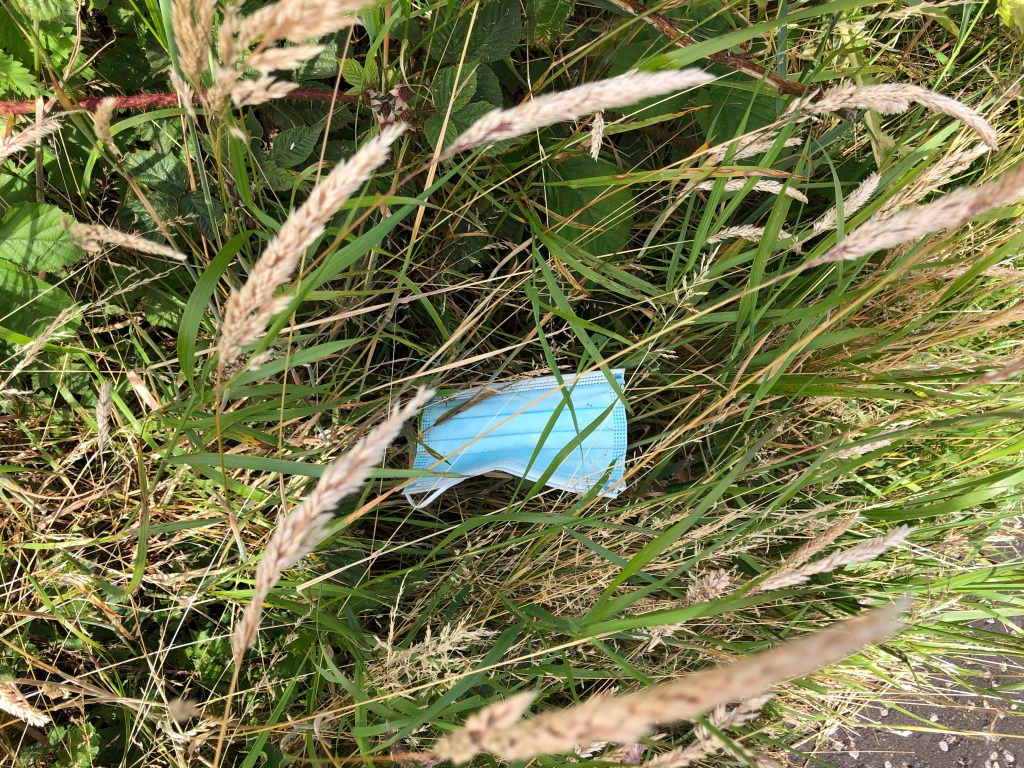
The government’s restrictions on our freedom were understandable. In the long term they may prove to have been essential or maybe not, but at the time it seemed like the right thing to do. They left us just one concession. We could go outside for exercise, initially just once a day. From the very start we went out for a daily walk. We tended to go in the evening and whilst we were limited in where we could go, the chance of being outside the home for just an hour gave us something to look forward to during the long day. Whilst we would have gone had it been wet we were lucky to be blessed with the finest, driest spring on record. These walks might not have been much in the grand scheme of things but to me they was everything. Most of the walks were ‘pavement pounding’ round Troon with some a bit further afield into the surrounding country. Most of the miles we walked were pretty familiar to us but even we, who have lived here for 34 years, discovered part of our small town that we hadn’t ventured through before or even been aware of. We passed through Fullerton Woods on numerous occasions, the budding trees gradually bursting into leaf as the days passed, the bluebells first blooming and then fading whilst being serenaded by birdsong, unmasked by traffic noise as the rest of the world stayed home. We’ve got two beaches to walk on or alongside with magnificent views across the water on a clear day of the Isle of Arran, Scotland in miniature, behind which the sun would gloriously set. We walked across land reserved in normal times for golfers and just as enthusiastically through oddly quiet housing estates, windows adorned with rainbows for NHS and other key workers, hopscotch squares chalked on the pavement by school-starved children. At first the roads were virtually empty apart from the occasional police patrol. Meanwhile the empty trains that rattled along the tracks as though nothing had changed were the only thing shattering the strange, tranquil peace of the place. Troon is not the busiest place in the best of times but now it had become a ghost town. We got into the habit of counting the other people who were out. Ten, twelve, nine, thirteen? Busy night that last one. Most were dog walkers with a few, like us, out on their ‘Boris’ walk. Or ‘Nicola’ stroll if you prefer. We’d generally do five or six miles. There was theoretically no limit as to how much exercise you could take as long as it was only once per day but people tended to get a bit sniffy at folk who were out for more than an hour or so. Those five or six miles would take upwards of an hour and a half and we did go further sometimes on our ventures into the country. We felt quite rebellious when we did. Yet our paths only rarely crossed that of others which was the important thing, surely? There are downsides to walking round built up areas such as litter – postmen’s elastic bands, discarded bags of dog shit and more recently disposable face masks are all too much in evidence – but we were walking outside in the fresh air which was the most important thing.

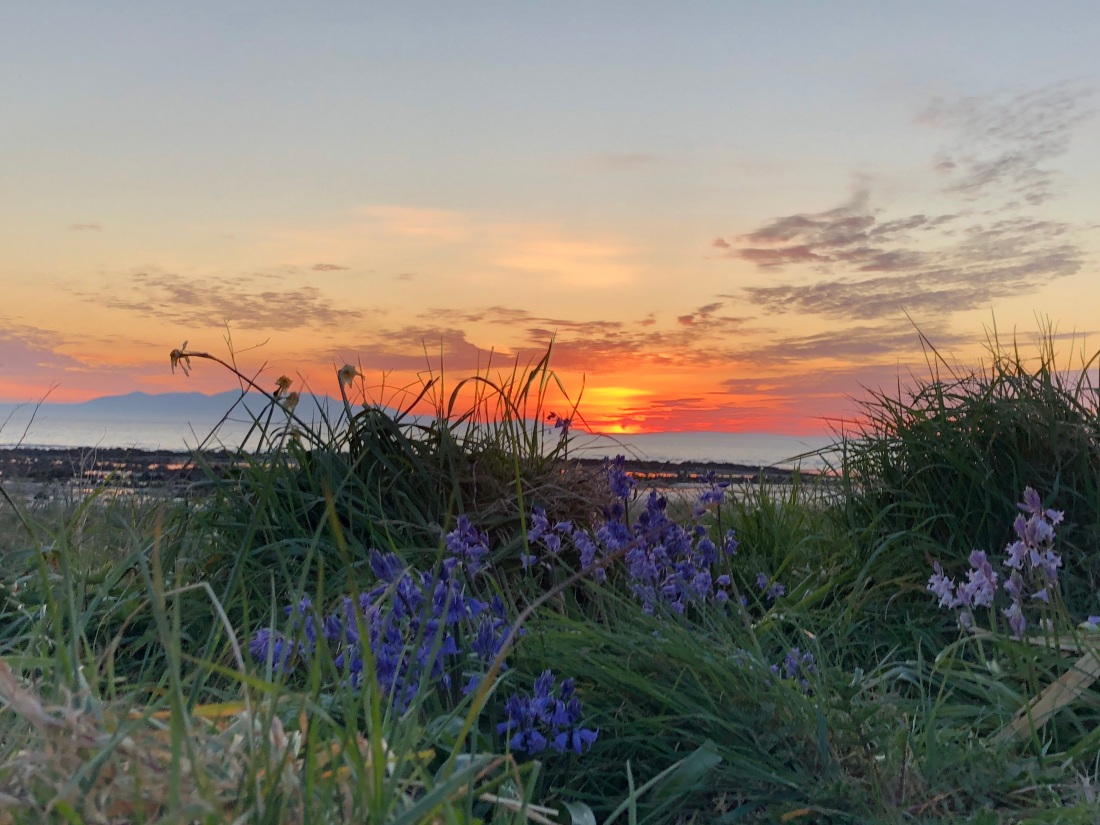
We were treated to many glorious sunsets…

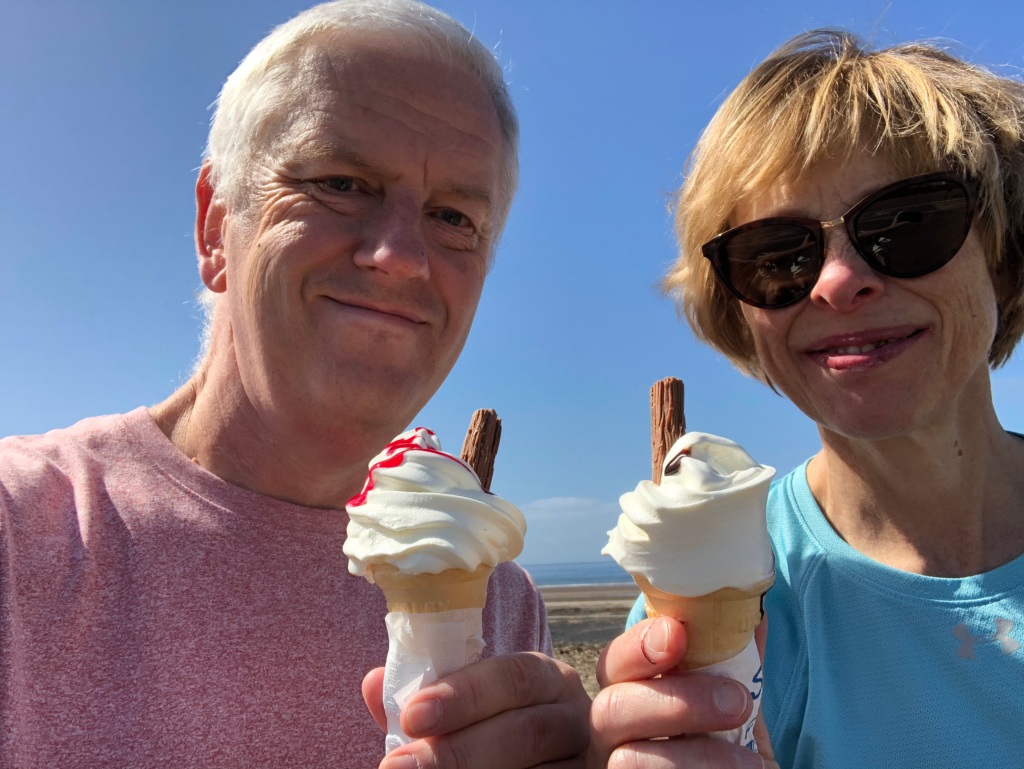
Eventually restrictions eased. We could go out as many times as we liked and for as long as we liked. As we were limited to the local area, however, the walks didn’t change much. With more people venturing out, the town wasn’t quite a ghostlike and we did some of the walking during the day rather than the evening. We even managed an ice cream or two as local businesses slowly reopened. We still tended to pound the same pavements though. Whilst glad of the chance to get out there were times when I started to feel trapped again. Not, as at the start of lockdown, so much within the four walls of my house, but within this small part of Ayrshire. For weeks I hadn’t been further north than Irvine, further south than Prestwick, was hemmed in by the natural barrier of the sea to the west and there was little scope to venture out east. Despite this we walked. It didn’t ‘cure’ me but it helped. We went a bit further and took advantage of the new rules on visiting family to have a walk round Glasgow. It was interesting to see how social distancing, quite easy to observe around Troon, was almost impossible in the big city. Although we did few walks of any great distance, our daily constitutionals meant the miles were mounting up.

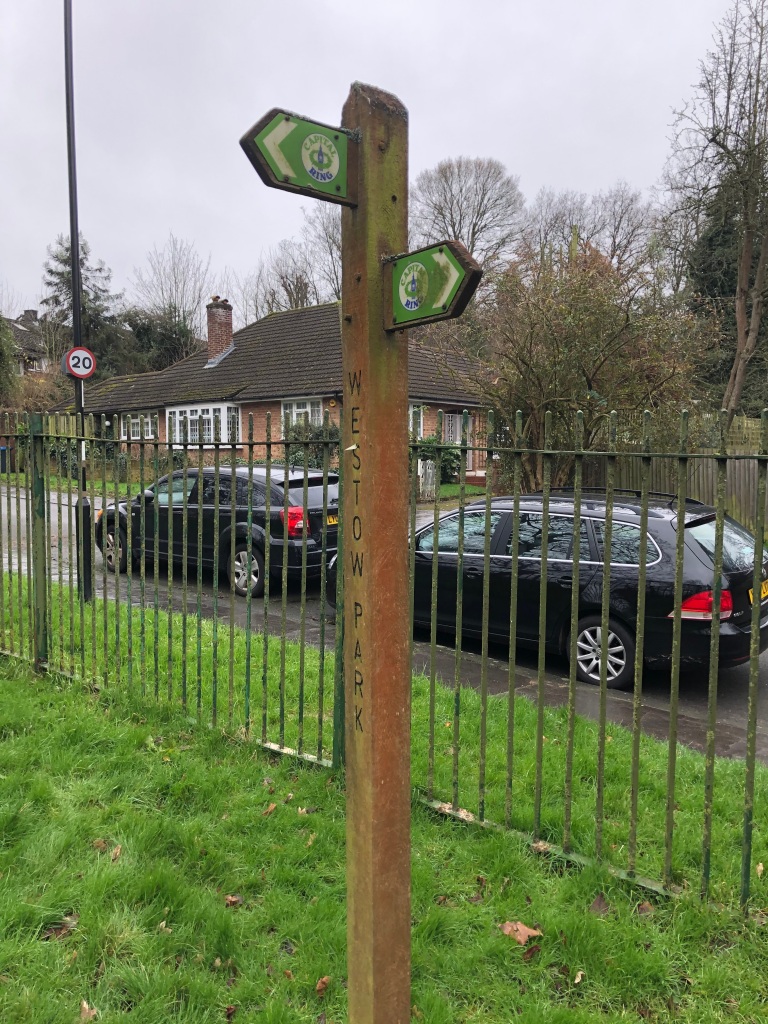
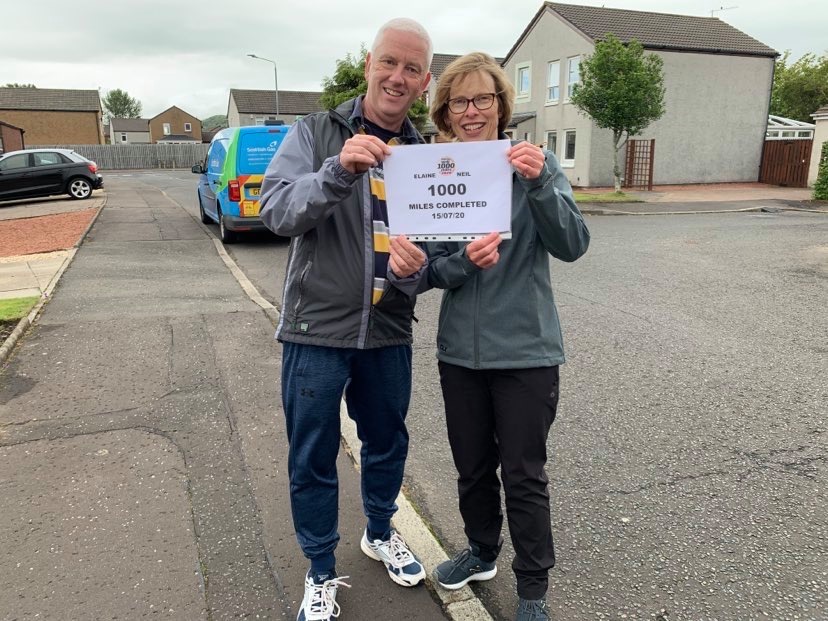
At the beginning of lockdown we had already recorded over 300 miles in our 1000 mile challenge. That was not a bad total for the first two and a half months of the year, especially when you consider just how rubbish the weather had been. Elaine had managed a few more miles than me and I had to clear that deficit with a some extra lockdown walks. Many of those 300 miles were the same local pavement pounding we would be restricted to for the subsequent three or four months but some were what we would consider ‘proper’ walks – following a predetermined route round a part of the country like Walk Number One on New Year’s Day. We even managed a few miles in London on the Capital Ring when we were there for a weekend away at the end of January. A weekend away? Do you remember those? Trips away aside, there are plenty of places to go for a walk within an hour’s drive of here. I suspect when we decided to take the 1000 mile challenge we had hoped that most of those miles would be accrued on that type of walk. Events rather put the mockers on that but by mid July all our Troon pavement pounding meant we were closing in on the target. As restrictions eased once more we finally managed to venture out further and had a walk up Glen Ness, a delightful hidden valley up near Loch Doon, which pushed us into the 990s. By July 15th we had just 3.1 miles to do. I measured out a circular route from our front door of exactly that length. It was, perhaps, the most boring walk of the lot but meant we crossed the finishing line exactly as we entered our driveway. It was a whole month earlier than Elaine’s solo effort last year but the situation had been so unlike 2019 it seemed like a completely different challenge.

Ness Glen.

We had been very lucky with the weather. Spring’s outstanding weather would have helped us through the long days of lockdown had we been walking or not. The solstice saw things change and so far the summer weather has been as poor as it was good in spring. We still managed to walk though. Finding a gap in the summer rain or simply walking through it meant we achieved our target 197 days after we’d started, an average of 5.08 miles per day or just over six miles per walk if you exclude the 31 days we didn’t record any milage. These figures pale into insignificance compared with some on the Facebook group who announced they had reached the 1000 mile total before the end of February. Others in the group are only just reporting that they have done 500 miles to become a bloody Proclaimer. That’s the point though, it is not a race. It is purely a personal challenge and the pace at which you complete it is of no concern to anyone else. Now the challenge has been completed, is it time to hang up my boots? No. For a start I don’t have any boots to hang, just walking shoes and trainers, but we don’t intend to give up walking. Our focus might change though. We no longer feel compelled to go out every day. Whilst there are still restrictions on life, lockdown is more or less over for most of us and hopefully will remain so. A walk round Troon when it is pissing down, or even when it isn’t is not as appealing or indeed necessary as it once was. We can now go for walks away from the local area and have done so. The emphasis now is on quality rather than quantity. Not that quantity was ever the most important thing. No, I walked to help me keep active, to have a shared goal and spend quality time with Elaine and above all, to stop my mind heading off to all those dark places that I was surprised to find existing in my head. I might not like being called a Proclaimer but I’m happy to proclaim the benefits of walking.

Target achieved.
…the Antonine Wall.

Solstice

At 22:43 BST on the June 20 2020 the sun reached the northernmost point in its annual journey north and south across the earth and immediately head back the way it came. This was completely imperceptible to the naked eye of course as it takes six months to travel from one extreme to the other, a distance on the earth’s surface of 3237 miles which is about three quarters of a mile per hour. For a brief moment the sun will, however, appear stationary which is where we get the word solstice from. In Latin, sol means ‘sun’ and sistere, ‘to stand still’. At 13:31 on December 21 it will stand still again when it reaches the southern most point of its journey and then heads north. The sun of course is not really moving up and down the earth. It’s the earth’s rotational axis that tilts at 23.44 degrees to the orbital plane that gives the earthbound observer the illusion of the sun being higher or lower in the sky depending on the time of year. With the sun reaching the highest point in the northern hemisphere sky we have our longest day, or, to be precise, most hours of sunlight per day, in June. It marks the start of summer. I always found it unusual that the warmest weather tended to come after the solstice. The higher in the sky the sun is, the greater its heating effect so you may have thought that warm weather would be distributed equally around the solstice. Seasonal lag though means the higher temperatures tend to come some time after the summer solstice (and coolest temperatures some time after the winter solstice) and this can vary from a few days to a couple of months. The reason is down to the oceans. Water takes longer to heat up and cool down than land and we’ve got an awful lot of the stuff covering the surface of the earth. In effect these oceans act as storage heaters and your best bet for warm weather is sometime after the solstice.

Sunset, 24 April, 20:45.

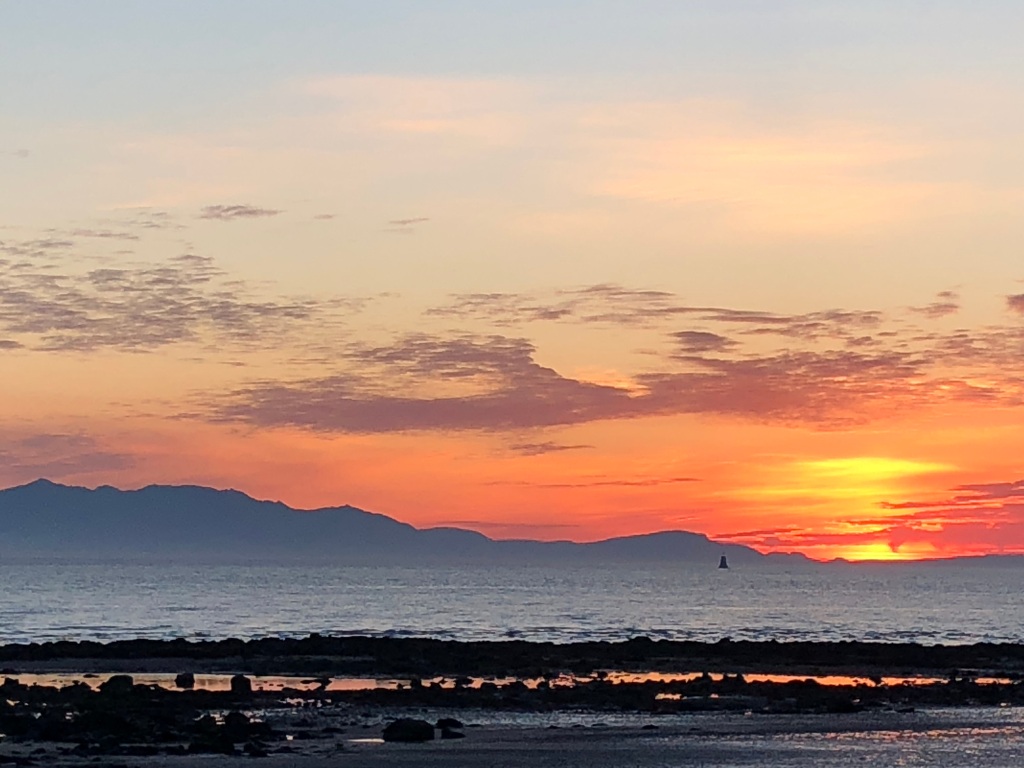
If that’s the case this year then we are likely to be in for a bit of a roasting. Weather-wise, spring has been outstanding in this small part of southwest Scotland, and possibly everywhere else in the British Isles. After a particularly wet winter we’ve had day upon day of sunshine and, until recently at any rate, hardly any rain. This is just as well as in all other respects spring 2020 has been utterly dreadful. Covid-19 has seen to that. A typical Scottish spring would have seen me go crazy in lockdown. The one concession the government made to keeping us sane was to allow ‘exercise’, initially once a day but subsequently as much as you fancied, on the understanding that you keep it local. We have gone for walks on all bar a couple of days since lockdown began some ninety or so days ago. That’s an entire spring of pavement pounding around Troon with the occasional excursion into the surrounding countryside, over 500 miles in total. Most of those walks have been in the evening and thanks to the outstanding weather we have been blessed with we have been able to plot the sun’s slow but steady progress north as it set, initially over Arran and latterly somewhere up towards Largs. Those sunsets have been glorious. With the sun low in the sky the light passes through more air which scatters the blue light away leaving red and yellow light to illuminate any clouds to stunning effect. Much as I love the science involved, I can’t help but marvel just at the beauty of it all, especially with the backdrop of Goat Fell on Arran.

Sunset, 6 May, 21:02

With the sun about to commence its journey southwards the days will get shorter. Seasonal lag should, however, mean there’s plenty of relatively warm days ahead though this being Scotland the wind and rain can trump warm temperatures any time of the year. That they didn’t in spring is almost without precedent. With lockdown restrictions easing just a bit those evening walks may well become less important. Who knows, in a few weeks we may even have the privilege of observing sunsets somewhere else in the world again. We can but hope. In the meantime, I think I’m going to celebrate the summer solstice with a bottle of something mildly alcoholic, raising a toast to the season just ended, both the worst and best spring ever, whilst telling Covid-19 in no uncertain terms to fuck right off.

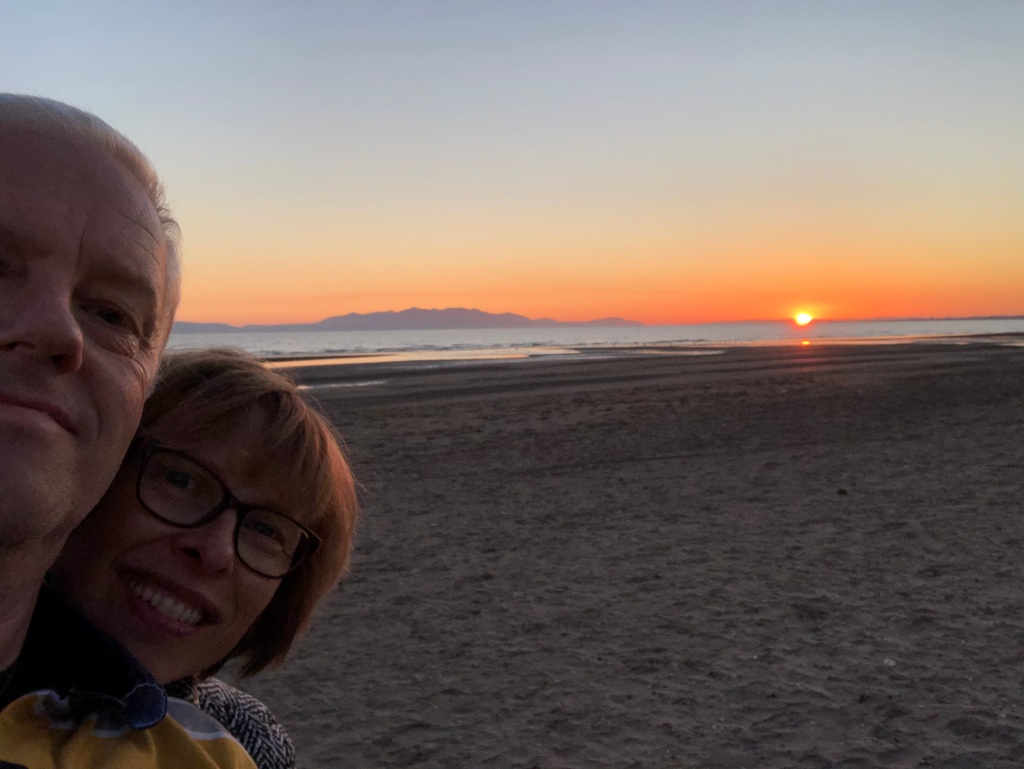
Solstice sunset, 20 June, 22:04. Not as good as the other two I’m afraid. The actual solstice happened 39 minutes later.