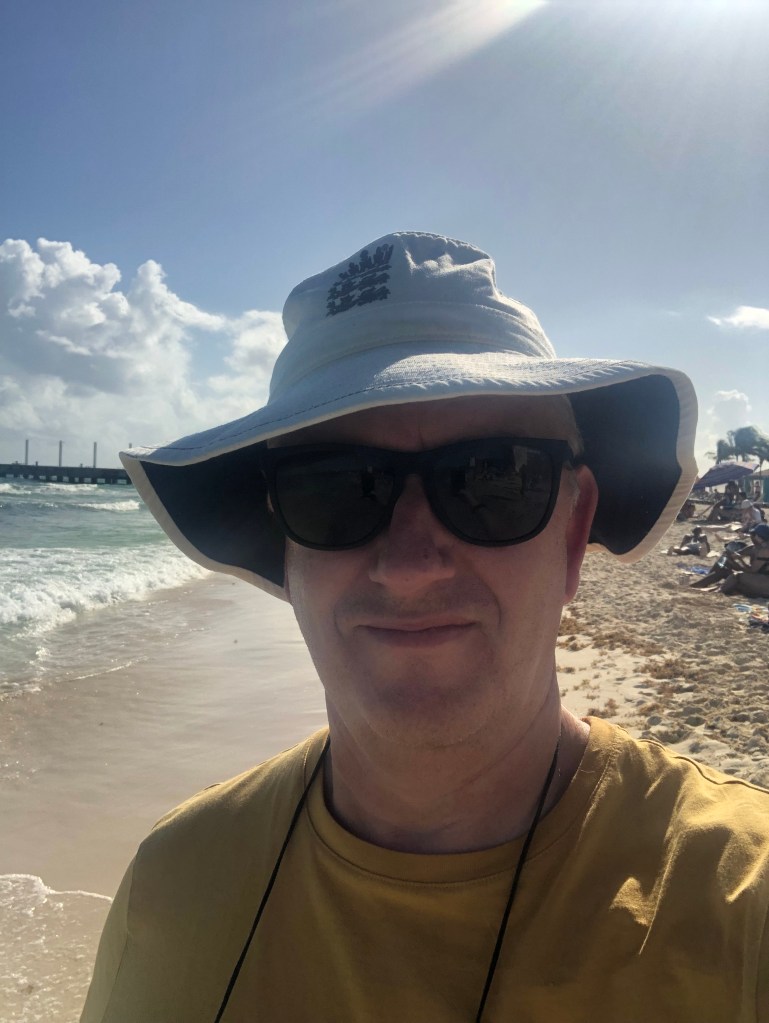
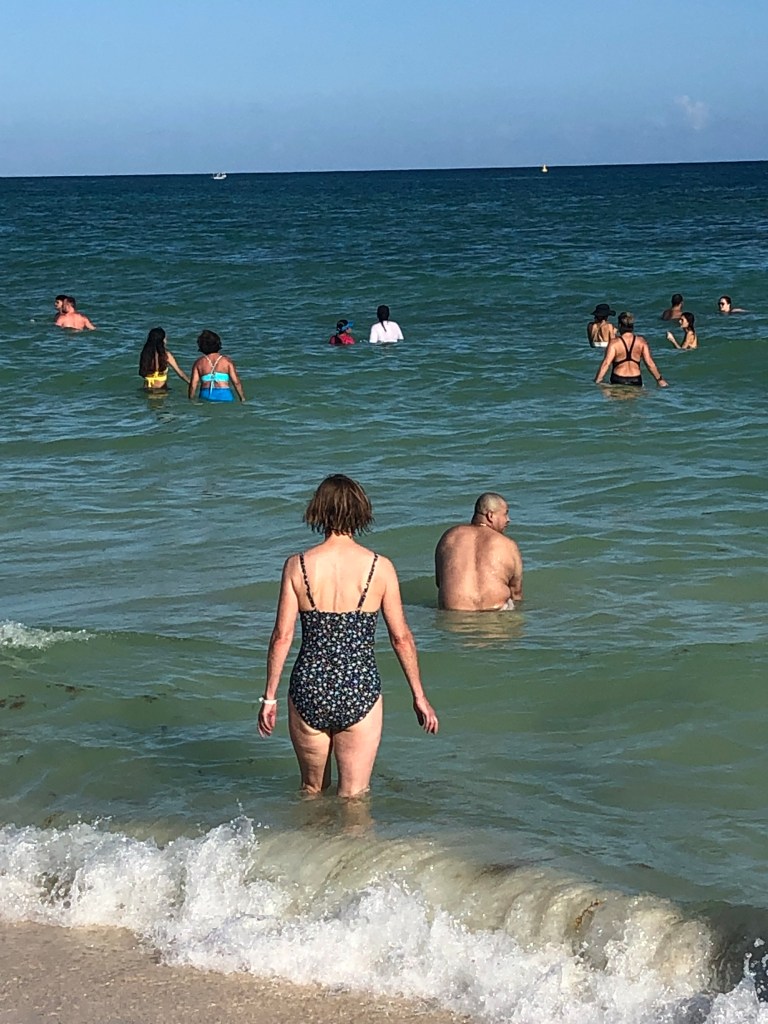
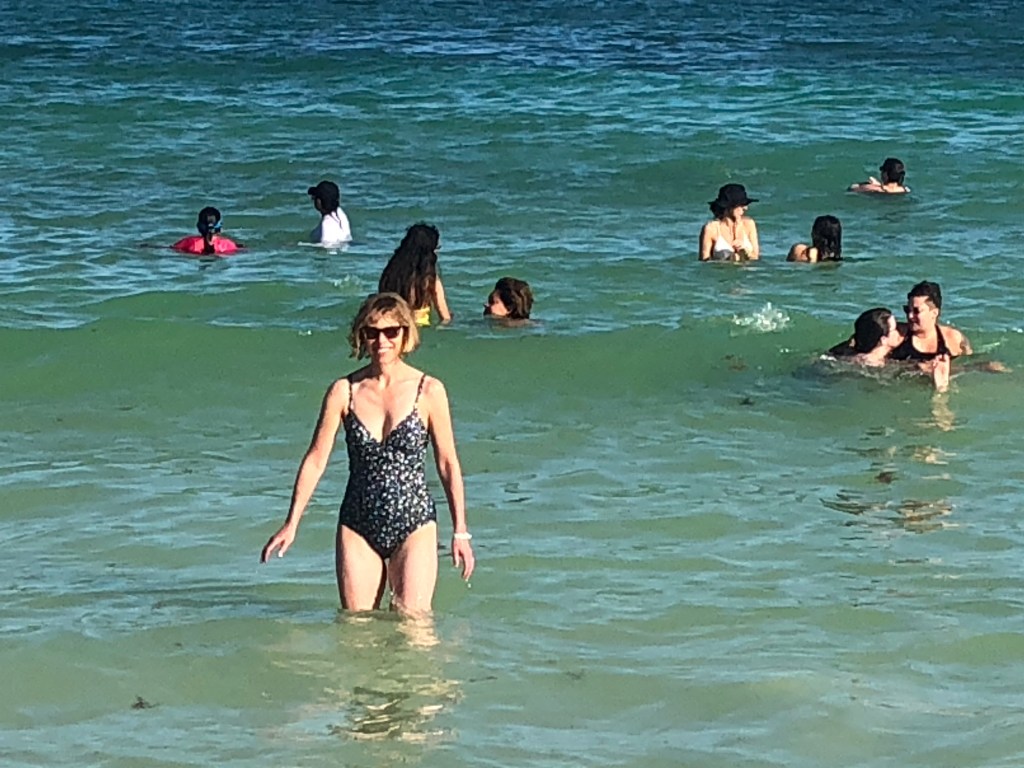
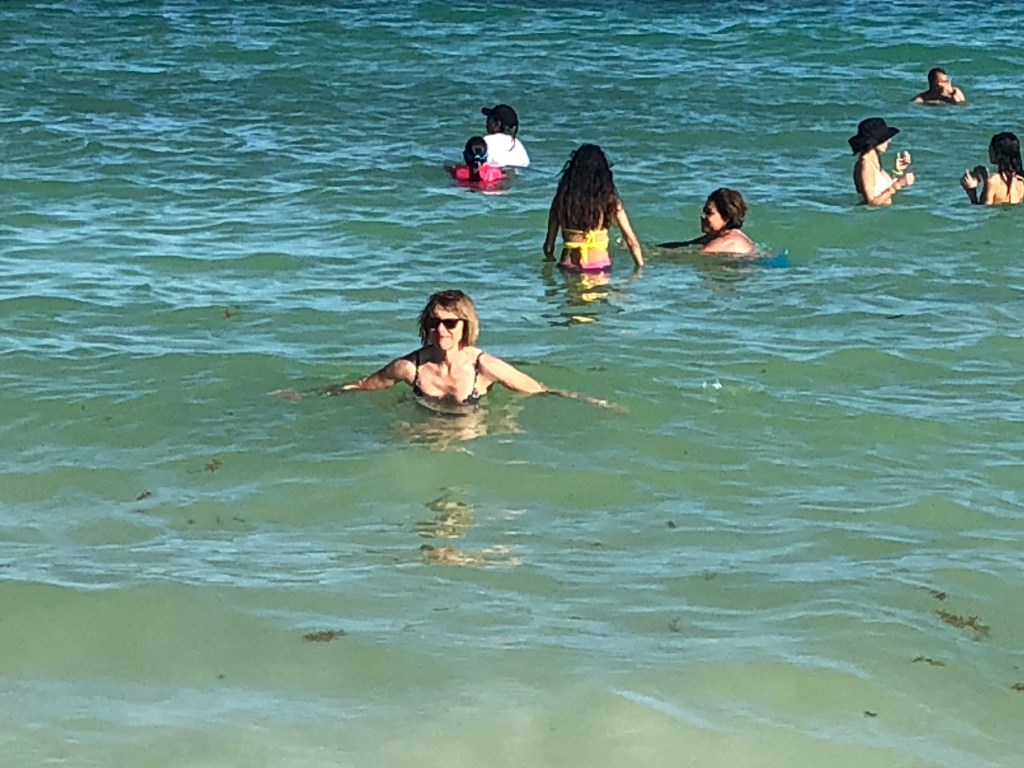
Crap Cars

Back in the summer of 2019 when I was churning out a blog every five minutes, I related the story of my car history and how I’d arrived at the Expensive German Car. You can read about it HERE if you like. That expensive German car was an Audi Q5 and it was my intention to keep it for a lot longer than four years. At the start of the year, however, I decided that I should really downsize my car. Not because I didn’t like it. Quite the contrary in fact, I loved it. It had a lovely smooth ride, almost indiscernible automatic gear shift, a good sound system, a capacious boot and, being a ‘chunky’ car, a nice high driving position with which to lord it over inferior makes and models. The one thing that was making me consider replacing it was money. The spike in fuel price meant it cost me £100 to fill the tank on several occasions last year. Whilst the car wasn’t particularly thirsty – I could go 600 miles on that full tank – I really felt as though I was forking out more than I had to on fuel. The same with car tax. The punitive tax HMRC apply to cars that are initially sold with an invoice price of over £40,000 was costing me an extra £390 per year just to run the thing. Not that I’d paid £40,000 for it, I’d got it ‘nearly new’ at a substantial discount. Servicing was expensive. I’d recently replaced two tyres which cost me more than £500 and it was fairly inevitable that other parts were reaching the end of their useful lives. With the value of second hand cars at an all time high at the moment I thought it was probably the best time to replace it although that needed to be tempered with the replacement would undoubtedly be outrageously expensive too. There’s no harm in looking though, is there?

Any thoughts of replacing it with another Q5 were quickly suppressed. A new one was over £55,000. I toyed with the idea of a Kia Sportage. It was a similar size to the Q5, was just as well specced up if not better and was £20,000 cheaper. Elaine and I visited the Kia garage in Irvine. It was just about to close and I felt the salesman was keen to get home. He mentioned that there was a nine month lead in time for the Sportage. Bye bye Kia. I went to Audi in Ayr. The Q5 might have been out but the Q2 was promising. There was a six month lead in time but there might be a few nearly new ones available quickly. There were a couple but, well, I wasn’t overly keen. I read an article which said a good alternative to a Q2 was a Mini Countryman. You know the one, it’s a Mini but on steroids. Off we went to Mini in Irvine where we took one for a test ride. It was nice. I ordered one with delivery due ‘by the end of April’ (this was early February). What’s more, I didn’t go for the cheap one. I also added a few bits and pieces. They offered good money to take the Q5 off my hands but said I could sell it privately if I could get more money for it. I did. Webuyanycar.com gave me quite a substantial amount of cash for it, a few hundred more than Mini were offering for a trade-in. So far so good.

webuyanycar were true to their word. Farewell old friend.

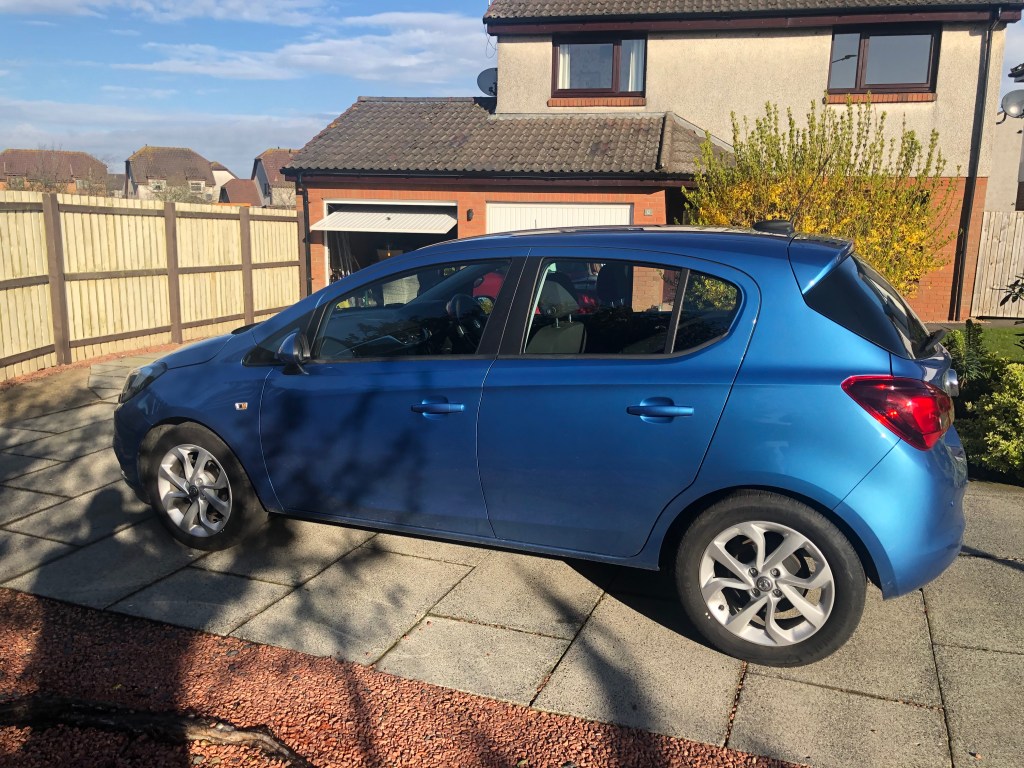
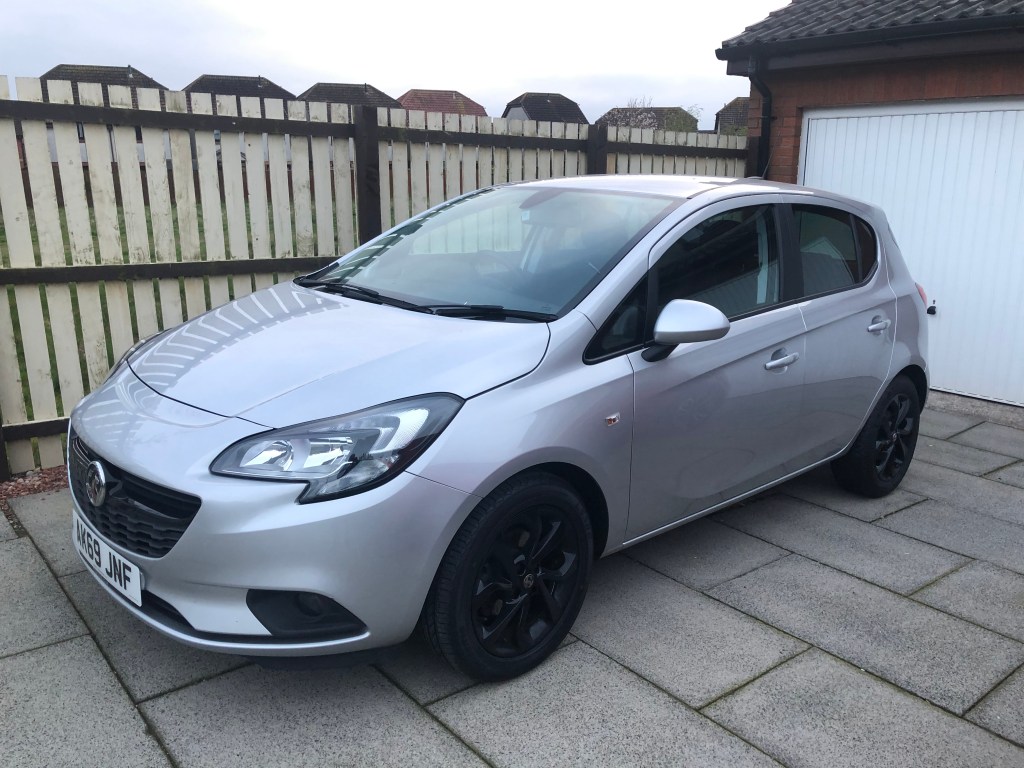
Facing a couple of months without wheels gave me time to reflect and not just about the Number 14 bus which I had to take a few times. Something was nagging me. I realised what it was. I didn’t really want the Mini. The whole idea of replacing the Q5 was to save money. To buy the Mini I was going to have to spend £9000 on top of what I’d received for the Q5 which wasn’t quite the idea. Yes, it would have been a nice car but nothing was going to be up to the standard of the Q5 so why bother trying? I formulated a new plan. It started with me phoning up the Mini dealer and cancelling the order. Why not, I thought, get a cheap secondhand runaround, cheap being a relative term of course. Secondhand cars are anything but cheap. A whole five minutes of research suggested that the Vauxhall Corsa would fit the bill. What’s more, there are supposedly a lot of them about. I thought I’d have a look on the online car vendors Cazoo and Cinch. Sure enough, there were a lot of Corsa to choose from so I picked 2019 model from the Cinch website. Cinch comprehensively list their cars and accompany them with a lot of photos. The Corsa I chose had no defects listed though it is understood that there might be a few very minor scuffs and chips consistent with the age of the car. It quite clearly stated that a number of extras were included when the car was first bought, namely a ‘winter pack’ and an ‘infotainment’ system upgraded to include a satnav. I paid just shy of £12,000 and awaited it’s delivery, insuring and taxing the vehicle as I waited. Sure enough, on the allocated day at the allocated time the car arrived on my allocated drive. It looked ok. The delivery driver gave me the once over and off he went. Easy as you like. Later that morning I went to check the car out. I popped on the infotainment system and found that there was no satnav. Needless to say I gave Cinch a call. Sorry, they said, there’s nothing we can do, there is a little disclaimer saying that the ‘extras’ mentioned in the listing were added during the manufacture and may have been removed in the meantime. Like anyone is going to remove the satnav? The truth is I didn’t need a satnav. The system had Apple Car Play which allows Google Maps to be used as the satnav. I was, however, somewhat peeved at being led to believe there was one when there wasn’t. Cinch offer a 14 day money back guarantee so I thought sod it, you can take the bloody thing back. After a few more phone calls, a date was arranged for the car to be collected. A full refund would be made when they received it minus £250 which would then be refunded once the V5 document was returned to them.

Corsa Number One

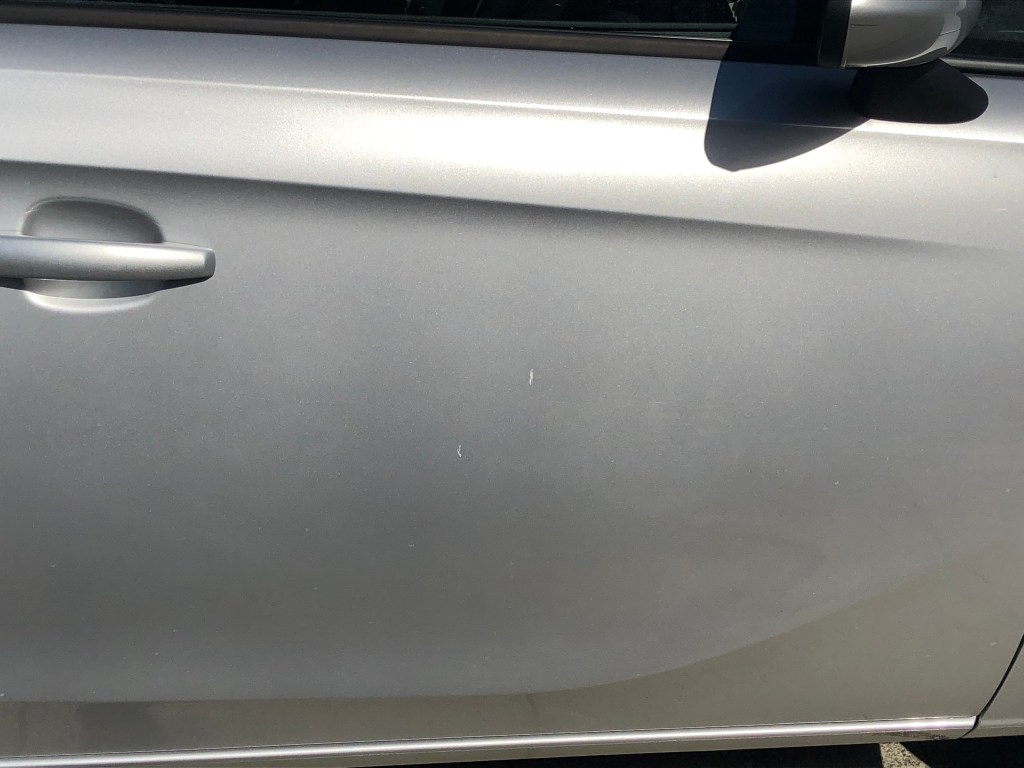
At the same time I was arranging the return, I spied another Corsa on the Cinch website. I double checked the listing to see if there was any other way they could catch me out and when I was pretty sure what it was I was buying I bought it. It was ten pounds more than the original one. I was in a situation where I could actually afford to pay for two Corsas and not wait until the refund had come through on the first. Consequently, it turned up and the first one was taken away. This Corsa had everything that the listing had promised, including the upgraded infotainment system with the satnav. Unfortunately it also had a few extra ‘features’ that hadn’t been listed. A very obvious deep scratch in the driver’s door and a less obvious but huge scratch across the roof. My guess was the scratch on the door had been caused by another car door blowing open onto it whilst it was parked whilst the one on the roof was as a result of a petrol pump hose being dragged across it. I wasn’t too happy about this. I phoned them up again with my concerns and followed it up with emails showing the damage. After a day or so they contacted me with their verdict. They would pay for a ‘machine polish’ of the roof but they were unable to help with the scratch on the door as it didn’t fit the criteria for being a listed defect. Apparently a scratch has to be 25mm or longer, this was 20mm. That there was another criteria which said that no paint defects should be visible from a distance of 2M didn’t seem to count. These scratches could be seen from outer space for heaven’s sake. I was incensed. No way was I going to accept the ‘solution’ they had offered so I told them to come and collect it under the same money back guarantee as before. Cinch’s advertising tagline is ‘Cars without the faff’. I’d suffered quite a faff overload by now and still didn’t have a car. Not only had I had the dealings with Cinch, I’d had to get insurance, change that insurance, get car tax twice and cancel it twice. That’s faff taken to a new level. I’d done a Trustpilot review after the first one which was actually not all bad. A customer service bloke contacted me and offered a few quid compensation which I accepted. He contacted me again after the second one and suggested that I might like to change the review. I told him that he really, really didn’t want me to change that review. I haven’t yet. I still might.

Corsa Number Two

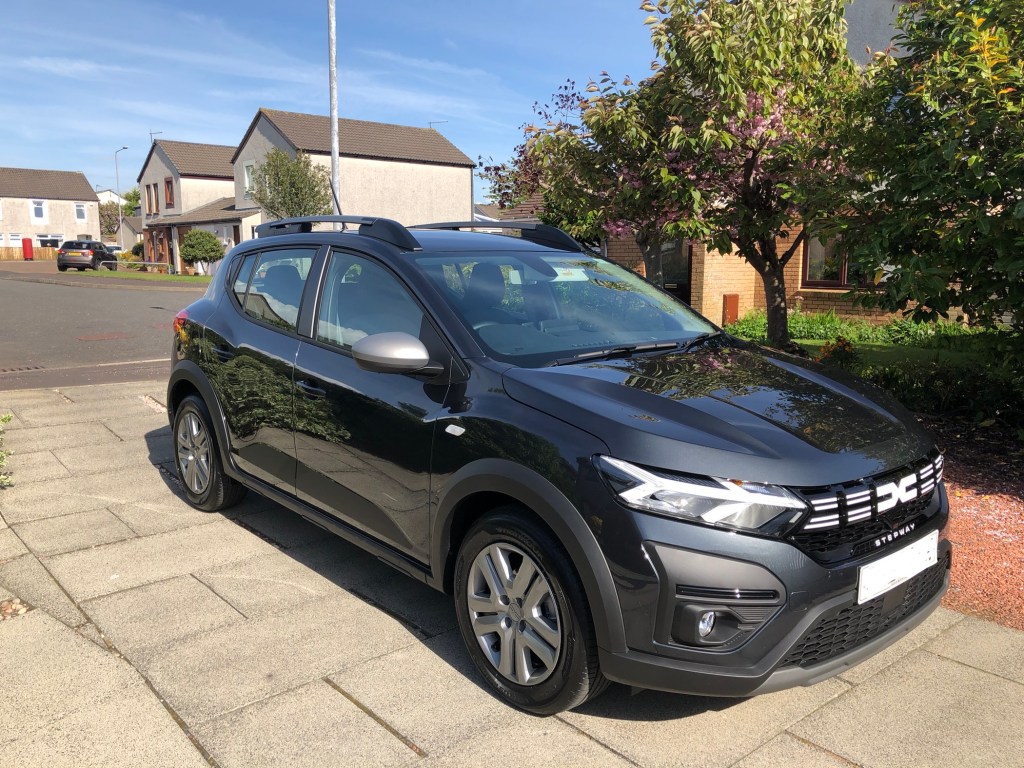
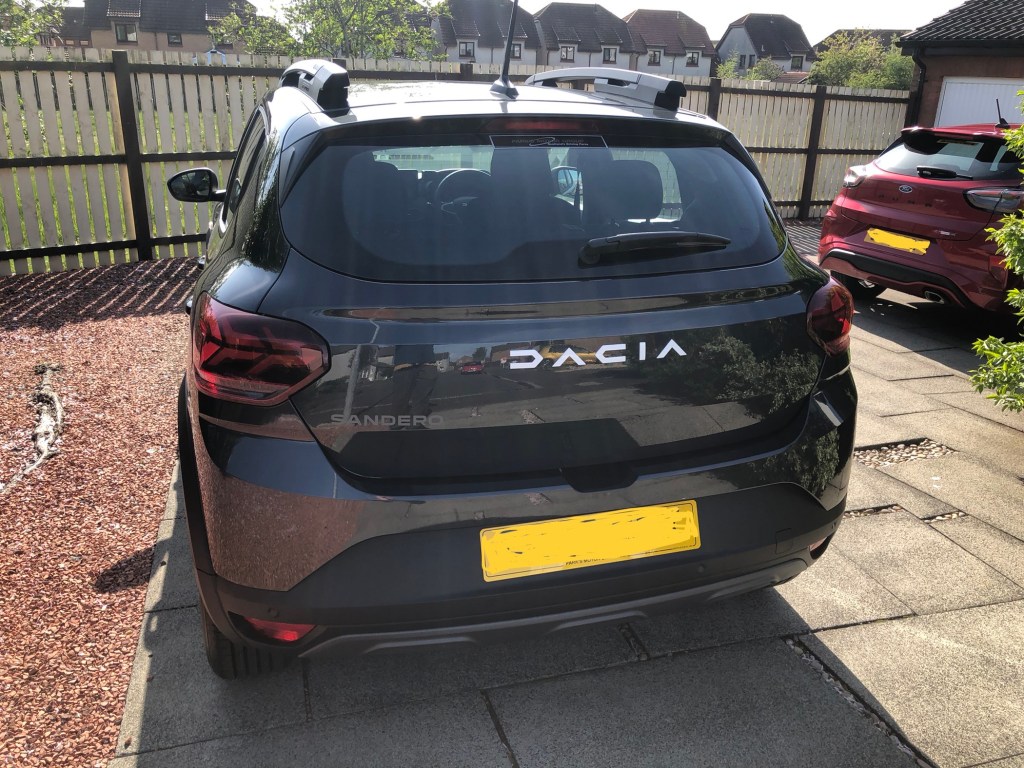
Needless to say I’d gone right off the idea of getting a car from Cinch, or any other online Honest John car sales outfit. Second hand cars were losing their appeal too. Was there any new car that could satisfy my need for a practical car for not much money? As it happens, yes, there is one. Dacia is the daddy when it comes to budget cars. Part of the French Renault group, their cars are made in Romania where presumably that unlike in France, the unions don’t insist that lunch hour lasts two hours. Dacia cars were famously so basic that the baseline model didn’t even have a wireless installed. You could, however, pick up that baseline model for a several thousand quid less than just about anything else that was on the market. Whilst still very much at the lower end of the price spectrum, Dacia has some competition nowadays from Kia, MG and even VW who can match the price, albeit with slightly smaller cars. I went along to the Renault/Dacia dealer in Ayr which happens to be just across the road from the Audi dealer where my much loved Q5 had come from. The young salesman advised that there was a bit of a long lead-in time for Dacias at the moment, However, if I wanted to take the showroom model off their hands I could have in a week. The car in question wasn’t the baseline model, the Sandero. It was a Sandero Stepway, a slightly chunkier version that tries to convince people it is an SUV type of vehicle. I had liked owning a ‘chunky’ car when I had the Q5 so why not try this pretend chunky car? I went for a test drive in a similar vehicle. It seemed to tick all the boxes. Press the accelerator and it goes, press the break and it stops. Turn the steering wheel and it goes round corners and it had seats to sit on. That is all I needed. Back at the dealers I agreed to buy the showroom model. It was more expensive than those Corsas but had zero miles on the clock, a three year guarantee, no scratches and a few little extras that I found surprising for a Dacia. Rear parking sensors and a reversing camera for a start. Zonal door locking was a new one on me. The oddest thing about it though was it was a duel fuel vehicle. As well as a conventional petrol tank, there was an extra tank for LPG.

LPG, or liquified petroleum gas, is a fuel that isn’t in widespread use in this country. It’s a bit more common in Europe but the fact that Dacia offer the duel fuel version in the UK seems strange. There are petrol stations that sell the stuff but not many of them. As it happens there are two in Kilmarnock, not too far from where I live. Whilst I might not have bothered with the LPG/petrol version had I been ordering a new Dacia, the fact it was already fitted to the showroom model meant that is what I was going to get. What is the advantage of LPG? It costs 80p a litre as opposed to £1.40 per litre of petrol. What is the disadvantage? It’s bloody scary filling the tank with the stuff.

My shiny new Dacia Sandero Stepway!

On the appropriate day I pitched up and paid for the car with Amex. That was a nice surprise and I’ll look forward to spending all the Avios I earned with that transaction. I was allowed to drive it straight out of the showroom and off I went. The petrol tank was full but there was nothing in the LPG tank. The first place I visited was the petrol station at the Bellfield Roundabout in Kilmarnock. I literally had no idea how you went about filling the thing but I eventually worked it out – there’s an adaptor you screw into the filler onto which the hose from the pump is attached via a bayonet fitting and secured by pulling a lever. You then press a button on the pump and fill the tank. It can only be filled to three quarter capacity before it clicks off, about 32 litres, then you have to dismantle it all. Release the lever and turn the hose. There will be an almighty hiss followed by a rather unpleasant smell as some of the LPG escapes whilst before the valve completely closes. This scares the shit out of you the first time you do it and, I can now relate, it scares the shit out of you the second and third time too. Then unscrew the adaptor, which was very difficult the first time I did it, put the cap back on and go and pay for it feeling both smug that the tank was filled for thirty quid and relieved that you haven’t managed to blow up Kilmarnock. It turns out that the best place to get LPG is at Morrisons in Kilmarnock where it is 20p per litre cheaper but it is all part of the learning process. I also own a pair of sturdy gardening gloves to be worn on every subsequent fill-up.

Dacia have recently changed their logo and branding. It’s as if they’ve finally come of age. Gone are the days of a slightly embarrassed Dacia in small type on an understated shield logo. Now it’s an emboldened snazzy font as if to say “I’m a DACIA, fuck you!”

Apart from the LPG aspect of the car, it is altogether underwhelming. This, however, is the point. If I’d wanted a whelming car I’d have bought one. It drives okay, is light on the steering and if you put your foot down it can get a bit of a shift on. There is not too much in the way of tech to worry about and Apple Car Play takes care of the music and navigation. I would have preferred automatic transmission and the touchscreen entertainment system is not that easy to adjust safely when you are moving but I do like having a reversing camera so you win a few and you lose a few. I might be imagining it but the engine seems to run slightly rougher on LPG than on petrol but not enough for me to ignore the financial benefit of utilising it. All in all, it is precisely the sort of thing I was after even though I didn’t realising it when I first considered replacing the Audi. Is it a crap car? If it cost 34 grand then yes, it would be a steaming pile of ordure. At 17 grand, however, it is a perfectly acceptable vehicle. I’m happy to have moved on from the Expensive German Car to the Cheap Romanian Car, although I do shed a tear whenever a Q5 drives past.

Postscript: Since selling the Audi, the diesel that powered it has come down in price so much it is cheaper than petrol at a couple of the local garages. Filling the tank would be a third less than when fuel prices hit the peak last year. Also, I had only one more year of paying the £390 car tax premium before it reverted to standard tax rates. Maybe I was a bit hasty in disposing of it…

SAGA

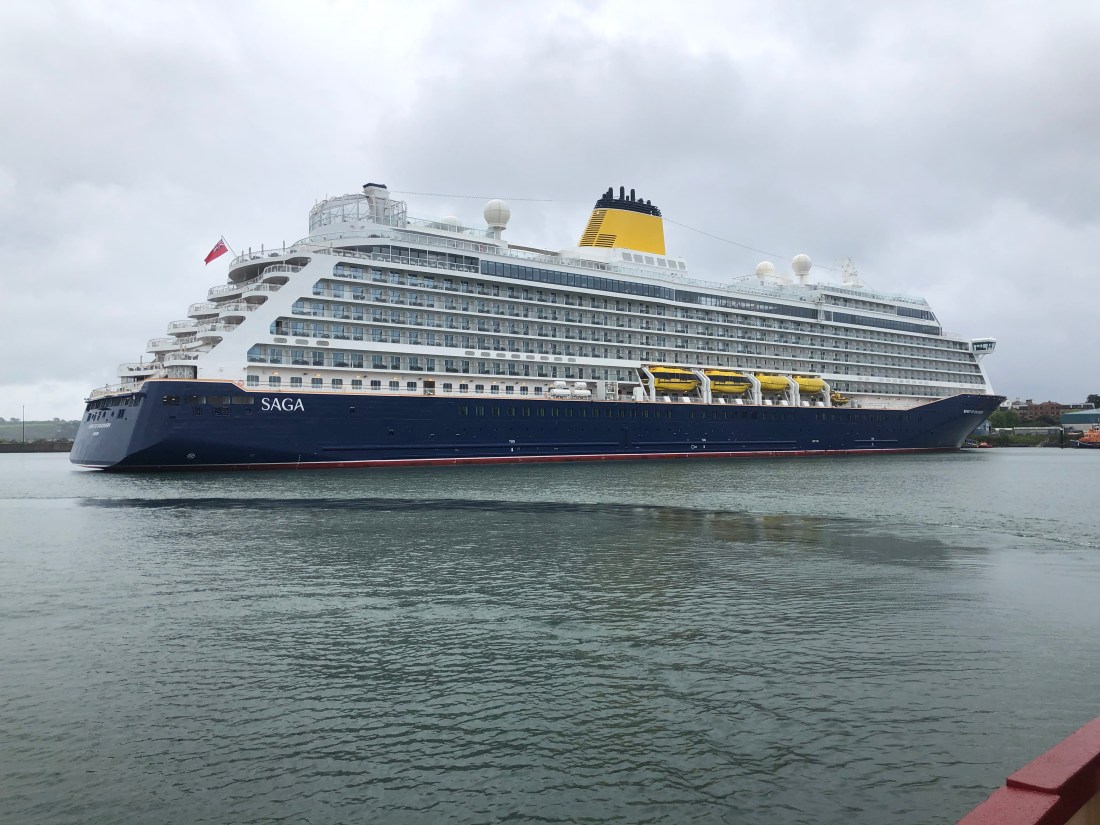
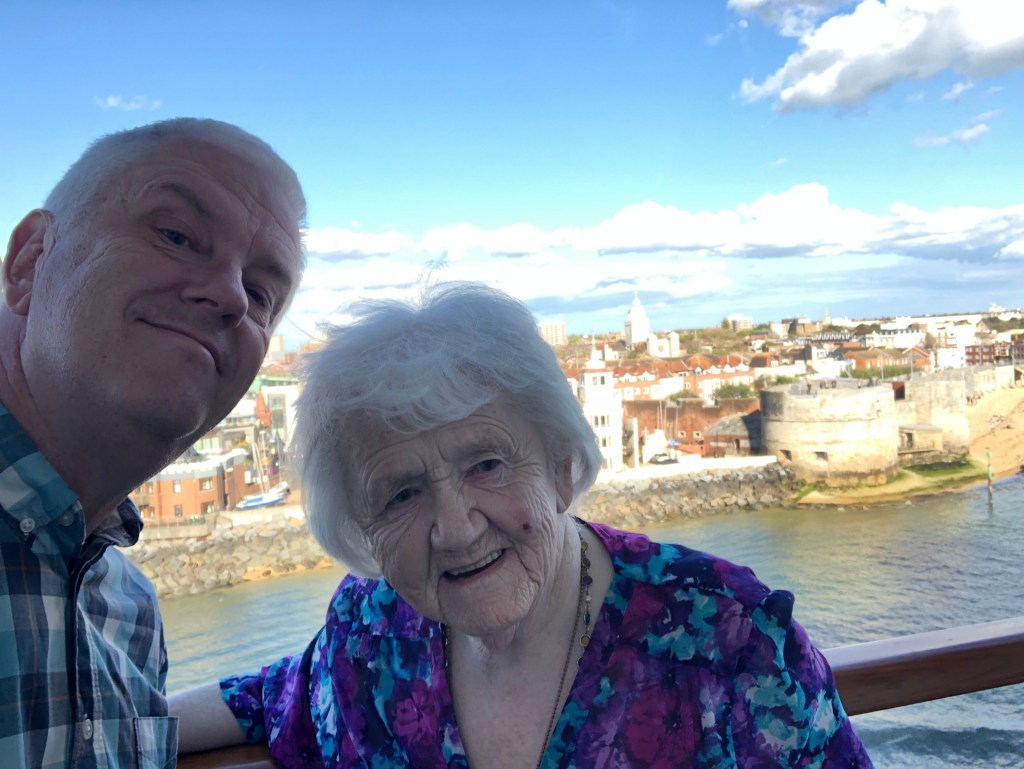
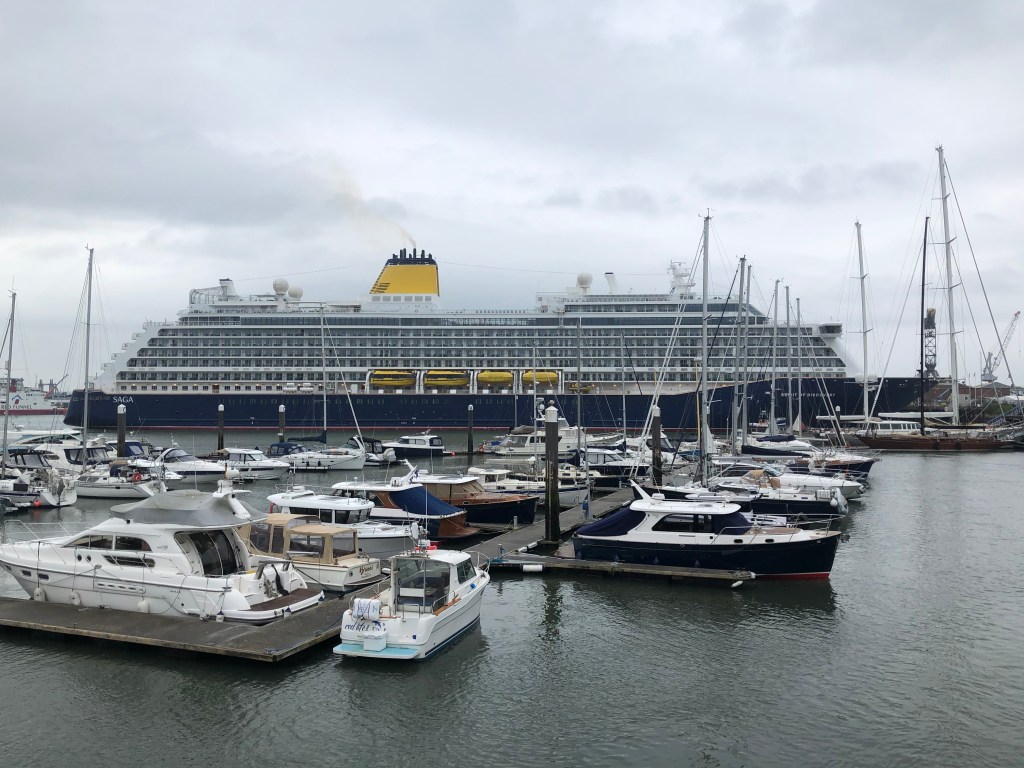
Spirit of Discovery. It’s not easy getting a decent shot to be honest.

Back in the dark ages that was forty-odd years ago, I was discussing various aspects of holidaying with some of my co-students at the College of Air Traffic Control where we were all setting out on long and (mostly) successful careers. The college was in Bournemouth which was, and still is a seaside holiday resort that attracted a reasonable cross section of British society. This included the more mature holidaymaker who were catered for by a number of specialist tour operators, the most famous of which is Saga. Formed in 1951, Saga runs tours, river and ocean cruises, all inclusive package deals and extras such as travel insurance for Britain’s over 50s. Back in that common room at the College of ATC we were mostly in our early 20s so you felt you had to be very old indeed to experience a Saga tour and ‘very old’ people on holiday were generally perceived to be a bit, well, grumpy. As such we decided that the name ‘Saga’ was an acronym for ‘Stupid Arrogant Geriatric Arseholes’. Oh how we laughed. Fast forward forty years. I’m now 61 years old, well beyond the minimum age you have to be to book a Saga holiday and have just returned from my first Stupid Arrogant Geriatric Arseholes holiday. Yes indeed, my desired reputation for being a hard nosed traveller is about to take a battering as I plump for the easy option of paying a company a lot of money and letting them deal with everything. My inner 20 year old was shaking his head in despair.

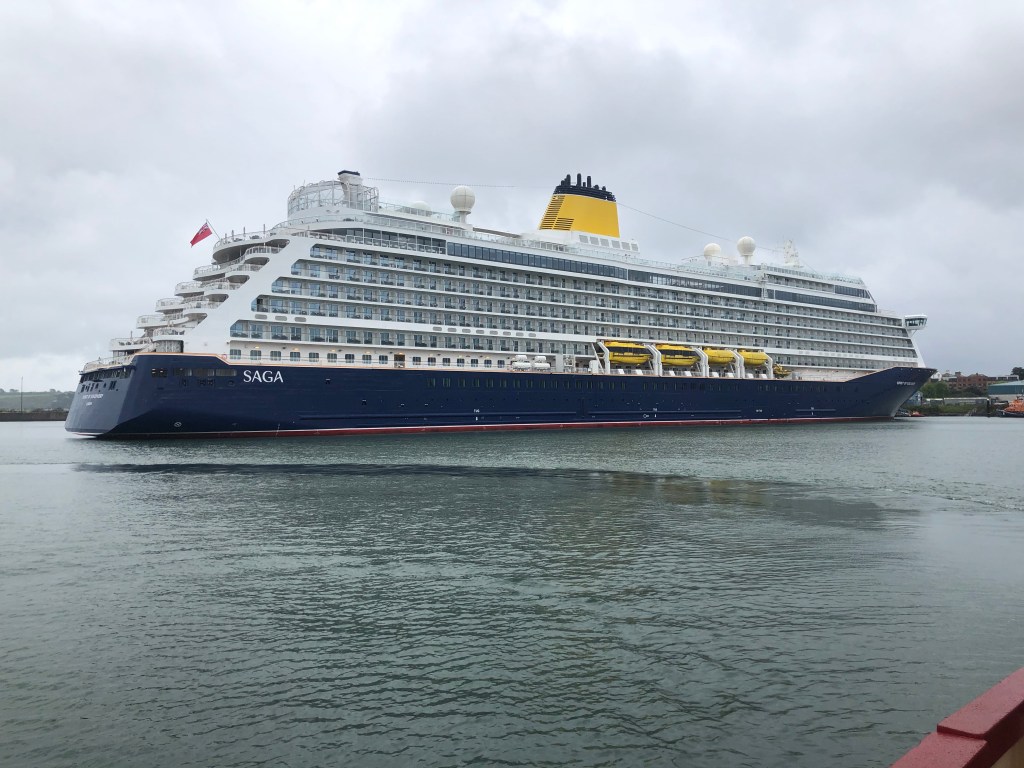
The best shot I have from the front.

How did it come to this? It should have been a year earlier as it happens. For the past few years my sister Jill and I have taken our mum away for a few days. Jill has in fact gone further and taken mum away herself. Those trips have been with Saga on both river and sea cruises. The fact that Saga look after the oldies was a big selling point for them, as was the travel cheap insurance that was an optional-but-you’d-be-mad-not-to-take-it extra. Mum is, in her own words, getting on a bit and has a number of medical issues that make normal travel insurance prohibitively expensive. Last year I decided to lose my Saga virginity by joining mum and Jill on a Rhine river cruise. Sadly, ten days before we were due to travel I came down with a dose of the Covid and as soon as Saga found out, they immediately refunded our money and strictly forbade us from setting foot within a hundred miles of their boat. I may be exaggerating a bit but it was quite obvious they were shit-scared of an outbreak on a boat full of elderly people with assorted levels of morbidity. My symptoms were mild, I’d have been over it by the time we were due to board but we weren’t welcome any more so that was that. We ended up spending a few days in Stratford-upon-Avon which was very nice, if a little lacking in German castles. A few months later we were looking to book this year’s trip. We went back to Saga and discovered a five night cruise on one of their two new ’boutique’ cruise ships, the Spirit of Discovery. It wasn’t the most exciting of itineraries as we would barely leave the English Channel but the cruise itself is the holiday, the ports of call are just a bonus. We booked it.

It starts with a Mercedes van.

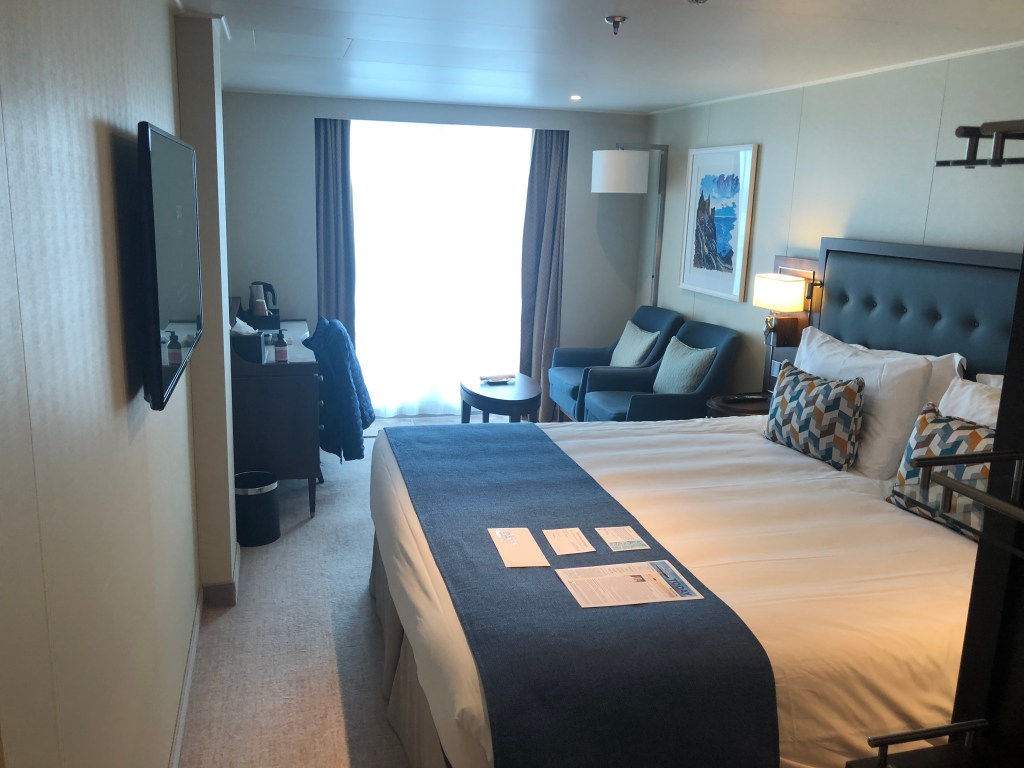
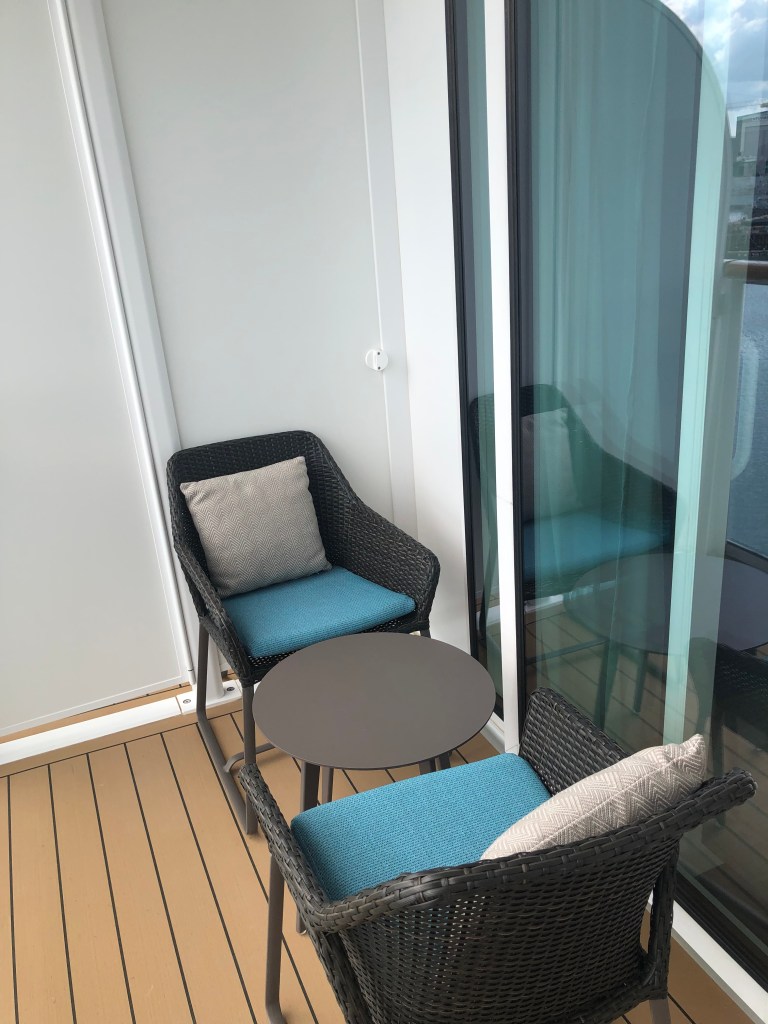
Another advantage of booking a Saga cruise is that they all go from the UK. That’s a bonus to most people but not necessarily an avgeek like me who rather enjoys a trip on a plane. Not having the hassle of airports is a good thing for many people, especially those who are of an age to take a Saga holiday. Not only that, Saga send someone to pick you up and drive you to the port. This service is free for anyone within 250 miles (300 miles from next year) of the port of departure. For this cruise it was Portsmouth which meant I, or anyone else residing in Scotland didn’t qualify for the free chauffeur service although Saga do supposedly offer cheap transfer services to those living outside the zone. As it happens, my mum’s house is 247 miles from Portsmouth so we booked the pick up from there. The driver duly arrived at the appointed time in a rather nice Mercedes people mover. There was one other passenger already in the vehicle and we set off to Portsmouth a four and a half hour drive away. For some reason I hadn’t really been looking forward to this but it was fine, very pleasant in fact. At the port the baggage, including mum’s wheelchair, was taken directly from the car before we were dropped off at the check-in. We had pre-booked assistance but needn’t have bothered as there was very little walking for mum to do. A bus took us from the check-in building to the gangplank where we boarded and were shown to our rooms. We’d each got a Superior Single cabin on the port aft of Deck 12. Look at me with the nautical terminology. I have been on a few cruises before. On none of those cruises have I stayed in a cabin as good as this one. All cabins on the Spirit of Discovery and its sister ship Spirit of Adventure have a balcony. That was a first for me and there’s no going back to inside cabins or even outside cabins with a non-opening porthole as I’d experienced a few years ago. Despite being a single cabin, it had a bed plenty big enough for two should any of the old solo travellers score on the cruise (stop being ageist and disapproving). There was plenty of living space and a small but well thought out bathroom, good storage and all the other little bits and pieces that you’d get in a good quality hotel room. Our cabin steward Jennifer introduced herself and promised not to fold the towels into animal shapes like you get with other cruise lines. Actually she didn’t promise, she just didn’t do it as presumably the Saga clientele is generally too old to be impressed by a towel folded into the shape of an elephant being left on the bed. I must be getting old too as wasn’t disappointed. I thought the room/cabin/stateroom, call it what you will, was fantastic.

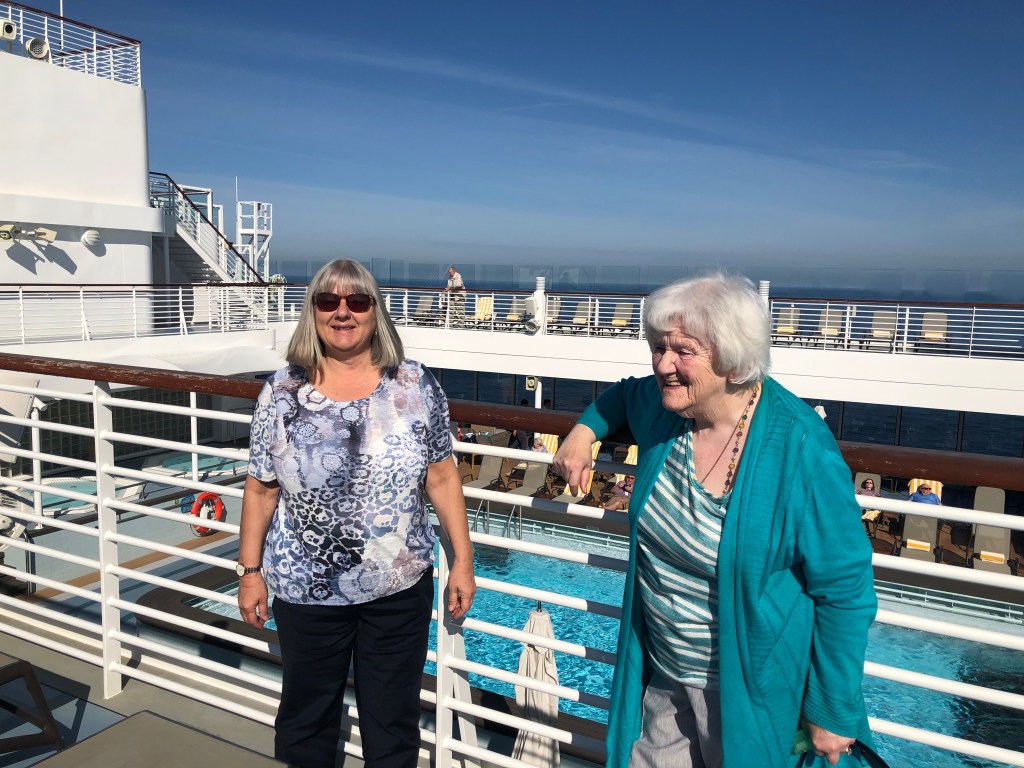
A word about the crew. All the cabin stewards, waiting staff, bartenders and just about every other job that had day to day contact with the passengers, were Filipino. For some reason all cruise lines, not just Saga, recruit from the Philippines and have no difficulty in filling the available vacancies. Some people can struggle with this: wealthy westerners being served by people from relatively poor countries. However, the Filipinos seem happy in their work and genuinely friendly towards the passengers. Yes, they could just be acting and secretly despise us but I very much doubt it. As mentioned, there is no shortage of people applying for all the various posts which suggests it is seen as a good employment option. Guilt avoided, let’s look at the ship they call home for much of the year. The Spirit of Discovery was built in 2019, the first of a pair of new ‘small’ cruise ships built exclusively for Saga, Spirit of Adventure being the other which took to the seas the following year just in time for the pandemic. I say ‘small’ but that is a relative term. Gross tonnage, which is actually a measure of internal volume rather than weight, is 58,250. By contrast, the world’s largest cruise ship, Wonder of the Seas, has a gross tonnage of 236,857 so Discovery is a tiddler by comparison. The difference is it caters for 987 passengers as opposed to Wonder’s nearly 7000. Wonder is indeed massive but do the maths and you can see they need to fit seven times as many passenger in four times the volume. Discovery has a higher crew to passenger ratio too, more than one to two as opposed to one to three in the big ship. The big cruise lines are all going down the road of huge ships but there is still a market for smaller, more intimate vessels and as Saga’s clientele is hardly likely to need the water slides, climbing walls and go kart tracks on the mega liners, it seemed a wise choice to commission two ships at the smaller end of the size range.

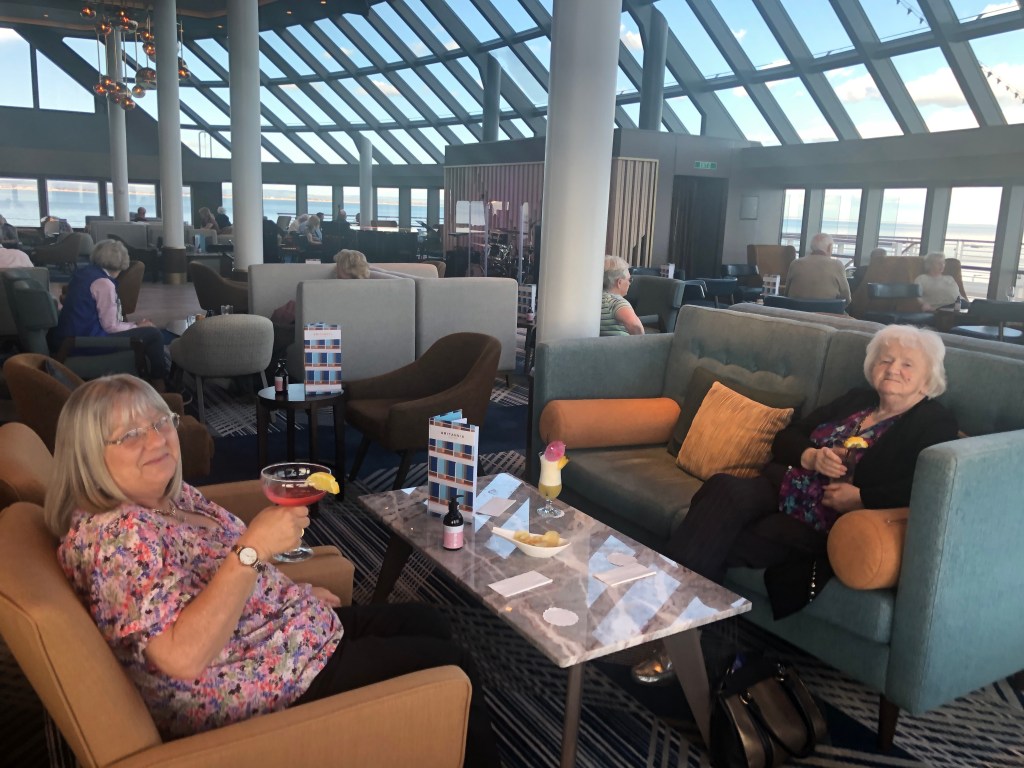
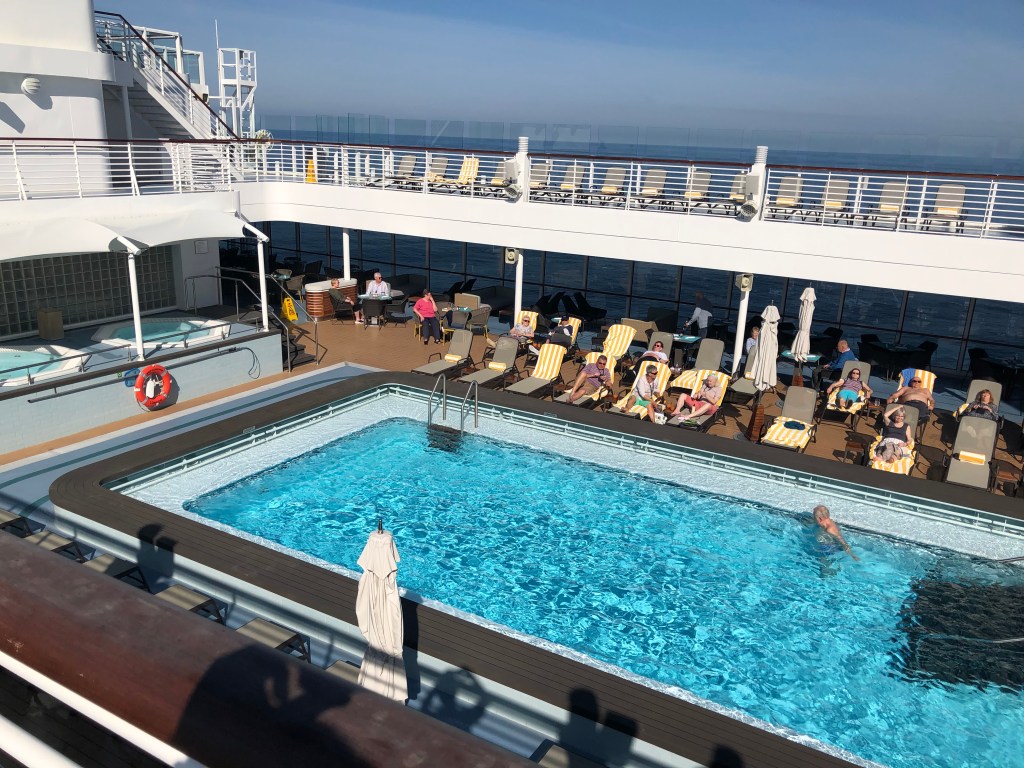
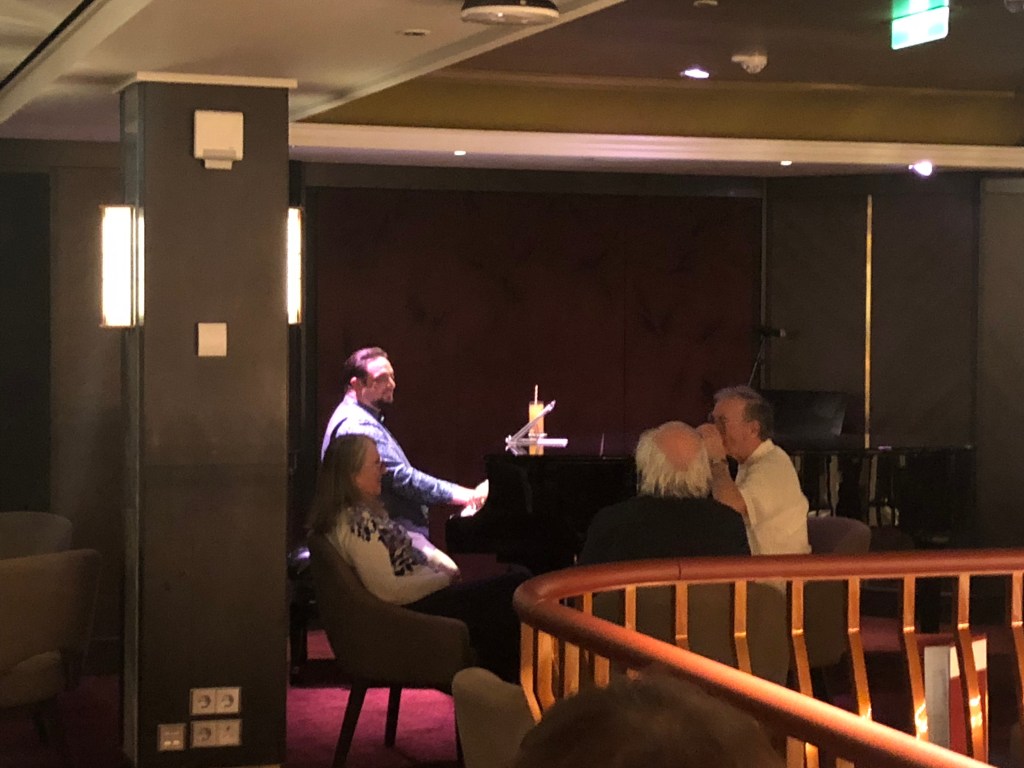
What do they manage to squeeze into their 58,250 tonnes? 554 cabins for a start. Around a quarter of those are for single occupancy which is a far higher ratio than other cruise lines which once again reflects the elderly clientele. There are five dining rooms: The Main Dining Room, the slightly less formal Grill and three speciality restaurants. The Club by Jools is a steakhouse under the patronage of Jools Holland, East to West is Asian cuisine and Coast to Coast which specialises in seafood. There was no supplement to use the speciality restaurants though for our short cruise they limited passengers to just one visit to one of them. We somehow managed to blag our way into two though, the only one we missed was Coast to Coast, much to mum’s disappointment as she rather fancied the lobster. Whilst you needed a reservation in the speciality restaurants, it was open dining in the others so no set sittings to worry about. The longest we had to wait was about two minutes. There are four different bars including the large Britannia Lounge at the pointy end of the ship (see, I told you I knew all the nautical terms). A lot of the entertainment takes place there including the daily quiz which we so nearly won one evening, losing out on a tie break. We would have won it had we not ‘checked’ an answer which only goes to show that bending the rules doesn’t always pay. The Club by Jools aptly becomes a piano bar after dinner is over and occasionally the pianist is Jools himself. Not on our cruise though, we had the equally impressive Zoltan to tickle the ivories. The Living Room is near the hub of the ship where you could sip a pina colada to the sounds of a classical four piece or some light jazz by a three piece who were forever telling us that they loved jazz. We didn’t frequent the South Cape Bar which was the fourth drinking establishment on the ship. The Playhouse Theatre could seat 444 people and held shows every evening either by the ship’s resident entertainment crew or visiting acts. Other things took place there such as lectures in the afternoon and it also served as the rendezvous point for the shore excursions. Up on deck there were more than enough sun loungers, something not all cruise lines can claim, a swimming pool filled with warm, fresh water and a couple of spa pools which were positively steaming. There is a bar there too with waiters bringing drinks directly to your sun lounger so no need to do the long walk of a few yards to get it yourself. There’s a few games you can play like table tennis, darts and the cruise line favourite, quoits, and if you are feeling fit, four times round the promenade deck is a mile. To complete the ship tour, there’s a couple of shops near the reception, a library for those who fancy some peace and quiet, a gym, a hairdressers and a spa. The hairdresser and the spa require additional payment but apart from some of the more expensive drinks, everything else on board is free, including the WiFi. Or, to be more precise, included in the price. Saga cruises aren’t the cheapest but you do get a lot for your money. We bought a bottle of Champagne to celebrate a special occasion and that was the only thing that we were charged for on disembarkation and that was only £30 which seemed more of a supermarket price than what you might find in a bar or restaurant.

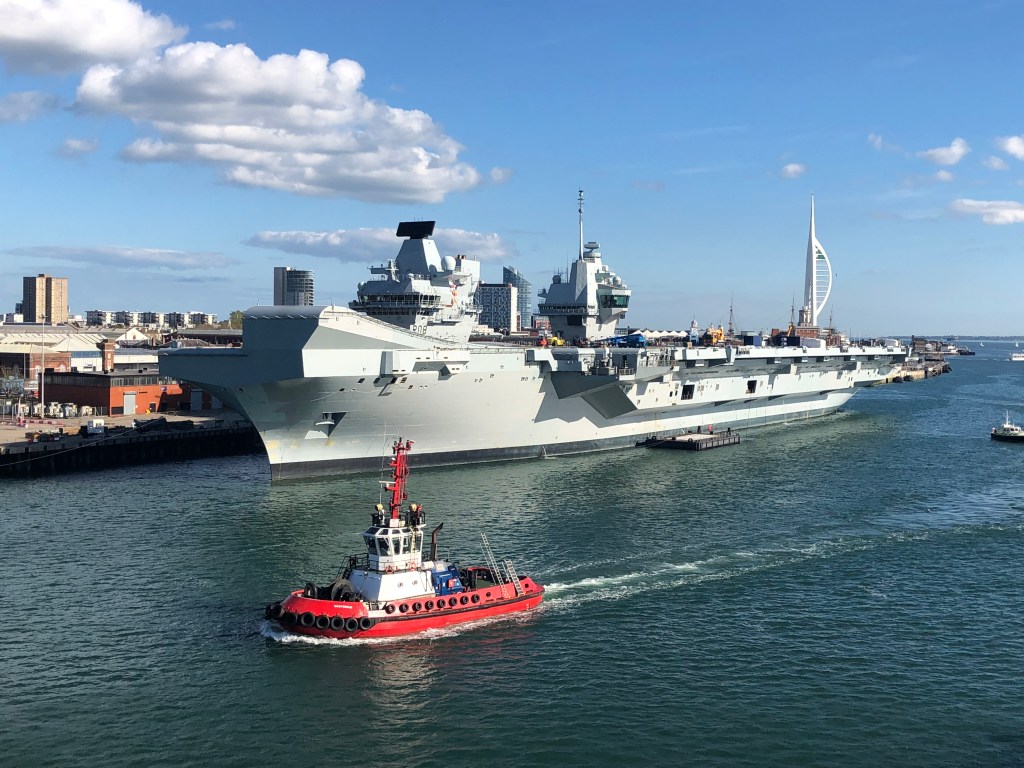
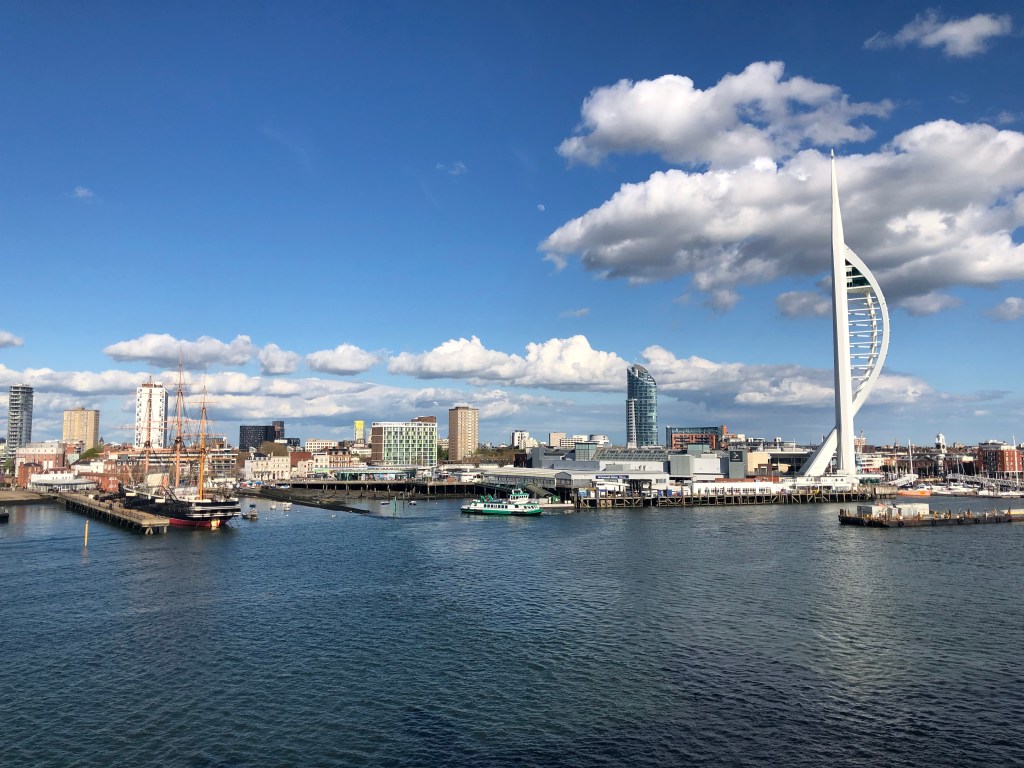
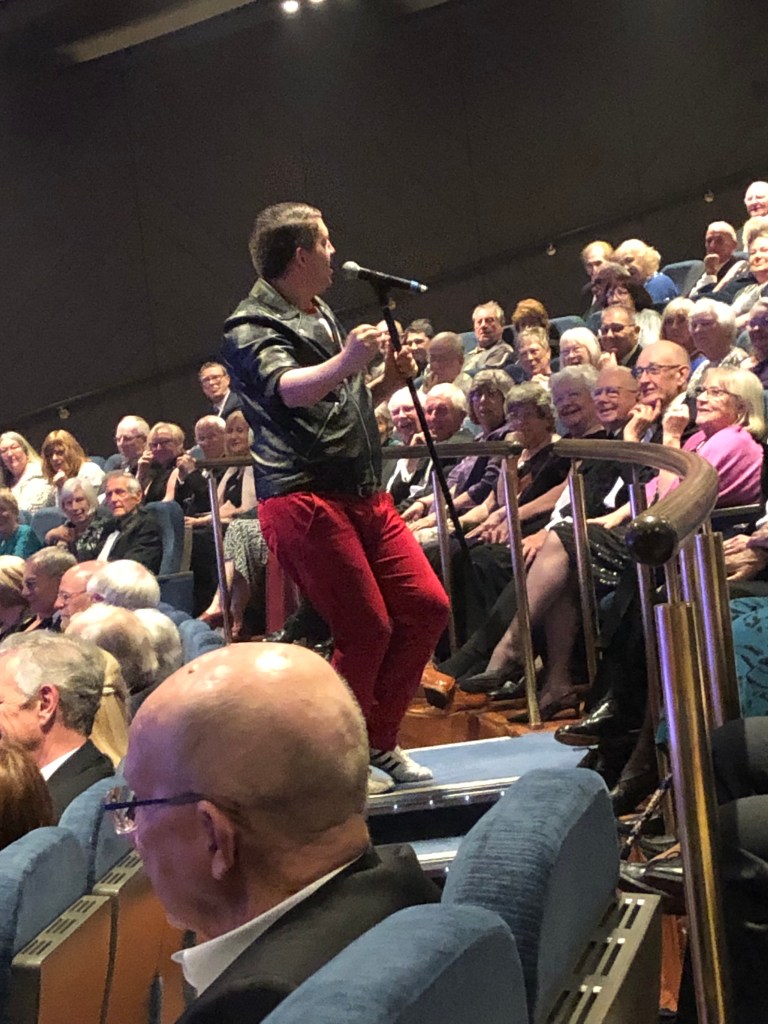
To summarise, it is a very nice ship, tastefully kitted out, with enough of what you might want on a cruise and not a lot of what you don’t. It is perfect for the 60+ age bracket and probably suits the 50+ cruisers too although to be honest, I didn’t see that many passengers who looked to be in their fifties. In fact at 61 I felt rather youthful. The cruise itself is a bit of a backstory to this blog but it is worth mentioning what happened to give an idea of what to expect on any Saga cruise itinerary. Sailaway from Portsmouth was not accompanied by much fanfare which I found a bit odd but it was very pleasant watching it from the balcony of mum’s room. Portsmouth isn’t an overly scenic place but there was a lot of interesting stuff to see. Day two was a sea day. We were lucky as the weather was particularly kind so spent much of the day on deck. There were plenty of organised activities to keep folk occupied if sitting around isn’t your thing but lots did take advantage of the sunshine. I even had a dip in the pool. That evening was Formal Night. Formal dress was required throughout the ship with the exception of The Grill where the chaps could get away without wearing a tie. We had booked The Club for that evening so I had to dig out my suit and blow the moths off. I may have grumbled about it once or twice but the steaks were fantastic. In the theatre that evening were a Queen tribute band which led to the comedy moment of the cruise: a lot of old folk DJs and cocktail dresses getting on down to Don’t Stop Me Now, especially the “I’m a sex machine ready to reload” bit. Don’t knock it though, the band were excellent and ties or no ties, it was a great evening. Day Three saw us dock in Brest. Another good thing about a Saga cruise is that some of the shore excursions are included. In Brest this was a trip to the Breton village of Locronan. It’s a nice place, even when it is full of Saga cruise ship passengers. That evening’s entertainment was a show put together by the ship’s entertainment company. There was some loose storyline which served as an excuse to perform song and dance and a bit of acrobatics.

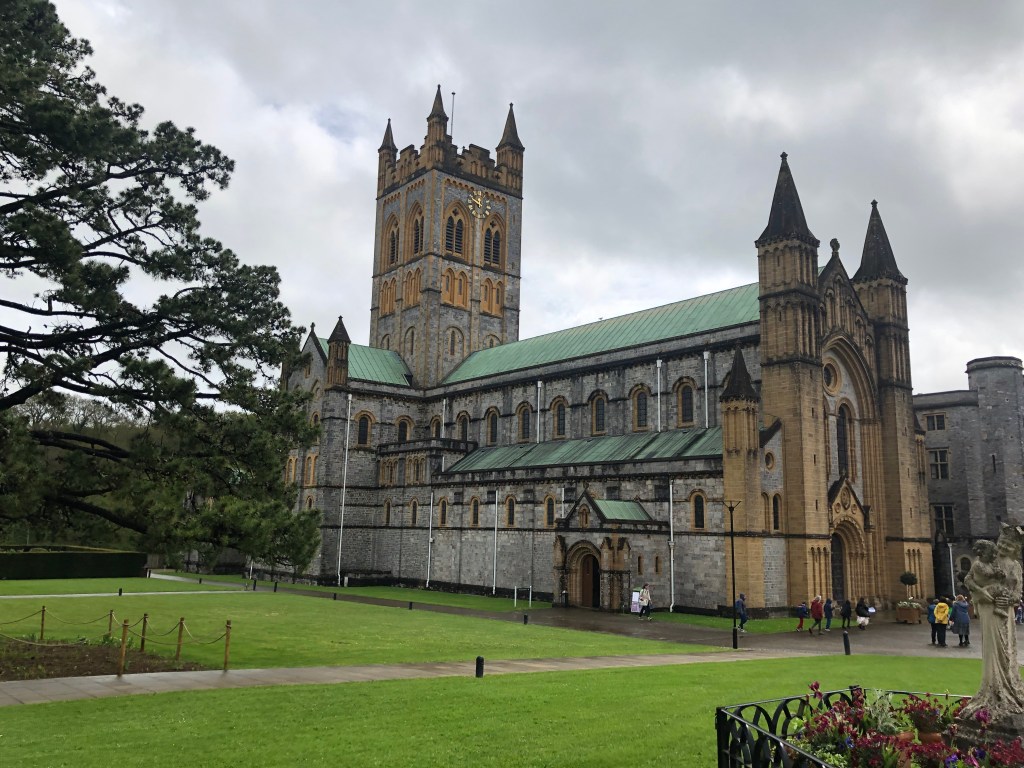
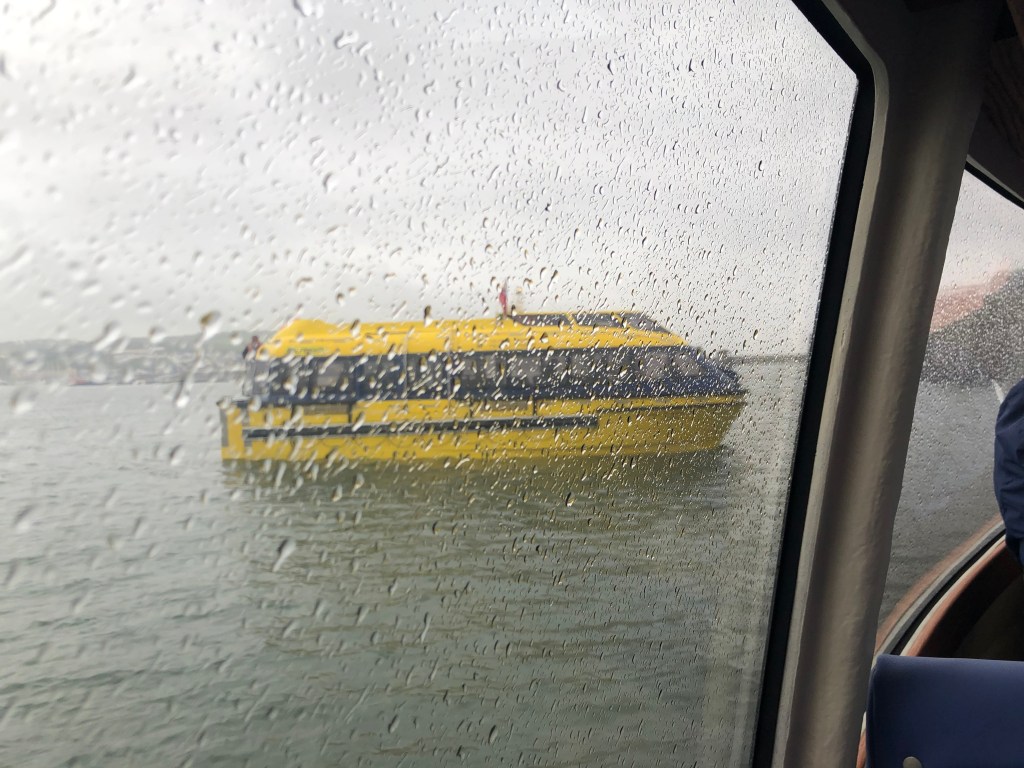
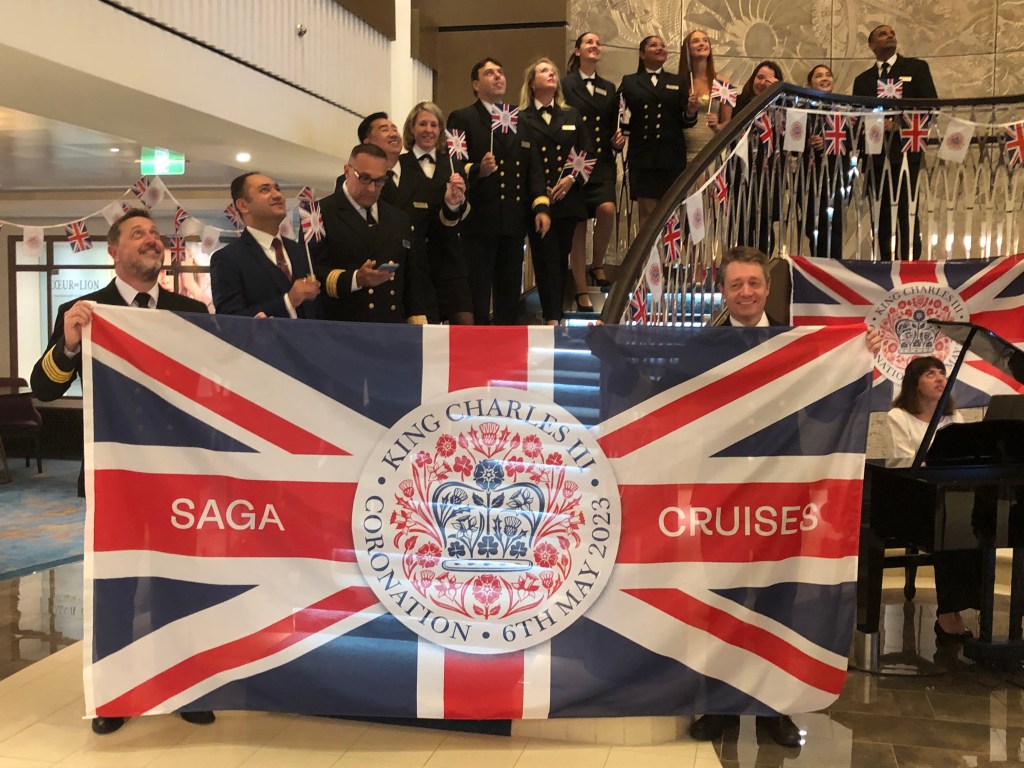
Day Four was spent in Falmouth. The weather had taken a turn for the worse which was a shame. We had decided to avoid the included excursion and pay for a different one which was a cruise up the Helford River in one of the tourist boats that ply their trade in Falmouth Harbour. However, the weather put paid to that idea and we headed off up the River Fal estuary instead. It was, well, a bit rubbish. It would have probably been ok if the weather had been better but a scenic cruise where you can’t see much is never likely to be the best. After dinner in The Grill, we nearly won the quiz as mentioned above, and then saw a magician do magic things in the theatre. He was pretty good at it too but I always try and work out how they do it and it frustrates me when I can’t. Day Five saw us drop anchor in Plymouth Harbour. This is always interesting as it requires the use of a tender to get the passengers to shore. That tender is in fact one of the lifeboats and it is quite a fun journey. We took another optional extra excursion in Plymouth. This was to Buckfast Abbey, three quarters of an hour or so away by bus. It was an interesting place. The abbey is less than 100 years old but made in the gothic style of many centuries earlier. However, the most interesting thing about it is that the monks produce their tonic wine, so beloved of the young scallywags of Scotland. I bought a bottle and took it home. It was a bit like taking coals to Newcastle. There’s something, however, about buying Bucky at the place where it is produced rather than the Spar just round the corner. That evening we got ourselves into the East to West restaurant despite us using up our speciality restaurant allocation of one a couple of days earlier. The food was amongst the finest Asian food I have ever tasted. It was another Queen night at the theatre with the tribute band, who go by the name of Royal Rhapsody, giving us another rousing night of classic Queen stuff. There were fewer people there this time and not a dinner jacket in sight but I have to give a big thumbs up to the cruise director for booking them. The band members were quite young and I do wonder what they made of their not young audience. Whatever, they put on a show and those present seemed to love it. Day Six of our five day cruise saw us dock in Portsmouth early. One final breakfast and we were off the ship by half past eight. Our bags had been collected overnight and were there for us at the quayside. Another bloke in a different Mercedes van was there to whisk us back to Yorkshire. It was Coronation Day and we got back in time to turn the telly on and. see the King and Queen on the balcony of Buckingham Palace.

What then of Saga cruises? I couldn’t really fault them. You are looked after from stepping out of your front door to stepping back inside it again how ever many days later. The ship is really classy. It looks good outside and in. In terms of size it was pretty much ideal. Not huge and intimidating but not small and too exclusive either. The cabins are great and you’ll get a balcony even in the cheapest one. The food was top notch in all locations with good portion sizes, not always a given with other cruise lines. If I was being really picky I would say the food could have been a bit hotter but you couldn’t fault it for quality and flavour. There were enough activities and entertainment on offer to fill your time on board and it was easy to avoid it if you just fancied a bit of peace and quiet. Yes, it’s full of old people and it the bathing beauties by the pool may be a bit on the wrinkly side but so what? I’m no spring chicken either. Would I do it again? Most certainly. Here’s the big question though, is Saga just for Stupid, Arrogant, Geriatric Arseholes? If I ever get to use a time machine I’m going back to that common room in Bournemouth and informing young me and my co-students that no it isn’t and to stop being a bunch of young wanks.

All Inclusive

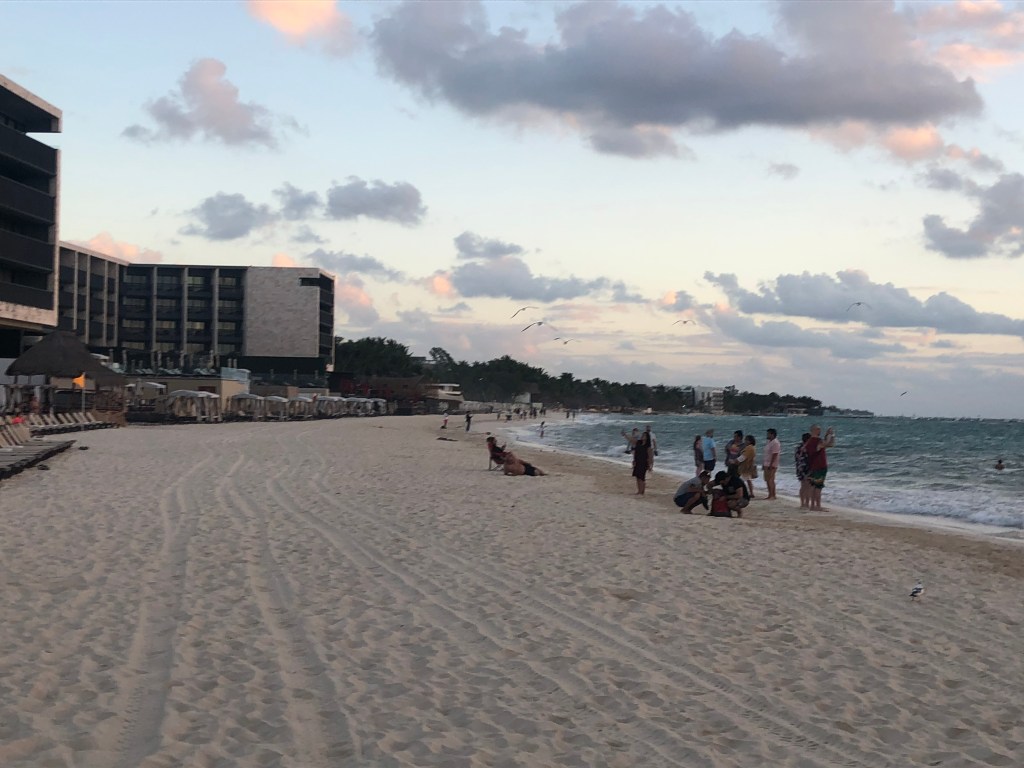
Hilton Playa Del Carmen, All Inclusive, Adults Only

When you hear of the word ‘holiday’, or if you are North American, ‘vacation’, what do you think? Companies that sell holiday packages seem to assume that sun, sea and sand are what most people want, combined perhaps with party evenings and cocktails. I presume they have done some market research and come to this conclusion. Maybe I should be a bit more cynical and think it is the adverts that are forming those ideas of what a holiday should be in people. Whatever, it is safe to assume that a holiday for a lot of people involves going somewhere with guaranteed sunshine, a nice beach and a regular supply of intoxicating liquor. And maybe a buffet breakfast too. We Brits love a buffet breakfast. There are, however, a large number of people who can’t think of anything worse than lying in the hot sun developing melanomas, sitting on a beach where the sand gets right up the crevice or swimming in a mixture of salt water and the outflow from the local sewage treatment works. Elaine and I fall into that category. For us a holiday tends to involve going somewhere that looks interesting, hiring a car and travelling around to see if it is indeed as interesting as we had hoped. It usually is. Lately, and forgetting the pandemic for a moment, we have tended to go to Canada. Not only does it tick the interesting box, it is also spectacularly beautiful and perhaps the most important of all, our daughter lives there. We tend to stay in Airbnb properties, usually for three nights at each destination, before moving on to a new one. I’ve been planning a holiday like this for the summer and we are looking forward to it, despite the lack of a buffet breakfast. That’s not to say we haven’t tried the sun, sea, sand holiday in the past. We had a fortnight in Menorca in 1994. We even had a couple of weeks in St Lucia in 2001. Neither holiday will make the highlight reel of Hughes Holidays.

Having read that initial paragraph, you might be a bit surprised as to the location of our recent holiday. We spent a week in Playa del Carmen in Mexico. This resort is situated 30 miles south of city of Cancun on the Yucatan Peninsular and the whole area exists for one thing – tourism. It might be cruel to call it the Benidorm of the Americas but it’s a mecca for Americans, Canadians and also many folk from Latin American countries. It is also popular with Europeans with daily flights from a number of cities. It has a pleasant climate for most of the year, is lapped by the warm waters of the Sunny Caribbean Sea™(thankand does a good line in tequila sunrise. All in all, it is an ideal holiday destination for the sun, sea and sand lovers and one that provides many tourist dollars to the Mexican economy. What could possibly be there for us? It was Elaine’s idea. We knew that the place where Rebecca worked in Canada closed the first week in January. Why not see if we could arrange a holiday for that time at a destination where we could meet up. Hopefully our son Nicholas could get time off and come too. Great idea but where exactly? Mid way between Troon and Victoria lies Nova Scotia. It’s a lovely place but not somewhere we fancy going in the depths of winter. Mexico, however, fitted the bill. It’s a seven hour flight from Victoria, ten hours from London, and the weather at that time of year looked perfect. Mid-20s, not much in the way of rainfall and, most importantly, a relatively easy place to get to from both the UK and BC. We booked a package through British Airways Holidays for the three of us and invited Caryn, a family friend along too. At the same time we booked a package through Last Minute for Rebecca and her boyfriend Harry for the same hotel. Their flight from Victoria arrived an hour after ours from Gatwick whilst our respective flights back were scheduled to depart at exactly the same time. It was if it was meant to be.

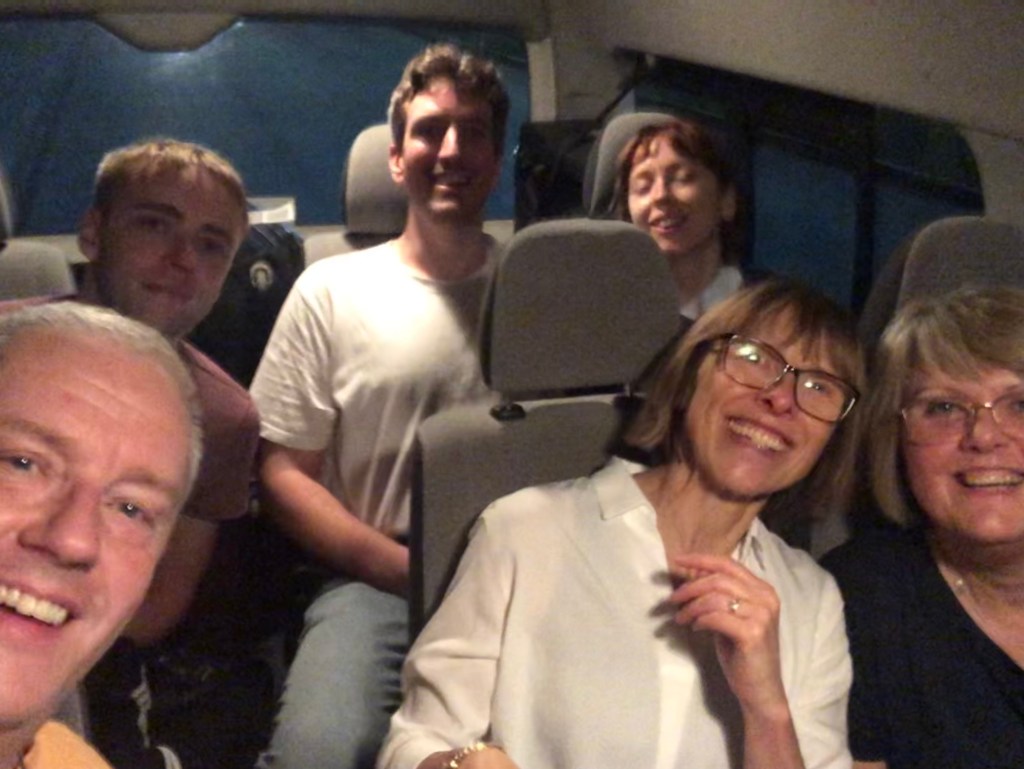
Having booked the holiday last September there was three or four months of worrying about what spanners might get thrown in the works. It turned out that nothing did. None of us got Covid, assorted strikes in various different industries did not affect us and the disarray in Canadian air transport caused by weather in the run up to departure had passed. On December 31st our respective flights ran to schedule, our bags made the connection and apart from a small panic when I realised British Airways and WestJet utilised different terminals at Cancun we all met up and piled into the pre-arranged transport to our resort hotel. It was shortly before 7pm when we set off and so we celebrated GMT New Year on the bus. It was five hours until the local New Year and eight before British Columbia New Year but it had been a long day for those travelling from the UK so we thought it best to get at least one of them done and dusted.

It took about an hour to get to our hotel. This was the Hilton, Playa del Carmen, an all inclusive, adults only resort. All inclusive resorts abound along the coast. I’m not sure why we chose this particular one but we all felt it was a good choice. Not that we have anything to compare it with but it seemed very well appointed. We all had Garden View rooms which were at the cheaper end of the resort’s accommodation spectrum yet were huge in size, each containing a large jacuzzi next to the beds which barely reduced the living space at all. The beds were comfy, the air conditioning efficient, bathrooms were spacious and all in all we were impressed. The resort had several restaurants, numerous bars and two pools – the main pool and a smaller quiet pool. It was right on the beach although that beach was public and got rather busy during the day. We checked in and had bands attached to our wrists. These were to identify us as residents of the Hilton and not chancers coming in from outside to avail themselves of the free stuff on offer. All inclusive meant that – food and drink were part of the package though certain things required a supplement. Once settled in to our rooms we went to the buffet restaurant for some food and then joined the New Year Party that was taking place. Well, sort of. We were all knackered from a long day of travelling and remained on the periphery. For the New Year countdown itself we retired to the balcony of Rebecca and Harry’s room where we watched proceedings. They were twenty seconds late with their countdown which annoyed the OCD in me but fireworks went off and we all retired to our respective rooms. Despite the party going on until 1am I was very tired indeed and fell asleep without difficulty. I’m not sure what I was dreaming about at 3am but I suspect it wasn’t New Year BC time. Two out of three new years would have to do.

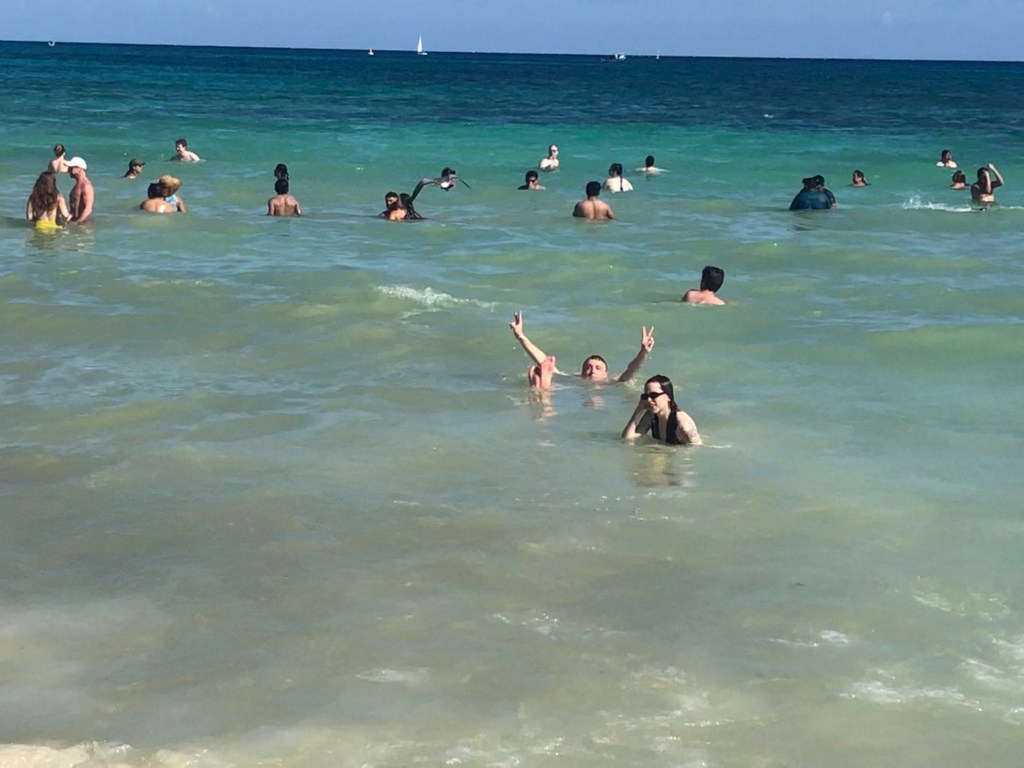
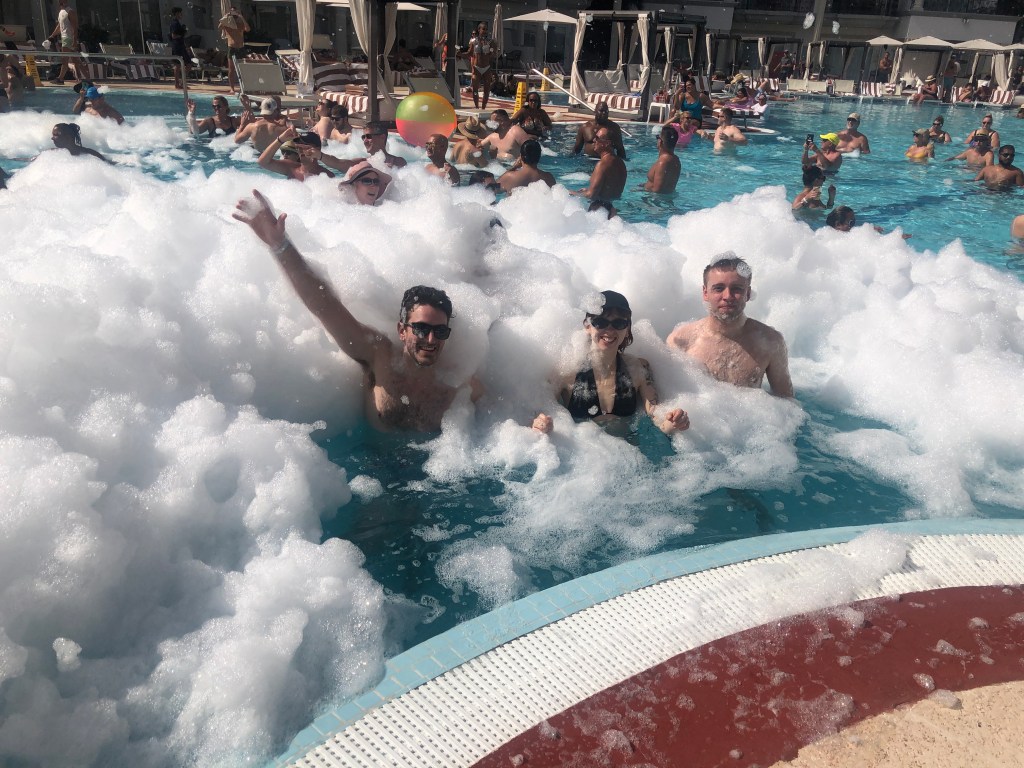
The following morning we all met up at the buffet breakfast (a big thumbs up for that) to decide what we were going to do during the following six days. What exactly do you do on a holiday like this? Sit in the sun, swim in the pool, paddle in the sea? For a week? Mainly yes, but not all the time. We booked an excursion for the following day but then spent the time getting ourselves orientated with the resort and the town itself. The main strip of Playa del Carmen was more or less right outside the hotel’s reception, not that you’d know it from inside. It was a long street of shops, restaurants and bars and packed with tourists, this being New Year’s Day and peak holiday time. It was good to know it was there even if we didn’t have to use it. The Hilton itself took a bit of discovery with the assorted restaurants and bars dotted around the place. The routine for getting beach towels and reserving sun loungers needed to be learnt – basically, grab some towels as soon as the towel station is open and plonk them on the lounger in a way that a German would be proud of. Even better, grab the towels the day before and reserve your lounger before the towel station opens. Towels on the sun loungers might be a cliche but it’s a real thing apparently. There were cabanas dotted round the pool. I didn’t really know what they were either. However, they are like four poster beds with an attached cool box which are available to rent for $99 a day. We did not avail ourselves of them as it might have been a squeeze getting all six of us on one. The main pool had various activities throughout the day including, on three of the days we were there, the foam party. To a 61 year old bloke like me this sounded absolutely horrendous. Soapy suds are generated by a couple of foam cannons and sprayed into the pool where some of them stick. Music of sorts is blasted out of speakers, the resort’s resident dancers gyrate in their thongs and you might get some bloke pouring cheap tequila down your throat from the bottle. What possibly is there to like about that, apart from maybe the thong wearing dancers? I can tell you it was brilliant. I don’t know why but it was great fun. Soap suds flying everywhere, a few beach balls thrown in for the hell of it and the hour it lasted flew by.

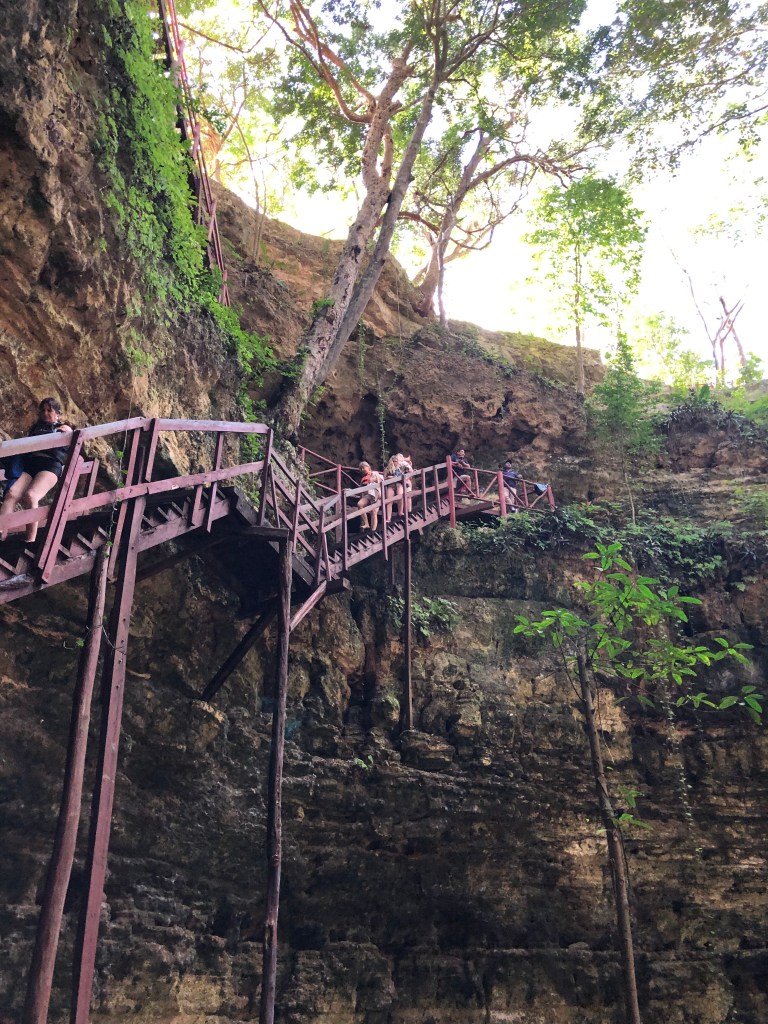
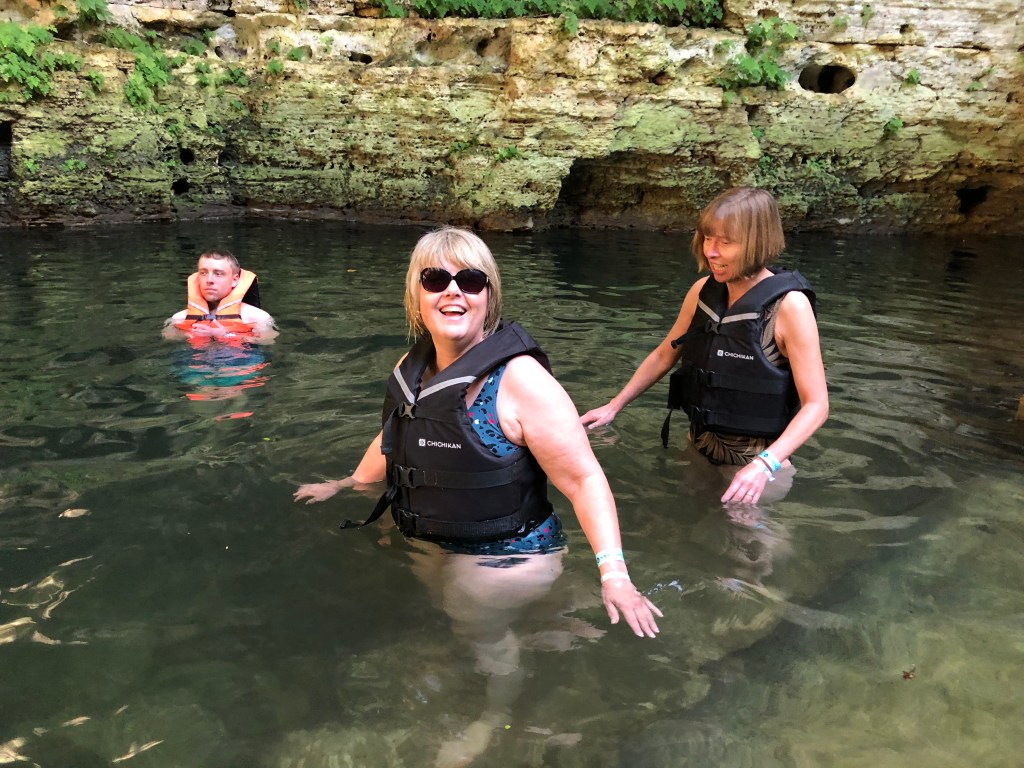
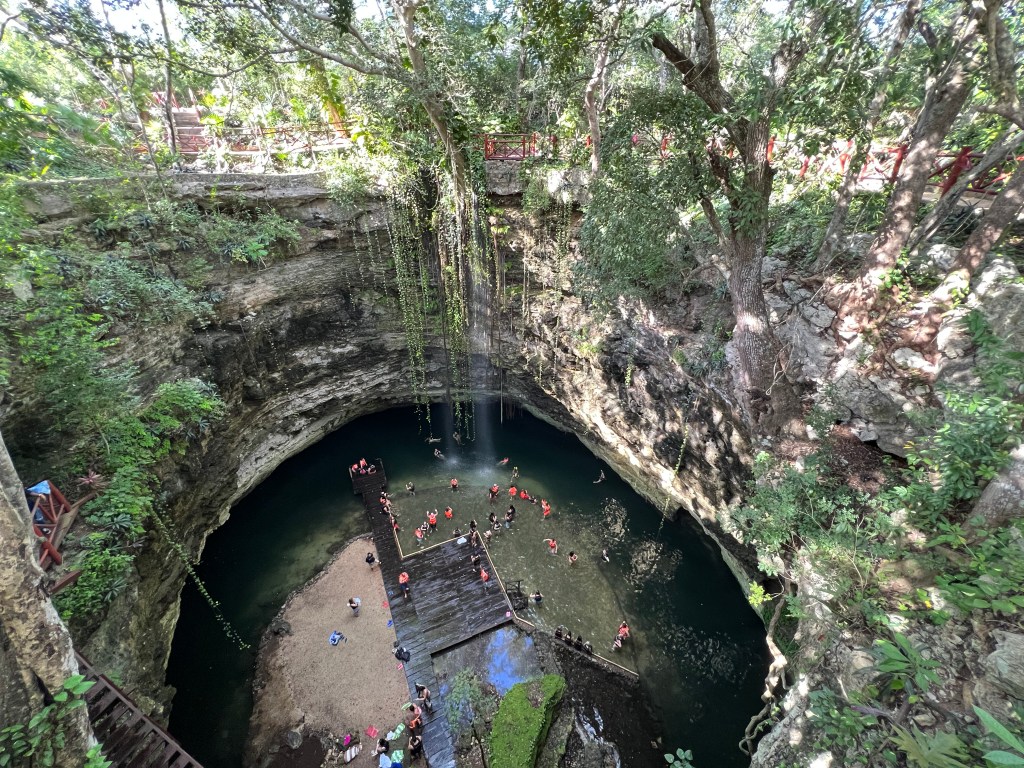
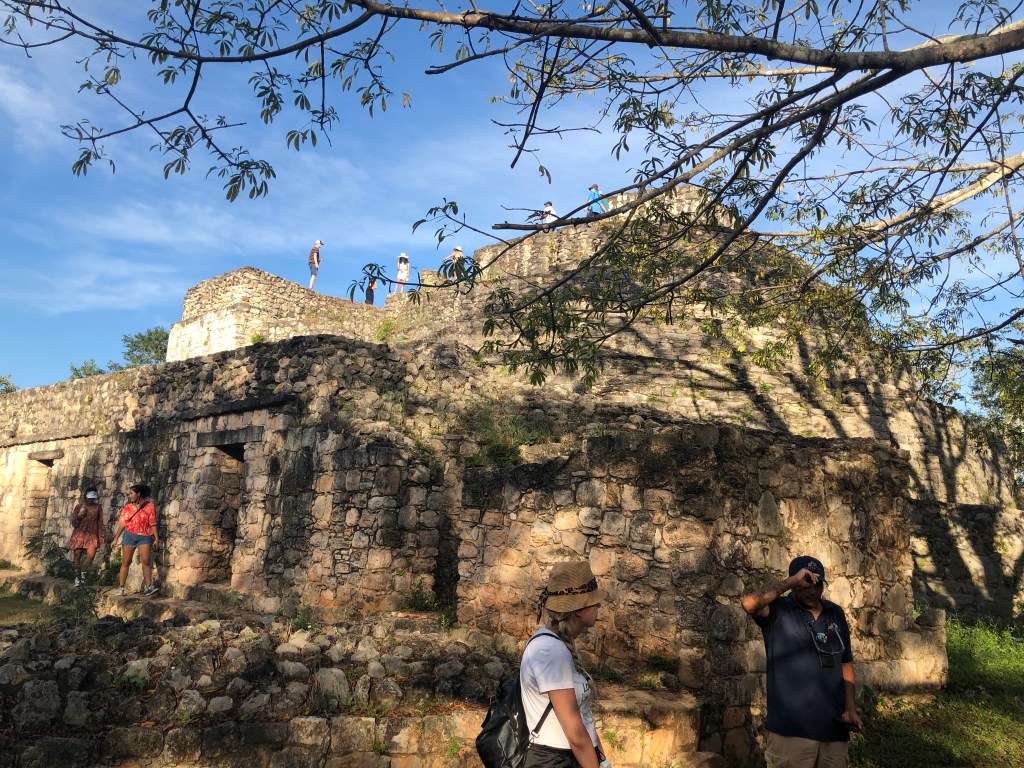
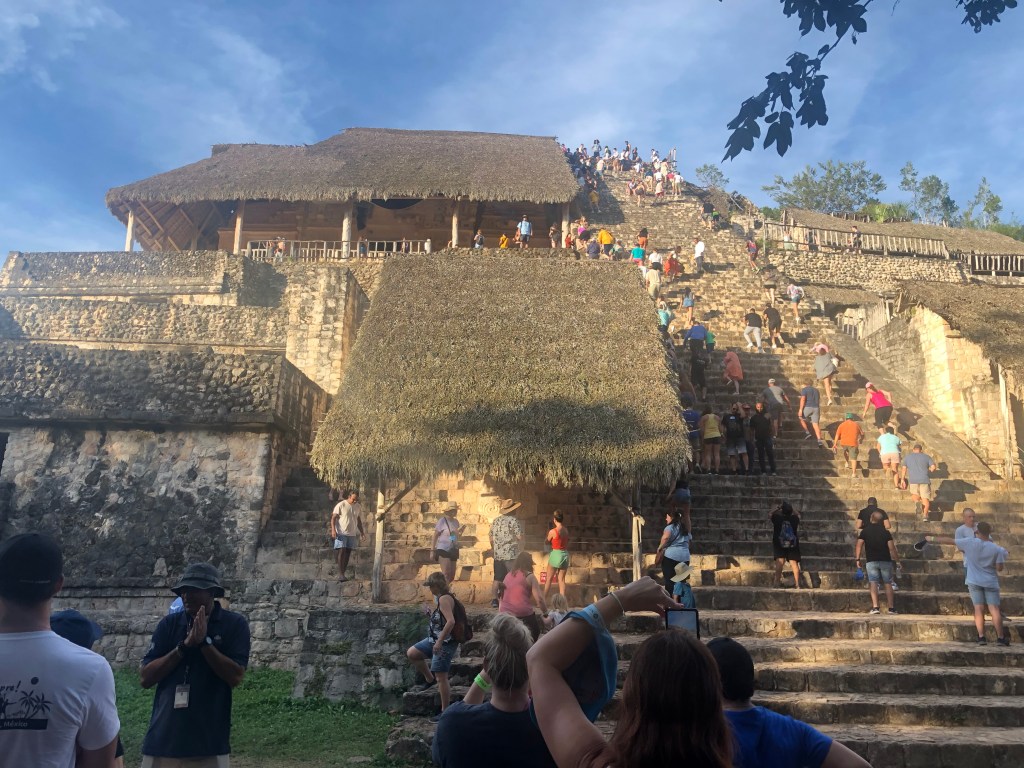
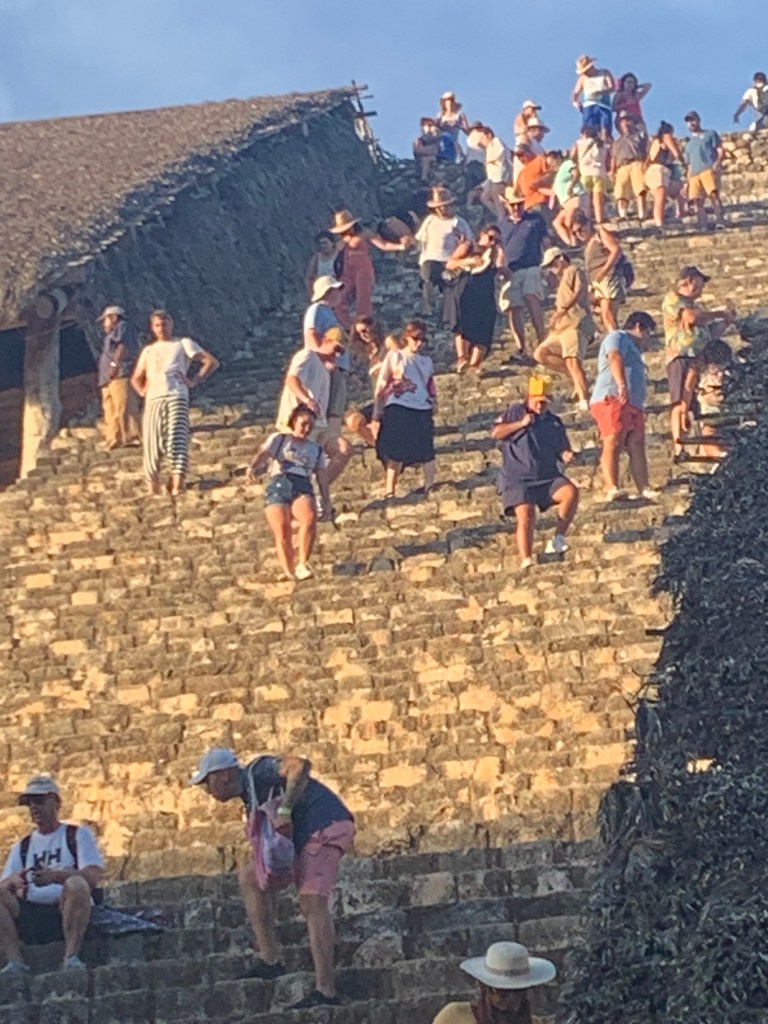
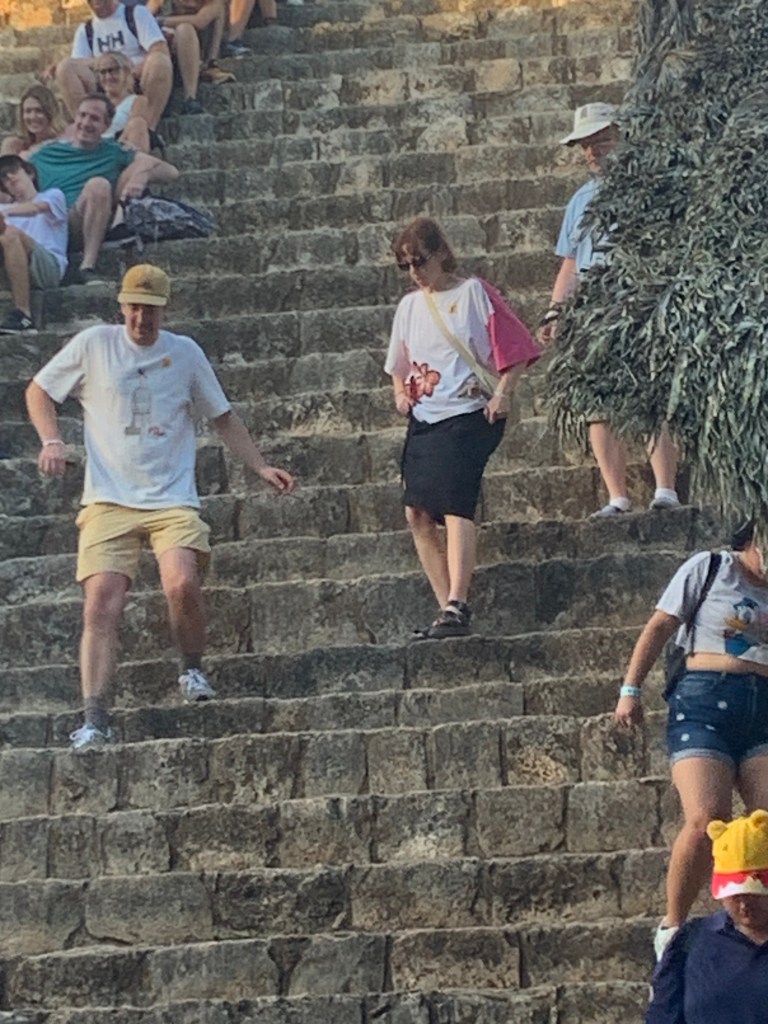
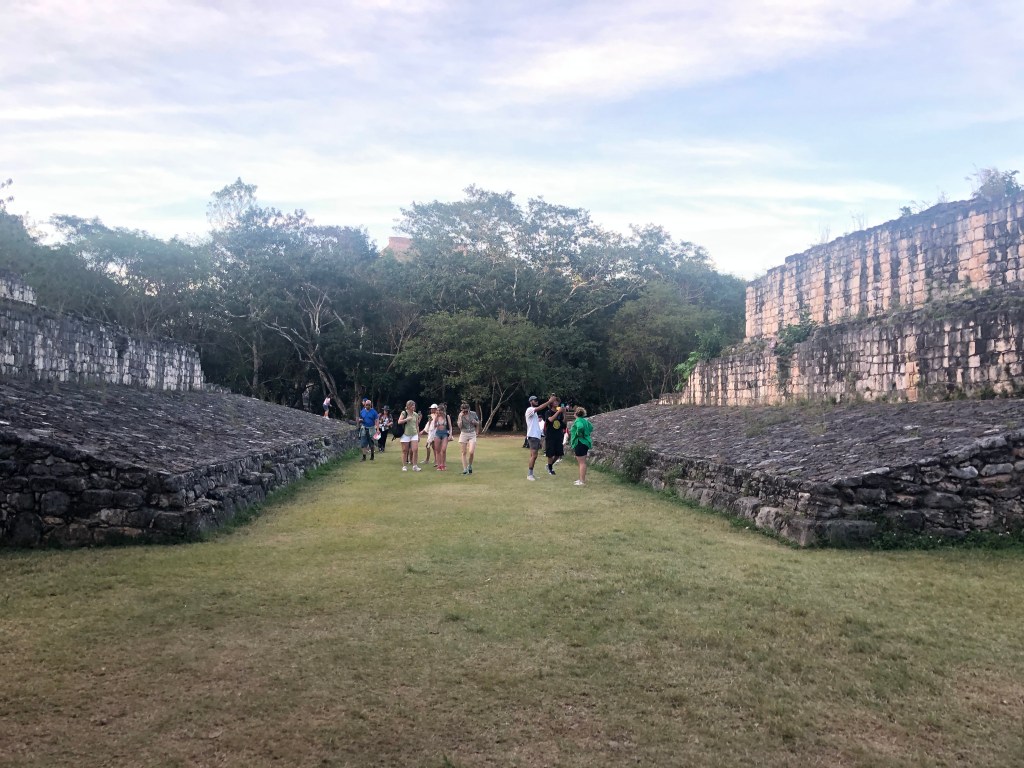
The tour we had booked was to Chichen Itza. This is an old Mayan city full of pyramids and all that sort of thing. It is first on the list of tours that visitors to the region might embark on. We’d booked the full day experience which involved a stop in the town of Vallodolid, lunch at some Mayan themed restaurant, Chichen Itza itself and a swim in a cenote, a sink hole in the limestone rock that the Yucatan peninsular is made from. All was going well until we pulled out of Vallodolid and were informed that Chichen Itza was closed due to ‘civil unrest’. To cut a long story short, the local population, most of whom were of Mayan descent, were less than happy with the management of the site and were kicking up a stink about it. It took a while for the tour leaders to come up with an alternative plan, concocted whilst we were enjoying lunch. Instead of Chichen Itza, we would go to Ek Balam, a different Mayan city. There was an option to return to the resort but we decided to stick with the tour. The schedule changed and we did the cenote swim first. This was really rather pleasant. The sink hole has sheer vertical sides and the water at the bottom, part of the aquifer that gives Yucatan its supply of fresh water, was fresh, warm and extremely inviting. The cenote done and dusted, we headed on to Ek Balam. You know what, if Ek Balam is number two on the Mayan city list, Cichen Itza must be bloody good. It was a fascinating place and, unlike Chichen Itza, you can walk on it, all the way to the top of the temple. The place was busy of course. Many other Chichen Itza tour buses had diverted there so it was quite crowded, even at the top of the temple, but we all felt we had got a very good dose of Maya at the end of what was a long day, even if it wasn’t quite the city we had expected.

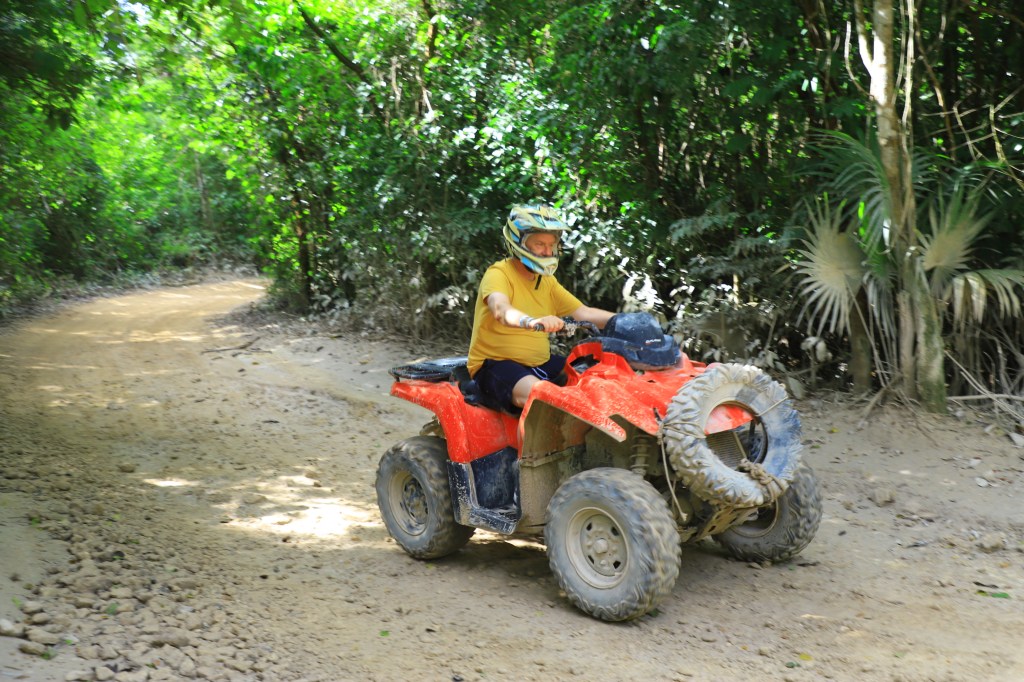
The other tours and off resort activities we did consisted of a snorkelling trip, initially for five people but reduced to four when Elaine got a touch of the Montezuma’s revenge, which the remaining participants seemed to enjoy. I didn’t fancy it so I booked myself on a jungle ATV tour. Once in the jungle, which covers most of the peninsula, I got to zip around some dirt tracks twice, interspersed by another cenote swim. Nice though that cenote was, it wasn’t a patch on the other one. It was the ATV ride I was there for and that was great fun, even if the first one I was one was worryingly smoking by the end of the first ride and I managed to drive the second one into a tree and was stuck for a while until I worked out where reverse gear was. Elaine, Nicholas and Rebecca all went on another outing to walk some rescue dogs in what was a rough part of town. The woman that runs the refuge was most appreciative of their efforts. Of the hundreds of thousands of visitors who visit Playa del Carmen every year, only a handful even know about the place. Apart for a couple of walks along Playa’s main tourist drag and the beach, that was it as far as leaving the resort was concerned.

No photos allowed on the snorkelling tour but I suspect it was something like this.

The rest of the time was spent relaxing, swimming in the Sunny Caribbean Sea™ and the pool, foam parties, eating and drinking. There were several places to do the eating and even more to do the drinking. We tried the Mediterranean style, the genuine Mexican and Asian fusion restaurants. We also tried a breakfast at the Caribbean cafe. All were good but we always tended to default to the buffet which had a great selection for breakfast, lunch and dinner that meant all tastes were catered for. You are supposed to make reservations for dinner at any of the restaurants but the buffet place always seemed to have plenty of room for those who forgot. Drinks were free but as in any other all-inclusive place in the world, this was restricted to local brands. Anything fancy had to be paid for. The coffee shop was well patronised, not just by the coffee lovers but by those who liked an ice cream, milkshake or pastry. The minibar in the room was also well stocked with free drinks so you were never going to go thirsty.

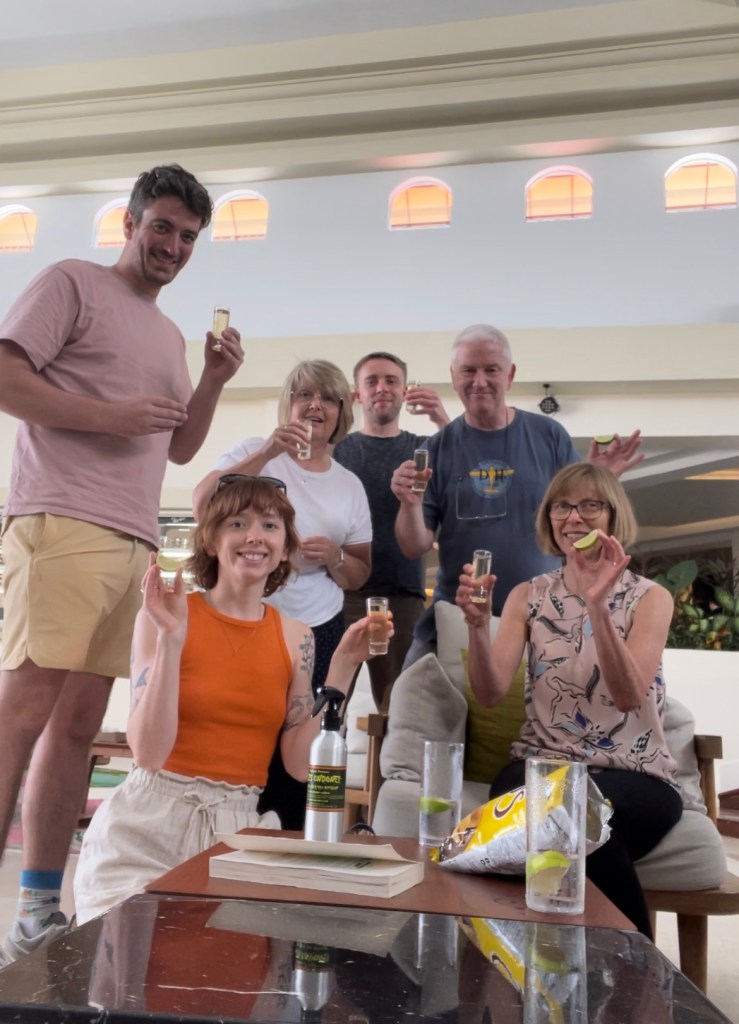
One last tequila.

All too soon it was time to leave. Checkout was at noon and the minibus was due at 13:30. Although our wristbands were carefully removed when we checked out we were given a chit that allowed us to continue using the facilities until then so with a final shot of tequila we boarded the bus back to Cancun Airport. It took two and a half hours to get there. The traffic and roadworks were horrendous but it is a known thing which is why we’d set off five hours before the scheduled departure. When we finally got there, Rebecca and Harry were dropped off at Terminal Four, the rest of us at Terminal Three and after a bit of a long check in queue we were through airside and complaining about airport prices for the food. Both our flights departed on time and we were all back in our respective homes when we expected to be. It took a couple of days to get over the jet lag, maybe a day or two longer to reacclimatise to the Scottish winter.

Are all inclusive beach resort holidays really for us? It turns out that at the right time, in the right place and most importantly with the right people that they actually are. They might not make for a particularly gripping blog but you can’t have everything. We are already thinking about doing something similar next winter.

Atlantic to Pacific By Rail

Prologue 1

I’d hoped that this blog site would be having regular updates by now with pandemic madness largely behind us but it just hasn’t happened. I don’t know why, it’s not as if I’m stuck in a lockdown stupor and haven’t been for some time. As the world has opened up again I’ve been doing stuff which might be of interest to other people but I feel that it has not been much different to what I was doing before. I’ve shared daily holiday blogs on Facebook but apart from the last blog, which was written five months ago, there’s been nothing I’ve done that has inspired me to return to Glad To Be Grey and get writing. Until now. I’m just back from what was an epic trip and if I can’t write a blog about this then I might as well give the site up.

Prologue 2

I first had the idea for this trip about a year ago. We had booked a holiday in Canada with our daughter for the summer of this year. This involved a rather indirect journey by air to and from Victoria in British Columbia where she resides. This got me wondering if there was any way to get to Victoria without using aircraft. The environmentalists will have you believe that your flight is directly responsible for the end of the world so maybe there’s a practical way to get there without killing your grandkids. The answer is of course no, so sorry grandkids, I’m still more than happy to take a plane (or four) to get to see my daughter and have a holiday. However, a seed was planted in my mind – travel to Victoria, which is 4,500 miles away from Troon, by surface transport. I soon found out it could be done and without too much difficulty. All I would need was a lot of time and a shedload of money. The plan was to get the train to Southampton and cross the Atlantic on the Queen Mary II. Once in New York I would cross the North American continent by train. There were a number of alternative routes I could have taken, even on a continent where rail travel is an afterthought. All itineraries would have ended in Vancouver where I would then have to get myself to the ferry terminal for a ferry to Vancouver Island where Rebecca would pick me up and transport me into the city of Victoria. This was a great idea, right up until I looked into the details for crossing the Atlantic on the QM2. The crossing takes seven days which is longer than is necessary as the ship could easily do it in five. Cunard want you to make a holiday if it apparently. The cheapest fare for a single occupancy cabin, presumably in the bilges, was in excess of £4000. Whilst I’m not averse to cruising holidays, four grand for a week of seeing nothing but ocean, and possibly a stormy ocean at that, was just too much. I came up with another idea.

What I would do was take the shortest possible flight to Canada which was Glasgow to Halifax, Nova Scotia. From there I would cross Canada by train to Vancouver, ending the journey to Victoria as mentioned above. The frustrated Travel Agent in me had a great time coming up with a suitable itinerary and I booked the trip in the early part of this year. The journey would be a solo one as Elaine really didn’t fancy spending five days on a train. In the summer, Canadian airline WestJet threw a spanner in the works by cancelling the Glasgow-Halifax flight. I rebooked myself with Air Canada from Heathrow to Halifax which included a connecting BA flight from Glasgow. Once in Halifax I’d spend a couple of days there before boarding the first of three different trains that would get me to Vancouver. It would take six days and six nights and get me from The Atlantic to The Pacific and as a bonus I’d arrive there on my birthday so Rebecca could buy me a beer.

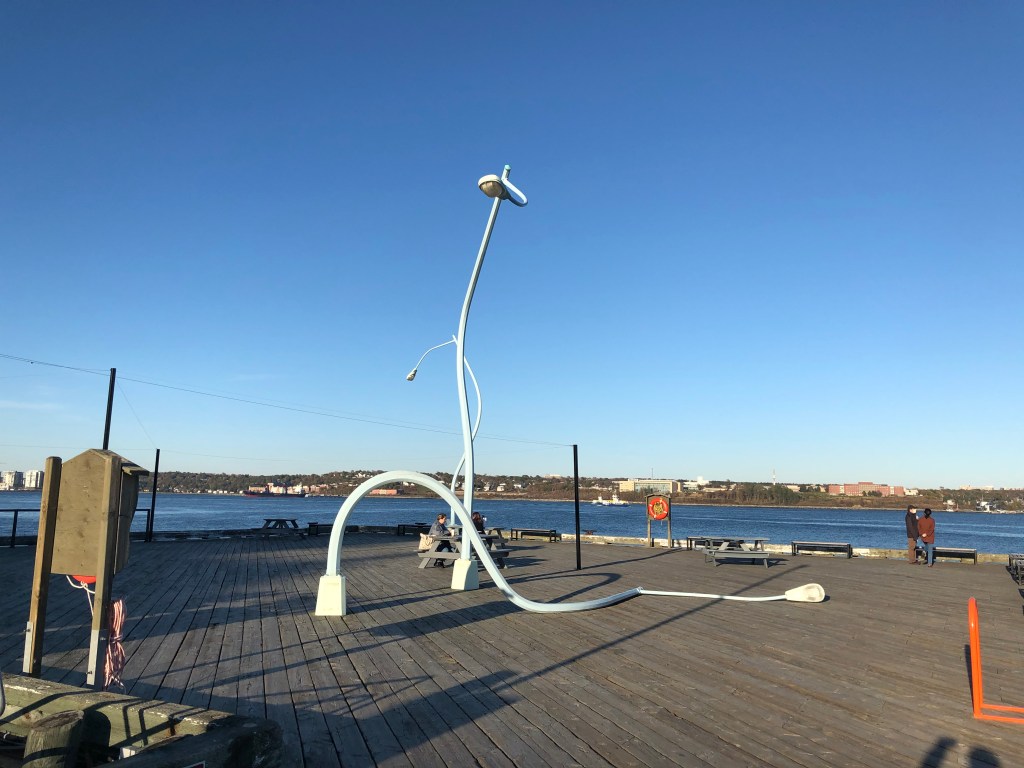
Halifax Harbour, Nova Scotia. It is an inlet of the Atlantic Ocean. I really should have taken a selfie here as the starting point.

The Ocean

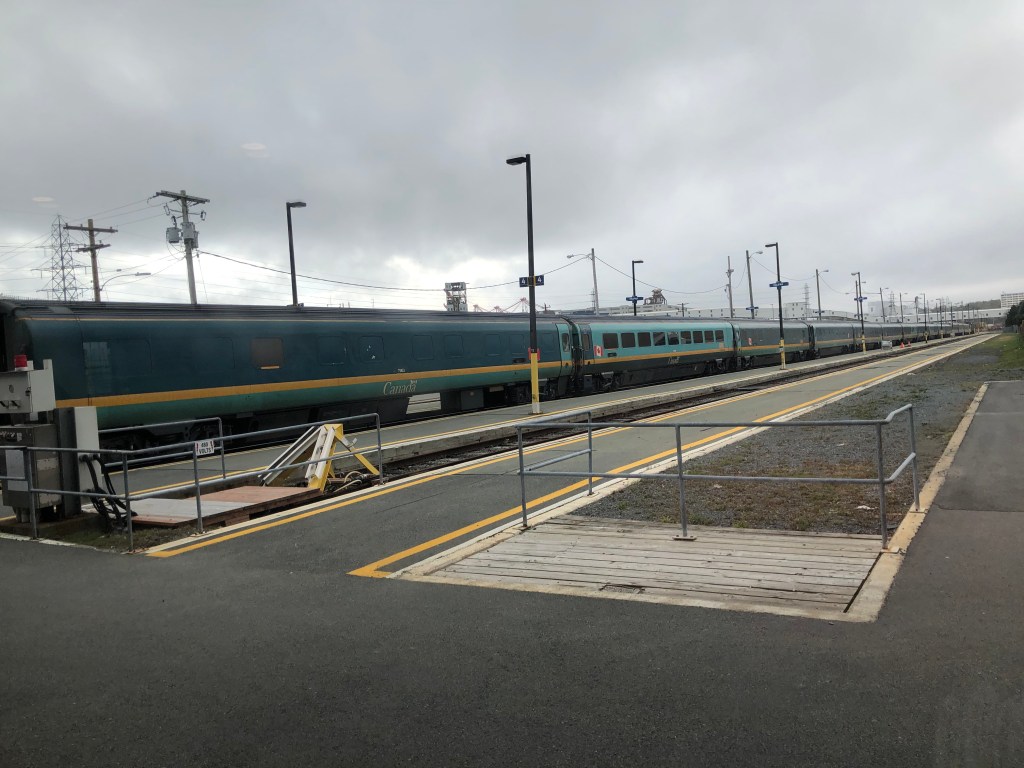
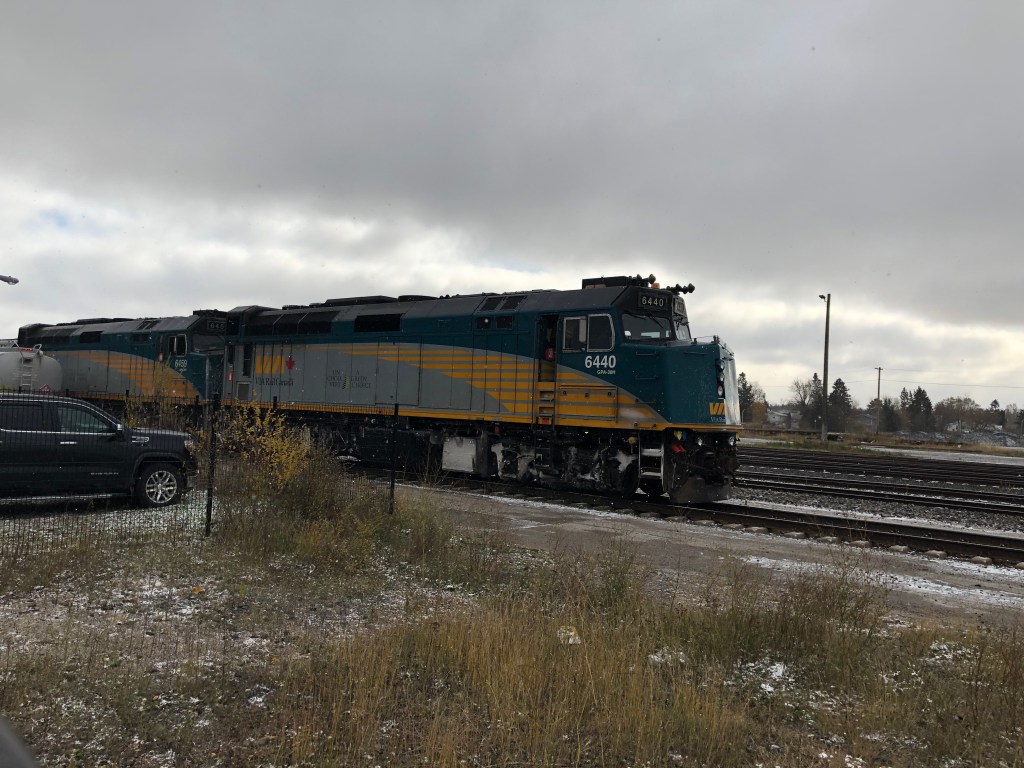
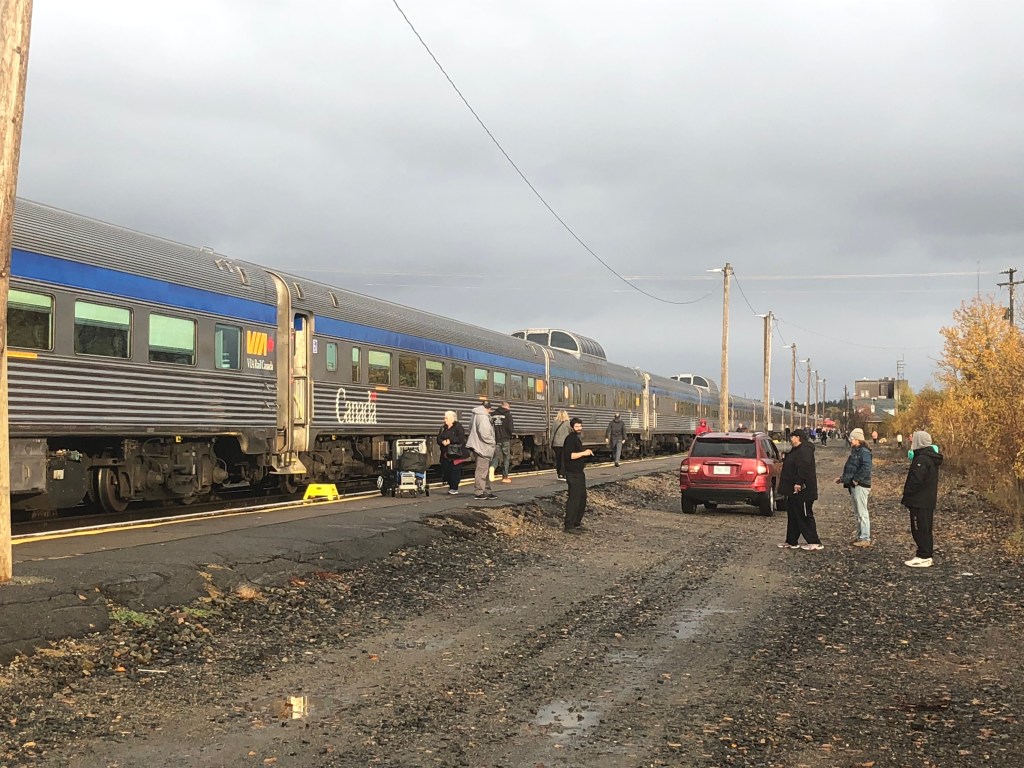
The Ocean. It’s quite difficult getting a Canadian train in one frame.

Halifax – Montreal

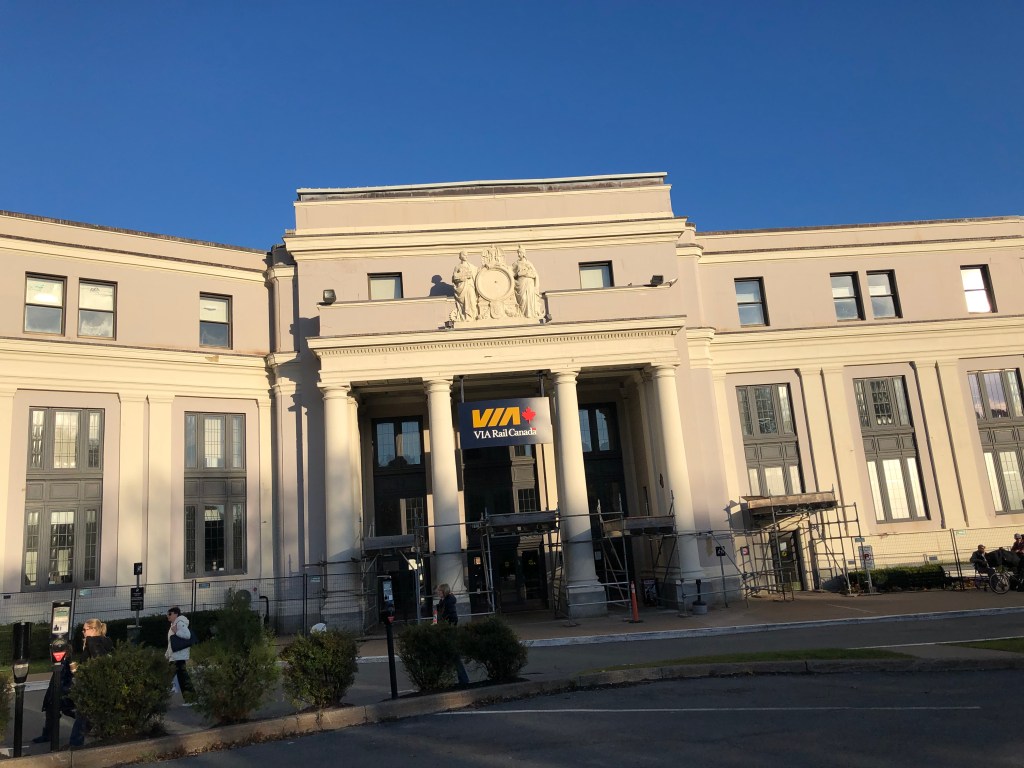
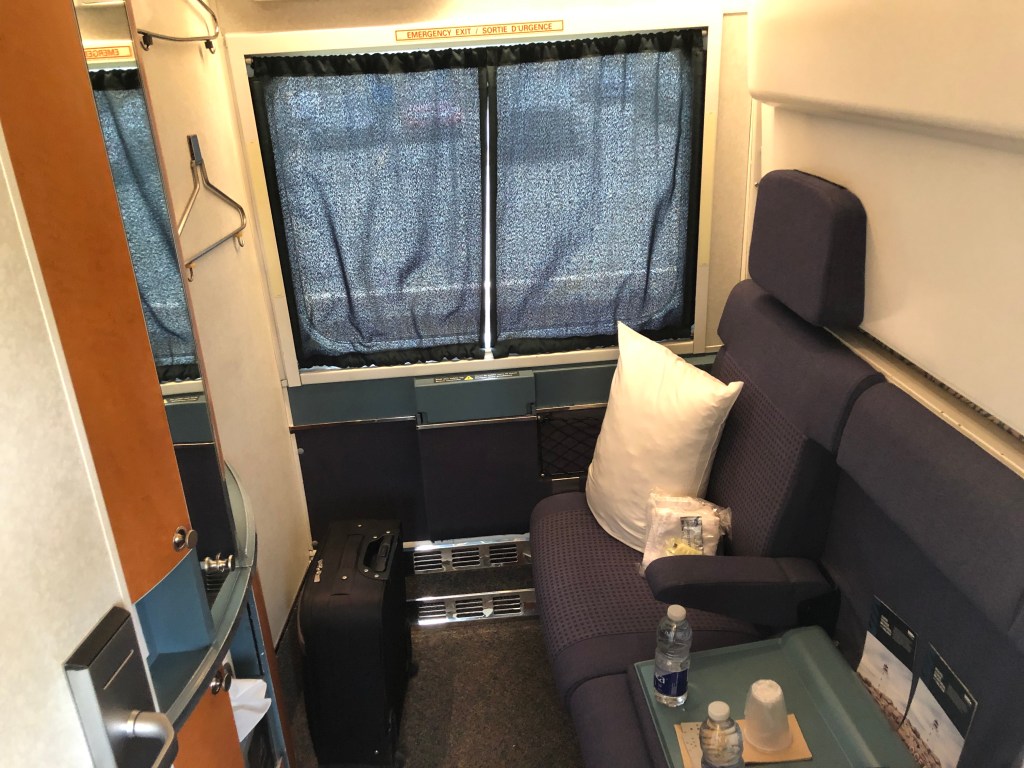
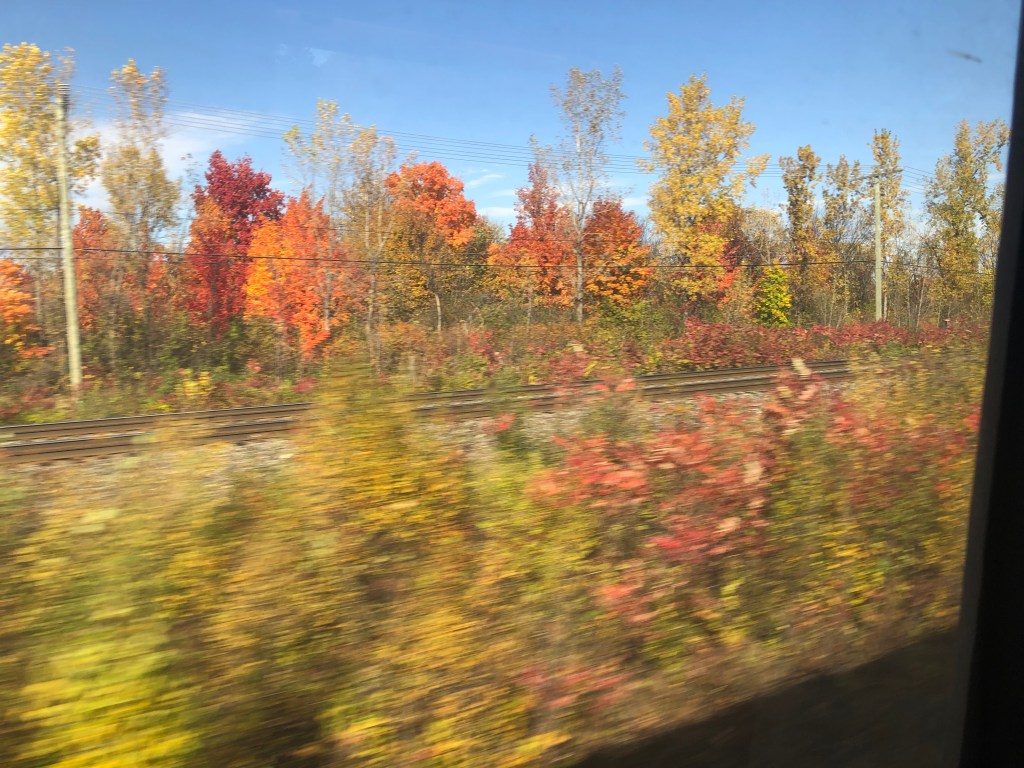
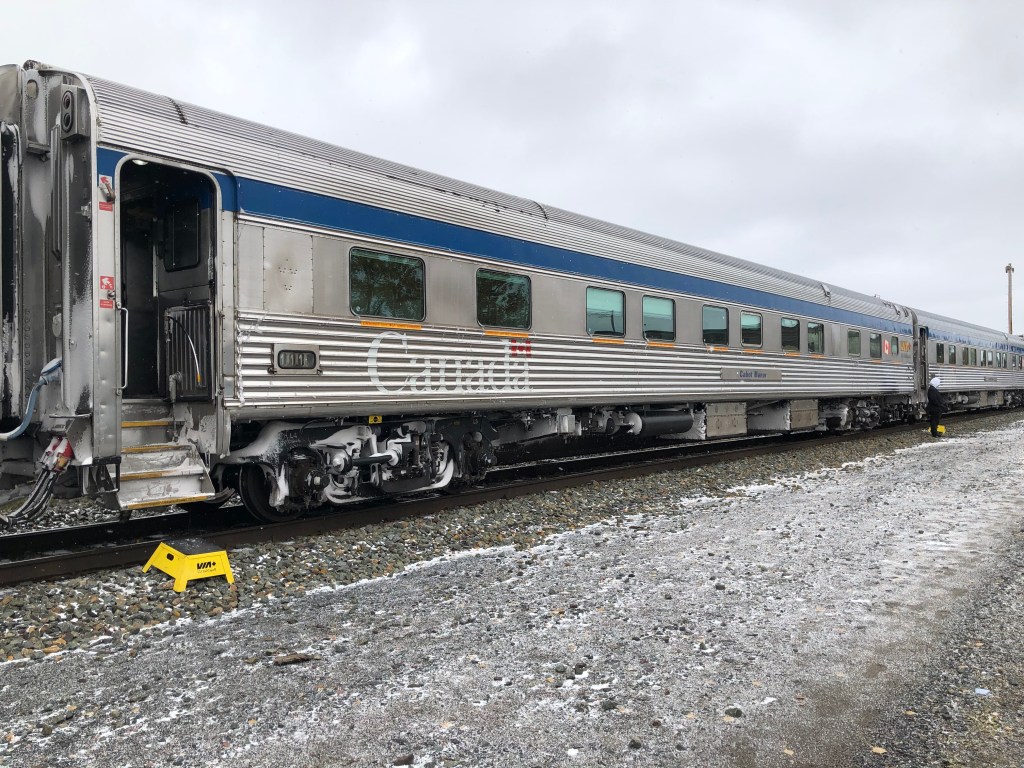
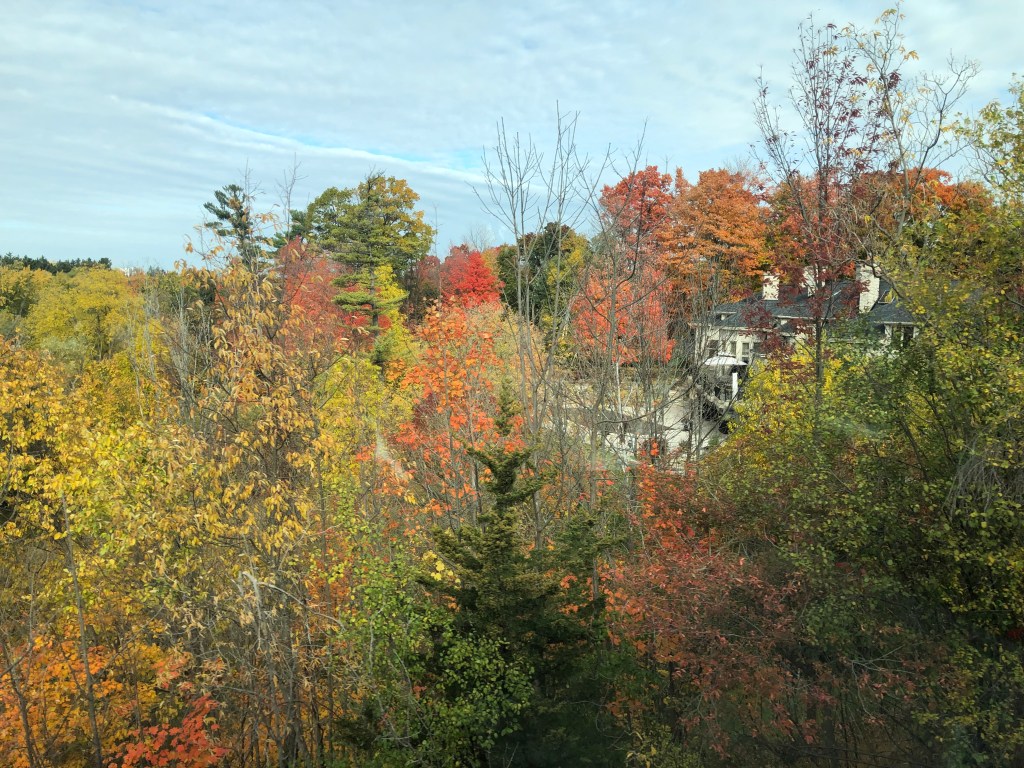
Trains in Canada are not really like trains in Europe. They give them names and numbers for a start. Train Number 15 is called The Ocean. It runs from Halifax to Montreal just two times a week. It is scheduled to take a leisurely 22 hours and, thanks to the small problem of the US state of Maine being in the way, follows a far from direct track through the Canadian provinces of Nova Scotia, New Brunswick and Quebec. Despite only servicing two arriving and two departing trains a week, Halifax has a pleasant station and it was to this I walked on Friday October 14th for the 1pm departure. My extra day in Halifax had proven essential as between them, British Airways, Heathrow Airport and Air Canada had failed to transport my bag to Halifax with me and it took another thirty hours or so for it to turn up. Until it did I had visions of it following me across Canada but never quite catching me up. The bag itself required checking in at Halifax Station so forward planning had been required to liberate sufficient items into a smaller bag to see me through the overnight journey to Montreal. The bag was duly tagged through to Toronto so I wouldn’t see it again for well over a day. I was advised that there was a lounge where sleeper passengers could relax before boarding. I found it, it was full of armchairs, a coffee machine and a fridge full of pop. One Diet Coke later and I got a bit bored and went back to the concourse where I confirmed my lunch and dinner sitting and waited for the boarding announcement. When it came I excitedly head for the train. Although the train was backed up right to the buffers, it was still a long walk to my carriage, or car as the Canadians (and me from now on) call it. These sleeper trains are long and along with two different types of sleeping car, consist of normal seating cars, restaurant car, lounge car and cars for the train staff. My car was a ‘modern’ Renaissance Class one. This meant it was nearly 30 years old. These cars had been built for Cross-Channel sleeper services through the Channel Tunnel and when those services failed to take off, the Canadians bought some of them specifically for The Ocean. They are getting a bit worn now but the advantage of these cars is that the cabins have en-suite facilities. They comfortably accommodate two people on generous seats in day mode and bunk beds at night. As there was only me it seemed rather spacious by sleeper cabin standards, not that I’ve got much experience in the matter.

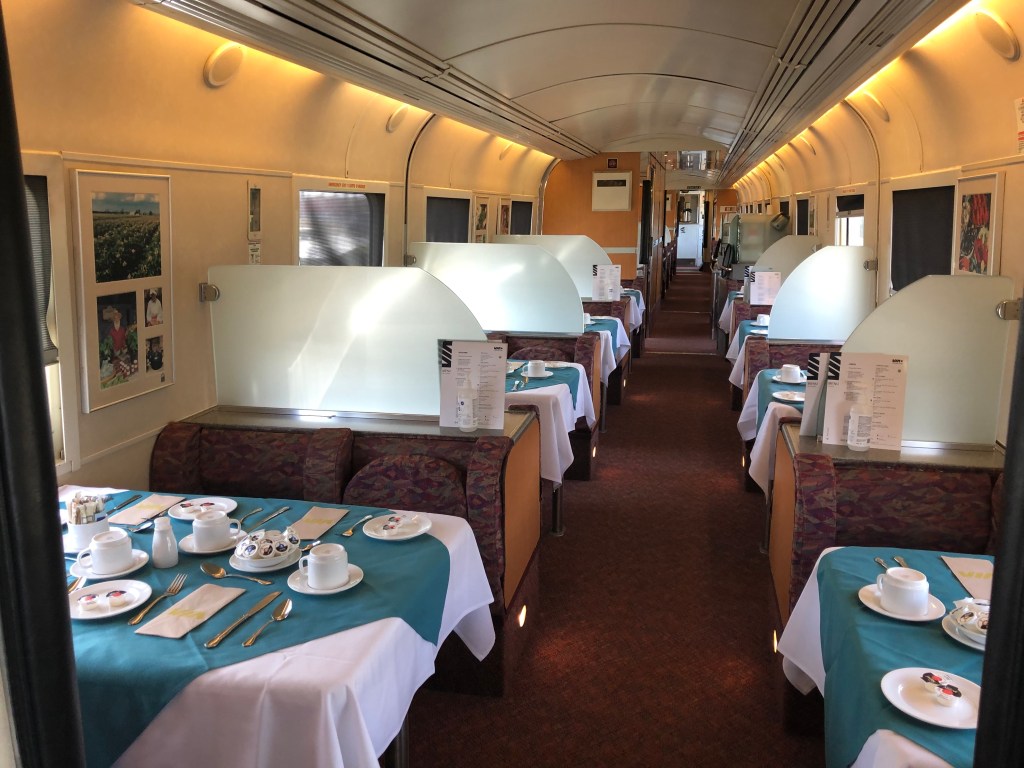
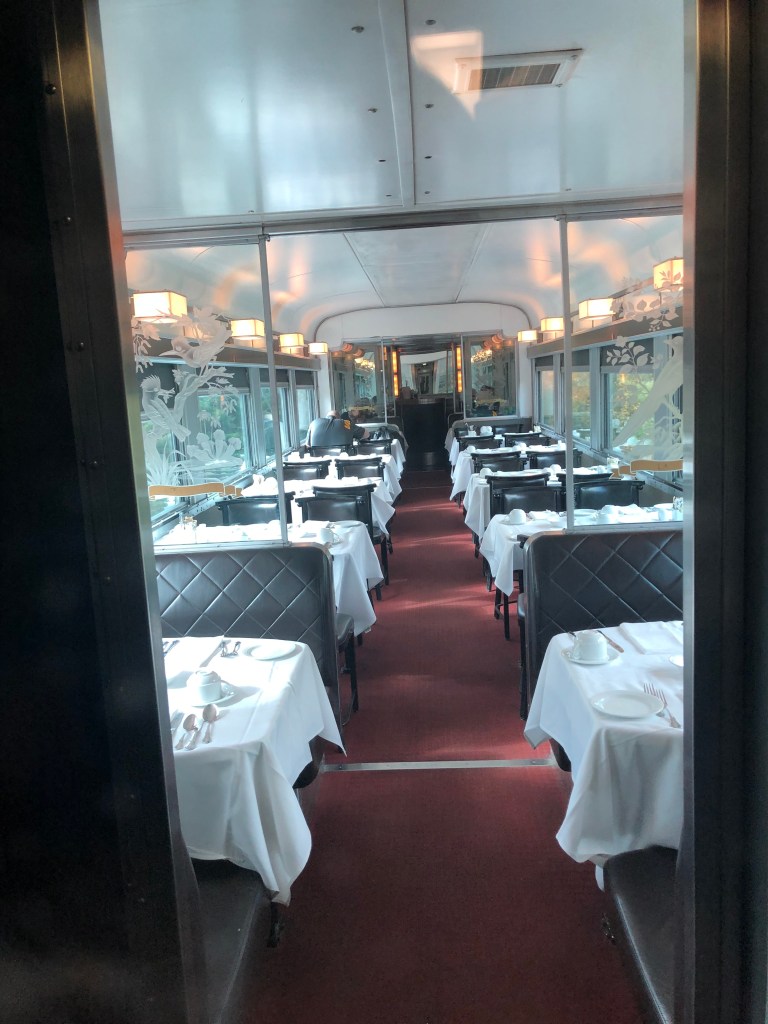
Restaurant Car.

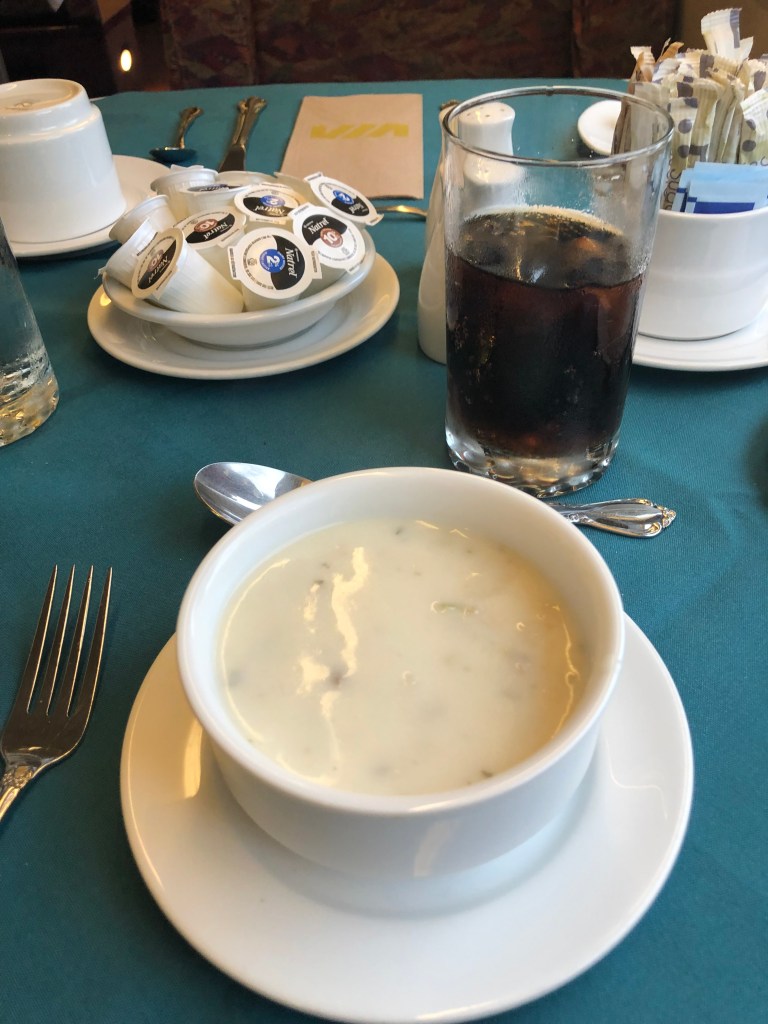
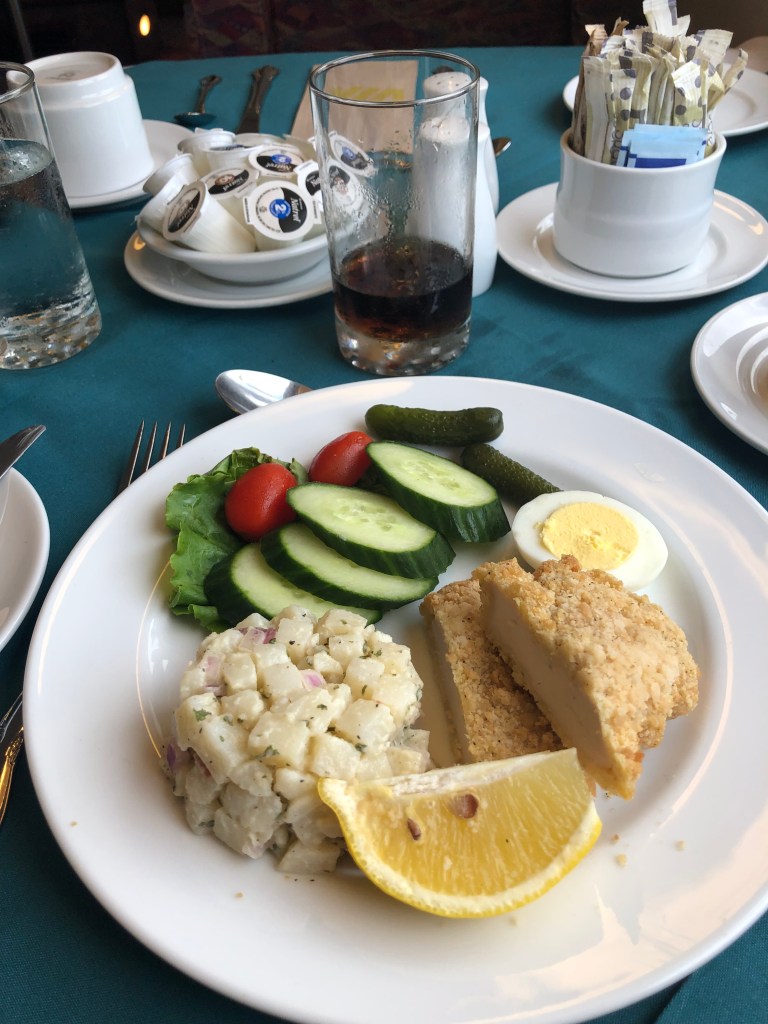
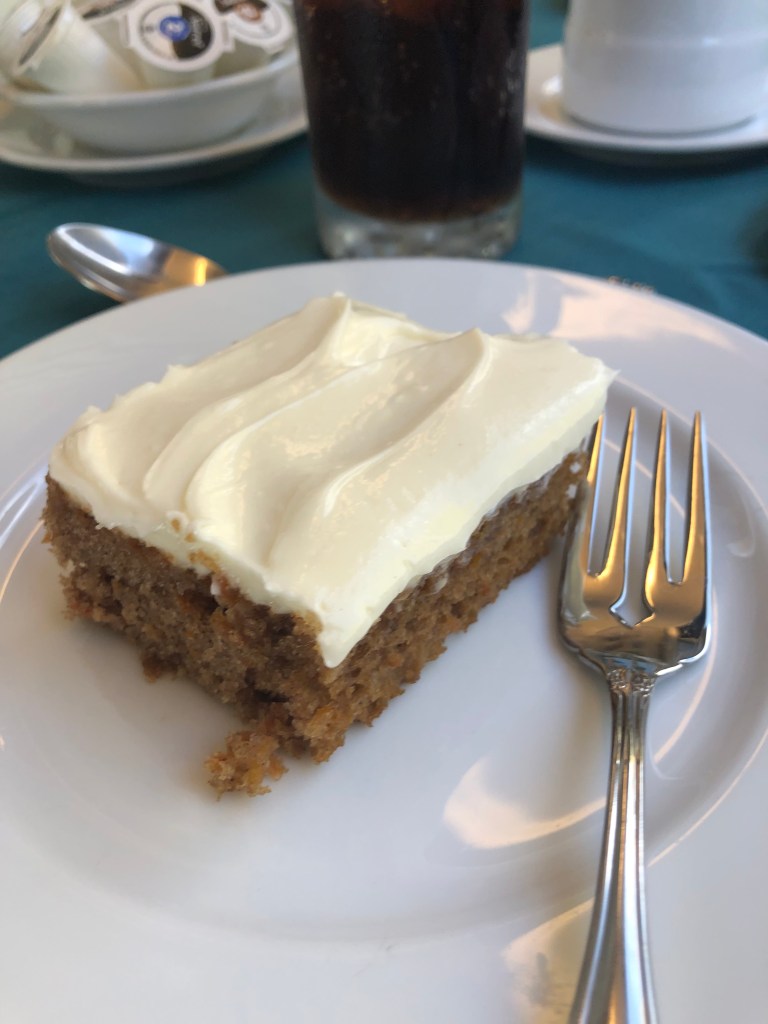
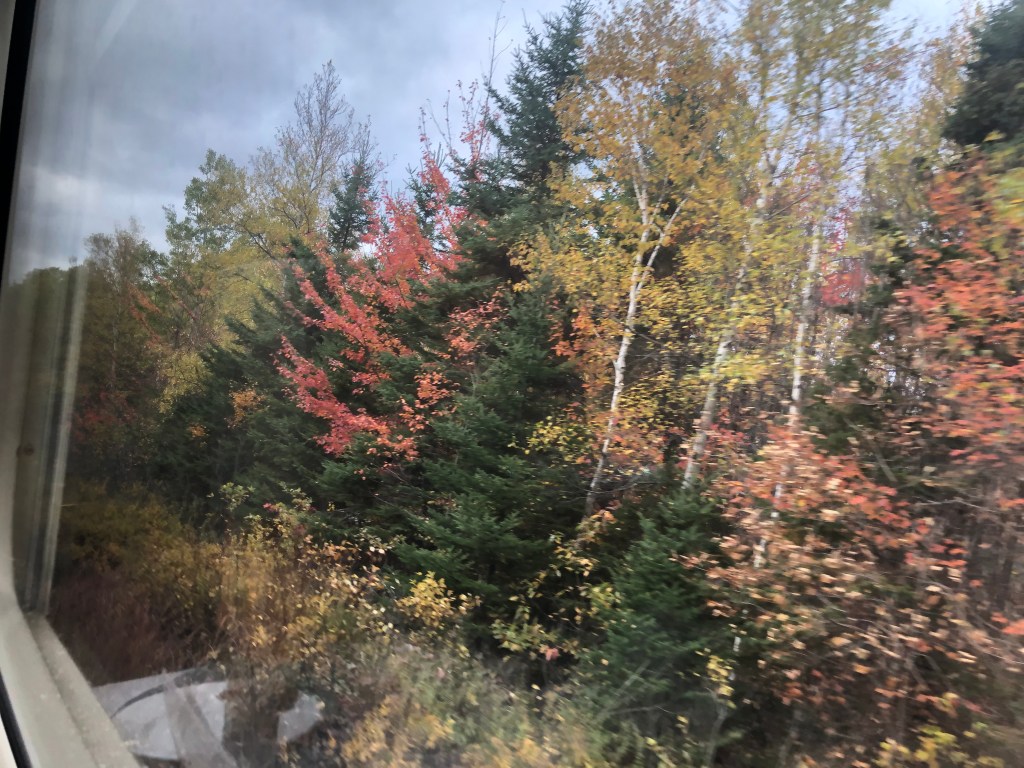
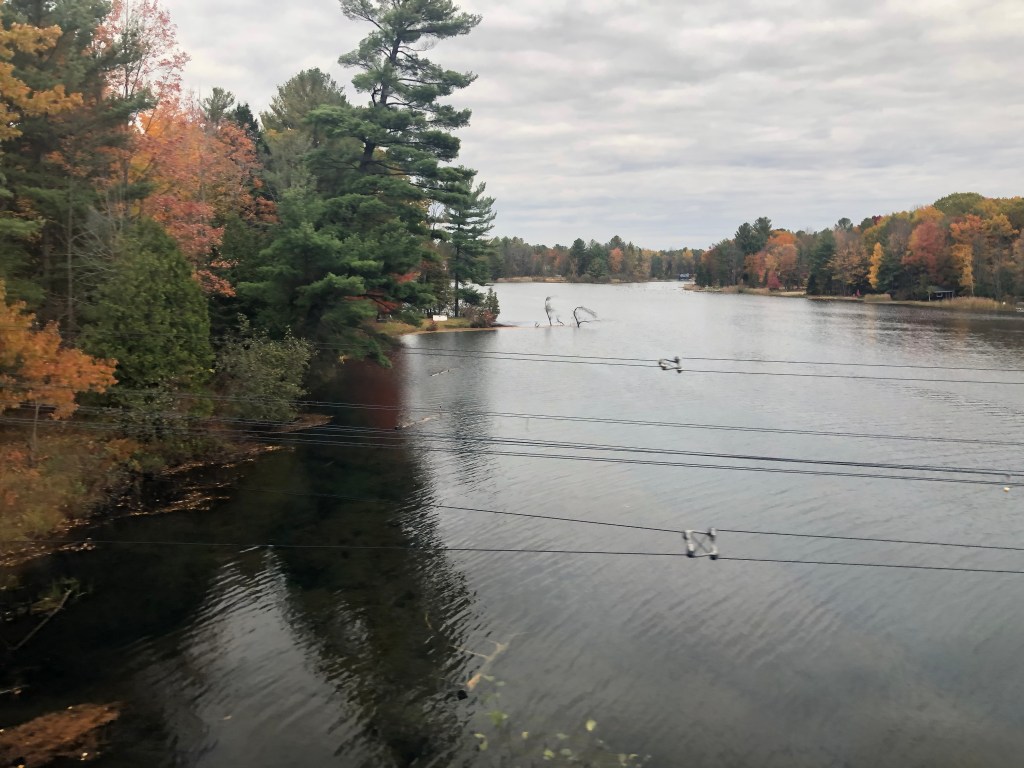
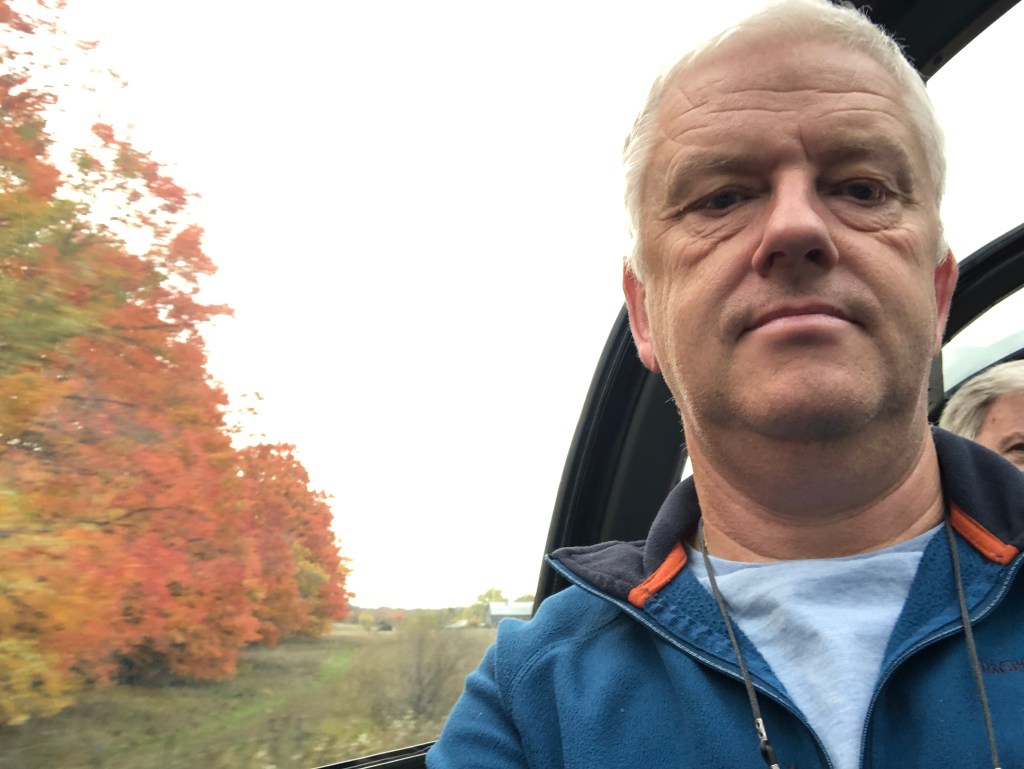
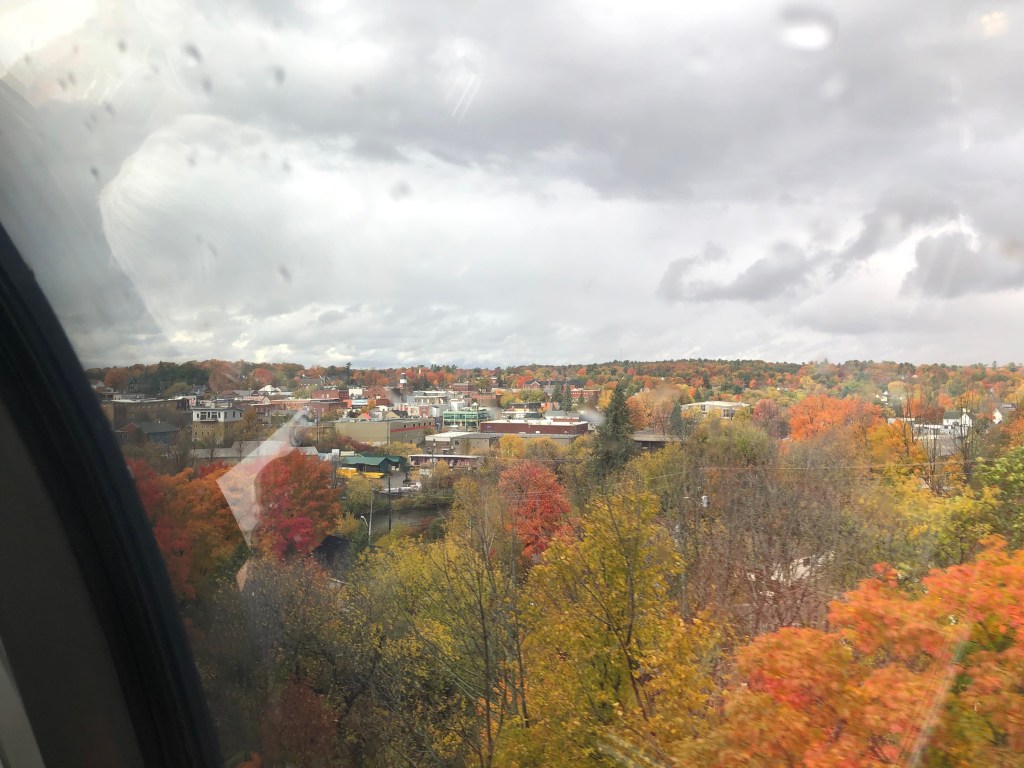
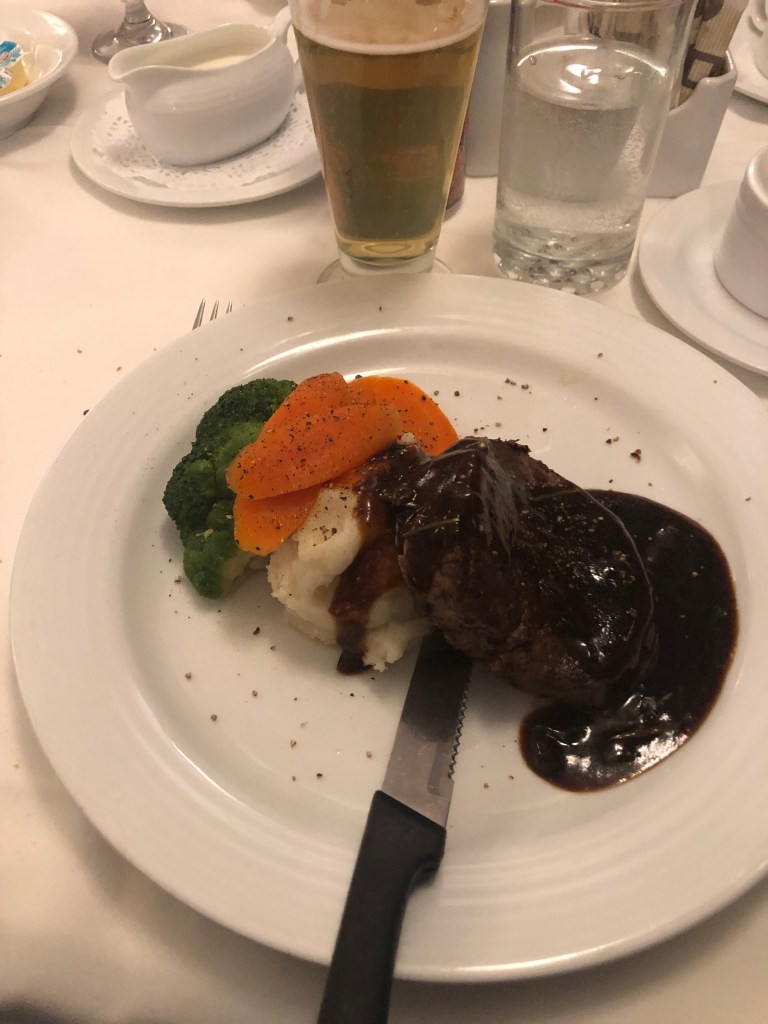
The train pulled out of Halifax bang on time. Whilst the cabin was comfortable I soon left it and made my way to the Lounge Car. Whilst this sounds a lot grander than it actually was, it was light and airy and you could see out of both sides of the train. It also had WiFi which I was surprised about. This, however, depended on the local cellphone coverage and as Canada is big – I might have mentioned this in previous blogs – it was a bit hit and miss as to whether there was any service. I had chosen second sitting for lunch and was called through to the restaurant car at 2:45pm by which time I was rather peckish. Sleeper passengers have meals included in their fare. A soup, chowder in this case – was followed by a choice of main courses. I had chicken schnitzel salad and followed it up with a quite a large slab of carrot cake. It was rather filling for a lunch and I can safely say I wasn’t peckish once I’d finished it. Lunch done, I continued to watch Canada roll by. Whilst I had not booked this journey in October to specifically view the autumnal colours, I was delighted to see the full spectrum of red and gold foliage passing by, sometimes tantalisingly close to the window. There were a number of stops at places like Truro, Amherst and Moncton. There were also numerous ‘flag’ stops at smaller settlements. These appear in the timetable even though we passed most without stopping. Eventually the sun set and the second sitting for dinner was called. Soup or salad for starter, a choice of three mains – butter chicken for me – and pecan pie for dessert. Soft drinks were free with meals or you could pay for an alcoholic one so it was a beer for me which I could have had for free as we were out of range of data and the card machine wasn’t working. I paid the following morning. I’m too honest for my own good sometimes.

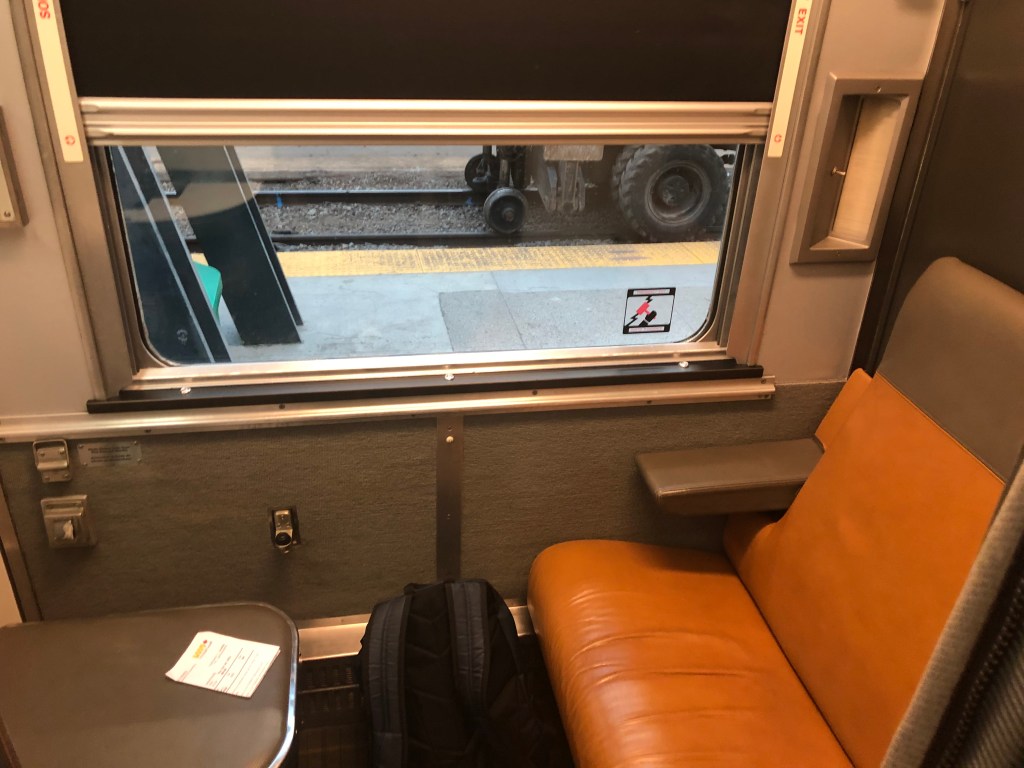
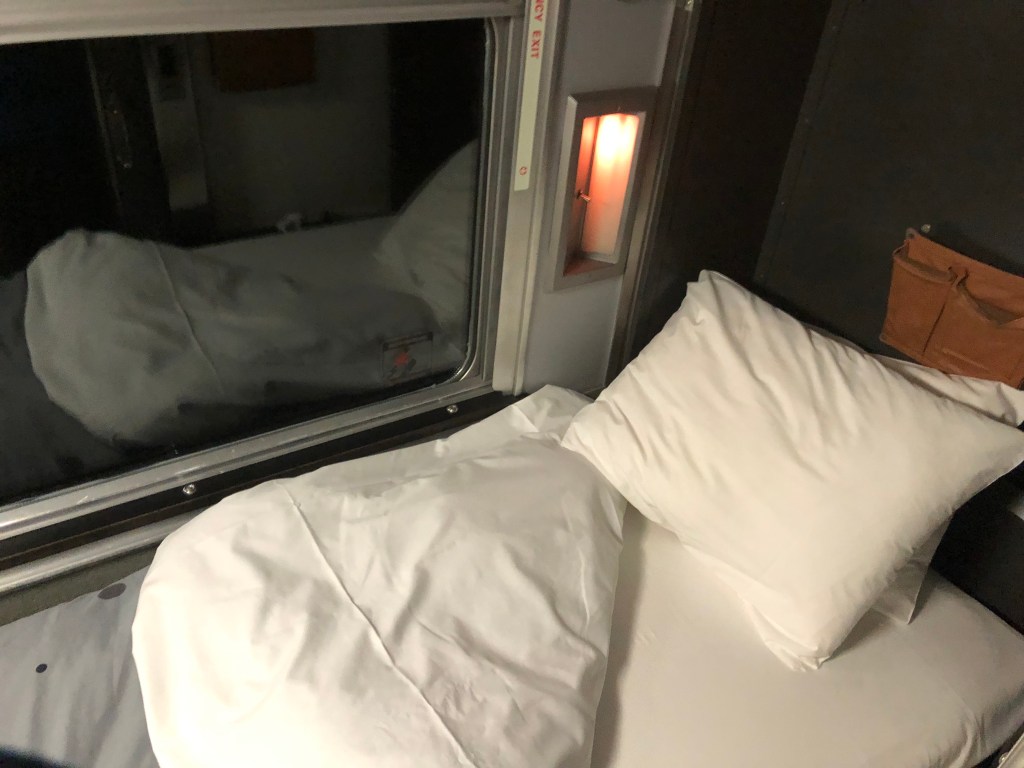
The cabin in night mode. The bed definitely tilted away from the wall.

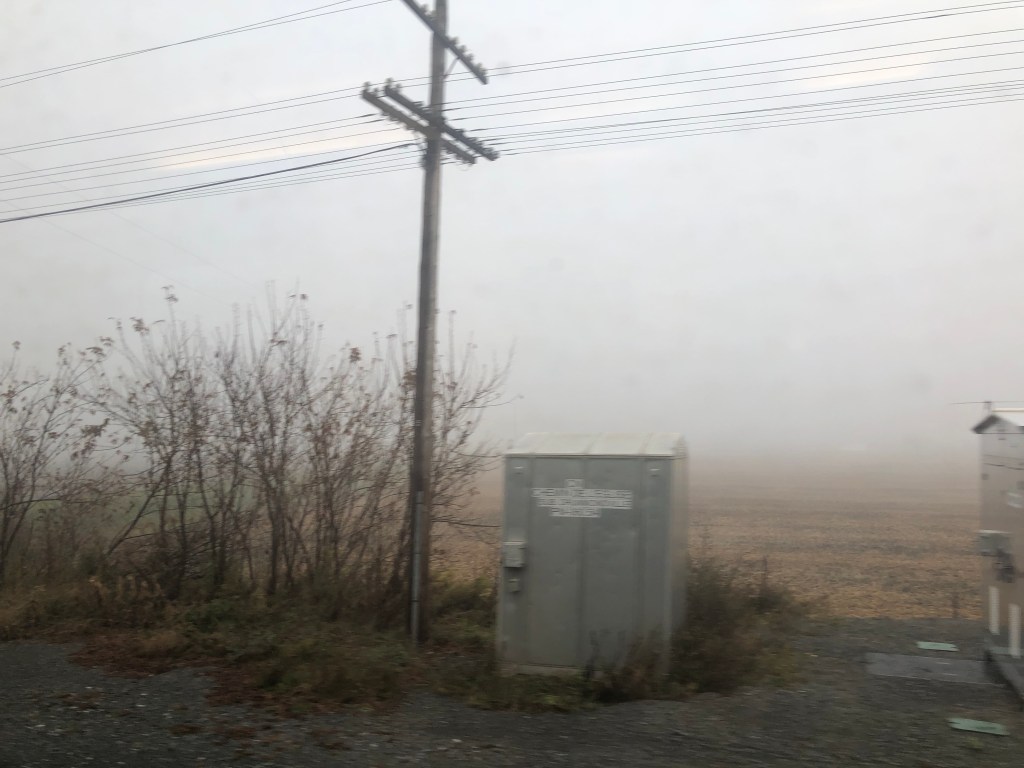
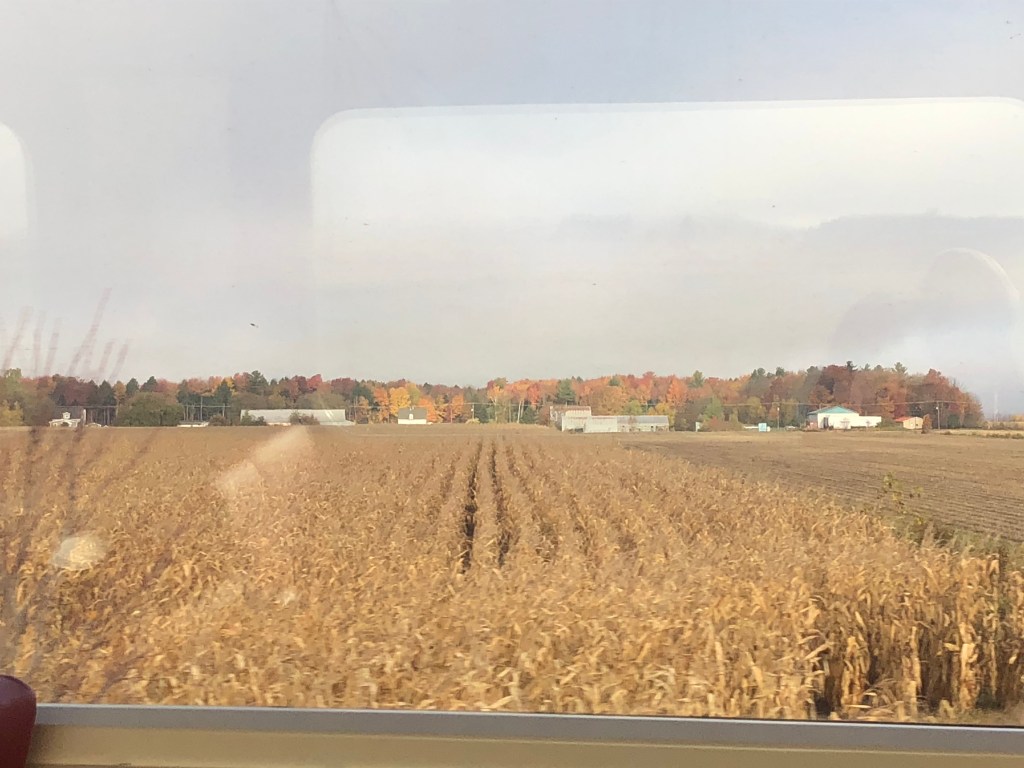
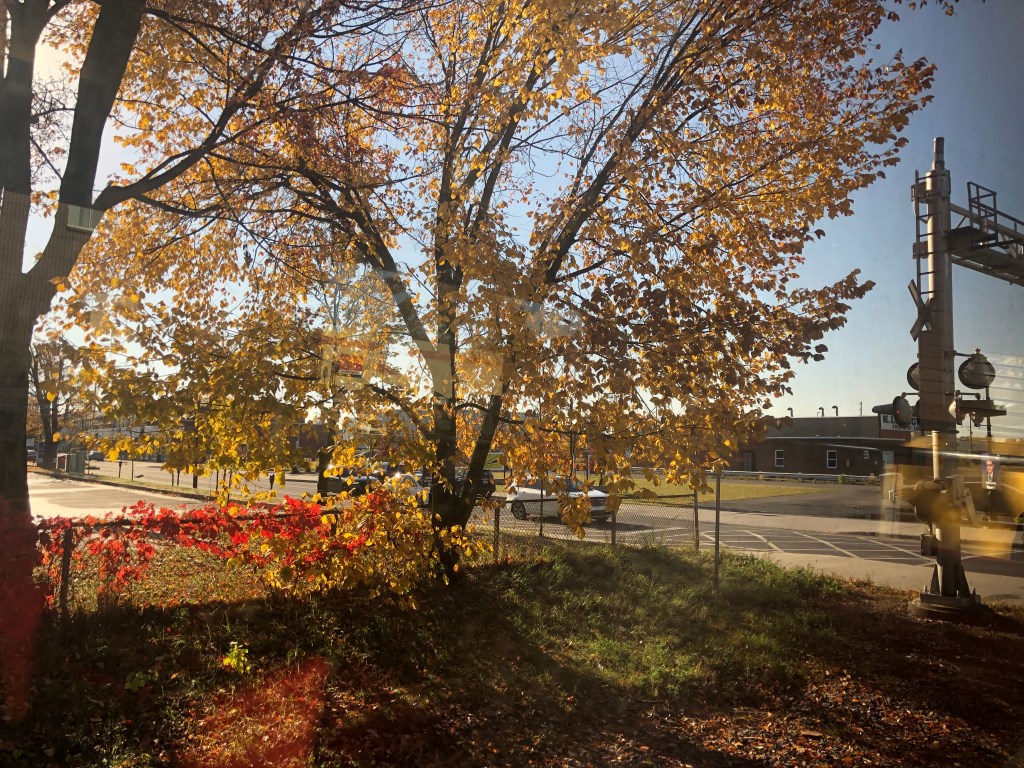
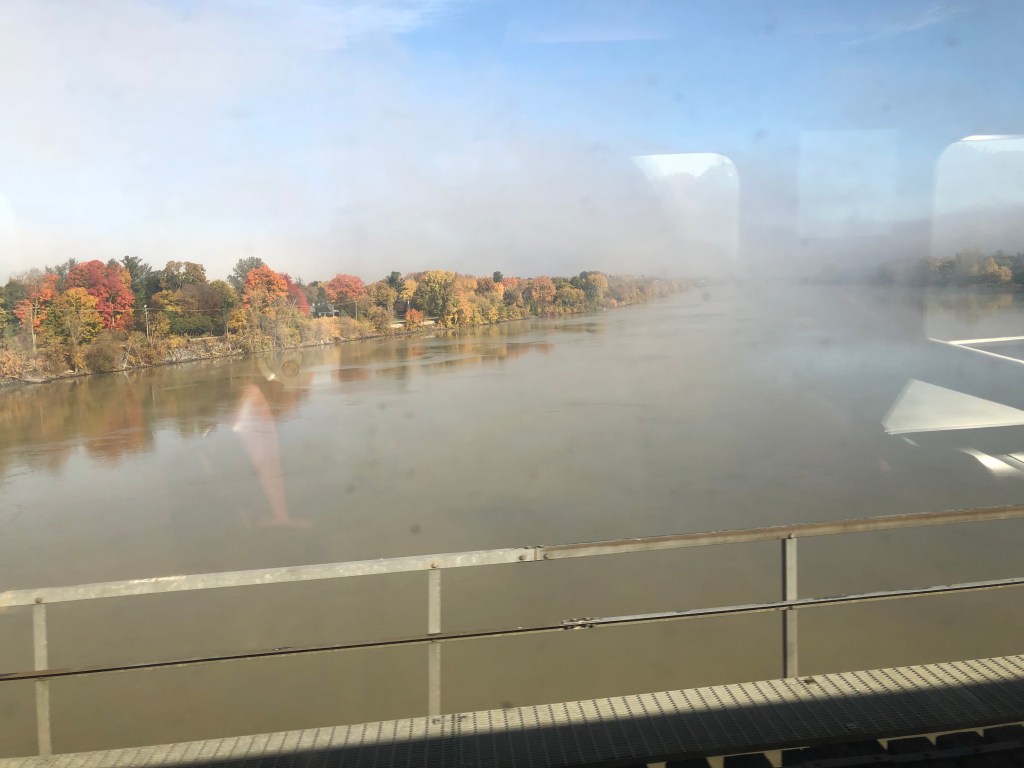
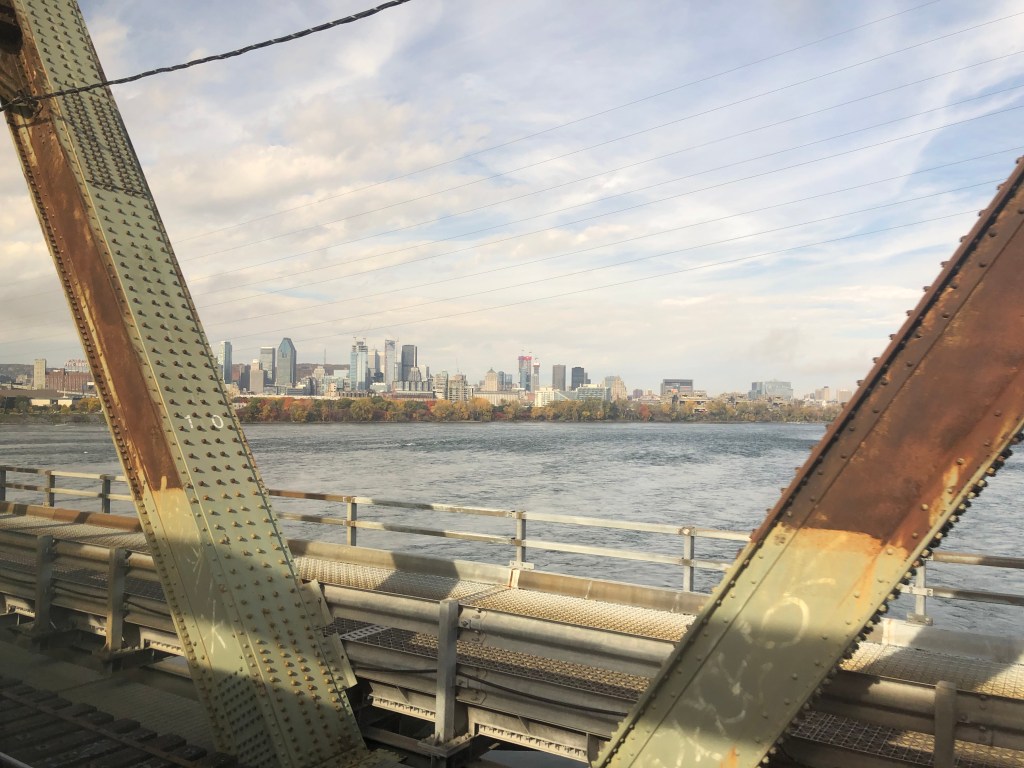
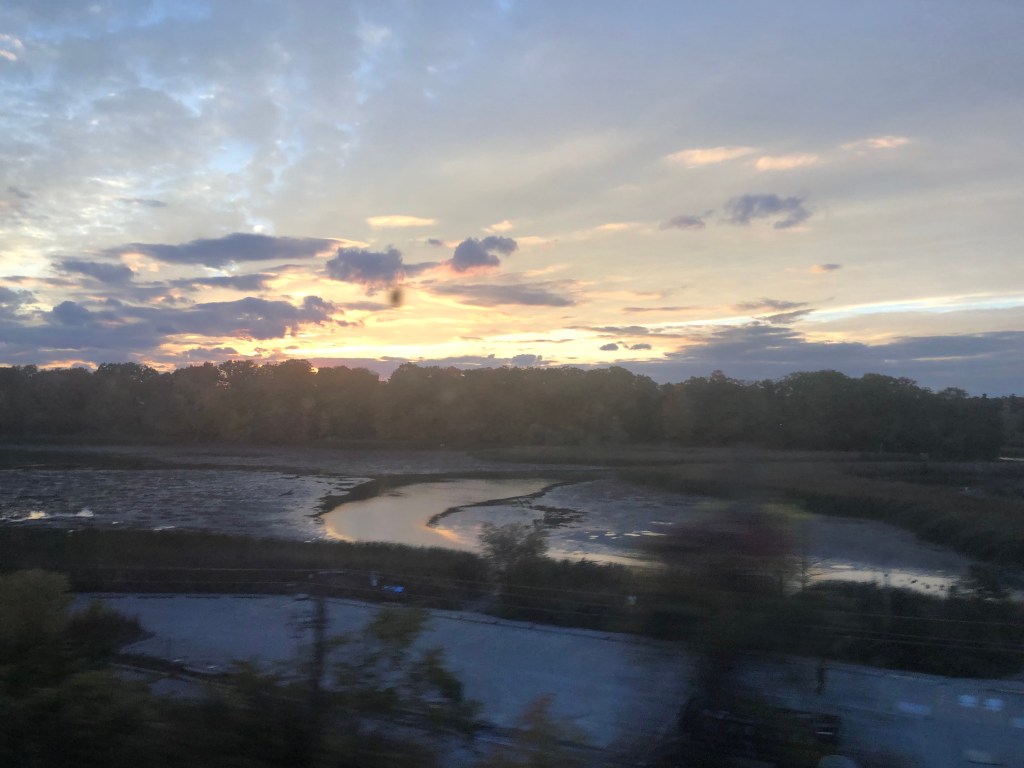
Eventually it was time for bed. The cabin had been transferred to night mode by the car attendant. It wasn’t the comfiest of beds. I found I could only sleep on my right hand side otherwise I was likely to fall out. The train rattles, rolls and is quite noisy but despite this I slept very well. That might have been down to medication I was taking for a cold I’d developed just as I was setting out for Canada a couple of days earlier. If it was the Canadian version of Night Nurse that resulted in me sleeping like a log then I’m mightily impressed. I woke up as the province of Quebec was passing outside, not that I could see much of it due to the morning mist. The clocks had also gone back an hour as I crossed into the second of five time zones on this trip. The en-suite was most welcome and fresh as a daisy I headed for breakfast. This is done on a first come, first served basis but I walked straight in. Breakfast is a big affair in Canada. Even I, who has a healthy appetite, couldn’t manage it all. Eventually the mist burnt off to reveal flat farmland and trees that were somehow even more spectacular than those I’d seen the previous day. Eventually we found ourselves in the suburbs of Montreal and crossing the mighty St Lawrence River, we pulled into Montreal Central Station, arriving an hour late just shy of 11am local time. This was a bit of a shame as I had hoped to get myself on the 11am train to Toronto but it was pulling out of the adjacent platform as I headed to the main concourse.

The Corridor

Montreal – Toronto

I had a couple of hours to kill before the 1:23pm train to Toronto. It was a nice day so I had a bit of a wander round Montreal, at least the bit of the city near the station. I got to see Notre Dame which, unlike its namesake in Paris, appears to not be fire damaged. However, the train was calling so I headed back to the station and awaited train number 67. Whilst this specific service does not have a name, all trains that run between Quebec City in the north to Windsor Ontario in the south are called Corridor trains. Trains linking Montreal and Toronto make up the bulk of these services with five or six of them a day connecting Canada’s two largest cities. The one I was on was scheduled to take five hours ten minutes. The train itself was much the same as trains in the UK and Europe. 2-2 seating in economy/second class, a trolly service for drinks and snacks and a couple of business/first class cars at one end of the train. It was busy too with most seats in my car taken. I was happy to see my checked bag had been transferred from The Ocean directly to one of the luggage stacks in my car. We pulled out of Montreal on time and headed southeasat. A brief stop at Dorval, for Montreal Airport, turned into rather longer one than anticipated but once we got a green signal we were soon rattling along at an impressive 95mph. Both Quebec and then Ontario continued to deliver on the autumn colours for much of the journey. We followed the St Lawrence and then the western shore of Lake Ontario but only saw them fleetingly as the train tried, and failed, to make up for the time lost at Dorval. It was a comfortable enough journey. The train itself was unremarkable though there appeared to be quite a few on board for whom train travel was a novelty. We pulled into Toronto’s Union Station fifteen minutes late which was a bit of a shame as I had a hockey game to go to and it was due to start at 7pm. I grabbed my bags and set off for my accommodation for the night. It was close to the station, as was the arena but unfortunately they were in opposite directions. A quick check-in and a dumping of the bags later, I hot-footed it to the Scotiabank Arena to see the Toronto Maple Leafs play the Ottawa Senators. I was sweating profusely by the time I made it to my seat which was way up in the gods. I only missed five minutes of action so I consider it a result. Speaking of results, the Maple Leafs won, 3-2.

Scotiabank Arena from the cheap, but not the cheapest seats.

My accommodation happened to be a hostel. Whilst I’m not really the hostel type – actually, I’m not even remotely the hostel type – this one had private rooms with facilities. With hotel prices for a Saturday night in Toronto being insanely expensive, especially when the hockey is on, I felt it was worth the risk of encountering caftan wearing, weed-smoking young people singing protest songs badly to get a bed for the night for seventy quid. I was right. The rooms were in a separate building to the dorms, were perfectly comfortable and I got a decent night’s rest. I decided to forgo the included breakfast though as I thought it might be a bit heavy on the avocado and oat milk.

The Canadian

The following morning I went through the rigmarole of sorting out luggage before heading back to the station for the next, and mightiest part of the journey. This was the 9:55am departure from Union Station to Vancouver aboard train Number 1, The Canadian. This takes 97 hours, traverses four time zones and five different provinces. It runs twice a week on a Sunday and Wednesday and passes through dozens of stations on the way. As with The Ocean, most of these are flag stops but there are plenty of compulsory stops too, due to a strict twelve hour working rule for the ‘engineers’, or drivers as we call them in the UK.

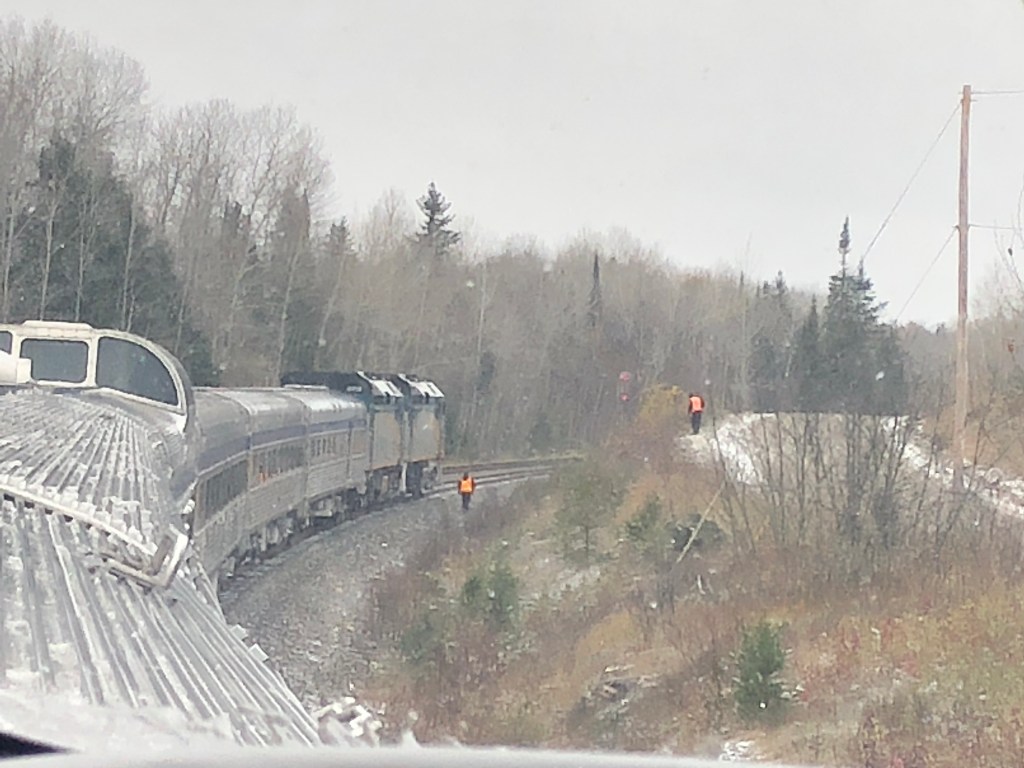
It might be worth a paragraph to explain a bit about the Canadian railway system here. Passenger trains in Canada are run by a state owned company called VIA Rail. Prior to 1978 the two rail companies, privately owned Canadian Pacific and state owned (since privatised) Canadian National had provided passenger services but these were experiencing huge losses since the early sixties when the Trans Canada Highway was completed. Having divested themselves of passenger services, the two companies concentrated on the highly profitable freight market. They retained ownership of nearly all the rail infrastructure and as such VIA Rail has to pay them to gain access to the tracks. The upshot of this is VIA Rail’s passenger services on all but the Corridor play second fiddle to freight. The Canadian uses the CN line which runs further north than its CP counterpart. For virtually its entire length this is a single track with passing loops. These passing loops are long as they have to accommodate freight trains which can be over two miles in length. They come around so frequently you wonder why they don’t just connect them all up and make it a much more efficient twin-track system. With a top speed of 70mph being achieved infrequently, extended stops for driver changes and refuelling, stops at passing loops and some bizarre shunting required to access certain stations, the whole 2775 miles from Toronto to Vancouver is covered at an average speed of 28.6 mph. The bullet train it is not.

Toronto Union Station. Just a bit of it. It is impressive.

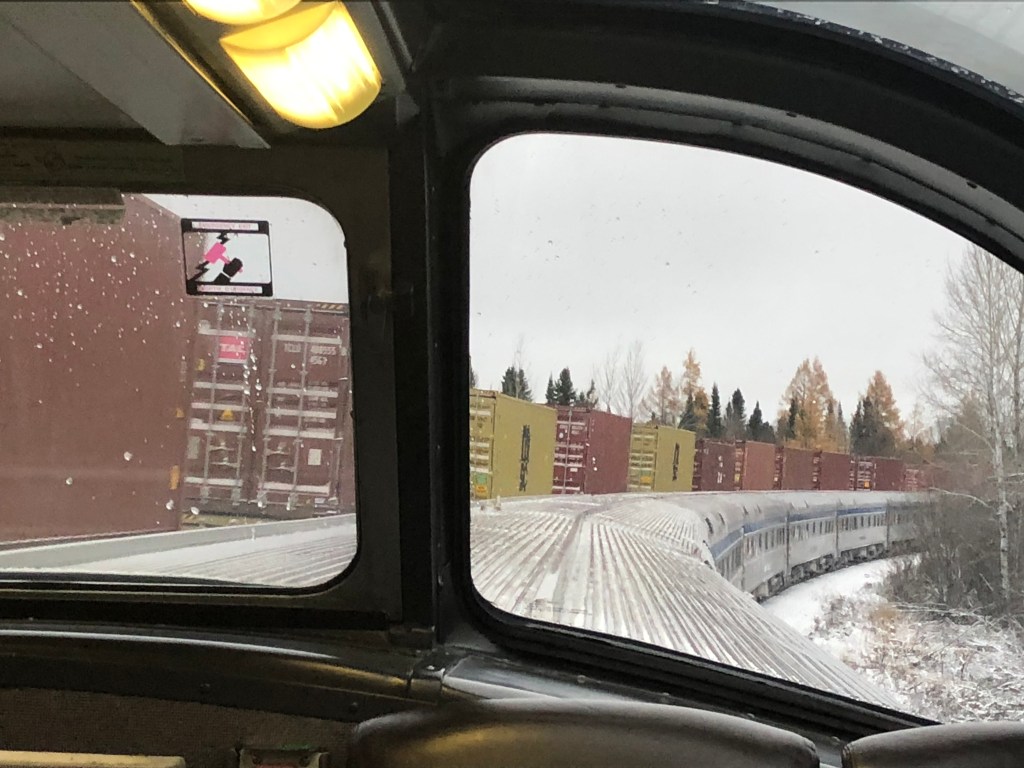
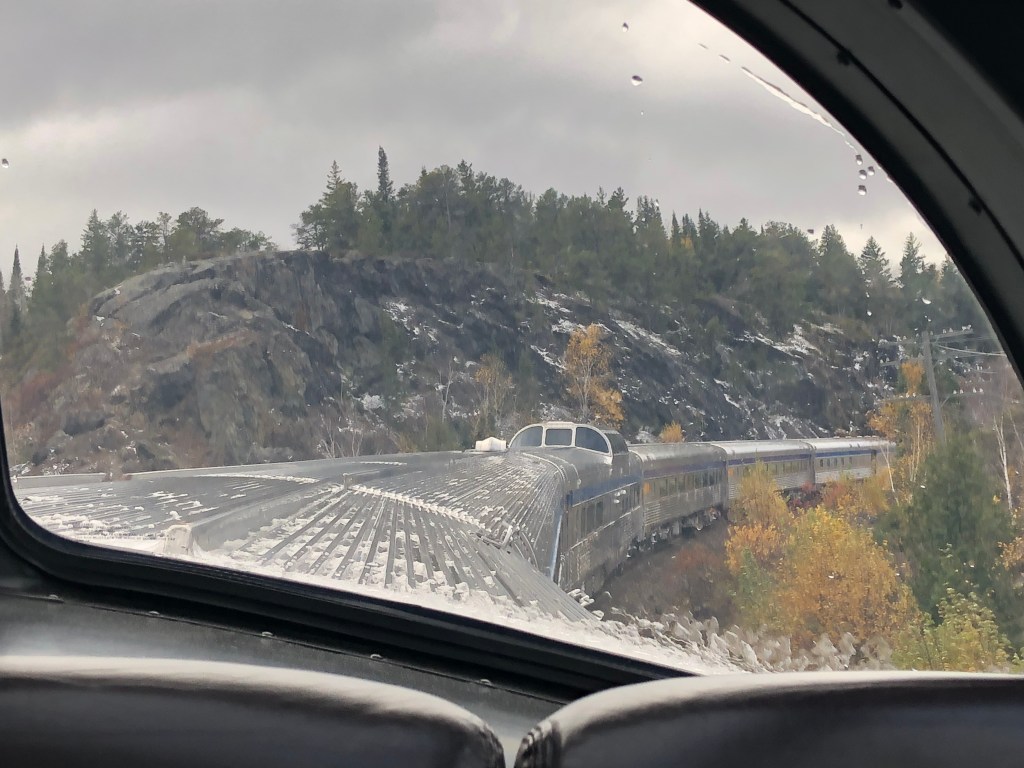
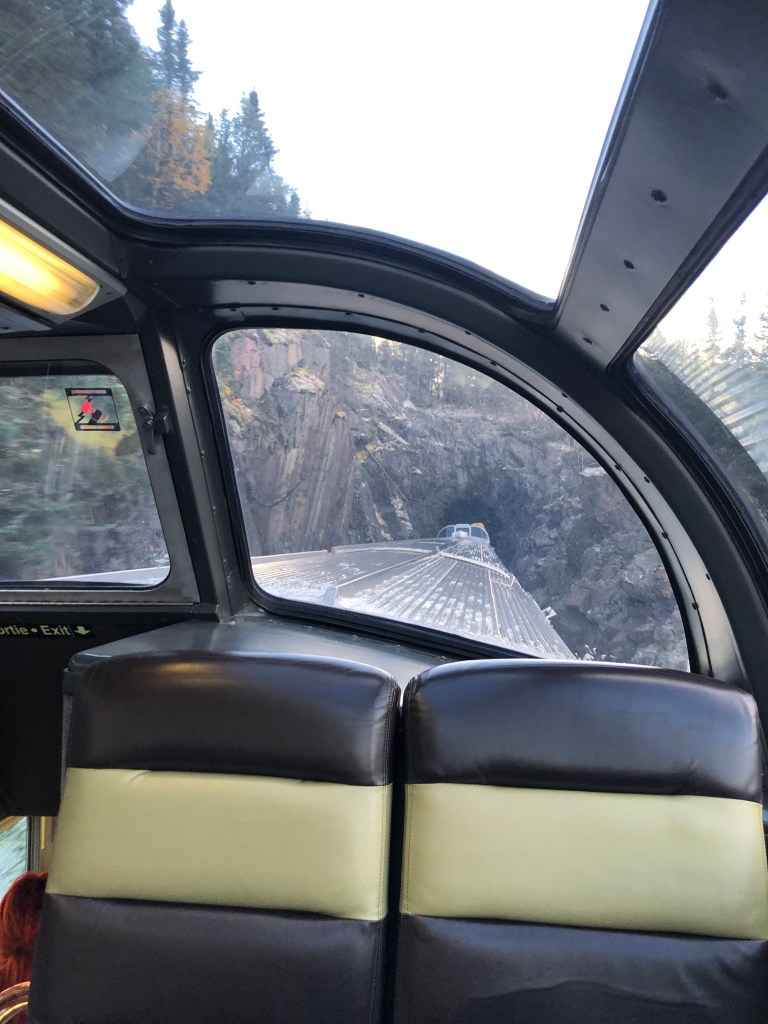
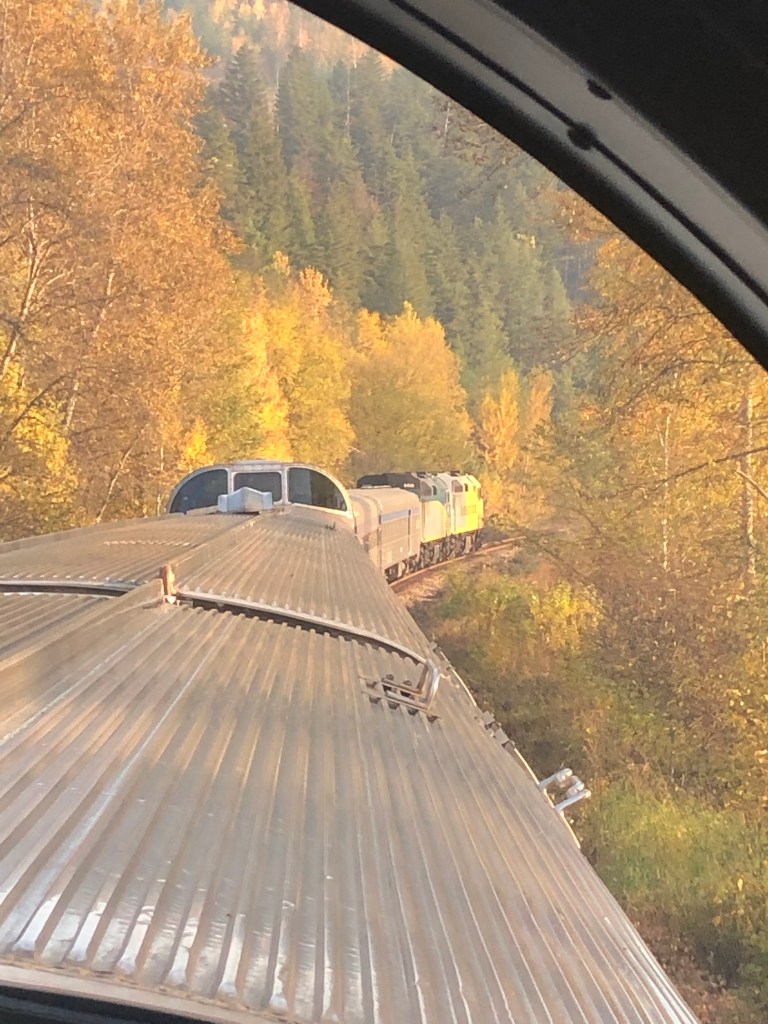
A far more leisurely stroll than the previous evening’s rush to Toronto Union Station, which is a very impressive building, meant I pitched up an hour before departure. As in Halifax there is a Business Class lounge where sleeper passengers could check in. It seemed very busy. Having done the necessary paperwork I went and deposited my suitcase with the baggage people and hoped I would see it again in Vancouver. Back in the lounge I wondered just how busy the train would be as the lounge itself was barely able to cope. I needn’t have worried. Once boarding was called, I caught a first glimpse of the train. It was huge. Twenty-two Stainless Steel cars, built in the 1950s, hauled by two diesel locomotives. The Canadian has four passenger classes. At the front of the train is the baggage car and two cars for the Economy (seating) passengers. Some of those seating passengers would do the entire journey to Vancouver including one woman with a large dog called Ellie. They are braver folk than me. Towards the rear were two Prestige sleeping cars each containing six luxury cabins with en-suite facilities. Behind that was the Park Car, a very well appointed lounge for the Prestige passengers with its own upstairs dome and a unique bullet shaped rear providing panoramic views of where you’d just been. Unfortunately Transport Canada, the regulator for all things public transport, had decided that this was unsafe and this particular journey was the first that required an extra empty car behind the Park car to serve as a buffer thereby spoiling the view. Between the economy and prestige sections lay the bulk of the cars which housed the sleeper passengers. There were approximately ten sleeping cars. Accommodation in each consisted of six double cabins, four singles, one of which was reserved for the car manager, and six semi-private bunk berths with night time privacy provided by heavy curtains. Passengers in these cars had access to two restaurant cars and two Skyline cars. The Skyline cars had a lounge area and a panorama dome upstairs. A third Skyline car was provided for the Economy passengers. There was another car for the train staff and I’ve possibly missed a few more so suffice it to say it was a long train. Almost half a mile long, yet still dwarfed by the endless freight trains we would pass.

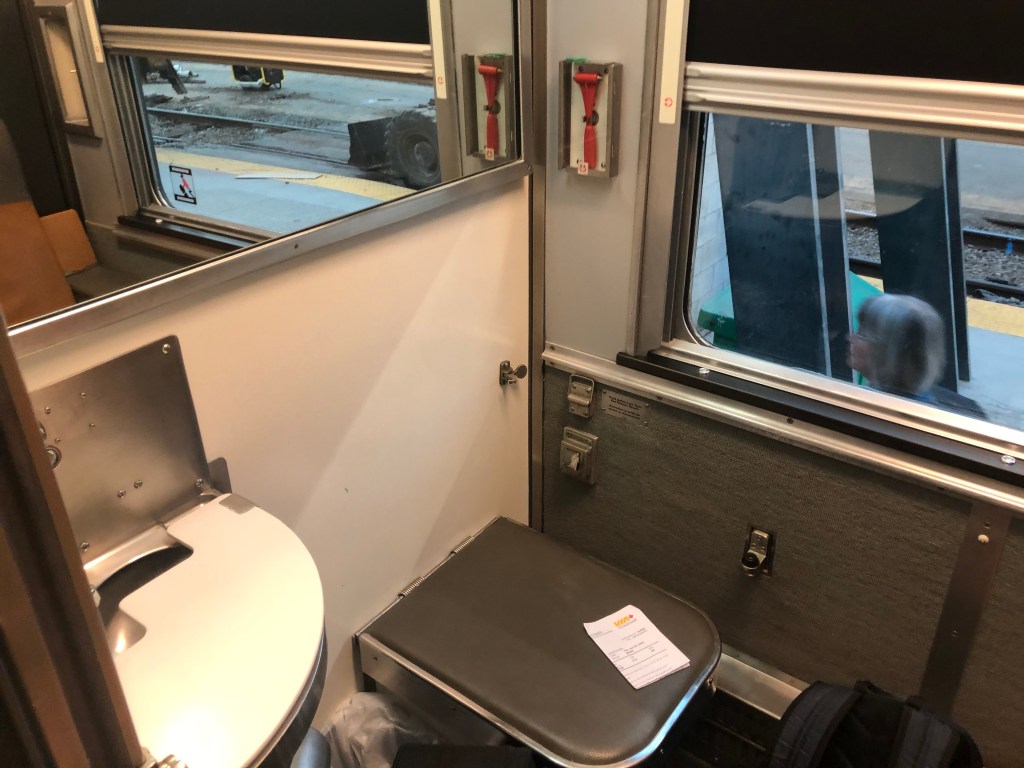
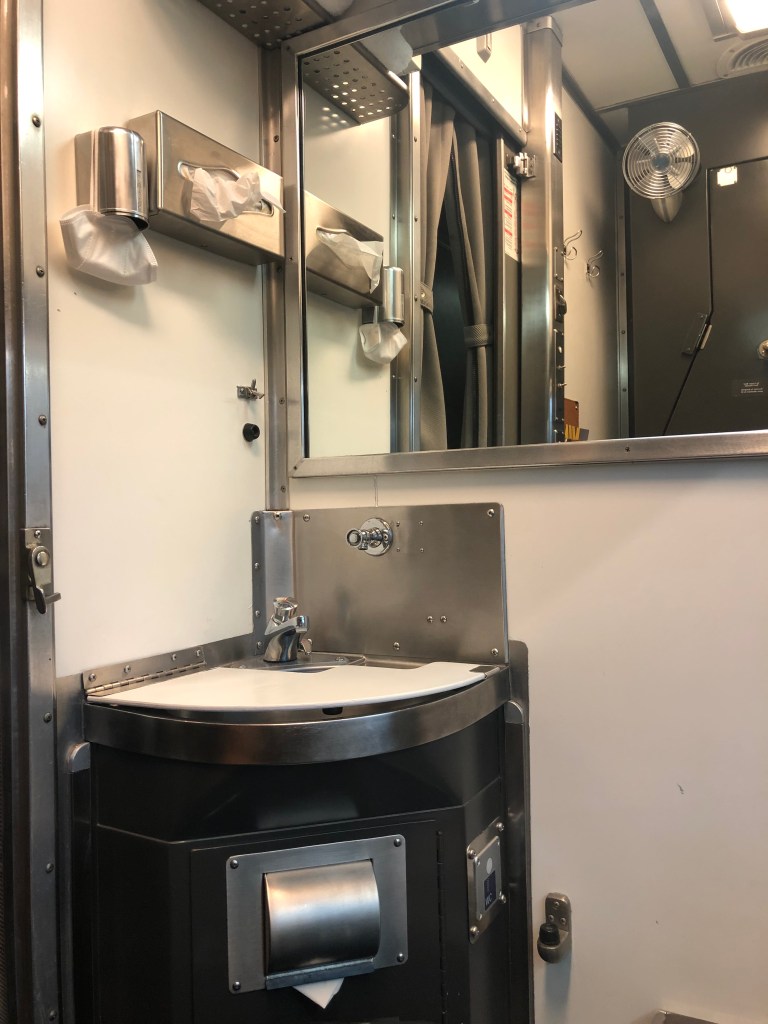
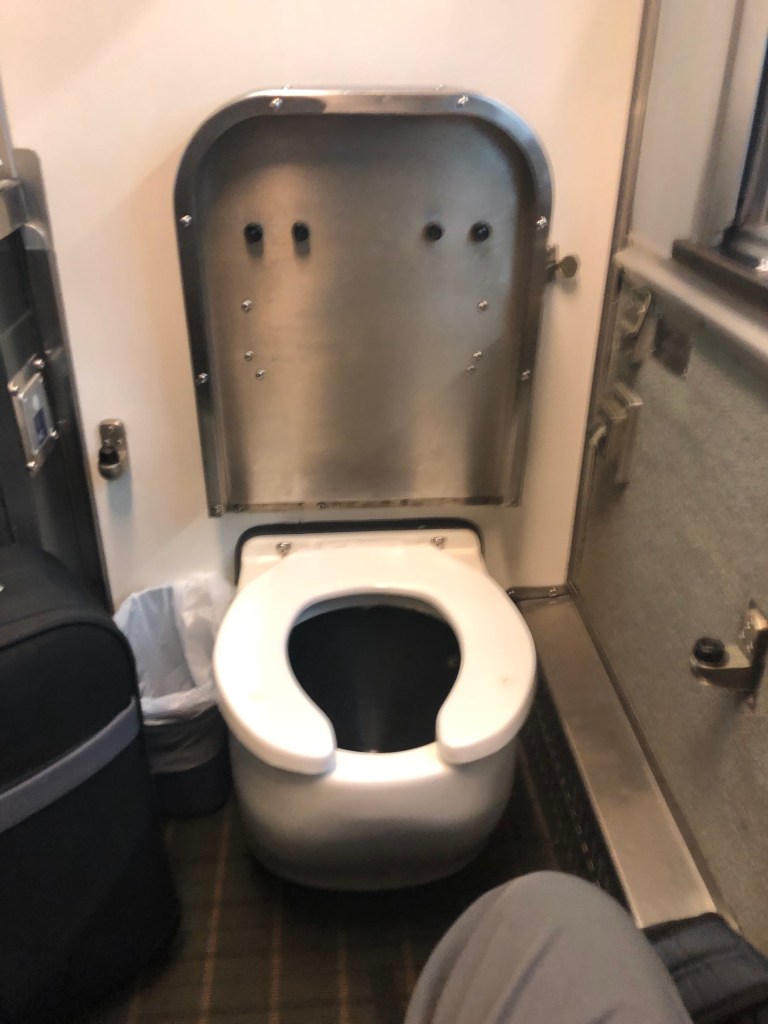
For my trip I had chosen a cabin for one. A Prestige cabin would have been nice but as they were all for two people the cost might have been prohibitive and they had all sold out when I came to book the trip anyway. Having been shown my cabin by car manager Gerard I was left to get acquainted with it. It was, well, bijou. In day mode there was a seat and a footrest. A sink was tucked up in the corner and that was about it. There was a solid sliding door and also heavy curtains which seemed like overkill but I’d soon find out why. But wait! What’s this? Lifting the lid of the footrest up revealed your own personal toilet. Erm, okay… For the night a bed is pulled down from the rear of the cabin and it takes up virtually all the space in the cabin. That included covering the toilet rendering it unusable at night unless you went to the faff of putting the bed up before you used it and back down again afterwards. I never used my personal loo at all, day or night, preferring the public ‘washroom’ at the end of the car. It seemed more hygienic to dispose of one’s body waste somewhere other than place you sat and slept. With the bed down there was hardly any floor space to stand. With the hard door open and the curtains closed you could expand slightly out into the corridor which helped when you were getting ready for bed. The hard door could be locked from the inside only. Leaving valuables in the cabin took a bit of a leap of faith at first but by the end of the trip iPhones were being left on charge unattended in open rooms, corridors and sometimes in the washroom shaver sockets. Apparently there have been no reports of things being stolen on The Canadian ever.

Day One: Toronto – Hornepayne

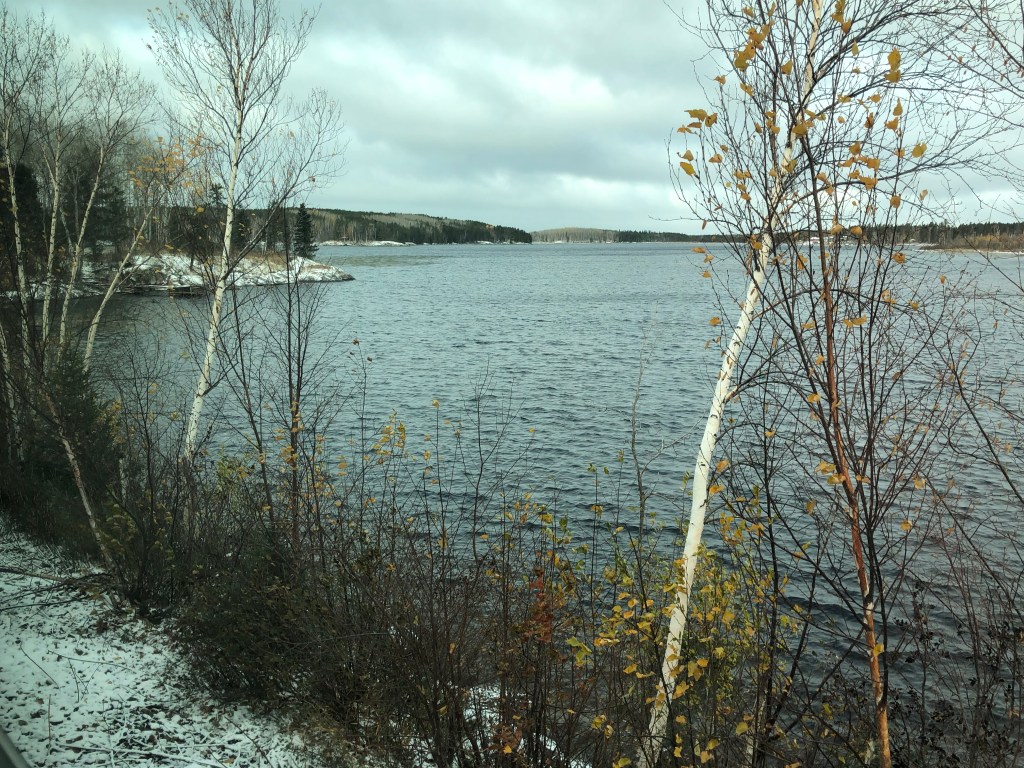
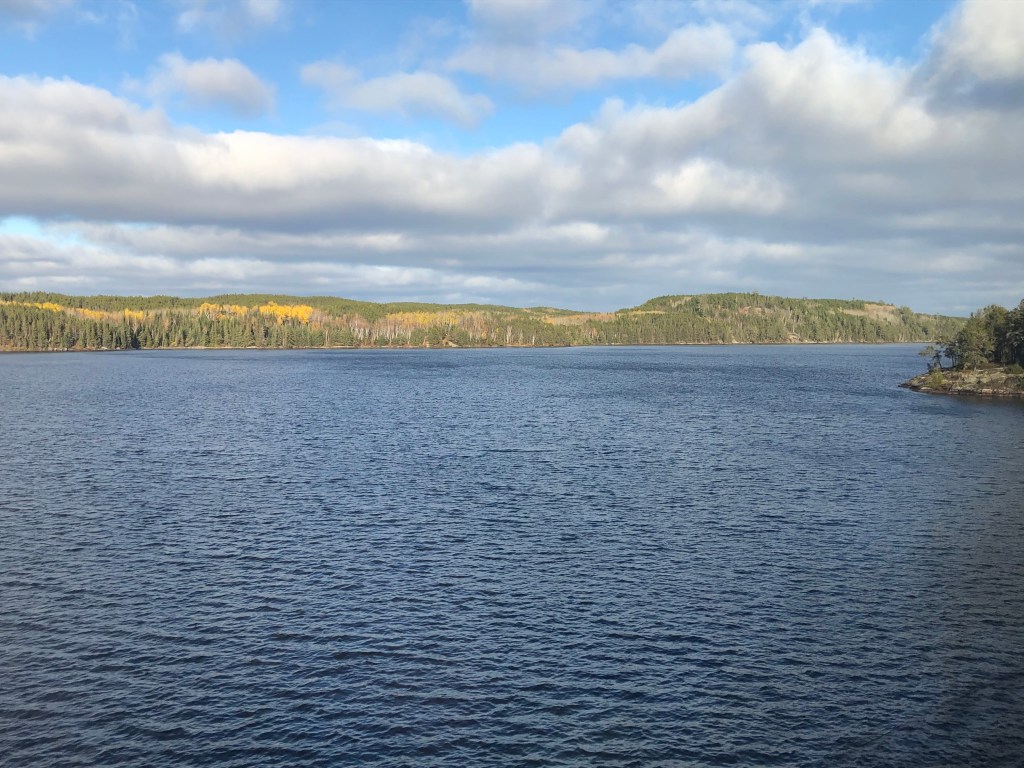
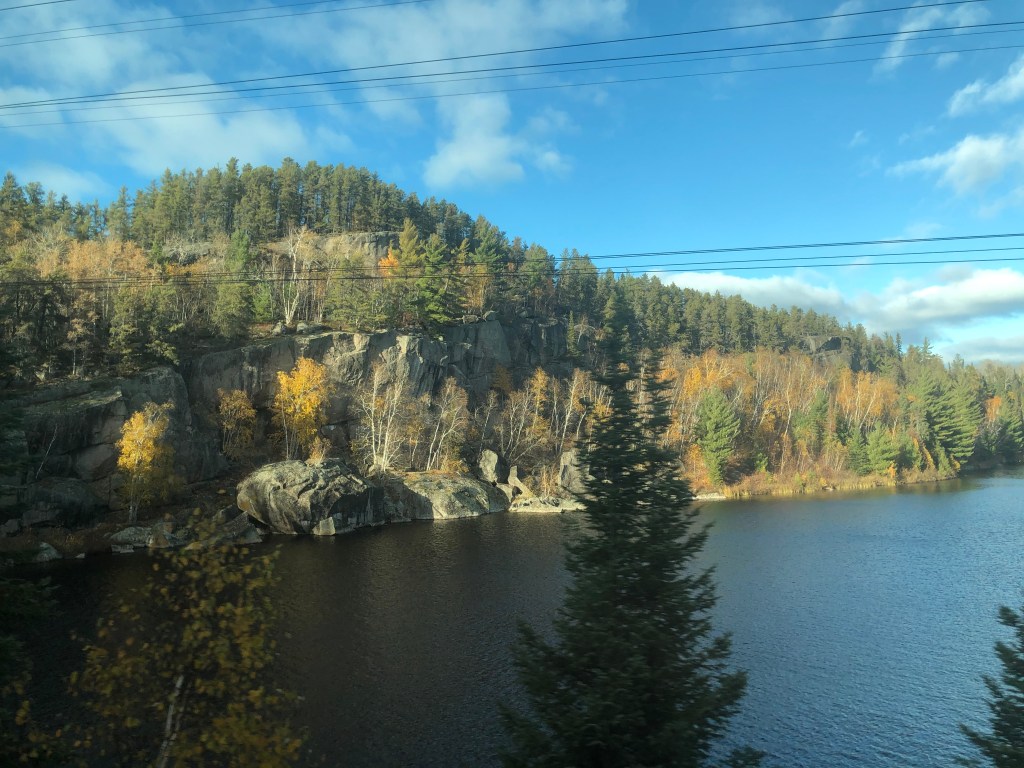
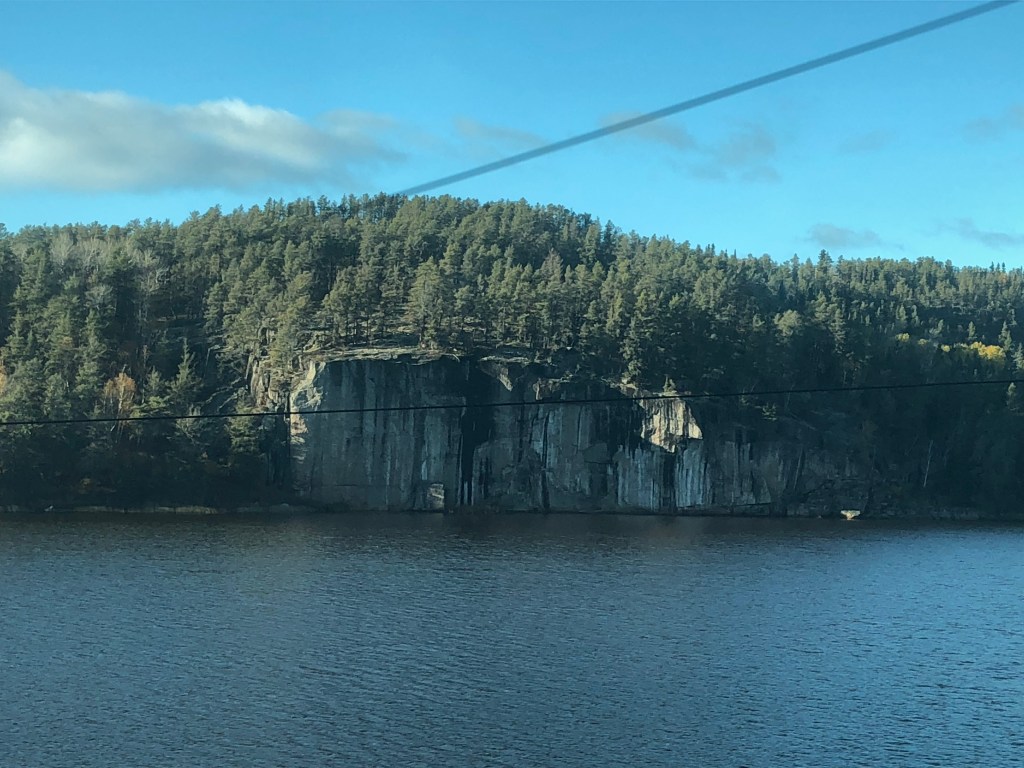
We pulled out of Union Station on schedule at 9:55am. For the first hour or so the train passes through largely unremarkable suburbs of Toronto. Some backing up and other jiggery-pokery was required to get us onto the correct track out of the city. It was an inauspicious start but gave me a chance to discover where everything was. I soon worked out that the Skyline car was the place I’d spend most of my conscious hours on board the train. The cabin was comfortable enough but as with The Ocean, it only gave access to one window. The Skyline had a couple of spacious areas to sit and, of course, the best part of the train, the panoramic dome. Twenty-four seats with views forward, backwards, left, right and even up thanks to its full length curved windows. In short, you could sit there completely surrounded by Canada. The dome could get busy at times but only rarely was full. The car had its own steward who would organise events and double as a barman. Tea and coffee were always available along with a few snacks. Soft and alcoholic drinks were available for purchase. Meals were arranged in two sittings, I was on the second today. Whilst the first sitting were being fed the Skyline car hostess gave those of us in the dome a talk about the history of the railway and more details of what to expect. There was no WiFi on the train. Contact with the outside world was restricted to Canada’s notoriously expensive cellphone data network which for long periods of the journey was unsurprisingly absent. By the time the second sitting was called to lunch we had left Toronto behind and passing through rural Ontario dotted with small settlements. As on The Ocean, lunch was a three course affair with a rather good cannelloni as the main. I wasn’t going to go hungry on this train either. In fact my emergency rations were barely touched by the time I reached Vancouver. We passed Parry Sound, a small town notable as being the birthplace of hockey legend Bobby Orr. Our first scheduled stop, where we could get off and stretch our legs, was in Caperol. Leaving there marked the beginning of the Canadian Shield. This is a vast area between the St Lawrence lowlands and the prairies. It is largely made up of boreal forest and ancient pre-Cambrian rock. Think lakes and trees then multiply that by several million and you’ll get the idea. Although we were leaving the vivd autumnal reds of Eastern Canada behind, the scenery was spectacular in a wild and unspoilt sort of way. Canada has many ‘Back of Beyonds’, the Canadian Shield is one of them that not many people know about. Eventually the light faded and the second sitting for dinner was called, steak and mash was the main. Unlike The Ocean, I was put on any table that happened to have a space which meant socialising with other people. As a shy, retiring type I felt a bit uneasy about this. I’m a silly sod. It was fine. We all had stories to tell including me. Eventually it was time for bed. The car steward Gerard had made up the bed as I ate. I hadn’t yet discovered the knack for getting changed without any floor to stand on but I managed it. It was time to sleep…

Day Two – Hornepayne – Winnipeg

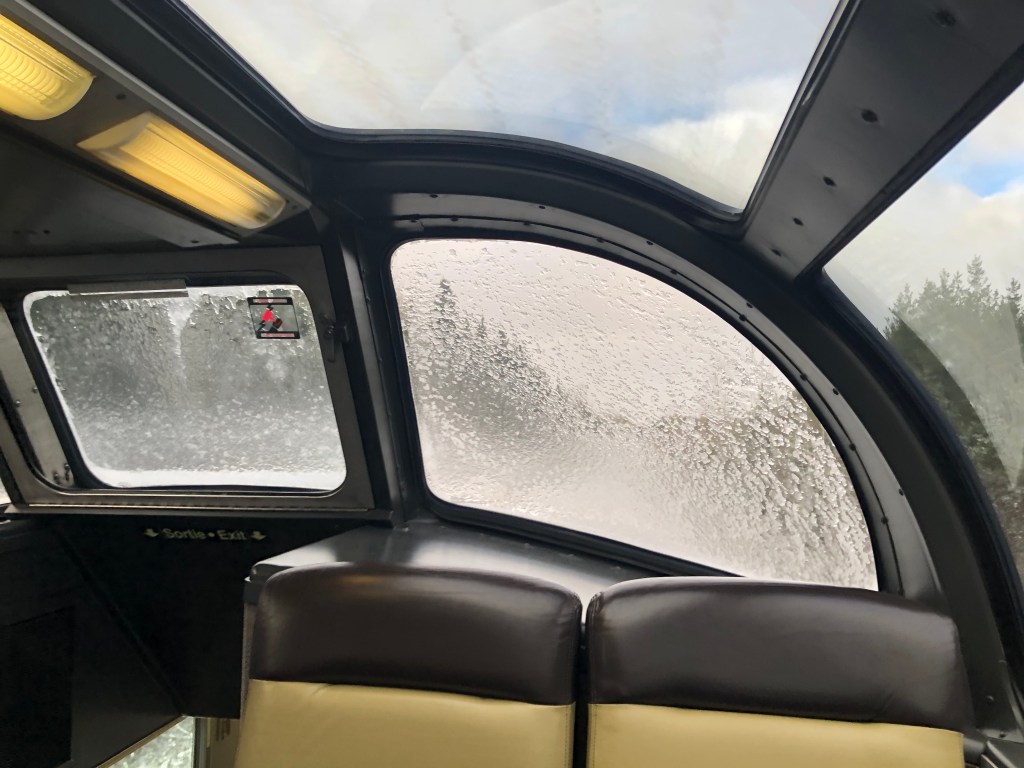
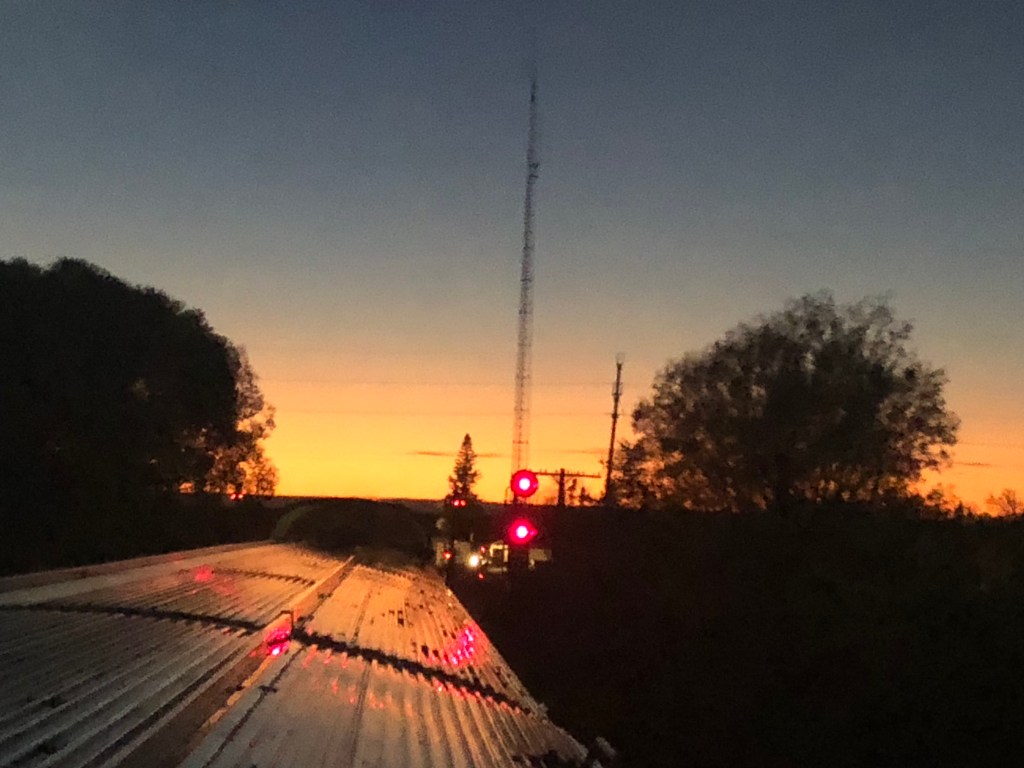
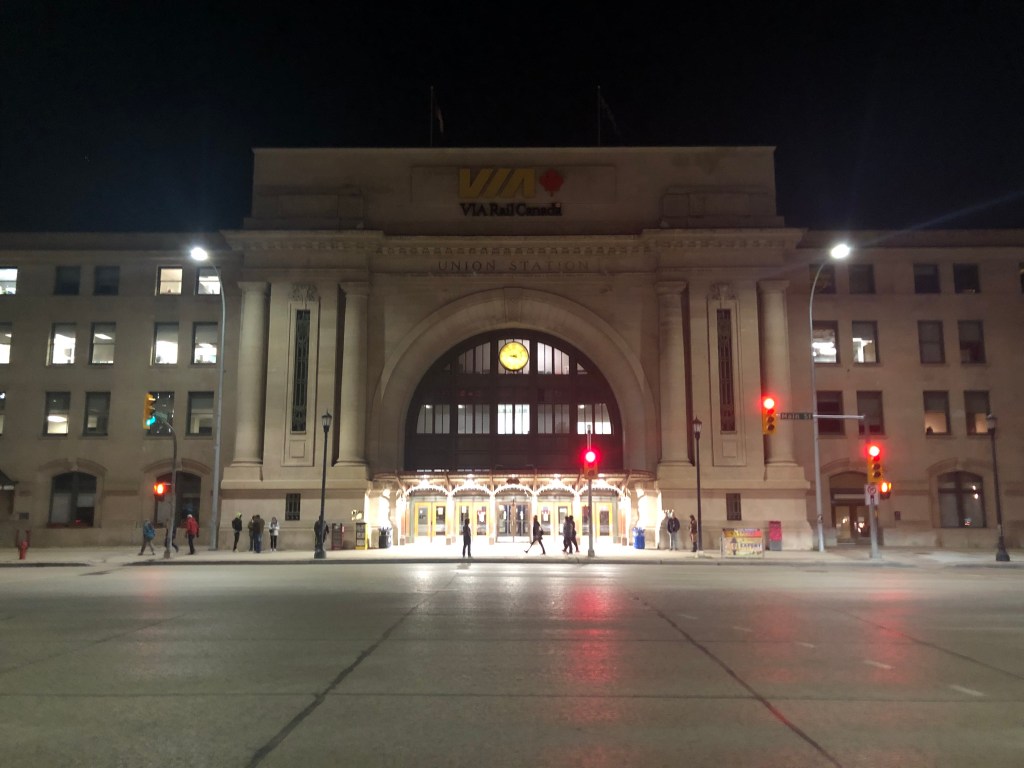
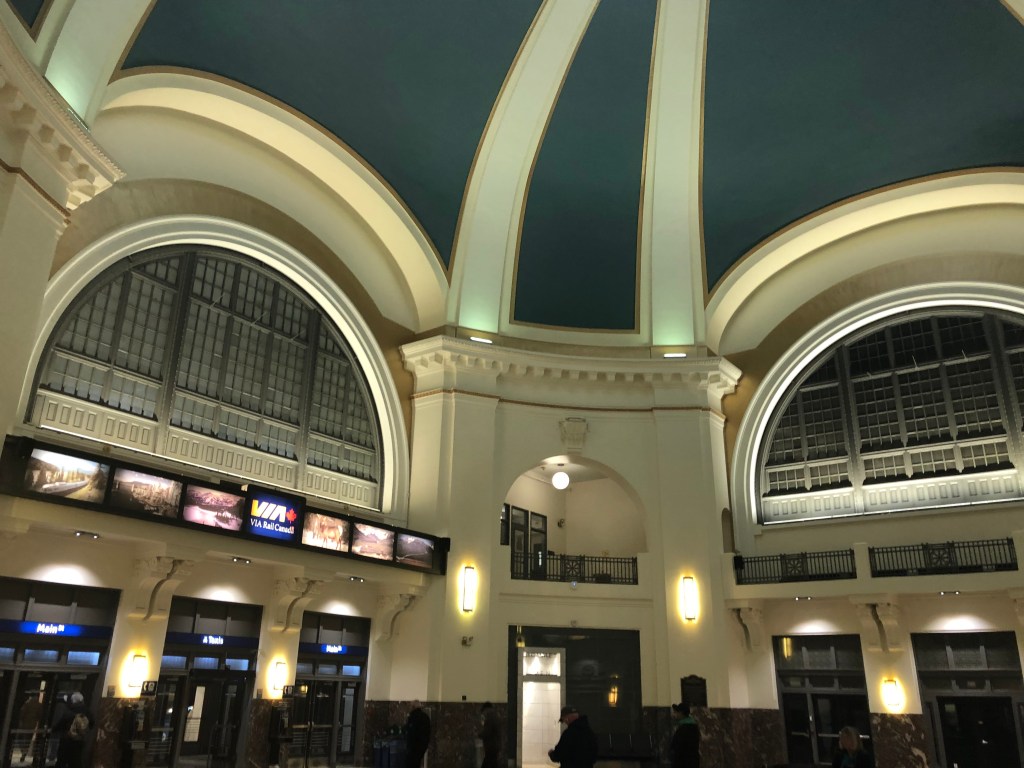
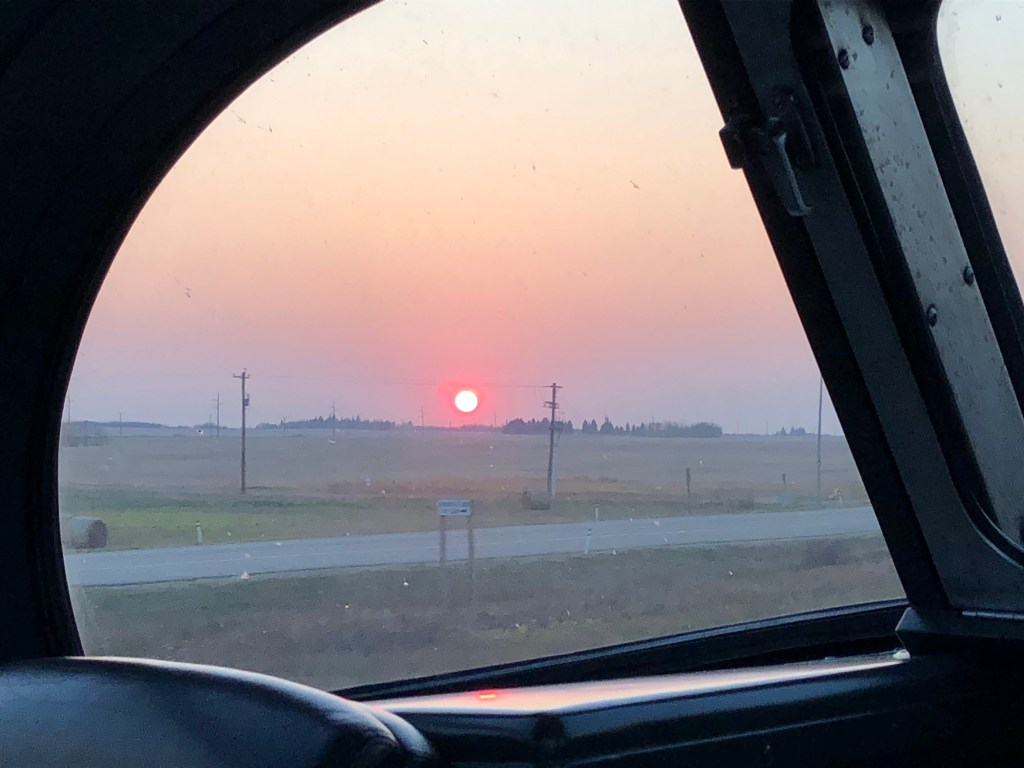
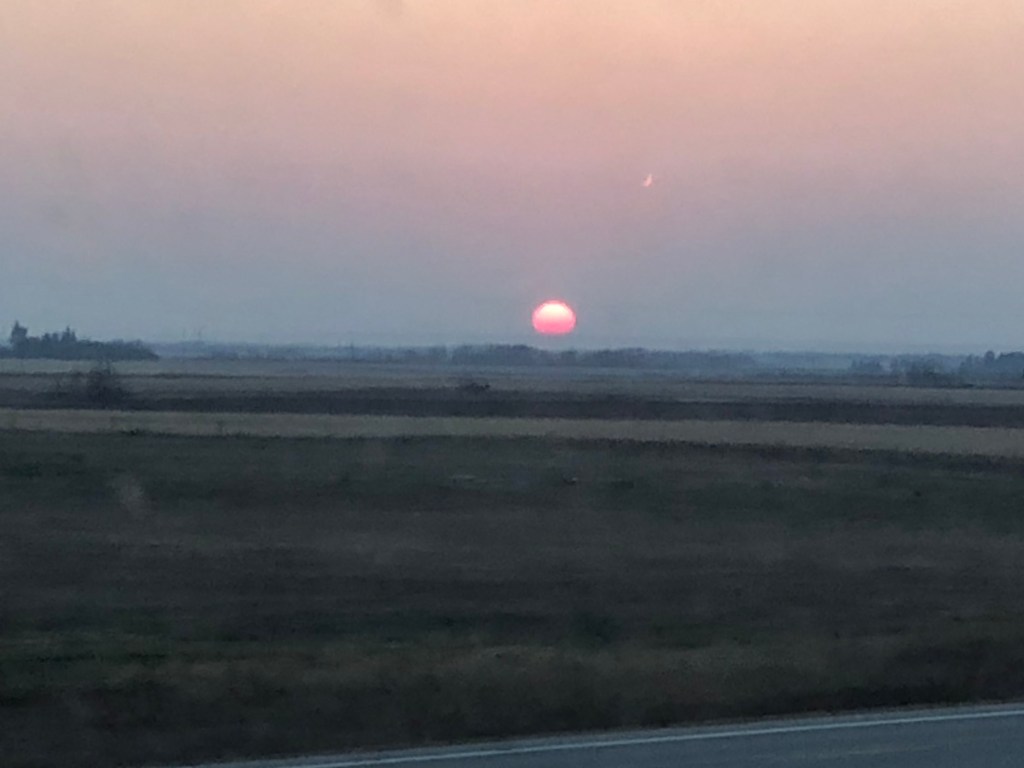
(Hornepayne was a technical stop in the middle of the night. I wasn’t tempted to step out and discover if it had anything to offer.) I had a terrible night. Whilst the bed was comfy enough and the bedding very nice, it could do nothing to stop all the rattling and racket of the train. My cabin was right over one of the car’s bogies and I felt every rough bit of track and there was plenty of that. To cap it all we had moved into another time zone so there was an extra hour in bed to endure. I needed to get out of bed and wander down the corridor to the toilet a couple of times (still better than trying to use the one in the room) and peeking out of the window the ground appeared to have taken on a white hue. Eventually nighttime became daytime and it became obvious that snow was covering the ground. Not much, but enough to turn an autumn Canadian Shield into a winter one. I pulled on some clothes and headed for breakfast. It’s first come, first served and I was stuck on a wait list. I went up into the dome, where ice on the window was spoiling the forward views, and waited. For quite a long time as it happens. I had either been forgotten about or not heard my name being called. So it was a late breakfast and last dibs for the day’s meal sittings which were being allocated by the waiting staff. It was to be first sitting or nothing which meant lunch would be only two hours after breakfast. It was an inauspicious start to my second day on The Canadian. However, things soon picked up. Each sleeping car has its own shower and it was pretty good. Refreshed, I headed back to the dome to watch a wintery looking Canadian Shield go by. It was really quite spectacular. Sure enough lunch came all too soon and in the early afternoon we came to a standstill in the only town for miles around, Sioux Lookout. It was time for a stretch of the legs again. The temperature was a chilly -4C with some light snowfall. Despite this, I wasn’t going to miss an opportunity to walk, even if it was only up and down the side of the train. With the new engineers arriving late, our stay there was a bit longer than anticipated but the bonus was the town has 4G and I was able to check in with home before we re-entered the data desert. Once they had turned up, the engineers moved us out of Sioux Lookout and it was more hours of the Canadian Shield, the snow eventually running out and returning the Shield to autumn once more. In the evening we finally managed to escape the surprisingly huge province of Ontario and enter Manitoba but the Shield hadn’t finished. As I watched the sun set over the front of the train, I actually felt very much at peace with a world that was gently rolling past me, increasingly unseen. We rolled into Winnipeg at about 9pm. The stop there was a couple of hours so I got off and went for a wander. Although the station is in the city, there wasn’t much to see at that time of the evening. It was -2C too so I spent most of the time in the station building which was quite impressive. Soon though it was back on board to see if I’d have a better night’s sleep.

Day Three – Winnipeg-Edmonton

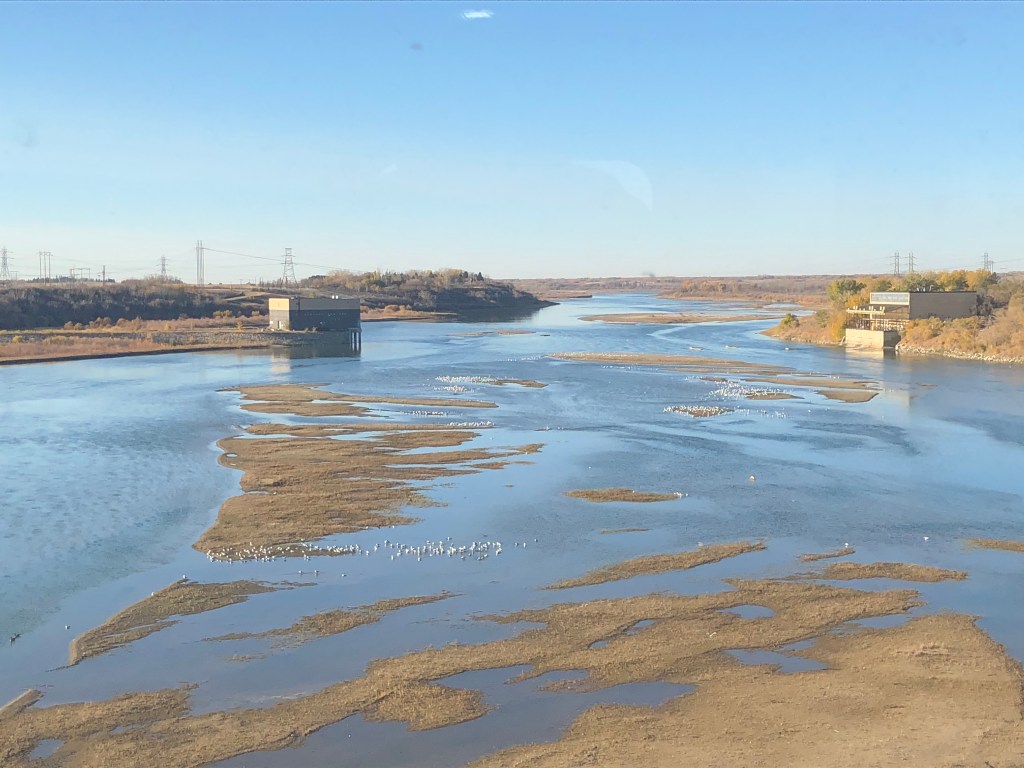
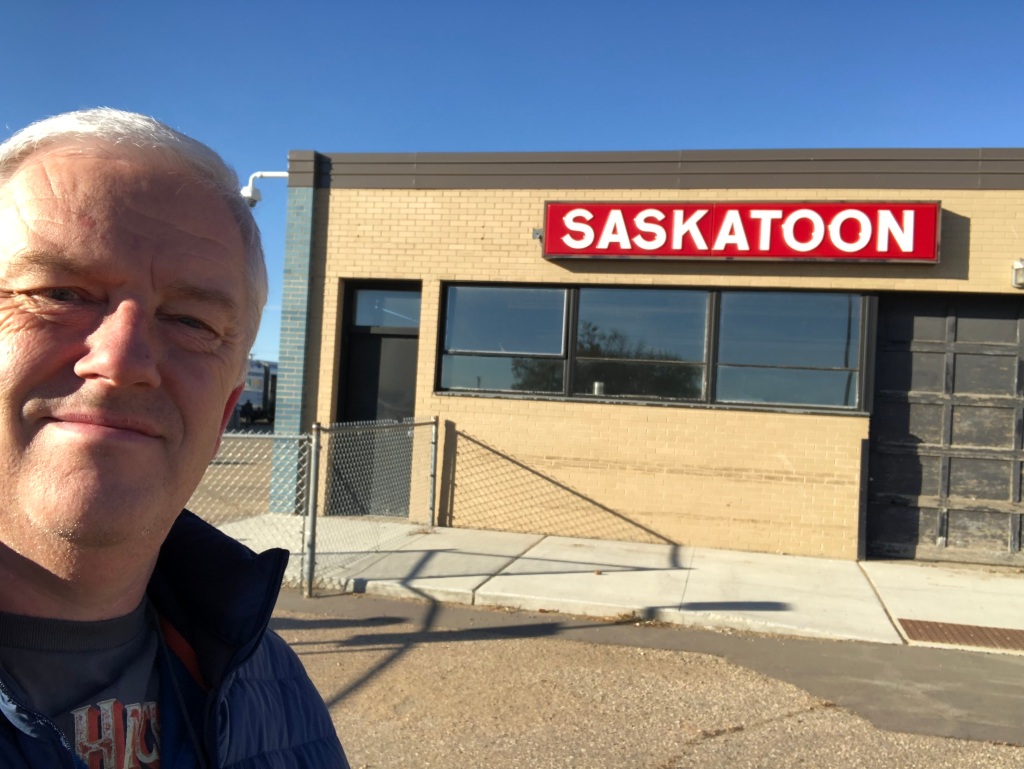
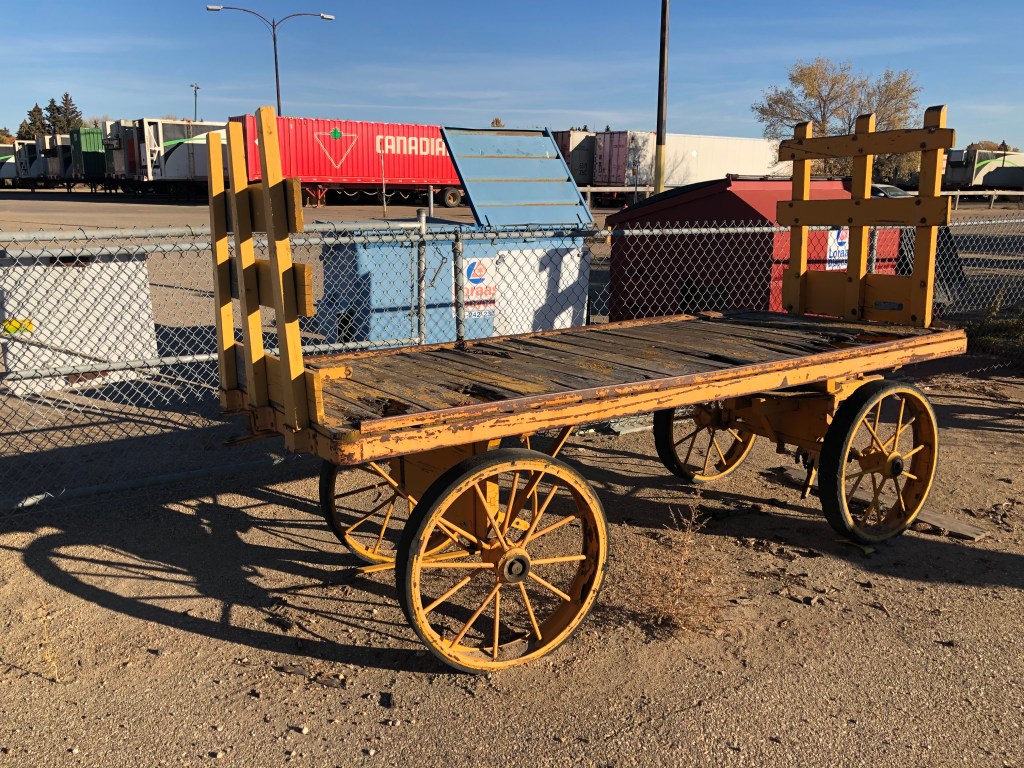
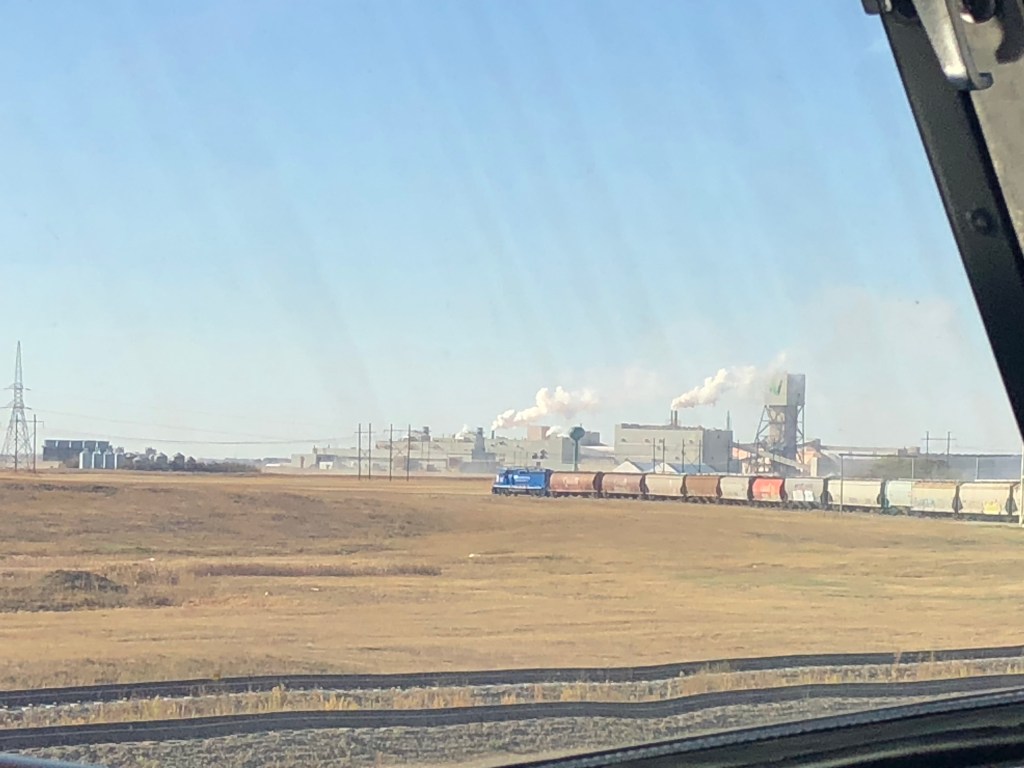
The train had a crew change at Winnipeg. Most of the onboard crew are based there. A new car manager introduced himself before I settled down for the night. I had a great night’s sleep, despite the same noise and motion problems as before. It might have had something to do with me taking another couple of Canadian Night Nurse capsules before lights out. I don’t think they should really be used as sleeping pills but never mind. The another hour had been added to the clock overnight and as I went for breakfast, we left the province of Manitoba and entered Saskatchewan. Today was Prairie day. Lying between the Canadian Shield and the Rockies are the Prairies, a vast area of lowlands and plains, largely grassland and very fertile. Despite leaving a good bit of it behind overnight, it would still take us the rest of the day to cross it. There were several introductions to the new crew members and I definitely felt as though I was getting into the swing of things as far as train living was concerned. We stopped for a couple of hours in Saskatoon. The station was out of town by a rather ugly logistics hub but it was good to stretch the legs in the cool sunshine. It took yet more reversing and waiting before we could get going again but you’ve just got to accept that that is the way with Canadian railways. Prairie day had always been a bit of a concern to me. Would I be bored crossing endless flatlands with nothing but the occasional grain elevator to relive the monotony? The answer to that was a great big no! I absolutely loved the day. The dome car was quiet so I got my preferred seat and spent virtually all day there, pausing only to have lunch. I simply lost myself in the enormity of the place. It was big country and even bigger sky. And whilst it certainly didn’t have the spectacular scenery of the Rockies or the Shield, the beauty was in the detail – a car graveyard, a Ukrainian Orthodox church, a small town with a Scottish sounding name and yes, the grain elevators. Grain is no longer transported by rail but the elevators remain, discharging vast quantities of grain into trucks, the town where they are situated proudly displayed on the side. There was even an old wooden elevator, no longer used but a reminder of an earlier, more innocent time. Eventually we passed from Saskatchewan to Alberta where nothing much changed, other than the addition of some nodding donkeys to the scene. Oil production is done on a micro scale here, such is the desire for Black Gold. As the sun set over the distant horizon it was time for dinner and socialising again. Interesting people, good food. Where else could you join in a discussion about the differences between Rugby Union, Rugby League and Aussie Rules Footie with a larger than life Australian lady and a couple from Vancouver? As we finished our dessert, the amount of lights outside the train informed us that we were approaching Edmonton. It still took an age to get to the station but once there we could stretch our legs in the late evening air. The station was a pretty soulless place. Edmonton’s city centre station, an impressive building by all accounts, is no more and the city is now served by something akin to a Portacabin on an industrial estate well out of town. It served as the destination for quite a few folk though, and the starting point for others. By the time we departed at midnight, I was already in bed. The next day was the one everyone was looking forward to, crossing the mighty Rockies.

Day Four – Edmonton – Kamloops

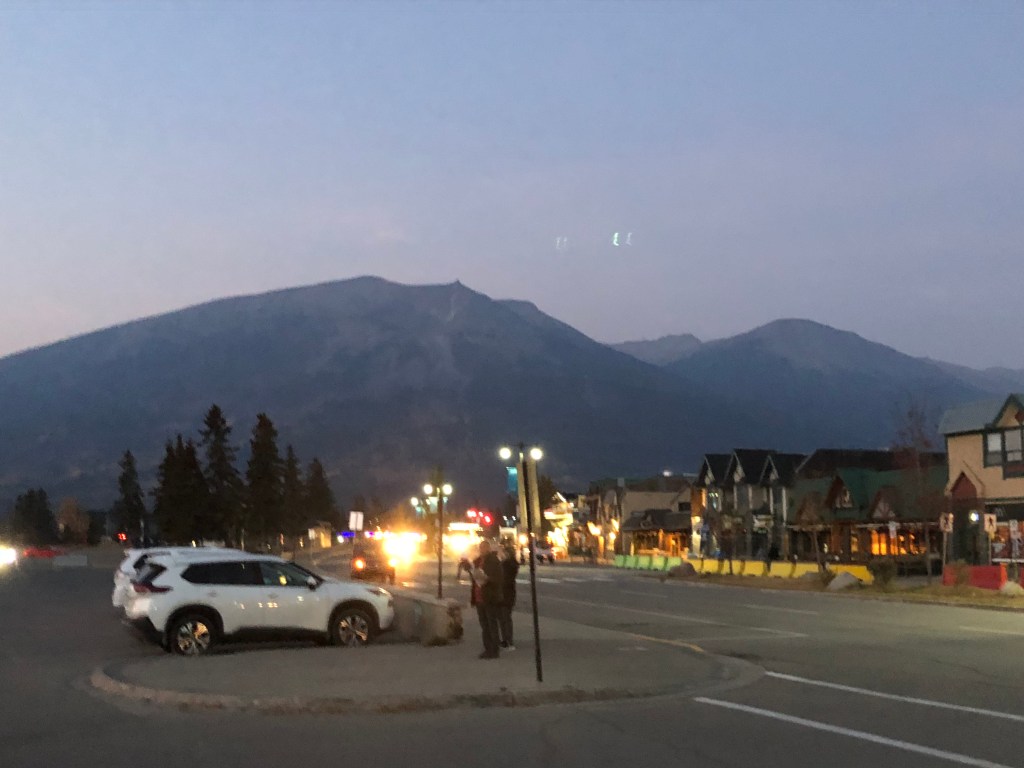
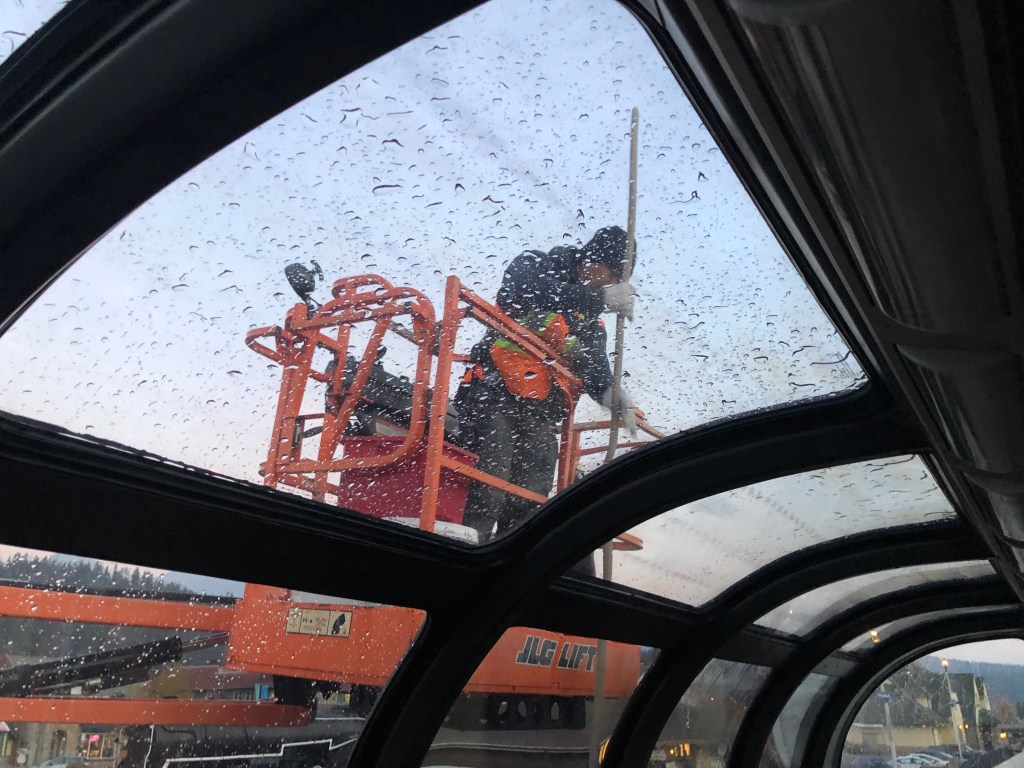
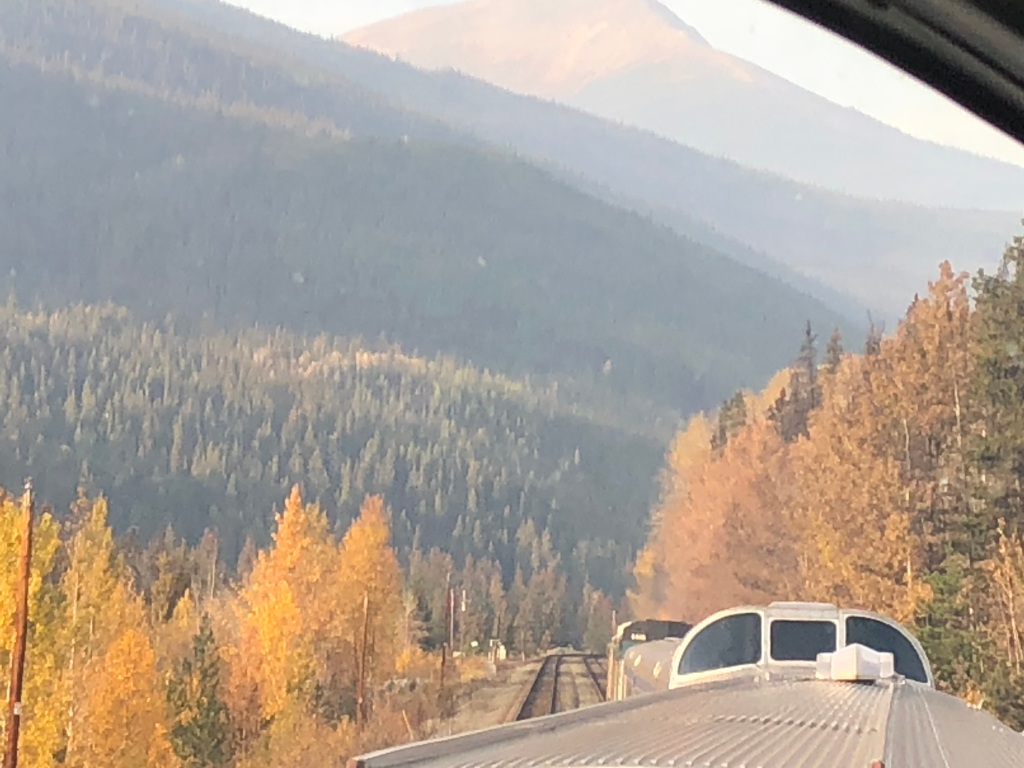
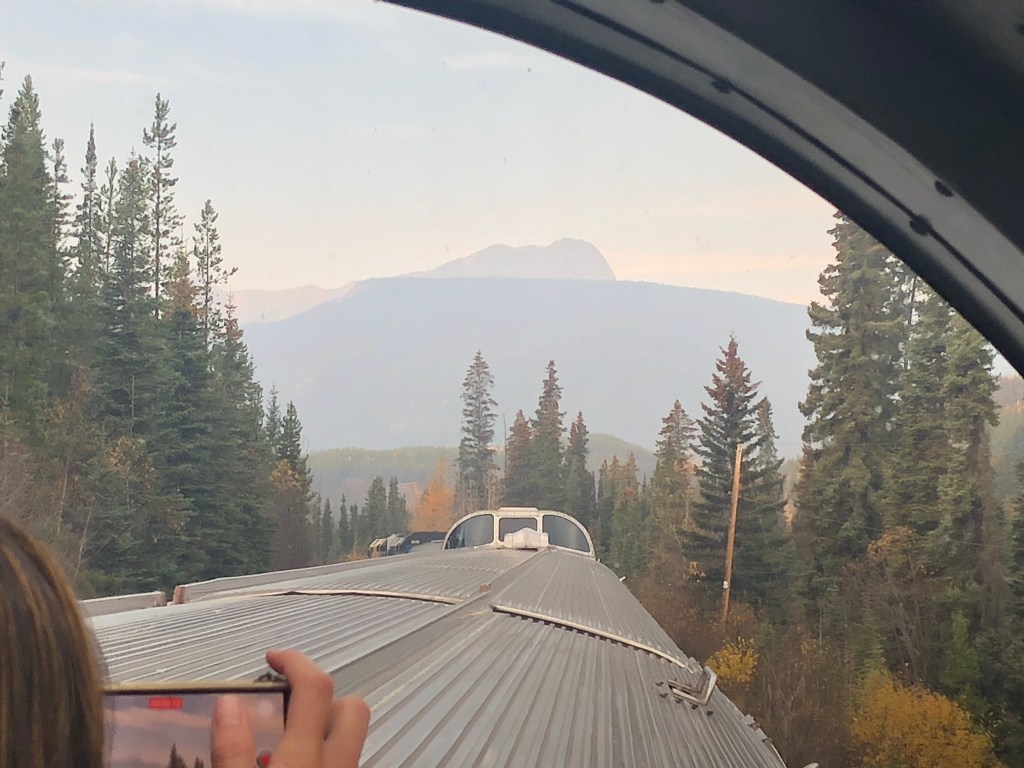
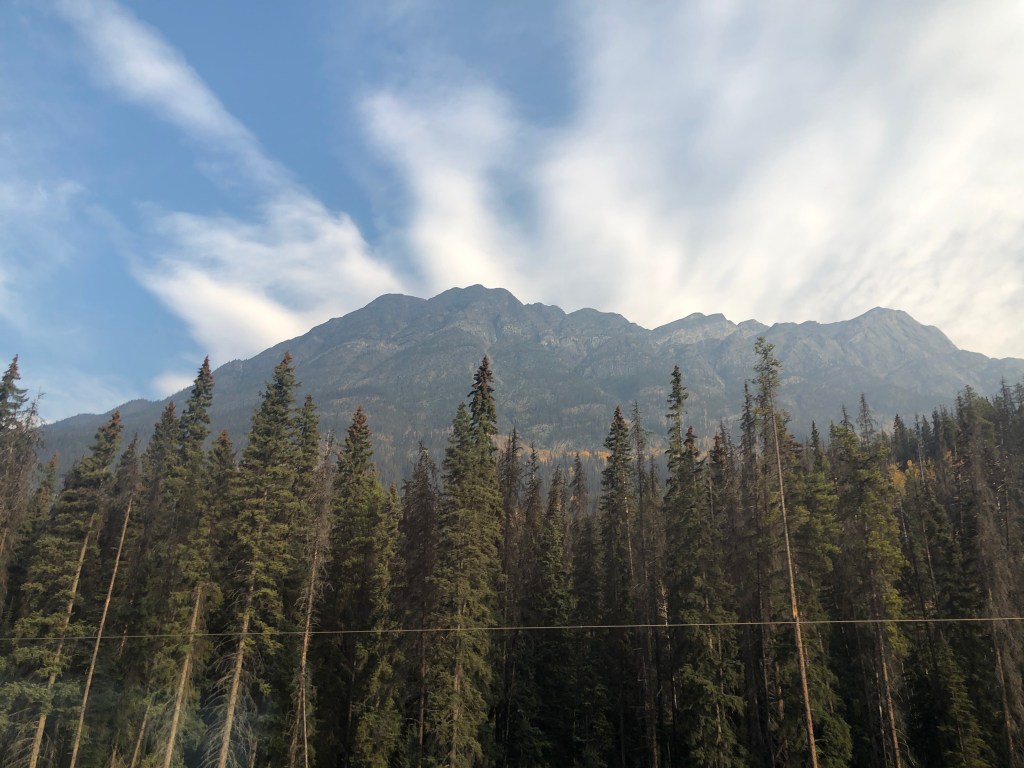
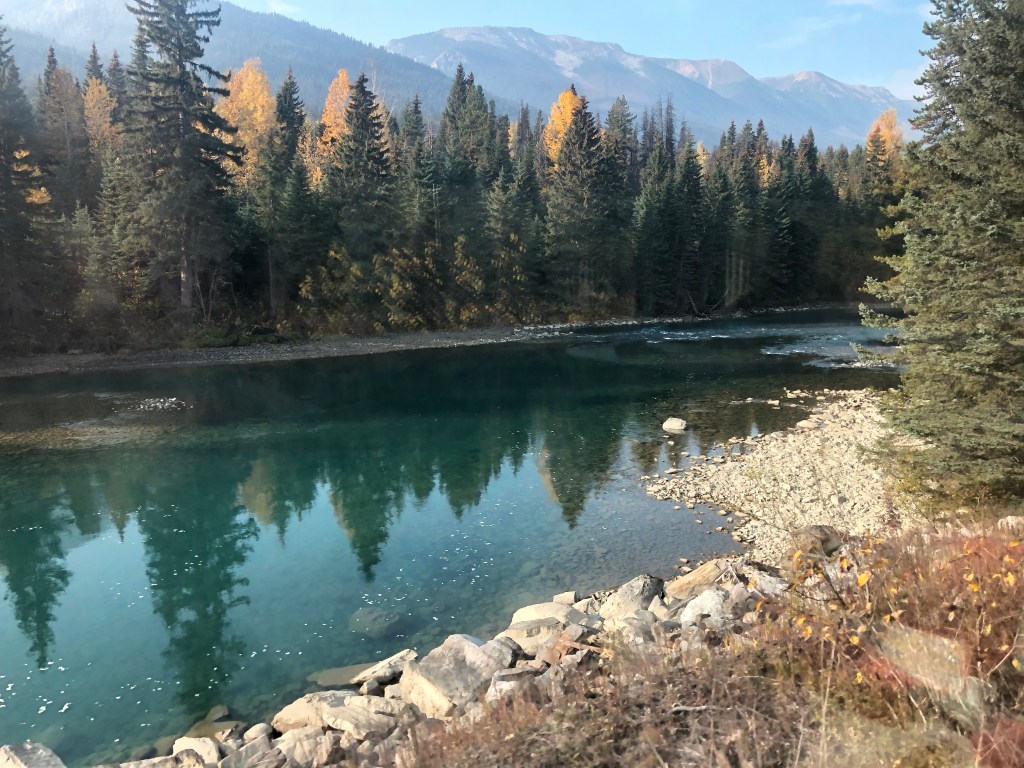
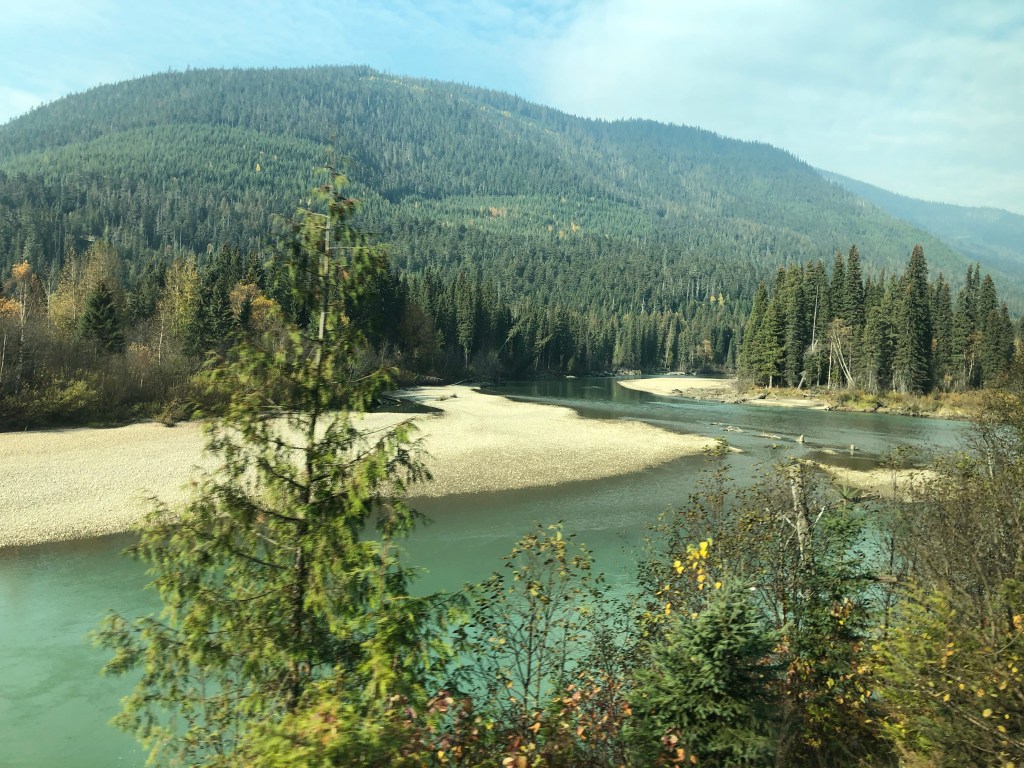
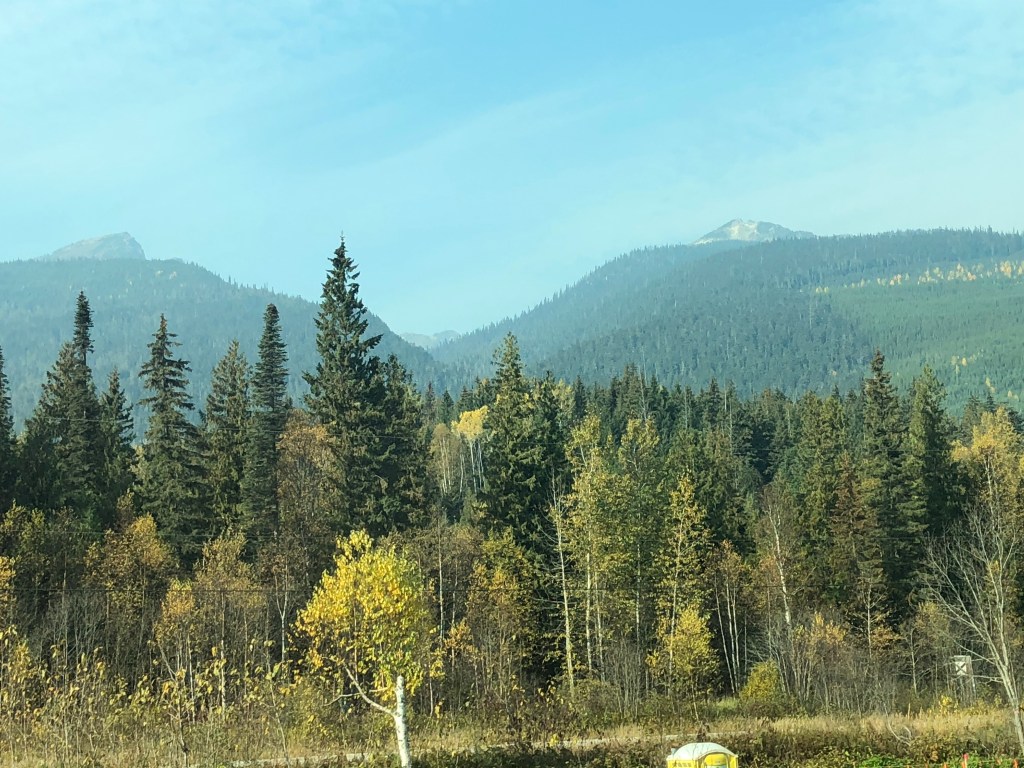
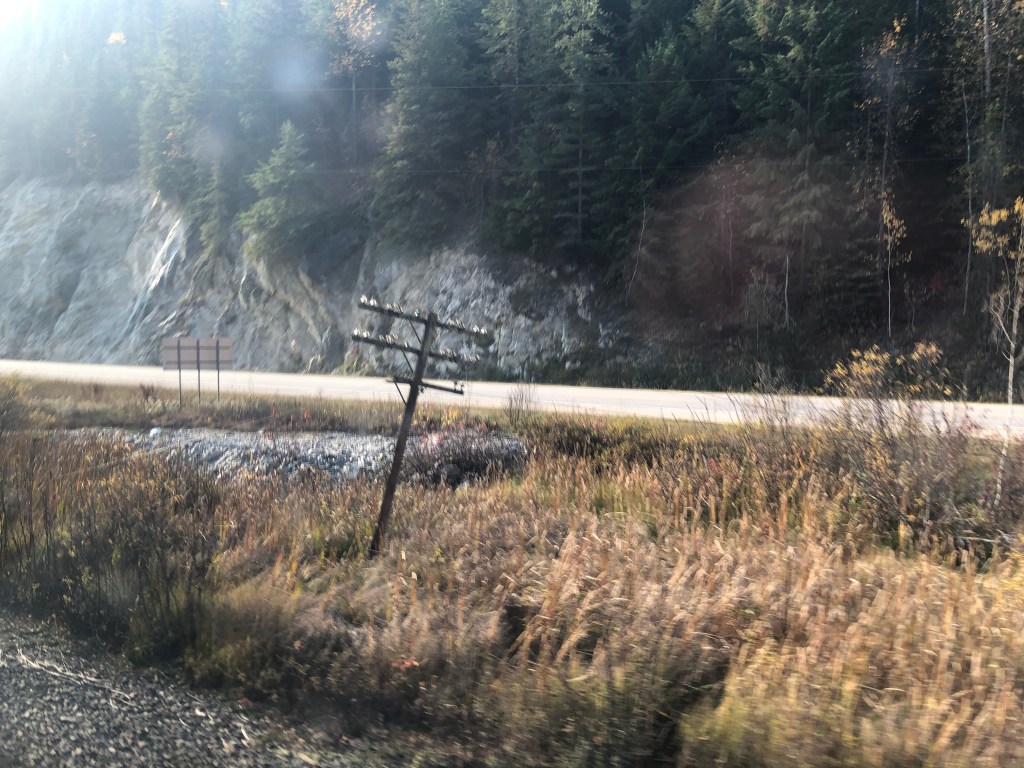
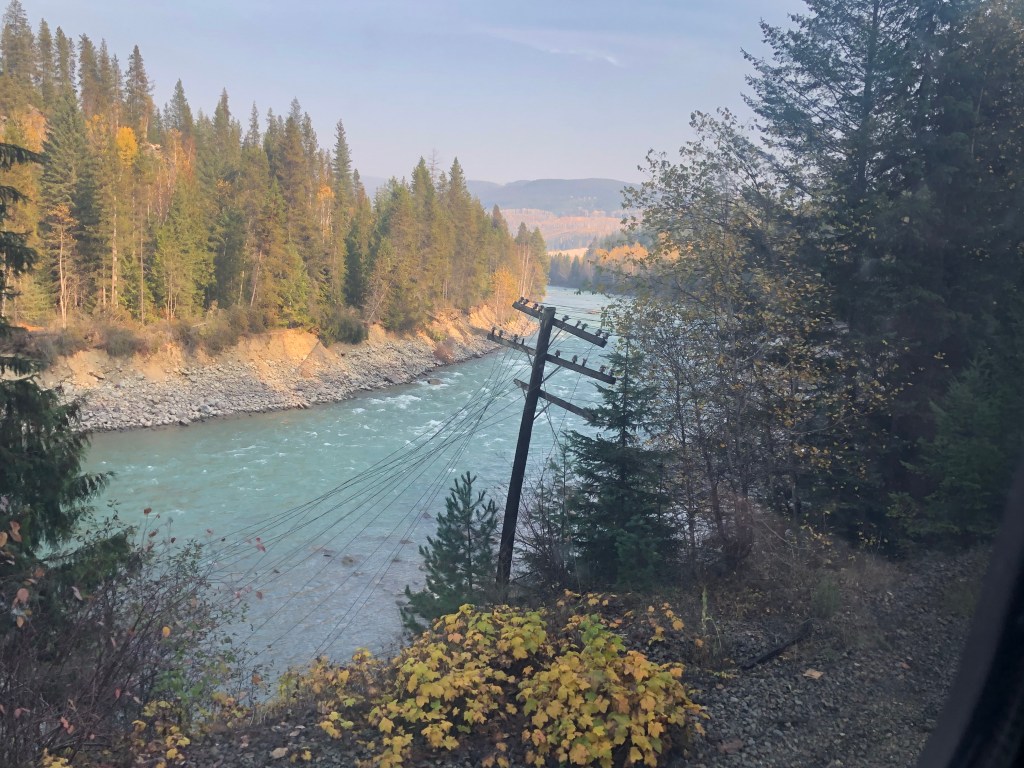
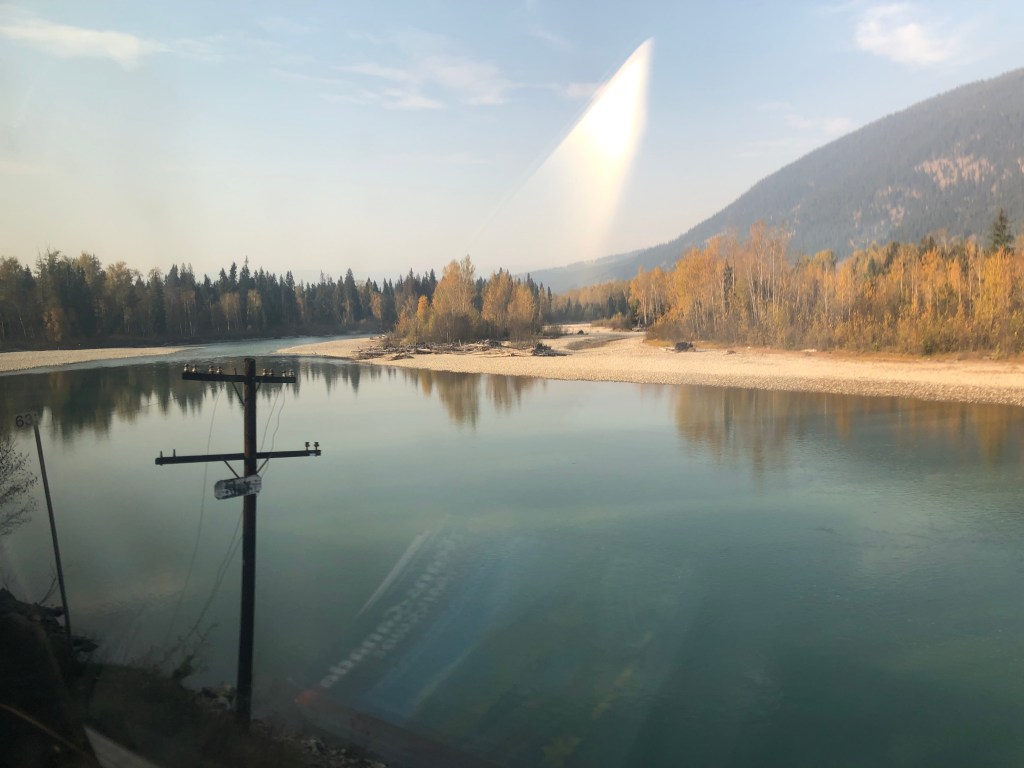
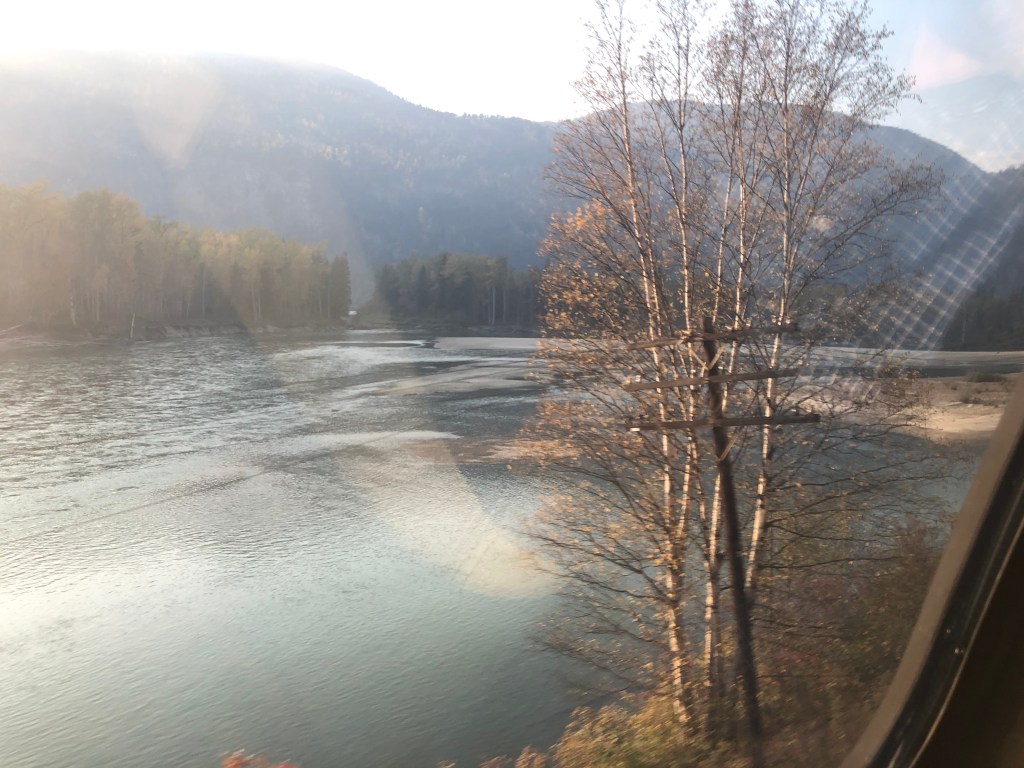
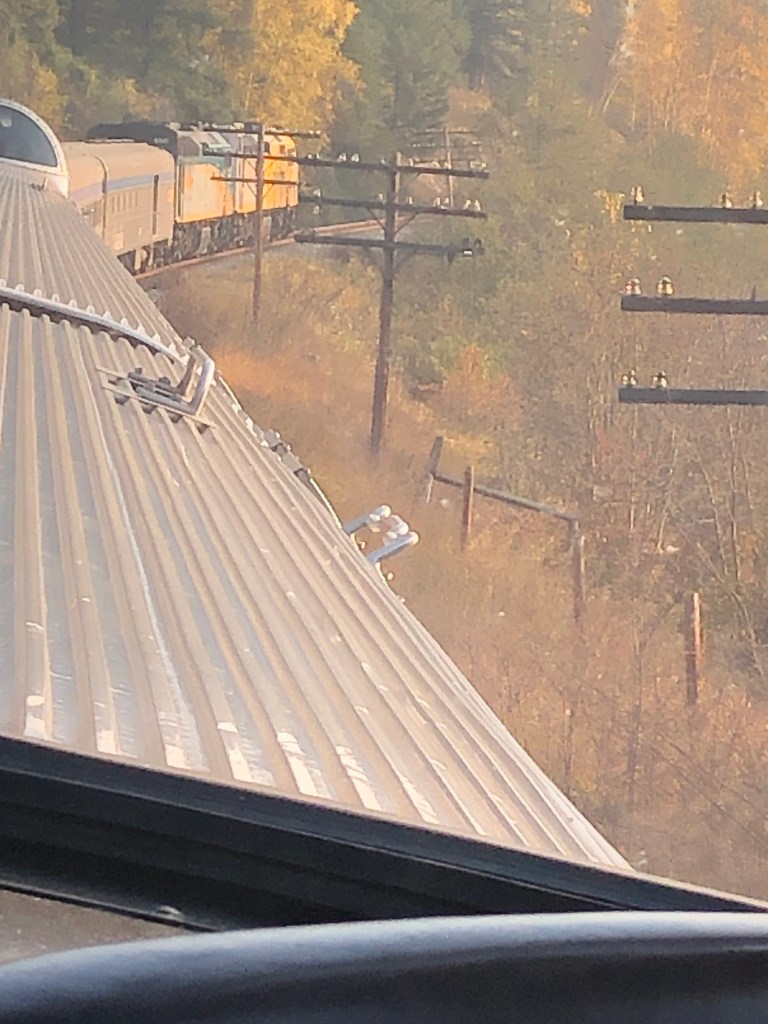
It was a patchy night’s sleep and I awoke at 5-30am as the train ground to a halt in the town of Jasper having arrived an hour ahead of schedule. There was a long stop here which would have been really nice if it had been scheduled later in the day when the town opened up. There was one enterprising gift shop that opened up along with a coffee shop but most of the town would remain in their slumbers until the train left. It’s a shame as it looked like a nice place. However, it was Rockies day and although we’d passed through quite a lot of them during the night, there was still plenty of Rocky action to come. The dome promised to extra busy today so I ignored the normal big breakfast and grabbed a few buffet items, claiming my seat early. It was a long wait until we set off. By then the place was understandably packed. The sun had risen over the mountains whilst we were stopped at Jasper giving us a preview of what was to come. It was, of course, fantastic. Mountains, trees, rivers, waterfalls, lakes and the regular sight of passing shipping containers heading eastwards on massive freight trains. Strangely enough, those didn’t spoil the view. What did spoil the view a bit was all the people in the dome car. It is perfectly understandable that they wanted to get the perfect photo but didn’t they know the I wanted to get the perfect photo too? After a while I decamped downstairs to the lounge area which was almost empty. You don’t get the stunning panoramic views that you get in the dome but at least there was no one jumping in front of me when another beautiful mountain gently sauntered past the window. After an early lunch I returned to a less busy dome car and spent most of the afternoon there. Emerging from the Rockies, we were told to put our watches back an hour as we entered the Pacific time zone. Finally I was in the same time zone as Rebecca in Victoria. The scenery remained spectacular, just not quite as spectacular as the Rockies. I became quite obsessed with the telegraph poles. Long since redundant, these poles, many with the wires still strung between them, once lined the entire track. Many of them remain in the Canadian Shield but they had all more or less gone from the Prairies. I suspect they were a valuable source of firewood for the harsh winters they have there. I was glad to see them back as we passed through the Rockies. Some have collapsed, some wires have snapped but many remain upright supporting cables that transmitted their last message many years ago. Eventually we started seeing signs of civilisation with some cultivated fields and isolated villages. This gave way to bigger settlements as we entered the furthest reaches of the town of Kamloops. As usual it took a lot of waiting and backing up to get into Kamloops. The town is a major railhead and the station part of the shunting yards so we were under strict instructions to remain on the platform. This was the last stop before journey’s end in Vancouver. There was to be just one last night onboard The Canadian.

Day Five – Kamloops – Vancouver – Victoria

I slept reasonably well. The route from Kamloops to Vancouver has, apparently some spectacular bits to it as it follows the Fraser River for much of the way. You don’t get to see that at night of course but I guess it’s nice to know it’s there. I woke at 6am just as the train pulled into Vancouver’s Pacific Central Station. It was two hours early! I suspect the schedule has the inevitable delays built into it. We had to disembark the train by 8am so there was time to pack and for the usual morning activities concerning ablutions and breakfast. Then, at 7-45am on October 20th, my 61st birthday, I stepped down from the train and headed up the platform to the main concourse. No bells and whistles, no ceremony, that was it. The rail trip was over. It wasn’t quite the end of the journey though. Collecting my suitcase, I walked a mile or so to one of Vancouver’s Transit stations, went on the Skytrain for a few stops, transferred onto a bus which took me to the BC Ferries terminal at Tsawwassen and bought a foot passenger ticket to Swartz Bay. The Spirit of British Columbia was the ferry charged with the task of navigating through the Gulf Islands to Vancouver Island and once there, Rebecca was waiting for me with her 18 year old Volkswagen Beetle, Frog. We stopped in the town of Sidney for lunch and that birthday beer before heading to my hotel in downtown Victoria. It was just a short walk from there to Milepost Zero, the start (or end) of the Trans Canada Highway. Although the other Milepost Zero is in St Johns, Newfoundland rather than my starting point in Halifax, and I’d crossed the country by train, not car, it seemed a fitting place to take an end of trip selfie there with the Strait of Juan da Fuca, part of the Pacific Ocean in the background. Atlantic to the Pacific by surface transport, TICK.

7-45am and with no fanfare, I walk along the platform and my trip on The Canadian is over…
…and I leave Vancouver’s Pacific Central Station behind.
Rebecca was there to meet me with Frog.

Postscript

It is hard to convey to you just how much I enjoyed this journey. Of course it isn’t a practical way of travelling between Troon and Victoria. After a few days with Rebecca it took me about 23 hours from leaving my hotel to walking through my front door at home. In that time I’d flown from Victoria – Calgary – London – Glasgow including a cheeky little Business Class upgrade between Calgary and London for less than half the cost of the flight out and train fares. Even if environmentalism is your thing, I can’t imagine five days on a diesel hauled train releases any less CO2 than nine hours on a Boeing 787. I didn’t take the trip for practical reasons though. The journey was the experience and for me, an experience like no other I’ve had before. I found myself getting quite emotional about the colours of the Autumn trees. I was surprised at the size of the Canadian Shield. I already knew the Rockies were spectacular but there’s nothing wrong being reminded of the fact. The biggest surprise to me, however, was just how much I enjoyed the day in the Prairies, a place where the Earth seems infinite and the skies even bigger! It wasn’t just the sights though. The staff on board both long distance trains were lovely. A special mention to the Skyline Car host on the Winnipeg – Vancouver section, Edgard, who made our days through the Prairies and Rockies even better with his knowledge and friendliness. If you ever go on this trip here’s a tip – tip! Some tipped as they went, others at the end. We Brits aren’t particularly au fait with the concept of tipping but I tipped the restaurant staff, sleeper car host and the Skyline car host before Winnipeg where the crew changes and in Vancouver when the trip ended. Another aspect of a journey like this was meeting fellow travellers. On the Ocean this wasn’t an issue as it was lightly loaded and most people kept themselves to themselves. At meals I had a table to myself and there was no dome car where people would mix during the day. On The Canadian the only way to avoid mixing with the other passengers was to stay in your cabin for the entire trip. I met some very interesting people on the way. I’m not the most gregarious of people but I enjoyed the interaction with the other passengers. Most were from Canada and the USA. There was a smattering of Aussies and Germans. One Austrian couple were on honeymoon. Surprisingly, I think I was the only Brit in our section of the train though there was an Irish chap so full of the Blarney that he knew everyone’s name and life story by the time we reached the Canadian Shield. Whilst most were towards the older end of the age spectrum and travelling in pairs, there were plenty of other solo travellers, from a young Chinese girl in her early twenties to Enid, a similar age to the only other Enid I know (my mum), who was travelling as far as Edmonton in one of the curtained bunk beds.

So, the sights, people, food and drink were great. Were there any downsides? Well yes, sleep on board a train is not the easiest. My previous experience was on the Caledonian Sleeper and I didn’t find it easy then, despite being upgraded to the best accommodation on the train. Trains are noisy, rattly and bounce around a lot. I shouldn’t be surprised at this but during the day you tend not to notice. Lying in your bed at night trying to get to sleep you do. Having said that, only one of the five nights I spent on the two trains was particularly bad. It is the price you have to pay for the full experience. Another thing to consider is that whilst tourists make up the bulk of the passengers, this is not a tourist train. The scenic highlight is, of course, the Rockies yet we passed through a good part of it at night. Then we stopped in Jasper for several hours whilst it was closed. If the Rockies is your reason for going on this train, consider The Rocky Mountaineer. That is a tourist train and is scheduled to run in daylight hours and any night stops are spent in hotels on the way. However, it wasn’t just about the Rockies for me, it was about the entire journey from Atlantic to Pacific and for that I can have no complaints. I loved it.

Taking notes…
…probably about the telegraph poles.

DC-3

Douglas DC-3. Or maybe C-47. Or Dakota

It’s been a while since my last blog which dealt with the joys of wearing a moon boot after I had done my ankle some serious mischief during a walk in the country last August. Since then the world has gradually been opening up and I have been able to do some things that are enjoyable but not, perhaps, worth blogging about. I came close to doing a trip on one occasion that might have been worth putting pen to paper, or fingers to keyboard to be more accurate, but was thwarted by the weather. Those of you who are friends on Facebook might remember my grumpy post on that particular issue, along with other mini blogs that fit that platform but not this. Recently though I managed to take my first trip out of the British Isles since December 2019. It was a short one, just two nights, but not only did it mean my globetrotting has restarted, it also ticked off a bucket list item. If I can’t blog about bucket list items, I might as well give this site up so without further ado, here’s my first blog in nine months.

Back in February I flew to Dublin to fly in a Fokker 50, a particular type of aircraft I’d not flown in before. This was my first trip out of the UK since I visited my daughter Rebecca in Victoria, Canada in November 2019. Shortly after that the C word hit the world and all future plans went out of the window. That trip to Dublin was supposed to be a big step on the road to normality but once there, a howling gale blowing off the Atlantic a hundred miles or so northwest of Dublin in Donegal put paid to the flight so I had to return home having achieved nothing. As momentous as that trip was in terms of timing, it was a huge disappointment. I had, however, already booked my next foreign adventure and whilst Ireland is abroad, it is still part of the British Isles. This time the destination was Amsterdam in The Netherlands which is also abroad but somehow more abroad than Ireland. Once again the reason was to fly in an aircraft. It wasn’t a Fokker this time, though the factory in which that Fokker 50 had been built was next door, but a DC-3. What was so special about flying in a DC-3? The following two paragraphs will give you a brief history of this type of aircraft and the particular one I was to fly in. Skip them if you want to just read about me being bounced around by the turbulence.

Old blokes in The Netherlands are much the same as old British blokes.

On December 17 1935 a new aircraft took to the skies over Santa Monica in California fresh out of the factory of the Douglas Aircraft Company. Designated the DC-3, it was primarily designed to the specification of American Airlines as the Douglas Sleeper Transport or DST, but was soon used in a more conventional daytime role as the USA’s first airliner that could transport passengers and make a profit at the same time. Hugely popular with the airlines before the USA entered World War 2, production was ramped up to an astonishing degree as the demand for transport aircraft soared. The military versions were known under a number of different designations, most commonly the C-47 Skytrain in the USAF and Dakota in the Royal Air Force. Simple and sturdy, the C-47 was of immense use to the allied forces during the war and no less a person as Eisenhower stated that it was one of the most vital pieces of military equipment used in winning the war. Over 16,000 were built including 3000 built under licence by the Soviet Union and, surprisingly, 500 or so built in Japan before that nation and the USA had a bit of a falling out. Production of the civilian version DC-3 ceased during the war and after hostilities ceased, the manufacturers were offering newer, more modern aircraft to the world’s airlines. However, there was a huge number of ex-military C-47/Dakotas going cheap and many airlines, both big and small, availed themselves of this reliable workhorse which more than other launched the post-war airline industry. For many years DC-3s could be found hauling passengers and freight on less glamorous air routes. Many new aircraft were designed as DC-3 replacements but few were successful. It seems the best replacement for a DC-3 was another DC-3. However, time took its toll and most were gradually withdrawn from service. Not all though. There are still airframes earning a Peso or two in South America. In Yellowknife, Canada, Buffalo Airways operate a number of DC-3s in the harsh, Northern climate and until 2019 utilised it on a scheduled passenger service to Hay River. Whilst there are no scheduled passenger DC-3 services any more, there is still the chance to fly in one as a number of the 80 or so still airworthy airframes offer air experience flights.

Low tail means high nose.

One of those PH-PBA. Built as a C-47 in January 1944 with serial number 19434, she was delivered to the USAF who designated her 42-100971. On June 6 that year she played her part in the allied invasion of Europe. Departing Cottesmore shortly before midnight on the 5th, Pilot Lt. Lee Ross and four other crew members delivered a ‘stick’ of 17 paratroopers to dropzone O near Ste Mere Eglise in Normandy. At 01:57 the 17 paratroopers jump into the night. Despite a bullet passing through the fuselage that had until a few seconds earlier contained the soldiers, 42-100971 returned safely to England. She would later be involved in Operation Market Garden, her first visit to The Netherlands although she didn’t land. Further paratroop dropping details over The Netherlands followed along with glider towing duties. On September 27 1944 she landed in The Netherlands for the first time. After the war she was acquired by HRH Prince Bernhard, a keen aviator and the consort of Princess Juliana, the future queen of The Netherlands. She was given the civilian registration PH-PBA and has remained on The Netherlands register ever since, seeing service with the Dutch Government, Dutch CAA and then the Prince Bernhard Alpha Foundation. Loaned to the Dutch Dakota Association and supported by Dutch airline KLM until 2016, PH-PBA is now licensed to fly 18 passengers on pleasure flights which, Covid break aside, it has been doing on spring, summer and autumn weekends for several years under the guise of DDA Classic Airlines.

The future Queen of The Netherlands is considerably younger than her namesake.

Back in the 1980s I was at an Air Display at Church Fenton in Yorkshire. At that display an airline called Air Atlantique were offering experience flights in a DC-3. I paid some money and was treated to a fifteen minute circuit. I can’t remember much about it. Years later Air Atlantique were forced to end passenger operations of their DC-3s due to European safety regulations and sent one on a farewell tour of the country. Flights were offered and I booked one from Edinburgh Airport. I drove over, entered the terminal, found the appropriate desk and was told that the flight had been cancelled due to some issue with the brakes. I got my money back but it was a bit of an anti-climax as I thought I may never get the chance again to fly in such an iconic aircraft. Roll forward to last year and I discovered the DDA Classic Airlines website. They were offering flights having somehow got round the same safety regulations that had forced Air Atlantique to stop passenger operations. I made the suggestion to my children that a voucher for one of these flights would be a good Christmas present and promptly forgot about it. On Christmas Day I was surprised and delighted to be presented with a voucher! Once the year’s flight schedule was announced I chose a day and crossed my fingers that covid restrictions wouldn’t scupper the journey. What’s more, I persuaded my friend and old work colleague Graeme to come along with me. He didn’t need much convincing. He’s just as much an avgeek as I am if not more so. Flights and hotel were booked, the DC-3 trip reserved and a keen eye was kept on the changing requirements for visiting The Netherlands. Luckily we ticked the appropriate boxes and were confident we wouldn’t be turned away by KLM or the Dutch immigration officials. The flight to Amsterdam went off without a hitch and we even had our passports stamped by a smiling immigration official on entering The Netherlands. Our hotel was the curious CitizenM just a couple of minutes from the central airport plaza. I say curious as I’ve never been in a hotel quite like it but it was comfortable, clean and they certainly came up trumps in supplying us with the airport view rooms I had requested.

Please don’t start the engine.

The DC-3 flight was the following day. Like the majority of flights offered by DDA Classic Airlines it was to depart from Schiphol but not the huge main terminal where we had arrived the previous day. We need to get a bus and head to the other side of the airport and the General Aviation Terminal. Having successfully negotiated this potential pitfall, we got off at the appropriate stop and could see our DC-3 parked amongst the business jets of the great and the good and/or the rich. When we found the desk in the terminal we were informed of a delay due to the previous flight having been held up due to the crosswinds. Surely we wouldn’t be scuppered by a mere zephyr at this late stage? Thankfully, no. Eventually one of the pilots pitched up and gave us a brief history of the aircraft in Dutch – I made out the odd word like ‘Market Garden’ and ‘Prince Bernhard’ but not much else and then we were handed high visibility vests and put on a minibus to take us across the apron to the star of the show. We were allowed to wander round and take pictures, which naturally we did, before boarding. PH-PBA is licensed to carry just eighteen passengers, little more than half the maximum number some airlines managed to squeeze in them back in the 1950s. Our seats were in Row 1 on the right hand side. One of the strange things about the DC-3 is that it is a taildragger, in other words it sits on two main wheels under the wing and a small tail wheel at the back. Not unusual back in the 1930s when it was designed, but virtually all post-war commercial aircraft were fitted with tricycle undercarriage with the main gear still under the wing but the other wheel under the nose. The taildragger arrangement meant that once we had boarded through the door at the rear, we had to walk up a fairly steep incline to our seats at the front of the cabin. Once there, we strapped ourselves into the seats, received a personal briefing from the hostess in English, and waited. All further announcements from her and from the cockpit were in Dutch but it mattered little, we were there to experience the aircraft and were not too worried about the name of the towns we were flying over.

Our seats were right next to the right hand Pratt and Whitney R-1830-92 Twin Wasp radial piston engine. This powerplant is the most produced aircraft engine ever with over 170,000 built. As it fired up I feared that we might be in for a deafening experience but whilst it was hardly a whisperer, it wasn’t really too loud and a bit of radial engine roar is all part of the experience. Graeme was sat in the window seat, although that window is level with your ribcage and gazing out of it involves a bit of contortion. I had a view into the cockpit as the pilots taxied out to Runway 04. Before we entered the runway the pilots performed their power checks, causing the aircraft to vibrate against the brakes, and we then lined up. Cleared for take off, full power was applied and we commenced our roll down the runway. In a taildragger you get the unusual sensation of the rear of the aircraft lifting off first before the main gear break free from the asphalt and this 76 year old aircraft takes to the skies. This was it! I had finally got my second (and almost certainly final) flight in a DC-3! For someone who has genetically malformed smile muscles, I was grinning like a Cheshire cat. With a sweeping left turn directly over the airport’s central area, we headed for the Dutch coast. A DC-3 doesn’t break any records with its rate of climb but we were only going to 1000ft so we soon levelled off. Being that close to the ground meant it was a bit turbulent. Once level, however, DDA Classic Airlines allow you to unfasten your seat belt, get up and walk around the cabin, pop your head into the cockpit. So what if you fall over, bang your head or suffer some other mishap – thankfully I didn’t – health and safety is assumed to be your own responsibility. With just eighteen seats it meant there were plenty windows free to look out of and of course being able to visit the cockpit itself is an avgeek’s dream. I turned to Graeme after a few minutes of being bounced around and said: “This is fantastic!”.

With regular updates on our progress in Dutch, we didn’t really have much of a clue where we were, but we managed to narrow it down to ‘The Netherlands’ due to the fact that a) we weren’t airborne long enough to leave the country at Dakota speed and b) not many other places look quite as wet as The Netherlands. The last vividly coloured bulb fields of the tulip season were a bit of a giveaway too, as was the odd windmill. We maintained 1000ft which might have caused a few problems in other parts of the world but most of The Netherlands is either at or below sea level so it was plenty high enough. A quick read of the flight instruments revealed that we had an indicated airspeed of 130 knots which, at just 1000ft, is as near as dammit to the true airspeed. Thats 150 mph for those of you unfamiliar with nautical miles and knots. With due respect to The Netherlands though, we could have been flying over a featureless desert for all we cared, the star of the show was the DC-3 and we couldn’t fail to observe every nook and cranny of her whilst the towns and country of North Holland (we think) region passed serenely below. Eventually it was time to strap in to our assigned seats for the approach and landing back at Schiphol. This time I had the window seat whilst Graeme observed the pilots doing their thing. As mentioned, the window is not conveniently placed at eye level so to get the views I had to ‘sit’ in a rather prone position but as it was almost certainly my last ever landing in a DC-3 I wasn’t going to let a bit of discomfort get in the way of observing it. The main gear gently touched terra firma a mere 34 minutes after they had last made contact with the same strip of asphalt we had departed from. The tail wheel soon followed and we taxied back to the GA apron to park amongst the business jets of the wealthy. Nice though those Learjets and Gulfstreams were, if I were a multi-millionaire I’d be looking for a DC-3 as my personal runaround. Not very practical for getting to that important business meeting in Los Angeles perhaps but a damn sight more fun.

We had to return the hi-viz vests but we did come away with a certificate and a souvenir hat pin of a DC-3 which I would proudly stick on my headset if I was still working. Naturally I’ve got several hundred photos and several videos to look back on but the main thing to take away is, of course, the memories. Now, is there anyone offering flights on a DC-4 or a DC-6?

Time for bed

Just for good measure, here are a couple of three and a half minute long videos of the landing and take off.

Graeme’s video of the take off.
My video of the landing.

Postscript: whilst this trip was all about flying in an old aircraft, as mentioned in the first paragraph it was also significant in that it has restarted my globetrotting adventures. I love going abroad and have missed being able to do so. That’s not to say I’ve been totally housebound over the past couple of years, I’ve been able to do plenty of things in the UK as and when restrictions allowed and I dare say I’ve come to appreciate this great nation more as a result. There is just something special about stepping just a little bit outside your comfort zone though. Even Amsterdam, which is surely one of the easiest foreign cities to visit, throws up challenges to an irregular visitor like me. What tickets to get for the trains and buses, where to go to find decent food, how to avoid falling into the canals, how to try and avert your eyes at some of the window displays and so on. It’s made just that little bit harder when you are out of practice when it comes to foreign travel. I’m glad to say, however, that between us, Graeme and I worked things out quite quickly, even if we did end up inadvertently ‘stealing’ a couple of bus rides as our travel cards didn’t include that particular bus route. Whilst we only popped into the city on the evening after the DC-3 flight and the following morning, it was good to see a major European capital in all its sometimes naughty and frequently aromatic glory.

Moon Boot

A few weeks ago, on the 28th June to be precise, I decided to go for a walk. I’ve been on plenty of those before of course and not many of them are worth blogging about. Had this one gone to plan I may well have had an interesting tale to tell about discovering 77 year old aircraft wreckage but unfortunately it didn’t go to plan at all. In the Ayrshire countryside there are the remains of quite a number of crashed aircraft from the 1940s and 50s. Nowadays air crashes are thankfully few and far between and investigators endeavour to collect any bits of wreckage that remain to try and piece together the events that led up to the accident. Back in the war, and the years following it, there were not the resources to do that and as such wreckage remains in the more remote locations to this day. One such wreck is that of a Hawker Hurricane which crashed to the south of Loch Doon on 24th March 1944. Sadly, the pilot, FO Roswell Murray MacTavish of the Royal Canadian Air Force lost his life in the crash. He was 24 years old. A bit of internet searching revealed that a small amount of wreckage including the Merlin engine, along with a recently built stone cairn memorial, is in forestry commission land near Loch Doon. So it was on that Monday back in June that I decided I’d go and find it. Spoiler alert: I didn’t. If I ever do I’ll write another blog about it.

There was one thing different about this walk. I was going to do it solo. Normally I have Elaine as a walking companion as it is decidedly more fun walking with someone. On this occasion, however, as she was working I thought I’d set off by myself on the eight mile round trip from the car park by Loch Doon Castle. It was a nice day with broken sunshine, pleasantly mild temperatures and I had packed an extra Mars Bar so was all set. The route is nearly all on gravel forest tracks with gentle inclines but nothing challenging. The views of the loch are fantastic and whilst it was a there and back walk rather than the preferred circular, I was quite enjoying myself. Once past the southern limit of the loch I didn’t see another soul and I dare say I was actually appreciating the solitude of the place. Eventually you have to leave the gravel road and traverse an area of felled woodland. There is a rough track to follow which I did. This should have quickly led me to the wreckage but in hindsight I must have walked straight past it without realising. The trail split. I followed one of the forks. I had to negotiate some small burns and piles of forest debris before the trail ran out. I turned around to retrace my steps, leapt over a small burn, caught my right foot in some of the forest debris and went over on my left foot, twisting the ankle in the process. I swore a great deal in the hope that it would help but it didn’t. After the intense pain had subsided a bit I took stock. I tentatively got up and discovered my right leg was good. Putting some weight on the left foot, however, proved much trickier. I could do it though, just about. I hobbled forward a few steps. Not easy but doable. A hundred thoughts went through my head, one of which was to call for help. I looked at my phone. No signal. Could I wait until someone else pitched up and hope they could help in some way? It could have been a few days before anyone else ventured out that way and I only had one spare Mars Bar. No, I was going to have to try and hobble back to the car some four miles away.

The wreckage is, apparently, visible in this photo. I somehow walked past it and ended up near those unfelled trees on the right which is where the fall happened.
Not ideal terrain for walking with a broken ankle.

I am, of course, an idiot of the highest order. I still hadn’t found the wreckage and even with my damaged ankle I felt it would be a shame to not see it now. I hobbled back to that fork in the tracks and went up the other one. In my catalogue of foolish things I’ve done, this decision has to be up near the top. It was painful, the path was dangerous to walk on and it was taking me away from where I really needed to be. What’s more, it proved fruitless. I’d already unknowingly passed the wreckage before the fall. I admitted defeat, which if I’m honest was almost as upsetting as knackering my ankle, and did my best to negotiate the horrible forest trails back to the road, obliviously passing the wreckage once again. Once on the gravel road I hoped the going would be a bit easier. It was, but only a bit. Every second step was a sheepish one, every bit of loose gravel was to be avoided and there was plenty of that. Had a forestry commission chap driven past in his pick up I would have flagged him down and asked for a pick up. Not a soul came by or near me. I made it back to the car, hugely relieved. It had taken a while, time for me to reflect on all the what could have beens. It was actually quite scary. Still, I’d made it back to the car and thanks to it being an automatic, I could drive it home with a redundant left foot. It was a fifty minute drive and by the time I arrived the ankle had swollen up so much I could barely get out of the car. Eventually I settled down with my leg up, ice on the ankle and a dose of ibuprofen to quell the inflamation. Yes, my tendons and ligaments were nobbled but they would get better over time.

Things are never that simple. Sharing my cautionary tale with the world led to calls for me to go and get it seen at A&E. I resisted at first as it was ‘only’ a sprained ankle but the clamouring got to such a level that the following day I reluctantly phoned 111. Come and see us at 2pm they said so I drove out to Ayr Hospital to be assessed. A quick prod and an x-ray later I was given the diagnosis. I had broken my ankle. To be precise it was the distal fibula which is the bottom of one of the two bones that make up your lower leg. Thankfully, this was not a weight bearing bone. Had it been I’d probably still be on the hillside right now. It did, however, need to be fixed. To be precise, it needed to be protected so it fixed itself which meant no ibuprofen – I didn’t even get that bit right – and the wearing of a contraption called a Moon Boot. It’s probably got another more clinical name but Moon Boot makes people smile so I’ll stick with it. It is designed to restrict movement and redistribute weight on the offending bone allowing it to heal quicker. It also helps prevent any strained ligaments from further damage so all in all it’s a good idea. A pair of crutches were also provided to help me walk. I wasn’t particularly happy receiving these NHS freebies and it took a while to get used to being an invalid. You don’t have to wear the boot all the time – it’s not exactly practical to sleep or shower in it – and I didn’t wear it about the house very much. This was probably a mistake but hey. A week later I had to attend the fracture clinic where doctor sent me off for another x-ray and confirmed the diagnosis made as A&E. The bone was indeed fractured and that I needed to wear the boot for six weeks. Oh great I thought. I did make the assumption that one week had already passed so set the boot free day some five weeks hence.

Ironically, following months of Covid restrictions, things had started to open up and I had things to do. A number of those were walks which were right out but I was buggered if I was going to let a damaged ankle get in the way of others. Eleven days after the accident I flew down to London – my first trip on a commercial airliner for seventeen months – to go to a cricket match at Lords. So many things had happened that suggested this trip might not happen, a broken ankle being just one of them, but I wasn’t going to be denied something I’d been looking forward to for many months. By then I’d ditched one of the crutches as it only complicated the walking process. I’d got used to walking in the boot. It had taken a few days to get used to it but once I’d begun to trust it, it became relatively straight forward. The single crutch was useful occasionally but was actually more use in clearing a path and showing everyone else that there is a cripple in the vicinity so mind how you go. At the cricket it proved useful to get me, and my sister Jill who I’d met up with down there, to push in to the front of queues. After a delay due to the English summer weather the cricket started and it was just wonderful to be at an event again, even if my left leg was getting in other people’s way. A few days later I went to another cricket match. This was at Old Trafford and I was accompanied by Jill again. By then I wasn’t even using one crutch. One of the stewards still took pity on me and led us to the front of the queue which was good. Not so good as I’d break my ankle again on purpose but good nevertheless.

EasyJet doesn’t have the greatest legroom in the world but you can just about squeeze in a moon boot.

That game was a prelude to a five night holiday I had planned with Jill and our mother. That was down in Dorset and off we set the following day. A word about my mum. She’s getting on a bit and is not the most mobile of people. As such we took both her walking frame and wheelchair. As a result both tourists and locals alike were most amused to see a man in a moon boot pushing a lady in a wheelchair along the promenade at Weymouth every day. One evening I swear we were the cabaret act in a Weatherspoons pub we’d popped in to for a gentle half pint. Despite mum’s protestations at being propelled around Dorset by someone with a dodgy ankle, we made the most of the time there, riding on boats and trains, visiting military museums – I somewow managed to get inside a tank which was probably a daft thing to do – taking in National Trust properties and even reliving the French Lieutenant’s Woman in Lyme Regis. The boot put in some hard miles and despite it starting to shed bits and pieces, stood up to the challenge well.

Me, my mum and a tank. Only one of us managed to make it inside.
The French Lieutenant’s Woman would, I think, have been improved had Meryl Streep been wearing a moon boot.

By the five week mark I was back at home. I must admit that I wore it little, if at all, in the seven days prior to Boot Freedom Day. To be fair I didn’t do much. We had the decorator in and the Olympics was on the telly so no major journeys were planned. On the day itself it was unceremoniously chucked in the bin as it was of no great use to anyone any more and it now presumably resides in the local landfill site. The crutches were returned to the physio department at Ayr Hospital, much to their surprise as most people tend to keep them, and I faced a future without medical aid of any kind. Most of the time it feels ok as long as I don’t try and flex it too much. I’ve been on a few local walks, building the distance up each time. At the moment, some eight weeks after the event, I can comfortably cover five miles on an even surface before the ankle starts to suggest that it has had quite enough exercise for the time being, thank you very much. I hope to increase both distance and severity of the terrain over the coming weeks. Who knows, by my birthday in October I might be hiking up Munros once more, though realistically that is more likely to be a 2022 pastime. If it is, I won’t be doing it solo.

After six weeks I think I’d probably got as much use out of it as I could.
Farewell old friend.
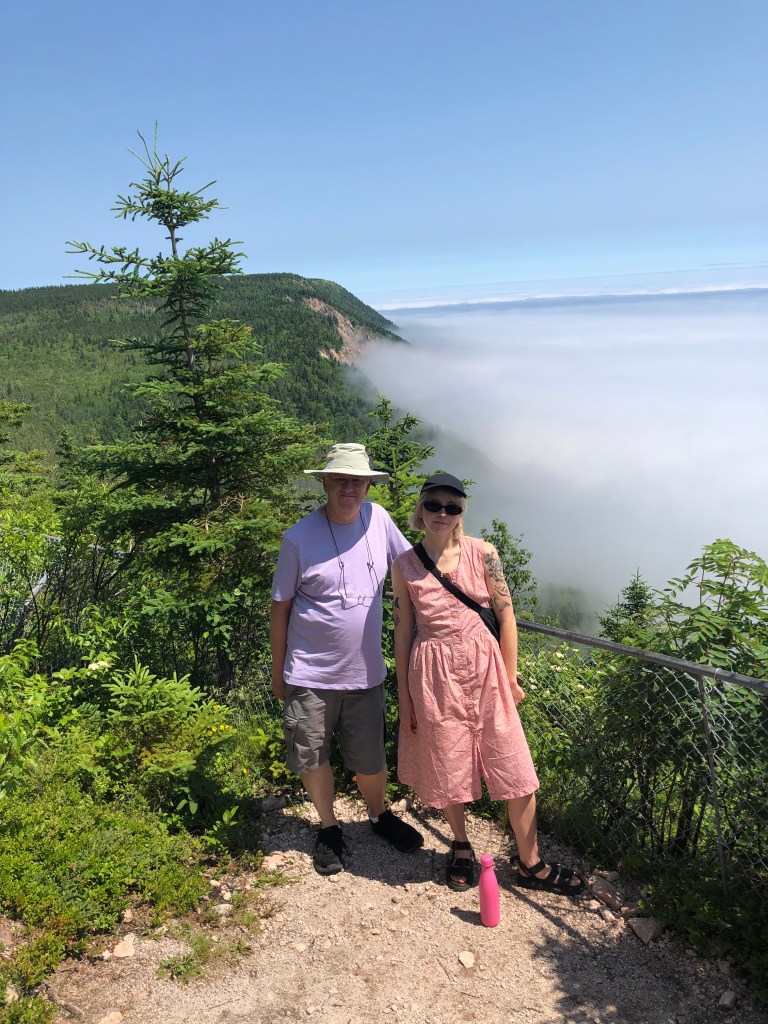
Olympiad

It’s been getting on for eight months since I last wrote something for the blogging site and even that was just a silly observation about a song lyric. That’s the problem when there’s only one thing anyone is talking about, something that has put countless lives on hold for the past seventeen months. I could blog about that but I suspect those of you who read these little missives are as sick to death (not literally I hope) of it as much as I am. However, the world is slowly seeing sense and returning to some semblance of normality, albeit at snail’s pace, and Doing Things is itself a thing once more. Ironically, the subject of this first blog in an age is the Olympic Games, a Thing that everyone could Do by watching the telly which would have been possible even in the dark depths of a severe lockdown. That the Games’ ending ending coincided with the “Nearly But Not Quite ‘Cos We Don’t Really Trust You Freedom Day” in Scotland is purely coincidental of course but at least I don’t now have the tricky decision to make as to whether I watch the dancing dressage horses or head to an all-night rave at the local discotheque. 

I happen to like the Olympics. Not everyone does. I’ve had it explained to me that I never show the remotest bit of interest in the aforementioned Dressage in the four (or five) years between Summer Olympiads. Nor do ever even acknowledge the existence of competitive canoeing whilst I actually go out of my way to avoid boxing. Even athletics, which for many people is the only sport that really counts at the Olympics, provides only a passing interest to me in non-Olympic years. This is true, guilty as charged. Far from this being a reason to not like the Olympics, however, it makes it all the more interesting as far as I’m concerned. Who knew horses could dance? Well, I did as I’ve been watching Olympic Games since 1968 when I was six (I was two in the summer of 1964 so memories of the first Tokyo games are somewhat unreliable) but four years is a long enough time to forget about piaffe pirouettes so it’s like a voyage of discovery every time. Not only is it interesting seeing some other sports for a change, it is a chance to be patriotic and whilst Team Great Britain And Northern Ireland (Team GB for short, apologies to my NI pals) is still a thing I’m damn well going to be cheering them on. So what if our thirteen year old skateboarder is actually from Japan, if she’s wearing a Team GB uniform and the Union Flag is raised at the medal ceremony, I’m delighted both for her and my country. 

I’m nothing if not patriotic.

As mentioned in the above paragraph, my first Olympic memories came from the 1968 games in Mexico. I can distinctly remember David Hemery winning the 400m hurdles for GB. It was one of five Gold Medals won by Great Britain which, along with five Silver and three Bronze put GB tenth in the medal table that year. Those of you who can’t really remember further back than London 2012 might feel that five golds and tenth place overall was a rather paltry return for a fine, sporting nation like GB. You’d be right of course but we were nothing if not consistent. In the seven Olympic Games to take place between 1968 and Barcelona 1992 GB finished between 9th and 13th in the medal table achieving five Gold Medals in five of those tournaments, four in one and just three in another. 1996 proved to be a low point with just the one Gold Medal and 36th in the medal table. Since then, thanks in part to the use of National Lottery funding, things have improved with eleven Golds on 2000 and nine in 2004, tenth place in the medal table on both occasions. In 2008 though things really got better with nineteen Golds and fourth in the table. Then, in 1012 with the Olympics on home soil, GB won a remarkable twenty-nine Gold Medals, finishing third in the table. Hosting the tournament obviously had an effect but GB went one place better in 2016. Despite winning two fewer Golds – twenty-seven – only USA finished above GB in the medal table and the overall medal count was two higher than in London at sixty-seven. Second place above China, who’d have predicted that?

I have memories from all those games starting with that David Hemery 400m Hurdles Gold in 1968. Mary Peters winning the Pentathlon at Munich 72, “And it’s WILKIE” shouted by Alan Weeks four years later in Montreal. The Ovett/Coe battles in Moscow 80 and another rivalry between Tessa Sanderson and Fatima Whitbread in Los Angeles 84. In Seoul 88 it’s Barry Davies’s immortal line “Where, oh where were the Germans. And frankly, who cares”. Barcelona 92 gave us Linford Christie and Sally Gunnell and Atlanta 96 gave us Steve Redgrave’s fourth Gold Medal on the trot, though very little else. From Sydney 2000 onwards it is hard to choose. Redgrave’s fifth and final Gold Medal sticks out though, not bad for a diabetic. “You’ve won Kelly, You’ve won” – Kelly Holmes double Gold was the big story in Athens 2004, Rebecca Addlington achieving the same feat in the pool at Beijing 2008. What to choose from London 2012 though? With so many golden moments, I’ve got to plump for Super Saturday with three athletic Golds in one session, made all the more memorable by the fact I’d applied for tickets for that session in the ticket lottery the previous year. I was unsuccessful. Allow me another golden moment though, GB’s utter dominance of the Track Cycling events. Take a bow Chris Hoy. As for Rio, Hollie Webb’s winning penalty in the Women’s Hockey Final is my favourite of many good memories though Max Whitlock’s two gymnastic Golds, secured within a few minutes of each other, comes close.

And so to Tokyo 2020. There was much to dislike about it. It took place a year late for a start. The global pandemic had caused that but was still on hand to taint the event once it started. The stadia were devoid of spectators, the joy of medal ceremonies was tainted by the masks the medallists were forced to wear, competitors had to fly home once their events had ended rather than being able to cheer on their compatriots in other sports. There were other, non-covid issues too such as Russian athletes competing under the flag of the Russian Olympic Committee and the murky waters of biological men competing in women’s competitions. With Tokyo eight hours ahead of the UK, much of the day’s action had taken place by the time I woke up and was all over shortly after lunchtime, not ideal for viewers in Europe and worse I suspect for those in North America. There was little build up to it and I was also away on holiday when it started so it rather crept up on me. And yet… I rather enjoyed it.

Going into the games GB’s aspirations were tempered somewhat by the uncertainty caused by the pandemic. Also, the generation that had benefitted from lottery funding and done so magnificently over the previous three games were getting on a bit. They were leaving some very big shoes to fill. As it turned out, some old favourites proved they weren’t past it whilst there were indeed others coming through the ranks. GB won sixty-five* medals, the same number as in London nine years earlier and only two less than Rio although it is only fair to add that there were more medals on offer this time round. ‘Only’ twenty-two of those medals were Gold, however, which pushed GB down to fourth in the medal table behind USA, China and Japan who took full advantage of the host effect just like GB had done in London. Cycling again produced the most golds but GB’s dominance in the velodrome was much less than in the previous three games. Three of the six Golds won by British cyclers were in the fresh air – two in the women’s BMX competition and one in the men’s Mountain Bike, all the more impressive as those disciplines receive just a fraction of the funding that the track cyclists get. Rowing, always good for a gold or two in the previous few games, had a bad games with just a Silver and Bronze whilst Athletics failed to produce a Gold for the first time since the dark days of 1996, though the squad had some rotten luck with injuries to a number of their top rated athletes. Thankfully swimming, something of an underachieving sport over the years, picked up the baton winning four Golds out of a total of eight medals, the best return from the pool since the days of woollen swimming trunks. One of those Golds (and no less than three Silvers) was won by Duncan Scott who learnt to swim at Troon Pool so I’m expecting a gold post box in the town soon. Sailing has done well for GB over the years and delivered once again with three Golds whilst the equestrian set contributed two to the total, including one for Huddersfield lad Oliver Townend which particularly delighted me. Two Golds too for Modern Pentathlon, a curious mix of sports, including taming disobedient horses, where Kate French and Joe Choong won the women and men’s events respectively. Max Whitlock’s outstanding performance on the Pommel Horse was great drama seeing that he was the first to go and we had to watch seven others try, and hopefully fail, to perform to his level. There was a Gold apiece for the Men’s and Women’s boxing which saw me saw me shouting “Knock his/her block off” at the telly on more than one occasion. And let’s not forget the 27 year old Tom Daly, who seems to have been around in his minuscule trunks for decades, finally getting an Olympic Gold with partner Matty Lee by managing to cram many twists, turns and rolls in the 1.5 seconds between jumping off the platform and hitting the water. So plenty of memorable moments, all fresh in the memory as they only happened a couple of weeks ago. If I’m going to pick one, however, it has to be in the velodrome. The Madison race is, to the uninitiated observer, just a load of cyclists going round the track, some slow, some fast. Thankfully, in the women’s race Laura Kenny and Katie Archibald know how it works and absolutely annihilated the rest of the field. At least that’s what the commentator said and who am I to suggest otherwise? This was Laura Kenny, formerly Laura Trott’s fifth Gold Medal. Her husband Jason Kenny would later win his seventh in the Keirin event on the same track. That’s some amount of metalwork in the Kenny household. It’s surely has to be Sir Jason and Dame Laura in the New Year’s Honours List.
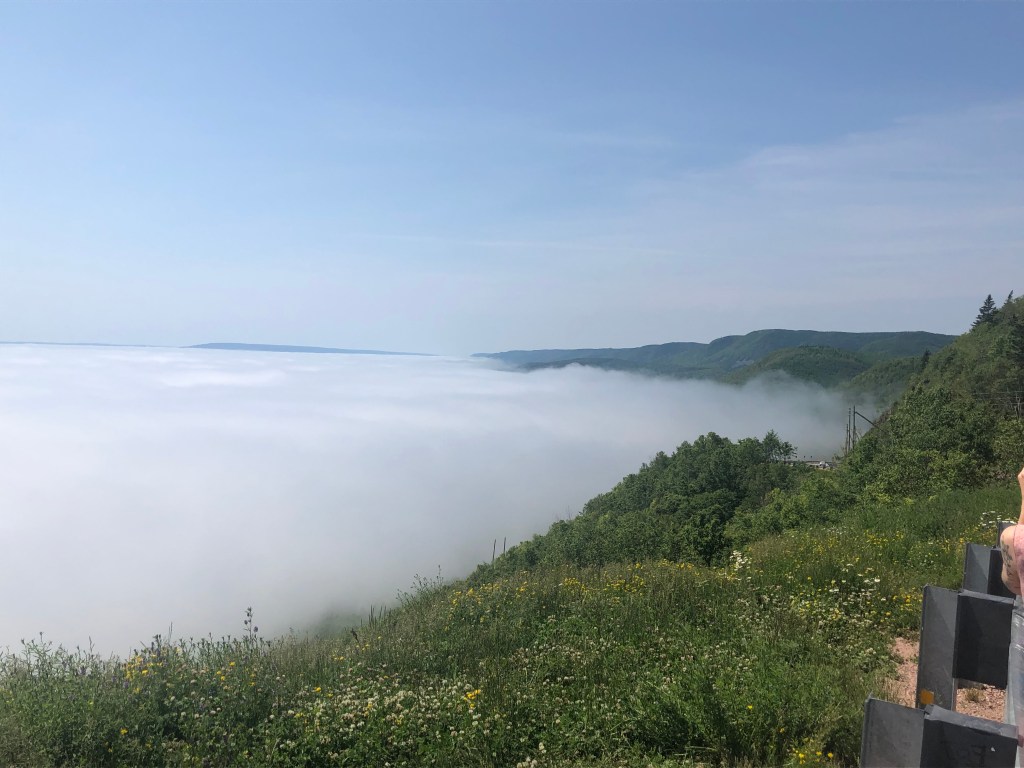
Albie is not going to be short of things to take to Show and Tell, is he? (Not my picture unfortunately)

One advantage of the 2020 games being delayed is that it’s only three years until the next one. It’s in Paris which is a lot handier than Tokyo and who knows, the world might have learned to live with Covid by then. I’ve decided I’m going to go. I decided I was going to go to London in 2012 and that didn’t exactly go to plan but Paris, I’ll be there. Maybe.

*GB’s medal tally of sixty-five is likely to be reduced to sixty-four following a positive drugs test on a member of the Silver Medal winning 4x100m relay team. Chijindu Ujah had traces of S-23 and Enobasarm in his sample. I’ve no idea what those substances do but if confirmed, Chijindu, you utter dope.

Cecilia

As Covid continues on its grim path, finding subjects to blog about is becoming increasingly hard. I might be dredging the bottom of the barrel with this one, coming as it does on the back of an ear worm that lodged itself in my brain the other day. Unlike other ear worms, which can be really annoying and impossible to cast from one’s mind, this one got me thinking. I first encountered the song in the mid-seventies where my teenage self wasn’t really much of a music buff. One of the first LPs I owned was hardly the sort of thing the cool kids were listening to. Neither was it prog rock which was waiting for me just over the horizon, right about the time it became the sort of thing that cool kids were no longer listening to either. No, this was Simon and Garfunkel’s Greatest Hits album. The last track on that compilation was Cecilia, originally released in 1970 on the Bridge Over Troubled Water album, just before the New York folk-rock duo split up for the first but by no means the last time. At a little over two and a half minutes, it doesn’t take up much of your time to get acquainted with it though I suspect nearly everyone will know the song anyway. I suspect it might have become an ear worm in some of you after you read the title of the blog. If not, have a look at this You Tube video:

All very well and good but what is so significant about it that it gets a blog of its own? It’s the lyrics. They trouble me. Sung in the first person, is it safe to assume that these are the words of the songwriter Paul Simon? If so I applaud Simon’s forgiving nature. The song starts with the chorus:

Cecilia, you’re breaking my heart, you’re shaking my confidence daily,

Woah Cecilia, I’m down on my knees, I’m begging you please to come home,

Come on home.

This has established that Simon is missing Cecilia and would really like her back, despite her destroying both his heart and confidence. We’ve all been there. Not necessarily with Cecilia of course although looking at the rest of the lyrics I suspect she’s broken a few hearts over the years. There’s only two verses, the first of which recalls the fateful afternoon where Cecilia gave a good shake to, amongst other things, Simon’s confidence. Here’s my thoughts:

Making love in the afternoon, with Cecilia up in my bedroom,

No problem with this bit. Cecilia is quite a catch it would appear. Why waste time waiting until bedtime to make love when the afternoon is free. And when it comes to the location for said rumpy pumpy, where better than your bedroom?

I got up to wash my face,

Erm, ok, just what type of carnal activity are Simon and Cecilia indulging in that he need to take a mid-coital break to give himself a face wash? But hey, it was the height of the hippy era, a time for experiment though not necessarily one for cleanliness it has to be said. I’ll let it pass as it pales into insignificance as to what comes next:

When I come back to bed someone’s taken my place.

What??? In the minute or so Simon is washing God knows what off his visage, some other bloke has snuck in to the room and he and Cecilia are at it like rabbits. We then get another rendition of the chorus which seems to suggest that despite the freshly broken heart and violently shaken confidence, Simon is so obsessed with Cecilia he is not only willing to forgive this indiscretion, he is desperate for her to ‘come on home’, which ignores the fact she never actually left. This is where I put myself in Simon’s shoes, well, maybe not his shoes as he is unlikely to have been wearing them at the time. I am now in Simon’s metaphorical shoes. I’m obviously having a really good afternoon with Cecilia, perhaps the best afternoon ever. At an appropriate point in the proceedings I nip to the bathroom for a quick freshen up and return to the bedroom. Not only is Cecilia now doing it with someone else, they are DOING IT IN MY BED. Not acceptable! Straight Red Card! Burn the bed sheets! Yes, my heart might be broken and my confidence shaken but I can’t imagine I’d be down on my knees begging any time soon.

However, it’s Simon’s song, not mine. The second and final verse suggests that his forgiving nature has paid dividends:

Jubilation, she loves me again, I fall on the floor and I’m laughing,

Jubilation, she loves me again, I fall on the floor and I’m laughing,

Woah woah woah woah….

So Cecilia is back, Simon is happy, if a little too manic for my liking, and I’m sure they both live happily ever after. I’m also sure that Simon checked the wardrobes for any ‘someones’ and washed his face prior to any afternoon shagging sessions with Cecilia in his, or for that matter, anyone else’s bedroom. Even someone as obsessed as him is likely to harbour suspicions.

Simon and Garfunkel. I wonder if Garfunkel was ‘someone’?

Troon’s Lost Railways

Abandoned track by Marr College.

I’ve walked a lot this year as regular readers of these blogs will know. Through necessity, many miles have been logged around the streets near to where I live and I’ve got to know Troon more intimately than I’d ever managed in the 37 odd years I’ve lived here. Troon is a small town on the Ayrshire coast, some thirty miles southwest of Glasgow. It is famous for golf with The Open Championship taking place at Royal Troon every nine years or so. Golf aside, however, Troon serves as a dormitory town for nearby large towns and the metropolis of Glasgow forty minutes away by train. Whilst a small amount of industry remains, it is hard to comprehend that the town used to be a busy place with factories, busy docks and shipbuilding being the major drivers of the local economy. In the first decade of the nineteenth century, William Henry Cavendish Bentinck, The Duke of Portland, the major landowner in this part of Ayrshire, commissioned a ‘plateway’ to run from Kilmarnock to Troon. (A brief history of the Kilmarnock and Troon Railway coming up – feel free to skip to the next paragraph if you wish.) Bentinck’s intention was for the railway to be used to carry coal from the many mines he owned in the area to Troon Harbour for onward shipment. Ireland was the primary destination for the coal. Whilst railroads were not new to Scotland – there is evidence of railways serving mines going back at least half a century earlier – the Kilmarnock and Troon railway would be different in that it crossed land, rivers and turnpike roads that were not under the Bentinck’s ownership. An act of parliament was required and in 1808 the Kilmarnock and Troon Railway was incorporated , the first railway line in Scotland to be so. The line was opened in 1812, possibly with wooden rails, but if so these were changed for iron rails just a few years later. Being a ‘plateway’ the guiding flange was on the L-shaped rail itself rather than the wheels of the wagons. The gauge was four feet and all wagons were horse-drawn. As part of its construction, a viaduct was built over the River Irvine near the village of Gatehead. The Laigh Milton Viaduct lays claims to be the first railway viaduct in Scotland, if not the world. In 1813 a regular passenger service was started, another Scottish first for the line. In 1837 the line was upgraded to allow the use of steam locomotives, an earlier attempt to utilise steam power having been unsuccessful. In 1846 the line was leased to the Glasgow, Paisley, Kilmarnock and Ayr Railway. Their line from Glasgow to Ayr ran just to the east of the town, crossing the KTR at Barassie. In 1899 ownership of the line passed to the Glasgow and South Western Railway, the successor to the GPKAR. The line still remains today, under the ownership of Network Rail. Passenger services between Kilmarnock, Ayr and Stranraer still ply the line along with goods traffic.

Thanks to the railways, by the end of the 19th century Troon was a busy place. The main line from Glasgow to Ayr now ran through the town with the original Ayr line acting as an ‘avoidance’ line. The section of the original Kilmarnock and Troon Railway continued to service the harbour along with a link from south of the new Troon Station. The harbour itself was a mass of sidings serving the port and other industries in that area. In addition, Barassie Works was a sizeable manufacturer and maintenance provider of railway wagons and coaches. The town itself grew and was shaped partly by the railways that had fuelled its expansion. In the early 1960s, however, the infamous Dr Beeching’s axe closed many railways and Troon was not immune. The curve to the harbour from the south was first to go in 1966 with the lines from Barassie to the harbour closing in 1973. Barassie Works closed at the same time. The Troon avoidance line closed in 1982, though some of the track remains for use as sidings. The Glasgow-Ayr line was electrified in 1985 and remains an important rail link for Ayrshire. The old rails have long since been removed and much of the track bed, once alive with the sound of steam and pistons, has been built over. Industrial heritage swept beneath the asphalt of human progress.

Whilst it’s hardly as exciting as shinning up Ben Lomond, one of our walking routes takes us along a cycle path that runs north to south to the east of the town centre. This runs for two miles alongside and then on the old Troon avoidance line. The fact that a railway used to run along there is quite obvious but it definitely piqued my interest in Troon’s old railways. I’ve got a couple of books about the railways of Ayrshire and discovered a website called Railscot full of interesting information. In addition to this there is a fascinating resource provided by the National Library of Scotland. On their Map Image website they have a side-by-side viewer that allows the user to have one of dozens of old maps on the left hand side and a modern satellite image on the right. Hover your pointer over one of the maps and a curser appears on the the over in the equivalent place. This works for all of the UK, not just Scotland. The maps go back to the late 19th century and provide history buffs with many hours of entertainment. For railway history buffs in particular, it is an invaluable tool for searching out long lost railway lines and infrastructure. I decided that I’d use the maps to search out Troon’s other lost railways. The old map I used was the OS 1:1250/1:1500 1944-1969. This was the most detailed and covered the time when the railways were at their most extensive. I started with the easy one.
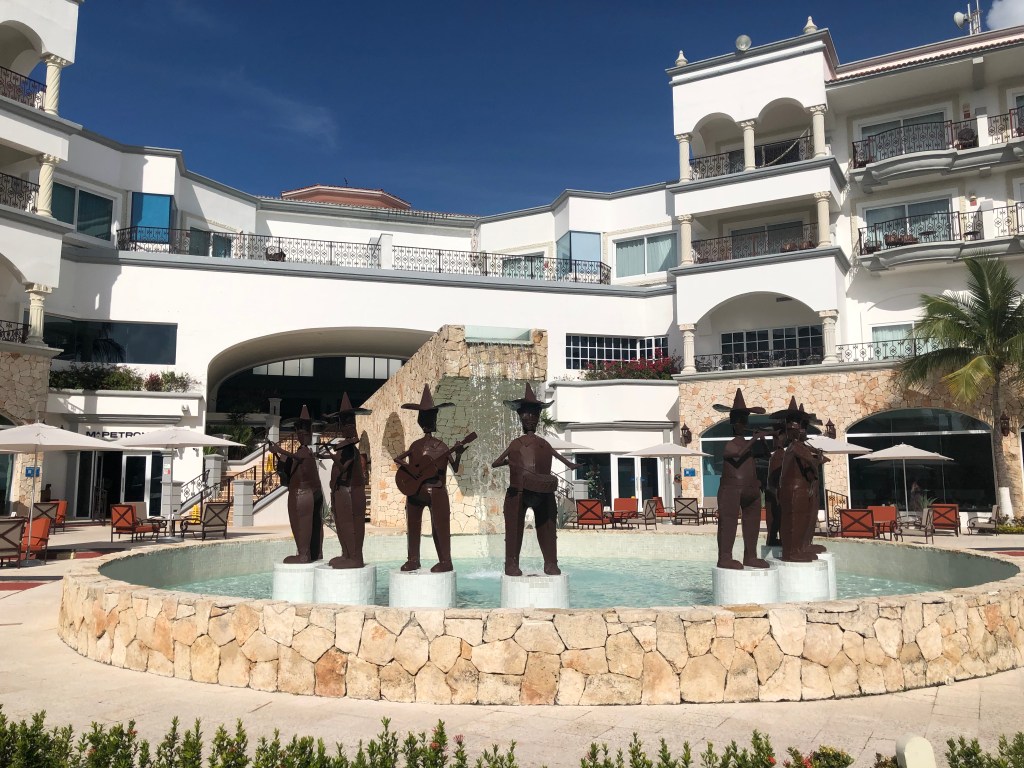
Troon Avoidance Line

Avoidance Line North.
Avoidance Line South

The Troon Avoidance Line was never really lost but the maps revealed things about it that I’d been unaware of. As mentioned above, this was the main line to Ayr until 1892 when the loop through the town was completed. It remained as a bypass for freight traffic and the occasional express passenger service. The line ran from Barassie Junction, past Troon’s municipal golf courses and Marr College. To the west of the line were extensive sidings and Barassie Works. Troon’s original station as situated just before the line passed under Dundonald Road with the station buildings, still in use as private dwellings, staggered. This closed to passengers in 1892 when the current station opened following the completion of the loop through the town. The old station continued as a goods yard. South of Dundonald Road the line continued between the municipal golf courses and the houses of Fullarton Crescent. Passing underneath Craigend Road the track rejoined the main line at Lochgreen Junction by Royal Troon’s Portland course. Closed in 1982, the track from Barassie Junction to Marr College remained as a siding along with some of the old Barassie Works sidings. Much of the Barassie Works site has been redeveloped for housing but a large area of abandoned sidings remains between the avoidance and main lines. Three or four sidings are still in occasional use. A small section of the avoidance line’s track bed by Marr College has the houses of Old Station Wynd on it whilst immediately south of Dundonald Road the track bed is overgrown as it passes the cemetery. After the line passes Willockston Road, once the site of a level crossing, the track bed has been tarmaced and is now part of a local cycle path which continues all the way to the former Lochgreen Junction.

Barassie Junction looking north. The old Kilmarnock and Troon Railway branches off to the right, the main line to Glasgow to the left.
Barassie Junction looking south. Main line to the right, the Troon Avoidance Line to the left, now sidings.
Troon avoidance line, now sidings. The site of the Barassie Works behind.
Troon’s original station on the Glasgow-Ayr line.
The bridge that carried Dundonald Road over the line. One of two road bridges over the line. There was a footbridge at Marr College too but that is long gone.
Site of former Willockston Road level crossing.
Cycle path on the original track bed behind Fullarton Crescent.
Lochgreen Junction looking north.

Troon Harbour Branch

Troon Harbour Branch 1. Formerly Kilmarnock and Troon Railway.
Troon Harbour Branch 2 – Templehill Junction.
Troon Harbour Branch 3 – multiple sidings to service the harbour and allied industries.

The branch to Troon Harbour followed the route of the original Kilmarnock and Troon Railway south from Barassie Junction. Running alongside the ‘new’ main line for half a mile, the track began to diverge behind the houses on North Shore Road. It curved westwards along what is now North Shore Lane, past the northwest corner of Portland Park football ground and through land now occupied by new sheltered housing and a Scottish Water facility. A bridge took it over Barassie Street and along an embankment where Troon Pool and Morrisons car park now stand. Here, the line split into multiple tracks, joining the curve from Troon Junction at Templehill Junction. The line then split further into a multitude of sidings connecting all parts of the harbour. Little evidence remains of this branch. For a number of years after I first arrived in Troon in 1983, one of the pillars of the bridge over Barassie Street remained alongside the old gas tower that sat next to the track. There has been much development since then and there is little to suggest Scotland’s first incorporated railway used to run there.

Mainline between Barassie and Troon. The branch to the harbour peeled off to the right here.
North Shore Lane follows the alignment of the branch line embankment.
Scottish Water building, site of the bridge over Barassie Street.
Troon Pool, the branch ran here on an embankment.
Dukes Road, built on the site of Templehill Junction.
Scotts car park. The branch split into many sidings here.
McCallums Restaurant and Wee Hurrie chip shop at Troon Harbour. This building used to be the Kilmarnock and Troon Railway’s powerhouse.

Troon-Templehill Curve

The Troon-Templehill Curve. Elevated on an embankment, if it were still here today it would chop Troon in half.

Whilst I knew of the Troon Avoidance Line and was aware that the harbour was served by a branch that had historical significance, the line from Troon Junction, just south of Troon’s ‘new’ station, to Templehill Junction, site of the current Dukes Road, was a complete surprise to me. The curve ran for two thirds of a mile along an embankment, crossing three roads on bridges, through what is now more or less the town centre. Being elevated above the roads and houses, this length of track must have held a commanding presence in the town. Once it was closed in the mid sixties, not only was the track lifted but the embankment and bridges were cleared too. Troon Junction was situated next to Cavendish Place with the embankment peeling off to the northwest. A bridge carried the line across Victoria Drive, the line continuing to the west of the ramp up to Troon Station and the Scout Hall along the line of what is now Dallas Court. Another bridge took it over St Meddans Street along the site of what is now Academy Court old people’s home. There was no bridge over Academy Street, the road coming to an abrupt end at the base of the embankment, which continued across the ground where the town centre car park now sits. Another bridge carried the line above Portland Street and the embankment curved to the left where the doctor’s surgery and the industrial units of Dukes Road now stand. Here it joined the harbour branch line with Templehill Junction being situated where the aptly named Branchline Industrial Estate now stands. The alignment of buildings, some roads and a few walls are the only clue as to where this railway used to be.

Site of Troon Junction from the Yorke Road bridge. The line to Templehill branched off to the left from just north of here.
The houses stand where the embankment once stood.
Academy Court stands where the curve ran and give an impression of the shape of the embankment cross section.
The site of this unremarkable car park once vibrated to the sound of passing goods trains.
The wall between the car park and Portland Street. I suspect it used to be part of the support for the bridge over the road and a retaining wall for the embankment.
Union Street Lane. Part of the embankment at Templehill Junction. This and the previous photo is the only physical evidence of the Troon-Templehill curve that I could find.

Troon might be a small place but it has four or five miles of old railway if only you know where to look. Even if you do you might not find much but it’s quite fascinating to think that steam engines were too-ing and fro-ing along where familiar roads and landmarks now stand. At least it is to me, anyway.

If you are remotely interested in railway history in Ayrshire I recommend the following books:

Railways of Ayrshire by Gordon Thomson published by The Crowood Press.

Ayrshire’s Forgotten Railways A Walkers Guide by Alisdair Wham, published by The Oakwood Press.

Ben Lomond

Just under a year go Elaine and I walked up The Merrick, the highest hill in Scotland’s Southern Uplands. You can read about it here in a blog I made about the joys of hillwalking. This was our first real hill walk which obviously made me an expert on the subject. Whilst the blog was really to share some nice pictures, I did conclude it by stating that whilst we were unlikely to become serious hill walkers like some of my former colleagues, we would definitely include a few hills in our walking repertoire. It only took the best part of a year for us to tackle another hill, though to be fair Covid did rather put the mockers on our best intentions for many of the previous eleven months. At the beginning of last week we noted that the weather forecast for Friday 25th was good and we had a free day so we could procrastinate no longer. We booked the ferry tickets and made our plans. The sharp-eyed amongst you will now be saying “ferry, to Ben Lomond?” and you would be quite correct in questioning me about it. The plan was, however, to climb Goat Fell on Arran, a hill that has been a frequent companion of us on our lockdown walks, albeit at a more than healthy social distance across the Firth of Clyde. We’d been meaning to climb it for years and Friday was going to be the day. Two days prior to the event the ferry was cancelled due to ‘operational reasons’, something to do with the port at Ardrossan rather than the boat itself. This led to some hasty rearranging of plans. Instead of Goat Fell we would scale the mighty Ben Lomond instead.

Whilst Goat Fell would have risen us 100 ft nearer the heavens than The Merrick had done, Ben Lomond is 430 ft higher at 3196 ft, or 974 m if you prefer the new fangled metric measurements. This pushes it into a category of mountains called ‘The Munros’. These are Scottish mountains above 3000 ft in height and would you believe there’s 282 of the buggers. Not only that there are another 227 Munro Tops, peaks above 3000 ft in height but lower than a nearby primary mountain summit. It appears that defining what is and isn’t a mountain isn’t exactly straightforward. Such matters are, however, beyond the scope of those of us who simply want a nice walk up a hill. Ben Lomond is the most southerly of the Munros, situated on the eastern shore of Loch Lomond and less than an hour away from the metropolis of Glasgow. It is also considered to be one of the most straight forward to climb, if not the easiest. These two factors make it very popular and around 30,000 people will reach the top each year. It will suffice to say that if you fancy dipping your toes in the turbulent water that is Munro Bagging, Ben Lomond is a good one to start with. It would be our first but would it be our last?

Earlier that week we had visited Edinburgh and climbed up Arthur’s Seat. Whilst this volcanic prominence towers impressively above Scotland’s capital, it is ‘only’ 823 ft high. It does involve a bit of scrambling up rocks and some steep sections so it was a good taster of what was to come. As previously mentioned, Ben Lomond is popular and the day we climbed it happened to be a local holiday in Glasgow. It made sense to set off early in an attempt to beat the hoards to the hill. As such our alarm went off at some unearthly hour and we piled into my car along with all the accoutrements required for a fair weather hill walk. Crampons and an ice axe were not required. Had they been then we would not have gone. It took us an hour and a half to get to the car park in Rowardenan at the foot of the hill. By the time we had got our shoes on, repacked our rucksacks, worked out where the path started from, waited for the portaloos to open, used said portaloos, ate half our picnic for breakfast and generally faffed about as you do, it was 08:10 when we set off. There are three paths up Ben Lomond. One is approached from the east and isn’t really a path at all. We will leave that to the more serious hill walkers. The second is the Ptarmigan Path, named after the Ptarmigan Ridge along which it runs. We were tempted to utilise this for our descent but it is known to be quite tricky so let’s not bite off more than we can chew, shall we? It was, therefore, the main tourist path for us in both directions. This path, which is under the care of the National Trust for Scotland, is clearly defined and well maintained. Not many Munros have the benefit of a path like it. Having said that, it is still a hill path so there is plenty potential for a twisted ankle or inglorious fall thanks to loose stones and gravel covered steps. It paid to be careful, at least for novices like us. There were others we passed who bounced both up and down the path like mountain goats, and three blokes were even carrying bicycles up to the summit with the intention of cycling down. Good for them, the mad fools. Initially the path led off into woodlands. It rose quite steeply at first and included a brief scramble up some rocks. There was a break in the trees where we caught our first glimpse of the summit, illuminated orange by the early morning sunlight. It seemed quite a long way away. We emerged from the forest onto moorland and saw the path weaving its way skywards. Whilst it didn’t look too intimidating, it was a while before the gradient eased. We stopped for drinks every so often which allowed us to take in the scenery. Whilst unchanging, it only seemed to get better with altitude. The central section of the path, whilst not quite a plateau, was gently inclined and so kinder on our bodies. The summit, which had been out a view for a while, finally popped over a ridge and we got a clear view of what awaited us. The ascent to the summit was quite hard work. The path zig-zags up the side and just as the top appears to be within grasp there is another rocky section to negotiate. Once through this you capture a glimpse of the trig point on the summit and it is a short walk to get there.

It had taken us two and a quarter hours to get to the top. It was a perfect day to do it. The sun was shining all the way up yet it was not too powerful. The path had taken us up the southern face and with the wind from the north, the hill itself sheltered us from its chilling effect. That wasn’t the case on the summit of course where there was nowhere to hide from the stiff breeze. Stiff breeze? Who am I trying to kid? It was blowing a hoolie up there which meant we couldn’t stay any longer than it took to give the trig point a hug and take some photos. That doesn’t matter though. We’d made it to the top without mishap and had our first Munro under our belts. Go us! As with any hill that is only half the story. We had to get back down again. Arguments will rage as to which is the hardest, going up or coming back down. Going up you are fighting gravity’s desire to pull you to the centre of the earth. It takes a lot of calories to overcome that. Coming down, that very same gravity should do all the work yet it is still trying to pull you towards the centre of the earth at a rate of 9.8 meters per second squared. Left unchecked you would make very painful and likely fatal descent down the hill so you still need to burn calories fighting gravity’s unerring pull. Maybe not as many calories but you will be utilising muscles that normally have quite an easy life. It took us two hours walking time to get down. In reality it took us longer than that due to a stop for a lunch with a view, other stops for drinks and snacks, waiting to allow the aforementioned hoards on their way up pass us, the occasional chats with some of the other walkers and the patting of dogs. Quite a few of the walkers took their dogs up the hill. One of those dogs was a Chihuahua for whom Ben Lomond must seem like Everest. Whilst you’ve got to keep a careful watch for your footing you do get to appreciate the scenery a bit more on the way down. It was absolutely stunning. Visibility was virtually unlimited. 44 miles away was Goat Fell, the mountain we had planned on being on. We could also clearly see The Merrick, scene of our first real hill walk eleven months ago. It was 72 miles away. The full 360 degree vista was never anything other than wonderful views. You can see why people like this sort of thing. Once we’d reached the bottom we wandered to the shore of Loch Lomond to see the Loch Lomond National Park Memorial sculpture. Since 1995 the area around Ben Lomond has been designated as a war memorial to those who had lost their lives in two world wars and the sculpture, by Doug Cocker, has stood there since 1997. We then discovered a nearby improvised trapeze hanging from a tree and felt we deserved a go. For no reason whatsoever, it seemed a fitting way to conclude our walk.

Will it be another eleven months before we tackle our next hill? I hope not. All walks are pretty good but there was a definite sense of achievement walking to the top of a hill so large it claims to be a mountain. What about attempting more Munros? Well yes, of course. It would be easier if they were just a bit closer to home but that’s not really an excuse not to try. What about bagging all 282? Not a bloody chance! There are few where you require mountaineering experience for a start and I’m not planning on becoming a Mallory any time soon, not least because he died on a hill, albeit one a bit higher than Ben Lomomd. There are, however, several Munros that are reasonably accessible and described as not too demanding. Maybe the next time a perfect day of weather is forecast, Elaine isn’t working and we’ve got nothing else on, we will bag Munro Number Two. Expect a new blog next summer…